Wayground logo

Free Printable Worksheets

Font size

S
M
L
XL
Worksheets

Atomic Structure & Nuclear

Total questions: 53

Worksheet time: 2hrs 2mins

Name
Class
Date
1.
The half-life of Zn-71 is 2.4 minutes. If one had 100.0 g at the beginning, how many grams would be left after 7.2 minutes has elapsed?
a)
100.0g
b)
50.0g
c)
12.5g
d)
8.5g
2.
Barium-122 has a half-life of 2 minutes. A fresh sample weighing 80 g was obtained. If it takes 10 minutes to set up an experiment using barium-122, how much barium-122 will be left when the experiment begins?
a)
0.25g
b)
2.5g
c)
25g
d)
80g
3.

The half-life of Zn-71 is 2.4 minutes. If 6.25 g of Zn-71 are needed for an experiment, how much is the orignal amount if it will take 9.6 minutes before the experiment can begin?

a)

100.0g

b)

50.0g

c)

12.5g

d)

8.5g

4.

Barium-122 has a half-life of 2 minutes. If after 10 minutes a sample of 15.0 g is left, what mass must have been initially present?

a)

30 g

b)

480 g

c)

240 g

d)

120 g

5.
After the third half-life, how much of the sample is left?
a)
1/2
b)
1/3
c)
1/16
d)
1/8
6.

What is the atomic number?

a)

the number of protons in the nucleus

b)

the number of protons and neutrons in the nucleus

c)

the number of neutrons in the nucleus

d)

the number of protons in the energy levels

7.

What is the mass number?

a)

the number of protons in the nucleus

b)

the number of protons and neutrons in the nucleus

c)

the number of neutrons in the nucleus

d)

the number of protons and electrons in the atom
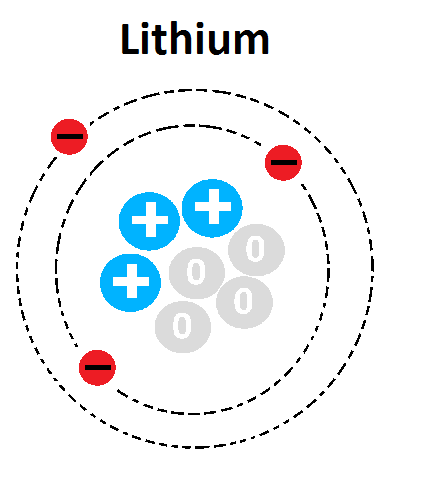
8.

What is the mass number of this atom?

a)

1

b)

3

c)

4

d)

7

9.
Most of the mass in an atom is made up of _____________________?
a)
protons and electrons
b)
protons and neutrons
c)
neutrons and electrons
d)
electrons and quarks
10.
In order for an atom to be neutral what has to be true?
a)
The atom has more protons than neutrons
b)
The atom has more neutrons than protons
c)
The atom has the same number of protons and neutrons
d)
The atom has the same number of protons and electrons
11.
How is the number of neutrons in the nucleus of an atom calculated?
a)
Add the number of e- and p+ together
b)
Subtract the number of e- from p+
c)
Subtract the number of p+ from the mass number
d)
Add the mass number to the number of e-
12.
What subatomic particles would you find in the nucleus of an atom?
a)
Protons only
b)
Protons and Neutrons
c)
Neutrons and Electrons
d)
Protons and Electrons 
13.
Which subatomic particles contribute the most to the mass of an atom?
a)
Protons, Neutrons, Electrons
b)
Protons only
c)
Protons and Electrons
d)
Protons and Neutrons
14.

An atom has 10 protons, 15 neutrons and 10 electrons what is its mass number.

a)

20

b)

10

c)

35

d)

25

15.
An atom has an atomic number of 15 and a mass number of 31. How many protons are there in the atom?
a)
15
b)
31
c)
16
d)
47
16.

The smallest particle of an element.

a)

Element

b)

Molecule

c)

Atom

17.
How many protons are in this element?
a)
79
b)
196
c)
117
d)
Cannot be determined
18.

How many protons does an aluminum atom have?

a)

27

b)

14

c)

40

d)

13

19.

How many electrons does a sodium atom have?

a)

23

b)

11

c)

12

d)

34

20.
Complete the missing label on the diagram.
a)
Neutron
b)
Centre
c)
Nucleus
d)
Sub atomic particle
21.

What element has 9 protons, 9 electrons, and 10 neutrons?

a)

nitrogen

b)

oxygen

c)

fluorine

d)

neon

22.
What element is represented in this Bohr Model? 
a)
Carbon
b)
Hydrogen
c)
Aluminum
d)
Lithium
23.
How many neutrons does the isotope of lithium have?
a)
8
b)
3
c)
4
d)
5
24.
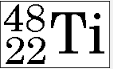
How many protons does this isotope of titanium have?
a)
48
b)
22
c)
26
d)
70
25.

Isotopes of an element have a different number of...

a)

Protons

b)

Neutrons

c)

Electrons

26.
In a correctly written symbol what would be located in the "A" position?
a)
number of neutrons
b)
atomic number
c)
number of electrons 
d)
mass number
27.
How many neutrons does the isotope below have?     89 36Kr
a)
53
b)
36
c)
89
d)
125
28.
A neutral atom of the isotope 2612Mg would consist of
a)
12 protons, 26 neutrons, 26 electrons
b)
26 protons, 12 neutrons, 26 electrons
c)
26 protons, 14 neutrons, 14 electrons
d)
12 protons, 14 neutrons, 12 electrons
29.

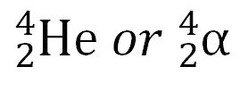
This is a symbol for what type of particle?

a)

alpha particle

b)

beta particle

c)

gamma ray

d)

positron

30.

The following nuclides may be stable except:

a)

Ba (Barium)

b)

Zn (Zinc)

c)

Au (Gold)

d)

Th (Thorium)

e)

Pb (Lead)

31.

Which nuclide is unstable?

a)

A

b)

B

c)

C

d)

D

32.

Who was the first person to come up with the Atomic Theory which included four parts.

a)

John Dalton

b)

Democritus

c)

Ernest Rutherford

d)

Niels Bohr

33.
Who discovered that the nucleus contains positively charged particles called protons?
a)
Ernest Rutherford
b)
James Chadwick
c)
Democritus
d)
Niels Bohr
34.
Who discovered the electron?
a)
Niels Bohr
b)
Democritus
c)

JJ Thomson

d)
John Dalton
35.

Worked with Rutherford to discover particles with no charge -- called neutrons.

a)

James Chadwick

b)

Niels Bohr

c)

Democritus

d)

Thomson

36.

Used the word "atomos" to decsribe the uncuttable (indivisible) atom.

a)

Democritus

b)

Thomson

c)

Bohr

d)

Dalton

37.

Proposed that electrons move around the nucleus in specific layers, or shells.

a)

Bohr

b)

Rutherford

c)

Chadwick

d)

Thomson

38.

The smallest particle of an element that still represents that element.

a)

Nucleus

b)

electron

c)

proton

d)

atom

39.
What did James Chadwick discover?
a)
neutrons
b)
electrons
c)
the atomic theory
d)
protons
40.
What is the name of this element?
a)
Lithium
b)
Boron
c)
Carbon
d)
Neon
41.
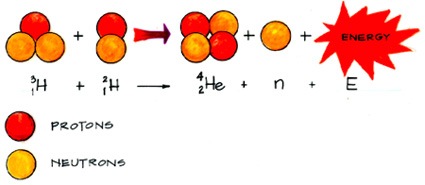
Which process involves the joining of small nuclei?
a)
Beta decay
b)
Alpha decay
c)
Nuclear fission
d)
Nuclear fusion
42.
Which process involves the splitting of large nuclei?
a)
Beta decay
b)
Alpha decay
c)
Nuclear fission
d)
Nuclear fusion
43.
The time taken for half of an amount of radioactive atoms to decay.
a)
Nuclear fusion
b)
Full-life
c)
Dead time
d)
Half-life
44.
The nuclear process occurring at a nuclear power plant.
a)
Nuclear fusion
b)
Nuclear fission
c)
Combustion
d)
Multiplication
45.
What do these symbols represent?
a)
alpha particle
b)
beta particle
c)
neutron
d)
gamma ray
46.
Has the symbol
a)
Alpha
b)
Beta 
c)
Gamma
47.
Balance the following equation:
146C --> 0-1e + ________
a)
145B
b)
146C
c)
147N
d)
42He
48.
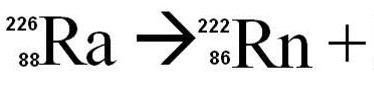
Complete the nuclear equation and determine the type of decay that is occurring in this reaction. 
a)
alpha
b)
beta
c)
gamma
d)
none
49.
What is the missing isotope that will balance the following nuclear equation?
94Be  +  11H →  _____  +  42He
a)
105B
b)
105Ne
c)
63Li
d)
63C
50.

When the isotope 5024X releases an alpha particle we get another element Y that looks like

a)

5022Y

b)

4622Y

c)

4820Y

d)

5426Y

51.

Complete the nuclear equation and determine the type of decay that is occurring in this reaction.

a)

alpha, 42He

b)

beta, 0-1e

c)

gamma

d)

none

52.
Very high temperature and pressure is required for:
a)
Fission
b)
 Fusion
c)
Radioactive Decay
53.
Which of the following is true about nuclear fusion?
a)
It is easy to implement.
b)
It produces less energy than nuclear fission.
c)
It produces more energy than nuclear fission.
d)
It has the ability to occur easily in everyday life.