wayground logo

Free Printable Worksheets

Font size

S
M
L
XL
Worksheets

Chemistry Review Chapter#01 States of matter

Total questions: 45

Worksheet time: 23mins

Name
Class
Date
1.
As particles are exposed to warmer temperatures they __________
a)
speed up
b)
slow down
c)
stay the same
d)
vibrate
2.
As particles are exposed to colder temperatures they _____
a)
speed up
b)
slow down
c)
stay the same
d)
become ions
3.
What is the change of state from a solid straight to a gas called?
a)
melting
b)
evaporating
c)
freezing
d)
sublimation
4.
What am I? I have a fixed mass, a fixed volume, I cannot be squashed and I have a shape that changes to fit the bottom of my container?
a)
solid
b)
liquid
c)
gas
d)
plasma
5.
What is a Solid?
a)
Matter that has a definite shape and a definite size.
b)
Matter that has a definite size and no definite shape
c)
Matter that has no definite shape or size
d)
Matter that has no definite shape and size
6.
A Gas is a state of matter that has _____________________________________________________
a)
No definite size or shape
b)
No shape but a defenite size
7.
Ice Melting is an example of.......
a)
A liquid turning into a gas
b)
A solid turning into a liquid
c)
Gas turning into a liquid.
d)
A ssolid turning into a liquid
8.
Which has particles that travel faster?
a)
gas
b)
solid
9.

Which characteristic is included in the particle theory of matter?

a)

All matter is made up of tiny particles

b)

All particles in a pure substance are the same

c)

Particles are always moving

d)

All of the above

10.

Solubility is

a)

when a substance can carry heat or energy

b)

when a solute dissolves into a solvent making a solution

c)

the ability of a substance to increase in volume as temperature increases

d)

The ability of particles to move from high concentration to low concentration

11.

Which image shows particles in a solid?

a)
b)
c)
12.

Which of the following statements about the particle of a gas is true?

a)

The particles of a gas vibrate and are packed closely together.

b)

The particles of a gas are far apart and move in all directions.

c)

The particles of a gas do not move.

13.

Something that goes from solid to liquid is...

a)

Evaporation

b)

Melting

c)

Freezing

d)

Sublimation

14.
An inflated balloon is placed in a refrigerator. Which statement describes the movement of the gas particles in the balloon?
a)
The particles move more slowly and become closer together.
b)
The particles move more slowly and become further apart.
c)
The particles move faster and become closer together.
d)
The particles move faster and become further apart. 
15.

What is MATTER?

a)

Anything that has MASS

b)

Anything that takes up SPACE

c)

Anything that has MASS and takes up SPACE

d)

Anything that DOES NOT have mass or take up space

16.
What is a solute?
a)

The substance that does not dissolve in a solution.

b)
The substance that is dissolved into the solution.
c)
The mixing of different substances.
17.
What is a solvent?
a)
The substance that does the dissolving in a solution.
b)
The substance that is being dissolved in a solution.
c)
The mixing of different substances.
18.
When a solution is saturated:
a)
No additional material will dissolve in it
b)
You need to stir it more 
c)
Crystals form 
19.
Condensation is . . . .
a)
gas to liquid
b)
liquid to gas
c)
gas to solid
d)
solid to liquid
20.
Freezing (or solidification) is . . . .
a)
liquid to solid
b)
solid to liquid
c)
solid to gas
d)
solid to plasma
21.
If 10g of sugar dissolves in 100g of water what is the total mass of the solution formed?
a)
110g
b)
90g
c)
100g
d)
10g
22.
Which point of the particle theory is depicted by this picture?
a)
all matter is made of particles
b)
particles are in constant, random motion
c)
particles speed up as heat is added and slow down as heat is removed
d)
different substances are made of different types of particles
23.
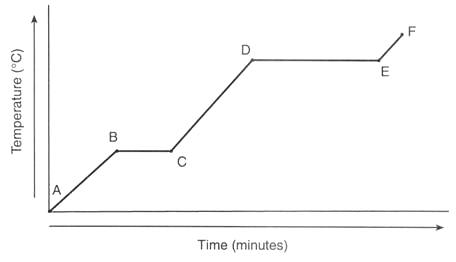
What line segment represents only the solid state?
a)
A-B
b)
B-C
c)
C-D
d)
D-E
24.
What state(s) of matter are present at D-E?
a)
Solid-liquid
b)
Liquid
c)
Liquid-gas
d)
Gas-Solid
25.
Between which points is the temperature of the substance remaining constant?
a)
A-B only. 
b)
A-B, C-D, E-F
c)
B-C only. 
d)
B-C, D-E
26.
This type of graph is called a:
a)
Phase diagram
b)
Heating curve
c)
State of matter
d)
Temperature chart
27.
A substance's heating curve is shown in the graph.  What is its boiling point?
a)
100 C
b)
60 C
c)
80 C
d)
20 C
28.
True or false: melting and freezing occur at the same temperature!
a)
True
b)
False
29.

The melting point of the sample is

a)

-60 ºC

b)

-100 ºC

c)

60 ºC

d)

100 ºC

30.
Anna filled a ​cup with hot tea. Then she added a sugar cube. ​Which of these will help to make the sugar cube dissolve more quickly? 
a)
stirring the hot tea
b)
adding more sugar cubes
c)
adding ice to the tea
d)
pouring more tea into the cup
31.

The sugar cubes are called the

a)

solute

b)

solvent

32.

The water is called the

a)

solvent

b)

solute

33.
Ernesto and Amanda fill two cups with water. They use hot water in one cup and cold water in the other cup. Next, they will stir a spoon of salt into each cup.     

In which cup will the salt dissolve more slowly?
 
a)
The salt will not dissolve in either cup
b)
The salt dissolves more slowly in the hot water
c)
The salt dissolves more slowly in the cold water
d)
The salt dissolves at the same speed in both cups
34.

The process of evenly mixing one substance into another forming a solution is ................... process

a)

concentration

b)

heating

c)

dissolving

d)

condensation

35.

The smaller the particle size the faster the rate of dissolution (rate of dissolving).

a)

True

b)

False

36.
Which of the following statements is true about how using smaller salt crystals would affect the rate of making a salt solution in water?
a)
Smaller crystals increase the surface area and slow down dissolving.
b)
Smaller crystals decrease the surface area and speed up dissolving.
c)
Smaller crystals increase the surface area and speed up dissolving.
d)
Smaller crystals decrease the surface area and slow down dissolving.
37.

Which of the following actions will NOT

increase the rate of dissolution

(dissolving) for solids?

a)

Stirring the solution

b)

Decreasing the temperature

c)

Increasing the surface area of the

solute

d)

Increasing the temperature

38.

Select the 3 properties that affect the rate of dissolving materials

a)

surface area

b)

temperature

c)

texture

d)

stirring

e)

Color of solute

39.

If the temperature is below the melting point of a substance and below the boiling point of a substance what state will it be in?

a)

Solid

b)

Liquid

c)

Gas

40.

If the temperature is above the melting point of a substance and above the boiling point of a substance what state will it be in?

a)

Solid

b)

Liquid

c)

Gas

41.

A substance has a melting point of 25 oC and a boiling point of 235 oC. What state is it at 5oC?

a)

Solid

b)

Liquid

c)

Gas

42.

A substance has a melting point of -125 oC and a boiling point of -35 oC. What state is it at 15oC?

a)

Solid

b)

Liquid

c)

Gas

43.
When a solid reaches the temperatures of its ___, it can become a liquid.
a)
melting point
b)
freezing point
c)
boiling point
d)
density
44.
When a liquid reaches the temperatures of its ___, it can become a gas.
a)
melting point
b)
freezing point
c)
boiling point
d)
density
45.

Freezing point and melting point of water is

a)
100 degrees Celsius
b)
0 degrees Celcius
c)
0 degrees Fahrenheit