wayground logo

Free Printable Worksheets

NEW

Font size

S
M
L
XL
Worksheets

Q1 CSA Review

Total questions: 60

Worksheet time: 39mins

Name
Class
Date
1.

What material is attracted to a magnet?

a)
Silver
b)
Water
c)
Metal
d)
Iron
2.
What happens when two north poles of a magnet are placed together?
a)
they repel
b)
they attract
c)
they cancel each other out
d)
the strength of the magnet is doubled
3.
A north pole and a south pole will attract.
a)
True
b)
False
4.
True or False: All metals stick to magnets.
a)
True
b)
False
5.
Magnetism is a type of ____________
a)
force
b)
book
c)
plant
d)
animal
6.
If you replace the paper clip with a plastic spoon, what happens?
a)
The bulb doesn't light
b)
The bulb is dimmer
c)
The wires get hot
d)
There is no change
7.
A series circuit has ____ path(s) that the electric current can take. 
a)
One
b)
Two 
c)
Three 
d)
Four
8.
In a parallel circuit, if one connection is broken, all of the connections stop working.
a)
True
b)
False
9.
What kind of circuit is this?
a)
series
b)
parallel
10.
If the electric circuit is OPEN, the switch is ____.
a)
ON
b)
OFF
11.

If lamp 2 is unscrewed from its holder, what will happen to lamp1?

a)

It will stay lit

b)

It will go out

c)

It will get dimmer

d)

It will dissapear

12.

The strongest parts of the magnet are ...

a)

fronts

b)

backs

c)

poles

d)

middle

13.

The area around a magnet is called the .....

a)

attraction zone

b)

work area

c)

magnetic field

d)

hot zone

14.

Why does the compass needle move at different locations?

a)

Because the needle is attracted to the magnetic field produced by the magnet

b)

Because north is up

c)

Because it is being attracted to the Magnetic North Pole

d)

Because north is down

15.
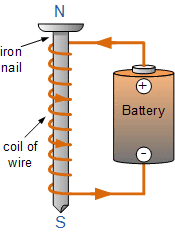
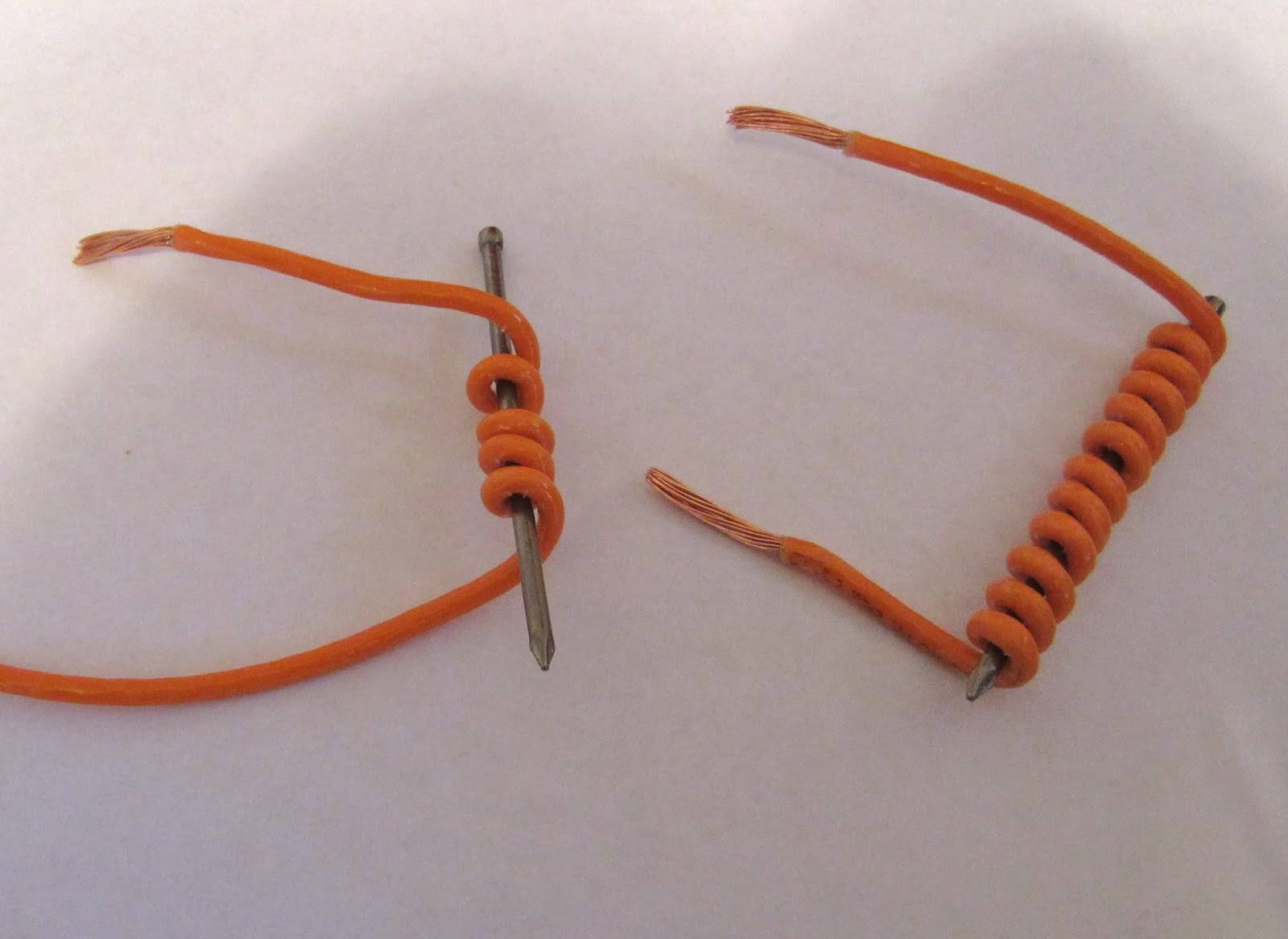
The picture is an example of an:
a)
Electric circuit
b)
Electromagnet
c)
Electric nail
d)
Electric power cell
16.

To make this electromagnet stronger you could:

a)

use less wire

b)

have fewer wire coils around the nail

c)

have more wire coils around the nail

d)

use a plastic core

17.
What is true about electricity and magnetic fields?
a)
Electricity is needed to create any magnet.
b)
Electricity always creates a magnetic field.
c)
Electricity is stronger than a magnetic field.
d)
Electricity prevents magnetic fields from occurring.
18.

When running a current through a wire, what do the blue lines represent?

a)

The wire spinning

b)

A magnetic field that was created

c)

Electrons leaving

d)

Electricity

19.

Which one represents the magnetic field lines of magnets repelling?

a)

A

b)

B

20.

Which one represents the magnetic field lines of magnets attracting?

a)

A

b)

B

21.
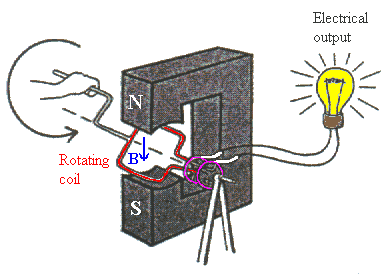
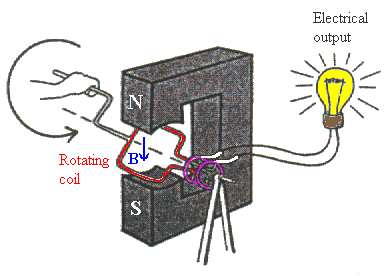
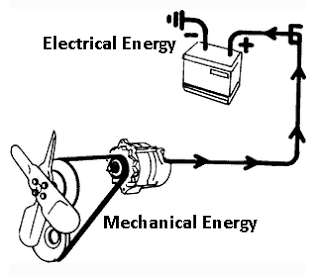
Generators are devices that convert _____ energy into _____ energy.
a)
chemical; mechanical
b)
mechanical; electrical
c)
electrical; mechanical
d)
potential; kinetic
22.
What can you use to make an electromagnet?
a)
Battery, nail and string 
b)
Battery, pencil and wire
c)
Wire, battery and iron ore (nail)
d)
Peanut butter, lampshade, hand sanitizer
23.
What happens to the strength of an electromagnet as you add more coils around it?
a)
Increases
b)
Decreases
c)
Stays the same
d)
Stops completely
24.
What energy do you put IN to a generator?
a)
Mechanical
b)
Electrical
c)
Thermal
d)
Potential
25.
What type of energy comes OUT of a generator?
a)
Mechanical
b)
Electrical
c)
Thermal
d)
Potential
26.
In an electric motor, the energy transformation begins as  ----
a)
electrical and becomes chemical
b)
mechanical and becomes electrical
c)
electrical and becomes mechanical
d)
mechanical and becomes chemical
27.

In an electric generator, the energy transformation begins as ----

a)

electrical and becomes chemical

b)

mechanical and becomes electrical

c)

electrical and becomes mechanical

d)

mechanical and becomes chemical

28.
Energy transformations occur when...
a)
energy is created through conduction
b)
energy changes from one form to another
c)
two forces slide together that are touching
d)
a chemical reaction takes place
29.
What does the Law of Conservation of Energy state?
a)
That energy is the movement of electrons within an atom.
b)
That energy is a means to an end.
c)
That energy can be created when needed.
d)
That energy cannot be created or destroyed.
30.
_________ is a force that resists the sliding of two surfaces that are touching.
a)
Ficiton
b)
Friction
c)
Function
d)
Fashion 
31.
The form of energy involved in eating a peanut butter and jelly sandwich can be transformed into riding a bike. What types of energy occur in this transformation?
a)
Nuclear - biomechanical
b)
Chemical - mechanical
c)
Potential - kinetic
d)
Electromagnetic - thermal
32.
The energy transformation that takes place when a flashlight is turned on is...
a)
Chemical - electrical - light
b)
Chemical - light - electrical
c)
Electrical - thermal - light
d)
Nuclear - light - electrical
33.
What energy transformations take place when a battery-operated radio is in use?
a)
Electrical to chemical to light
b)
Sound to chemical to mechanical
c)
Chemical to electrical to sound
d)
Light to electrical to thermal
34.
People get energy from the food that they eat and transform that energy as they move. Which energy transformations occur as a student rapidly rubs the palms of his hands together?
a)
mechanical to thermal to electrical
b)
chemical to mechanical to thermal
c)
mechanical to chemical to sound
d)
chemical to sound to electrical
35.
Which of the following devices transforms electrical energy into mechanical energy?
a)
An e-reader
b)
a fan
c)
a manual pencil sharpener
d)
ipod
36.
A television works by transforming electrical energy into what other kinds of energy?
a)
Light, thermal, and sound
b)
Thermal, chemical, and solar
c)
Sound, mechanical, and electrical
d)
Light, chemical, and mechanical
37.
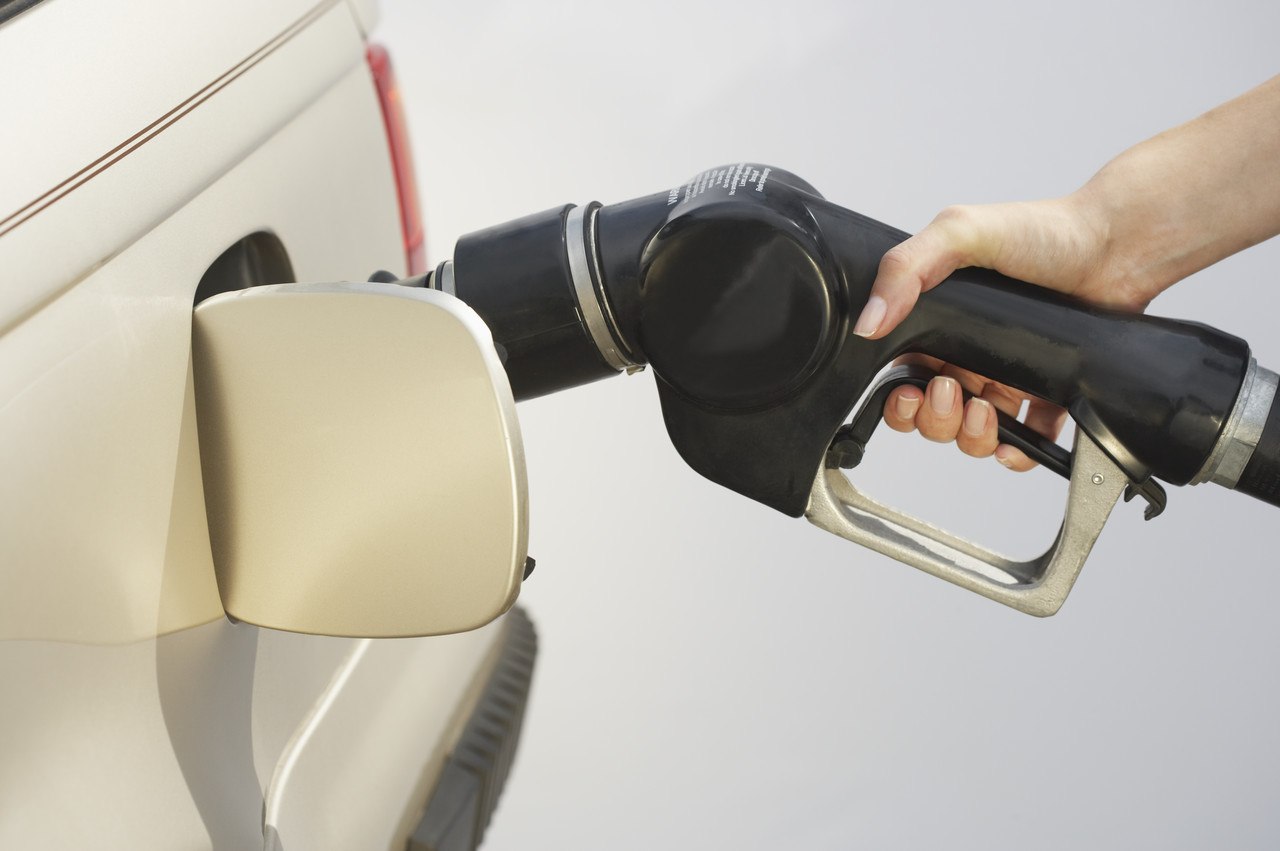
Which energy conversion is taking place when you put gasoline in a car?
a)
thermal -> electrical
b)
mechanical -> electrical
c)
chemical -> mechanical
d)
mechanical -> electromagnetic
38.

Choose the answer that has the most GRAVITATIONAL POTENTIAL energy.

a)

a 500 kg boulder on a 5 meter hill

b)

a 500 kg boulder on a 10 meter hill

c)

a 500 kg boulder on a 20 meter hill

39.

What two factors affect GRAVITATIONAL POTENTIAL energy?

a)

mass

b)

height

c)

speed

d)

mass and speed

e)

mass and height

40.

What location on the coaster has the greatest potential energy

a)

W

b)

X

c)

Y

d)

Z

41.

Which location has the least potential energy but the most kinetic energy.

a)

W

b)

X

c)

Y

d)

Z

42.

Which point has the most potential energy?

a)

A

b)

B

c)

C

d)

A and C

43.

Which point has the least potential energy?

a)

A

b)

B

c)

C

d)

A and C

44.
As a boulder rolls from the top of a hill to the bottom, how does its potential and kinetic energy change?
a)
Potential and Kinetic energy both increase
b)
Potential increases and Kinetic decreases
c)
Potential decreases and Kinetic increases
d)
Potential and Kinetic energy both decrease
45.

As mass increases, KE ...

a)

increases

b)

decreases

c)

stays the same

d)

can't be computed

46.

This is an example of

a)

Nuclear Fission

b)

Nuclear Fusion

c)

No reaction

47.
This is an example of ---
a)
Radioactive Decay
b)
Nuclear Fission
c)
Nuclear Fusion
d)
Fossil fuel reaction
48.

Which energy transformation is shown in this picture?

a)

chemical -----> light

b)

light -----> mechanical

c)

mechanical -----> chemical

d)

chemical -----> mechanical

49.

What type of potential energy does a match have?

a)

thermal energy

b)

light energy

c)

chemical energy

d)

electrical energy

50.

Almost all energy systems produce this type of energy...

a)

light energy

b)

chemical energy

c)

thermal energy

d)

electrical energy

51.
A fifth grade class constructed this circuit.  Which of these objects most likely made the light glow when connected to points X and Y?
a)
plastic straw
b)
cotton string
c)
aluminum foil
d)
rubber eraser
52.
What is NOT an example of an insulator in the kitchen?
a)
An oven mitt
b)
Pots and pans
c)
A wooden spoon
d)
A plastic measuring cup
53.
Styrofoam is an example of _____.
a)
a conductor
b)
an insulator
54.

This girl is wearing pink wool earmuffs to keep her ears warm in the snowy weather. Differentiate between conductors and insulators. How does the wool affect heat transfer? (wool is a type of fabric)

a)

The wool is a conductor that transfers heat from her ears to the wool earmuffs.

b)

The wool is an insulator that provides heat to keep the girl's ears warm.

c)

The wool is a conductor that transfers heat from the girl's earmuffs to her ears.

d)

The wool is an insulator that keep the girl's ears from loosing heat.

55.
You know that the object connected to the wires is a conductor because:
a)
The light bulb is glowing bright.
b)
It's a complete circuit.
c)
It's a closed circuit.
d)
The object is shiny.
56.

The picture shows an electrical circuit. This circuit is a series circuit because:

a)

It has 3 light bulbs.

b)

The same current flows through all three light bulbs.

c)

It uses a single battery.

d)

The electrical current is divided between the three light bulbs.

57.

A series circuit has ____ path(s) that the electric current can take.

a)

One

b)

Two

c)

Three

d)

Four

58.
Which of the two circuits would have the brightest bulbs? 
a)
A
b)
B
59.
what is this symbol for?
a)
light bulb
b)
switch
c)
battery
d)
resistor
60.

a)
b)
c)
d)