
 Worksheets
Unit 1 Forces and Motion Practice
Total questions: 158
Worksheet time: 2hrs 5mins

Select the description of motion from A - B.
Slowing down away from the origin
Speeding up away from the origin
Constant velocity away from the origin
Constant velocity towards the origin

Which segment shows an object speeding up towards the origin?
A to B above the x-axis
C to D below the x-axis
C to D above the x-axis
D to E
The slope of a velocity - time graph represents?
Velocity
Displacement
Acceleration
Time
The area between the x-axis and the line of a velocity - time graph represents?
Velocity
Displacement
Acceleration
Time

The graph depicts what type of motion?
Rest
Constant Velocity
Speeding up
Slowing down

The graph depicts what type of motion?
Rest
Constant Velocity
Speeding up
Slowing down
Which direction is the object moving based on the graph
positive
negative

The graph depicts what type of motion?
Rest
Constant Velocity
Speeding up
Slowing down

Which line shows the fastest velocity? (choose all that apply)
Line A
Line B
Line C
Line D
None of them

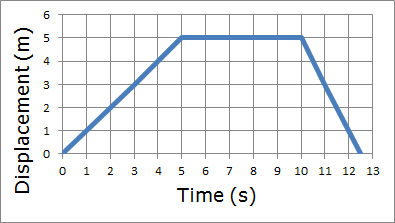
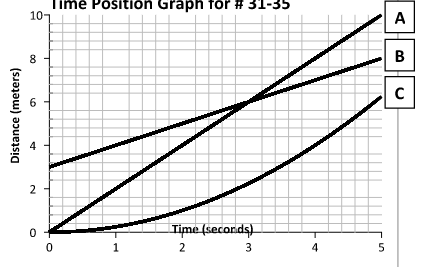


On a position-time graph, the steeper the slope _____
the slower the speed
the faster the speed
the less the acceleration
the greater the acceleration
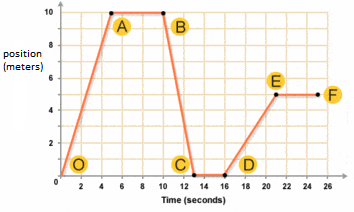
What is happening in this graph from point B to C?
The object is going down a hill.
The object is returning to its starting location.
The object is slowing down.
The object is staying still.
According to the graph how far does the person travel in the first 5 seconds?
2 m
10 m
0 m
5 m

Describe the motion of an object given by this position-time graph.
not moving, then moving backward
moving forward, then not moving
moving backward, then not moving
moving forward, then backward

From the following position-time graph of two brothers running a 100-m run, analyze at what time do both brothers have the same position. The smaller brother started the race from the 20-m mark.
2 s
4 s
6 s
8 s
Slope of a Position -Time graph gives
Velocity
Displacement
Acceleration
Distance

Describe the motion of an object given by this Position-time graph.
slowing down, moving backward
slowing down, moving forward
speeding up, moving backward
speeding up, moving forward

Describe the motion of an object given by this Position-time graph.
speeding up
slowing down
constant speed
not moving

Describe the motion of an object given by this Position-time graph.
speeding up
slowing down
constant speed
not moving

Given the Position-time graph below, which way is the object moving at 3 seconds?
forward
backward
not moving
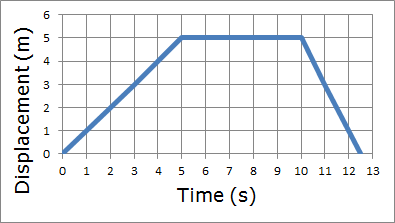

What is the average velocity of this object? Use slope equation.
+ 0.5 m/s
-0.5 m/s
+ 2 m/s
-2 m/s

Which one of the following graphs describes an object that is moving at a constant speed to the right (+ direction)?
a.
b.
c.
d.

The velocity-time table represents the motion of a rightward-moving motorcycle. What is the magnitude (i.e., value) and direction of the acceleration?
2 s2m Right
2 s2m Left
4 s2m Right
4 s2m Left

The dot diagram represents the motion of a rightward-moving truck. What is the direction of the truck's acceleration?
Right
Left
The truck is not accelerating
Can not be deduced from the given information
What is the unit for velocity?
m
s
m/s
m/s/s

Velocity and time information for a rightward-moving car are shown.
What is the magnitude (i.e., value) and direction of the acceleration?
10 s2m
2 s2m
16 s2m
8 s2m
Two cars traveling in different directions at the same speed have the same velocities.
True
False
If a ball rolls 30 meters in 5 seconds, what is its velocity?
6 m/s
10 m/s
3 m/s
150 m/s



Why does a car accelerate as it round a corner at a constant speed?
Its direction changes
It doesn't
It slows down
It speeds up
A downward moving elevator is slowing down. What is the direction of the elevator's acceleration?
Down
Up
No acceleration
Not enough information
In each of the following cases, determine where the car has no acceleration ?
A car shortly after a stoplight turns green.
A car approaching a red light.
A car with the cruise control set at 30 m/s.
A car turning a curve at a constant speed.
What is the difference between mass and weight?
mass is how much matter is in an object, and weight is the gravitational pull on that object
mass and weight are the same
weight affects how much mass is in an object
weight is determined by how many atoms make up an object
The unit of measurement for force is
meter
Newton
Kilogram
Joule
How do you calculate force of gravity?
Fg = m/g
Fg= m+g
Fg= m
Fg= m*g
What is a normal force?
It always opposes gravity. The same as a frictional force.
It is equivalent to the weight of an object.
It is a contact force supporting from the surface below.
It is equivalent to mass.

A man standing on a scale in an elevator notices that the scale reads 40 newtons greater than his normal weight.
Which type of movement of the elevator could cause this greater-than-normal reading?
accelerating upward
accelerating downward
moving upward at a constant speed
moving downward at a constant speed
A woman standing on a scale in an elevator notices that the scale reads 100 newtons less than her normal weight. Which type of movement of the elevator could cause this greater-than-normal reading?
accelerating upward
accelerating downward
moving upward at a constant speed
moving downward at a constant speed
The elevator is accelerating downwards at a rate of 2 m/s/s. What would the people in the elevator feel like?
Heavier than normal
Lighter than normal
Normal weight
Weightless
The elevator is accelerating upwards at a rate of 2 m/s2. What would the people in the elevator feel like?
Heavier than normal
Lighter than normal
Normal weight
Weightless
The elevator is moving upwards at a constant speed. What would the people in the elevator feel like?
Heavier than normal
Lighter than normal
Normal weight
Weightless
What is Newton's 2nd Law?
Every action has an equal and opposite reaction
An object at rest stays at rest, an object in motion stays in motion.
F = ma
Friction

If the man pushes with an equal amount of force, which object will accelerate more?
Car because it has more mass
Lawnmower because it has less mass
Car because it has less mass
Lawnmower because it has more mass
The unit of measurement for force is
meter
Newton
Kilogram
Joule

Calculate the displacement traveled in section D. Hint: Remember the area under a v-t graph = displacement!
250 m
50 m
100 m
200 m
150 m
Calculate the displacement traveled in section A. Hint: Remember the area under a v-t graph = displacement!
75m
50 m
100 m
125 m
150 m
Calculate the displacement traveled in section B. Hint: Remember the area under a v-t graph = displacement!
150 m
50 m
100 m
200 m

According to Newton's second Law, which would take more force to slow down?
The silver car
The green car
They would both take the same force
True or False: There is no gravity in space.
True
False
True or False: On Earth the acceleration of a falling object changes by 10 meters per second each second.
True
False
Select all statements that are true about "acceleration due to gravity."
It is near a constant value on Earth.
It changes value from planet to planet.
It increases as an object falls
It is in the positive direction.
What are the units for acceleration?
Meters
Meters per second
Meters per second squared
Seconds
When an object is tossed in the air, the velocity is always 0 m/s __________.
At the top
As the final velocity
As the initial velocity
At the bottom
True or False: If a skydiver jumps out of a plane, they will continue to increase velocity until they hit the ground.
True
False
What is the difference between mass and weight? (Select all that apply)
Nothing, they are different words for the same thing.
Mass is matter. Weight is force due to gravity.
Weight is matter. Mass is force due to gravity.
You can lose mass, but not weight, with exercise.
You can lose weight, but not mass, with exercise.

from 3rd second to 5th second, the object is
moving at a constant speed
speeding up
not moving
slowing down

What is happening at E?
Stationary
Accelerating
Fast steady speed; moving away from the starting position
Steady speed; returning to start position
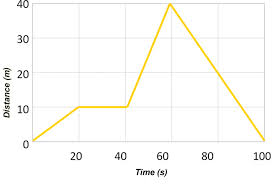
What is happening in this graph from point B to C?
The object is going down a hill.
The object is returning to its starting location.
The object is slowing down.
The object is staying still.
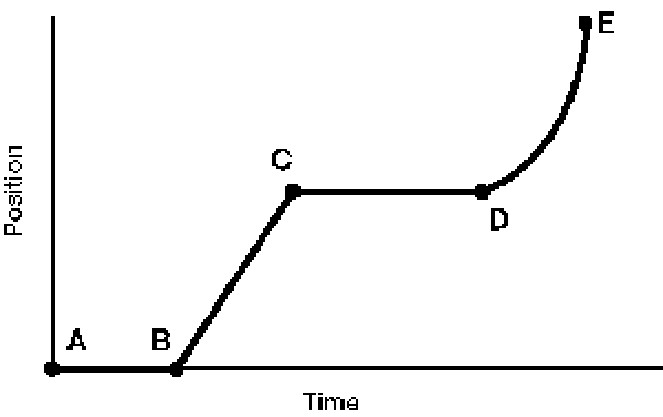
From t=1.0 second to t=3.0 seconds, the object is
moving at a constant speed
speeding up
not moving
slowing down
On a position-time graph, the position (distance) is plotted on the ____ axis.
x
y
What does the slope of a position-time graph represent?
Distance
Displacement
Velocity
Acceleration
What does the slope of a velocity-time graph represent?
Distance
Displacement
Velocity
Acceleration

Explain the motion from 0-1s
Stationary
Constant speed
Constant acceleration
Non-constant acceleration
Explain the motion from 1-3s
Stationary
Constant speed
Constant acceleration
Non-constant acceleration
Explain the motion from 3-5s
Stationary
Constant speed
Constant acceleration
Non-constant acceleration
Explain the motion from 5-7s
Stationary
Constant speed
Constant acceleration
Constant deceleration
Explain the motion from 8s onwards. The blue line runs along the x-axis. Hint: What is the velocity from 8s onwards.
Stationary
Constant speed
Constant acceleration
Constant deceleration

Where is the acceleration the highest?
0-1s
1-3s
3-5s


A quantity that includes both size and direction.
scalar
vector
magnitude
direction
A push or pull on an object.
Magnitude
Force
Newton
Motion
Standard unit of measurement for force
Newton
Mass
Magnitude
Meter
The combination of all forces acting on an object.
Motion
Newton
Net force
Friction
Direction is...
how fast an object is moving.
a force that pulls.
the path in which an object is facing or moving.
the change in an object's position over time.
An object in motion will remain in motion unless acted upon by another force.
Newton's Third Law of Motion
Net force
Newton's First Law of Motion
Newton's Second Law of Motion
The speed and direction of a moving object.
Velocity
Mass
Friction
Kinematics
a force of attraction between two objects that is due to their masses
gravity
force
friction
The distance an object travels per unit of time.
Net force
Speed
Gravity
Displacement
A measure of the force of gravity on an object
Mass
Force
Weight
Net force
The tendency of an object to resist a change in motion.
Mass
Force
Inertia
Gravity
greatness of size, strength, or importance
magnitude
velocity
Speed
The amount of matter in an object.
Weight
Mass
Speed
Magnitude
A force that opposes motion between two surfaces that are in contact
Gravity
Friction
Mass
Net force


The change in position of an object.
Acceleration
Motion
Meter
Unbalanced Force

A non-contact force that pulls objects toward one another.
Gravity
Speed
Force
Net force
The location of an object.
Force
Motion
Gravity
Position

Speed in a direction.
Momentum
Velocity
Speed
Inertia
According to Newton's First Law, an object in motion will stay in motion unless:
An opposing force acts on it.
It's in outer space.
It stops.
It remains at rest.
For every action, thereʼs an equal and opposite reaction.
Newton's First Law
Newton's Second Law
Newton's Third Law
Net force
Newtons 2nd Law of Motion
Force= Mass multiplied by Acceleration
An object at rest stays at rest unless acted on an unbalanced force. (inertia)
For every action there is a equal and opposite re-action.
Law of gravity
The standard unit of measurement for velocity.
meters
seconds
meters per second
meters per second squared
The standard unit of measurement for acceleration.
meters
seconds
meters per second
meters per second squared
The area between the x-axis and the line of a velocity - time graph represents?
Velocity
Displacement
Acceleration
Time
The x-axis of a velocity - time graph represents?
Velocity
Displacement
Acceleration
Time
The y-axis of a velocity - time graph represents?
Velocity
Displacement
Acceleration
Time

Find the displacement from A to B?
625m
25m
50m/s
Calculate the total displacement in the first 3s.
(a)
Calculate the total displacement in the first 1s.
(a)

Calculate the displacement traveled in section C. Hint: Remember the area under a v-t graph = displacement and you will need to use TWO shapes!
200 m
100 m
50 m
400 m
Calculate the displacement traveled in section B. Hint: Remember the area under a v-t graph = displacement!
150 m
50 m
100 m
200 m
Calculate the displacement traveled in section D. Hint: Remember the area under a v-t graph = displacement!
250 m
50 m
100 m
200 m
150 m
Calculate the displacement traveled in section A. Hint: Remember the area under a v-t graph = displacement!
75m
50 m
100 m
125 m
150 m
What does Δx mean?
change in position
sum of position
duration
position

What is the object's displacement from 0 s to 1 s?
-5 m
5 m
2.5 m
-2.5 m
What is the object's displacement from 4 s to 6 s?
15 m
30 m
60 m
90 m
What is the object's displacement from 1 s to 3 s?
10 m
15 m
20 m
30 m
What is the object's displacement from 0 s to 2 s?
-2.5 m
0 m
2.5 m
5 m


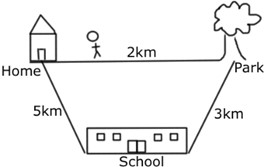


Negative displacement means the object is
moving to the right.
moving to the left.
slowing down.
negative displacement is not possible.
Distance
Total length of the path travelled
How far an object is from its starting point
Location of an object relative to a defined zero point


Ray runs 30 feet north, 30 feet west, and then 30 feet south. What is the displacement?
30 feet west
90 feet
30 feet south
0 feet
Wind blowing at 20 mph. Vector or scalar?
Scalar
Vector
30 m/sec, East. Scalar or Vector?
Scalar
Vector
Neither

