
 Worksheets
Kinematics & Graphing (all levels of Physics) 1D & 2D motion
Total questions: 155
Worksheet time: 4hrs 34mins
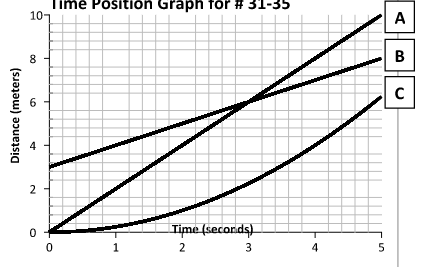
Which runner had a head start? (a)
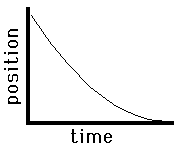
Describe the motion (a)

from 3rd second to 5th second, the object is (a)

What does this graph represent? (a)
On a distance vs. time graph, the steeper the slope the (a) the speed.

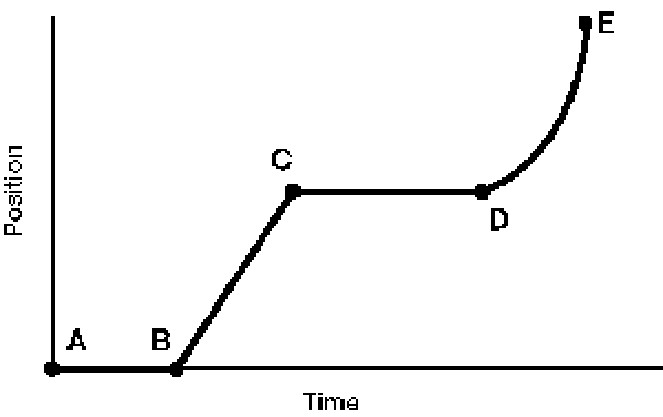
What is happening at E?
Stationary
Accelerating
Fast steady speed; moving away from the starting position
Steady speed; returning to start position
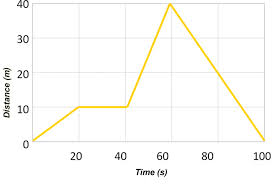
How long did it take this object to travel back to its reference/starting point? (a)
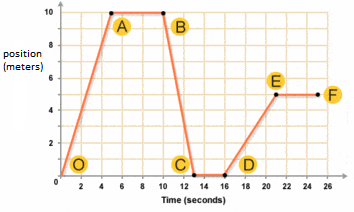
What is happening in this graph from point B to C?
The object is going down a hill.
The object is returning to its starting location.
The object is slowing down.
The object is staying still.
The speed of the object is changing during interval: (a)
From t=1.0 second to t=3.0 seconds, the object is (a)
(Multiple selection: Select all that apply)
On a position-time graph, the position is plotted on the ____ axis.
y-axis
vertical axis
x-axis
horizontal axis
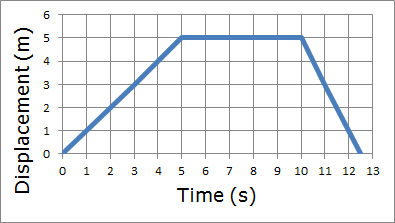
According to the graph how far does the person travel in the first 5 seconds? (a)
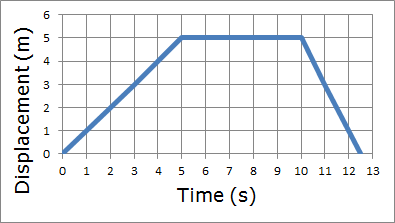
What is the person doing from 5 seconds to 10 seconds? (a)

What is happening between 2 and 3 seconds? (a)


Which expression has the same dimensions as an expression yielding a value for acceleration (m/s2)?
t2v
x2v
tv2
xv2
Which expression has the same dimensions as an expression yielding a value for time? (a)
vx
v2x
xt
v2t1
Which of the following equations is dimensionally correct?
(Multiple selection question: Select all that apply)
Δt=vΔx
a=xv2
Δv=Δta
Δt2=a2Δx
A hiker travels south along a straight path for 1.5 h with an average velocity of 0.75 km/hr, then travels south for 2.5 h with an average velocity of 0.90 km/hr. What is the hiker's displacement for the total trip? (a)
A toy car is given an initial velocity of 5.0 m/s and experiences a constant acceleration of 2.0 m/s2. What is the final velocity after 6.0 s? (a)
A rock is thrown straight upward with an initial velocity of 24.5 m/s. What is the rock's displacement after 1.00 s? (a)
A car travels down a road at a certain velocity, v. The driver slows down so that the car is traveling only half as fast as before. Which of the following is the correct expression for the resulting velocity? (a)
A football player runs in one direction to catch a pass, then turns and runs twice as fast in the opposite direction toward the goal line. Which of the following is the correct expression for the original velocity and the resulting velocity? (a)
If a student wants to solve for the horizontal length of a triangle and they know the hypotenuse and its angle, which trigonometric function could they use?
(a)
An athlete runs 110 m across a level field at an angle of 30 degrees north of east. What are the east and north components, respectively, of this displacement? (a)
To determine an object's acceleration using a Velocity-time graph I should...
Look at the vertical axis for that time
Determine the area between the graph & the x axis up to that time
See whether the graph is above or below the x axis at that time
Solve for the slope of the graph at that time
To determine which way an object is moving on a Velocity-time graph I should...
Look at the vertical axis for that time
Determine the area between the graph & the x axis up to that time
See whether the graph is above or below the x axis at that time
Solve for the slope of the graph at that time
To determine how fast an object is moving on a Velocity-time graph I should...
Look at the vertical axis for that time
Determine the area between the graph & the x axis up to that time
See whether the graph is above or below the x axis at that time
Solve for the slope of the graph at that time
To determine how far an object travels using a Velocity-time graph I should...
Look at the vertical axis for that time
Determine the area between the graph & the x axis up to that time
See whether the graph is above or below the x axis at that time
Solve for the slope of the graph at that time

Describe the motion of an object given by the velocity vs time graph.
It is speeding up.
it is not moving.
It has a constant speed.
It is slowing down.

Describe the motion of an object given by the velocity vs time graph.
It is speeding up.
it is not moving.
It has a constant speed.
It is slowing down.

Describe the motion of an object given by the velocity vs time graph.
It is speeding up.
it is not moving.
It has a constant speed.
It is slowing down.

Describe the motion of an object given by the velocity vs time graph.
It is speeding up.
it is not moving.
It has a constant speed.
It is slowing down.

Describe the acceleration of an object given by the velocity-time graph.
acceleration is zero
acceleration is positive
acceleration is negative

Describe the acceleration of an object given by the velocity-time graph.
acceleration is zero
acceleration is positive
acceleration is negative

Describe the acceleration of an object given by the velocity-time graph.
acceleration is zero
acceleration is positive
acceleration is negative

Describe the motion of an object given by the velocity-time graph.
moving forward, speeding up
moving backward, speeding up
moving forward, slowing down
moving backward, slowing down

Describe the motion of an object given by the velocity-time graph.
moving forward, speeding up
moving backward, speeding up
moving forward, slowing down
moving backward, slowing down

In the velocity-time graph shown, at which time was the object traveling the fastest?
10 s
20 s
30 s
40 s
In the velocity-time graph shown, how far did the object travel in the first 10 seconds?
30 m
60 m
300 m
600 m
For the velocity-time graph shown, which best describe the motion for 10-15 s?
not moving, not accelerating
moving forward, not accelerating
moving backward, not accelerating
moving forward, accelerating forward
For the velocity-time graph shown, which interval had the greatest acceleration?
0-10s
10-15s
15-40s
40-55s
For the velocity-time graph shown, at what time does the object change directions?
10s
15s
30s
40s
d
distance / displacement
direction
velocity
acceleration
vi
velocity
initial velocity
final velocity
acceleration
vf
velocity
initial velocity
final velocity
acceleration
a
velocity
distance
acceleration
accuracy
acceleration units
m/s
m/s2
m2/s2
m
distance or displacement units
m/s
m/s2
m2/s2
m
Slope of a position time graph gives you:
change in position
velocity
acceleration
y=mx+b!!!
time units (that we use in physics)
s
min
hr
year
gravity is a(n)
acceleration
initial velocity
final velocity
distance
Select all that are correct: In free fall, if I drop an object
the initial velocity is 0 m/s
the final velocity is 0 m/s
the acceleration is 10 m/s2
it speeds up as it falls
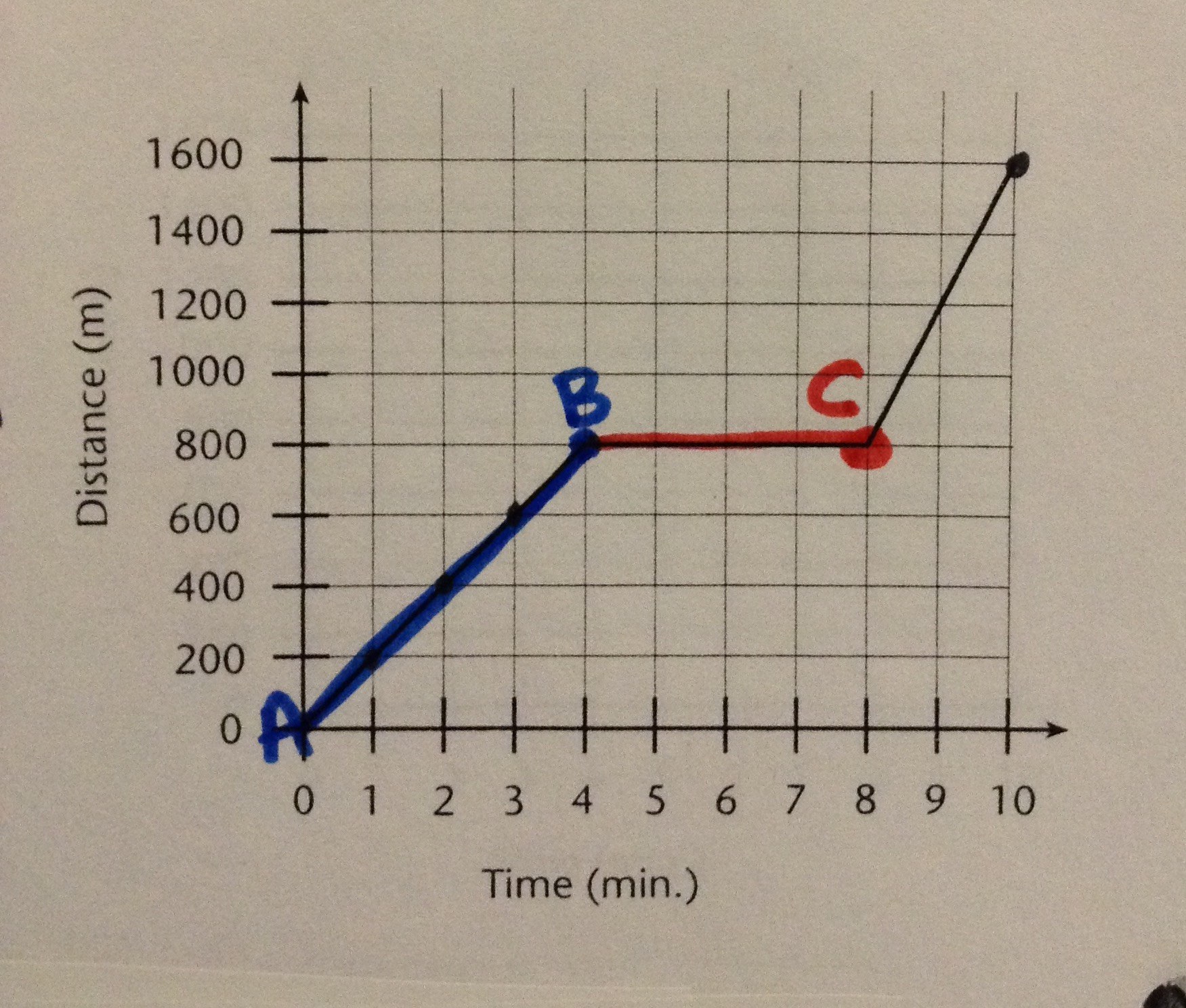
The graph shows Ashley riding her bike to Maria's house.
What is occurring from point A to point B?
they are traveling at a constant speed
they are slowing down
they stopped to take a break
they are speeding up
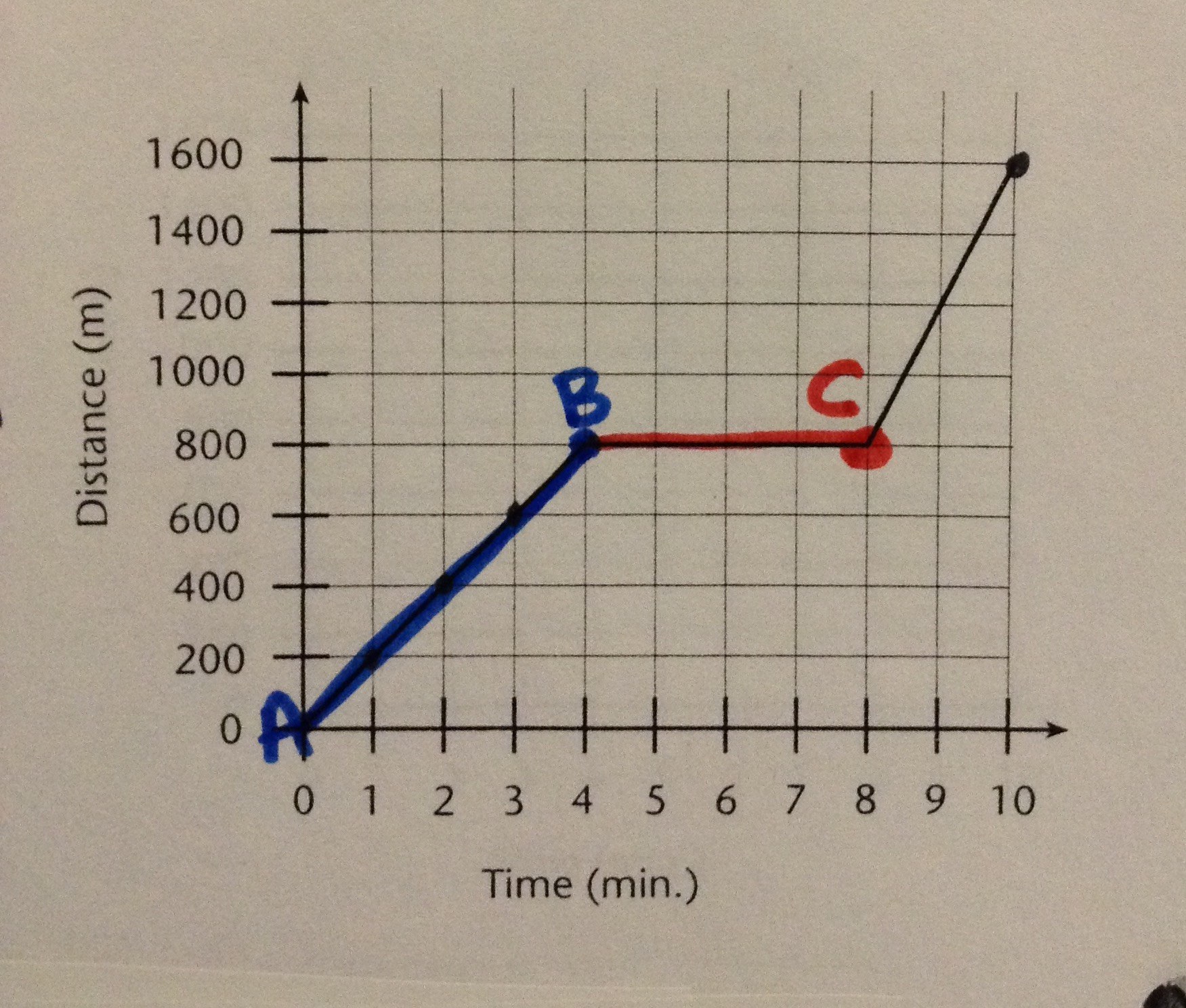
The graph shows Ashley riding her bike to Maria's house.
What was occurring from point B to point C?
She was increasing her speed.
She stopped
She was decreasing in speed
She was moving at a constant velocity
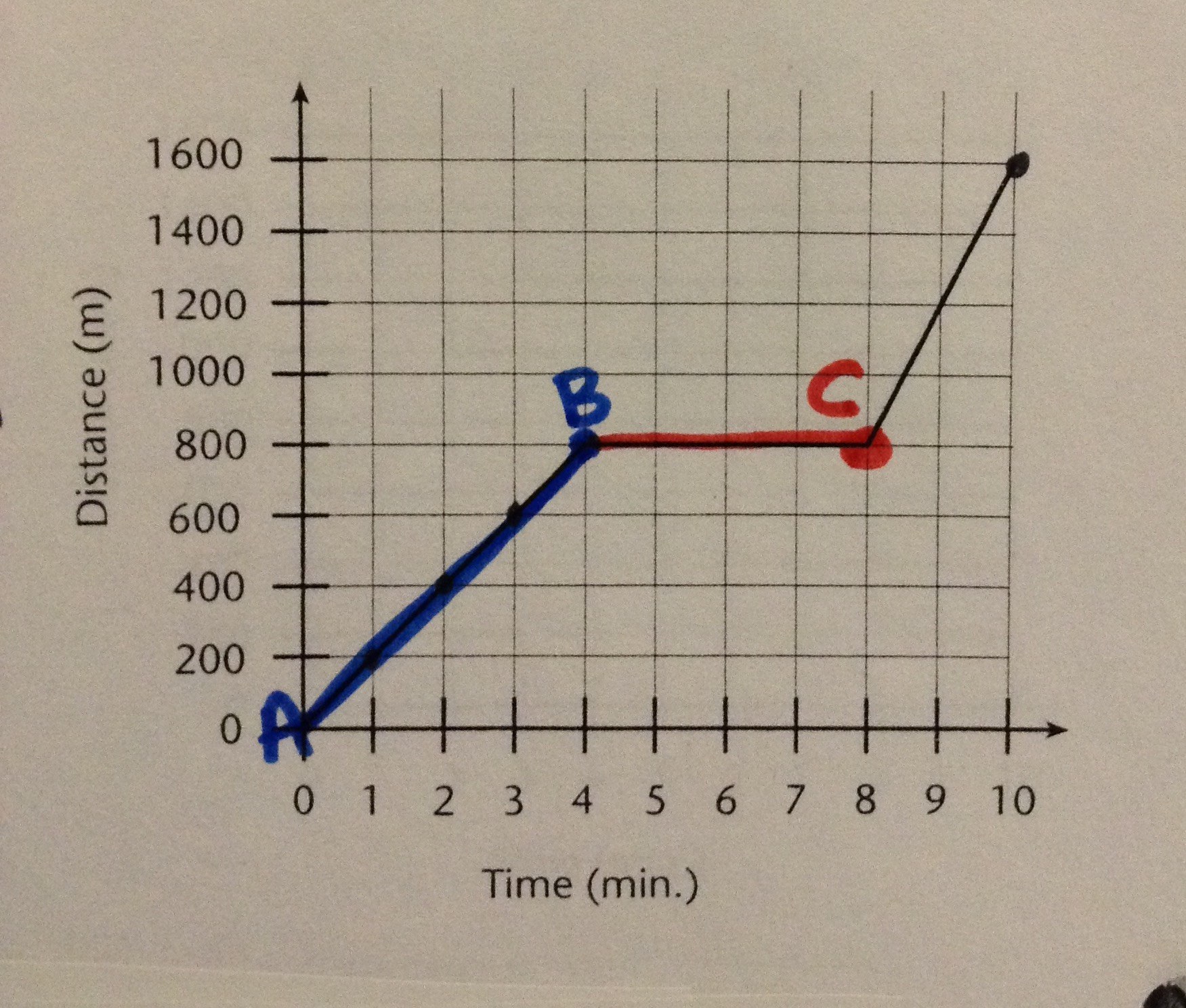
The graph shows Ashley riding her bike to Maria's house.
What was her average speed for the ENTIRE trip?
80 m/min
200 m/min
160 m/min
0.8 m/min
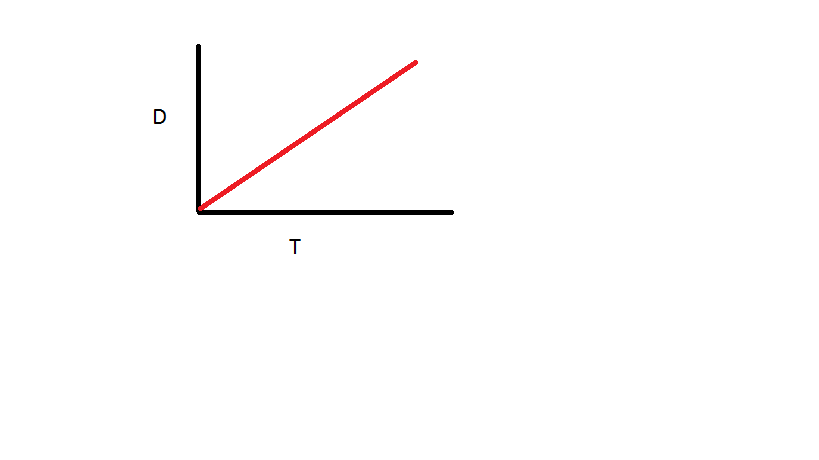
The graph represents
speeding up
no motion
slowing down
constant velocity


What is speed?
how far you go
how far you go for a given amount of time
how fast you accelerate
the change in the location of a object
What is velocity?
the quickness of an object
the location of an object in a specific direction
the acceleration of an object
how fast an object is going in a specific direction
Percival travels north 5 miles and then goes west 3 miles before coming straight back south 2 miles. What is their distance?
10 mi
7 mi
8 mi
6 mi
Slim Jim runs exactly 2 laps around a 400 meter track. What is the magnitude of their displacement?
800 m
400 m
0 m
200 m
Wilamina cycles at an average speed of 8km/h. How far has this person traveled if they cycle for 4 hours?
55 km
32 km
43 km
32 miles
Mrs Gallenstein travels 100 km in 5 hrs. Find this person's average speed in km/h
5 km/hr
10 km/hr
50 km/hr
20 km/hr
Mrs. Scull drives for 400 km at an average speed of 80 km/h. How long was her journey?
Mrs. Scull's journey was 5 hrs long
Mrs. Scull's journey was 10 hrs long
Mrs. Scull's journey was 20 hrs long
Mrs. Sculls journey was 15 hrs long
Ray runs 30 feet north, 30 feet west, and then 30 feet south. What is the displacement?
30 feet west
90 feet
30 feet south
0 feet
Mr. Stick Stickerson walks 50 meters directly north, stops, and then travels 32 meters directly south. What is their distance?
82 meters
18 meters
28 meters
The shortest path from the beginning to end is the
scalar
vector
distance
displacement
How many meters is 63 km?
63,000 meters
0.063 meters
63 meters
How many kilometers is 63 meters?
0.063 kilometers
63,000 kilometers
63 kilometers
How many grams is 63 kilograms?
63,000 grams
0.063 grams
63 grams
How many kilograms is 63 grams?
0.063 kilograms
63,000 kilograms
63 kilograms
How many seconds are in 1 hour?
60 seconds
3600 seconds
100 seconds

If you drop a banana, how fast is it going after 2 seconds?
5 m/s
10 m/s
20 m/s
30 m/s

If you throw a baseball straight up, what is its velocity at the highest point?
10 m/s2
10 m/s
0 m/s2
0 m/s


What is the horizontal acceleration of a projectile?
0 m/s2
10 m/s2

What is the vertical acceleration of a projectile?
0 m/s2
10 m/s2

What is the shape of the path of any projectile?
Hyperbola
Hypotenuse
Parabola
Diagonal
Trajectory
Does horizontal velocity change as a projectile rises and falls?
yes
no
direction

At its peak, a projectile has a velocity of 0 m/s
True
False
The time it takes for a projectile to reach the ground is based only on
The launching height
The launching speed
How far the projectile lands from the launch horizontally
The horizontal acceleration
Which of the following pictures correctly depicts the motion of a horizontally launched object?


Two objects of the same mass are launched from the ground. Object A has a launch angle of 45, while Object B has a launch angle of 65. Which object has the greatest range (horizontal distance)?
A
B
Both objects reach the maximum height
unable to determine with the given information


If you throw a baseball straight up, what is its acceleration at the highest point?
-9.8 m/s2
9.8 m/s2
0 m/s2
0 m/s

At which point along this projectile's path is the horizontal component of the velocity equal to the initial horizontal velocity?
A
B
C
ALL OF THEM
At which point along this projectile's path is the acceleration constant?
A
B
C
At all points

Consider a ball thrown up from the surface of the earth into the air at an angle of 300 above the horizontal. Air friction is negligible. Just after the ball is released, its acceleration is:
Upwards at 9.8 m/s2
Upwards at 4.9 m/s2
Downwards at 9.8 m/s2
0 m/s2
None of the above

In a lab experiment, a ball is rolled down a ramp so that it leaves the edge of the table with a horizontal velocity v. If the table has a height h above the ground, how far away from the edge of the table, a distance x, does the ball land? You may neglect air friction in this problem.


A rock is thrown into the air at an angle relative to the vertical, and follows the path shown here. Consider air friction to be negligible. What is the direction of the net acceleration of the rock at point D?
to the left
to the right
straight up
straight down
there is no net acceleration at point D
A projectile is fired horizontally from a height of 20 m above the ground, with an initial velocity of 7.0 m/s. How far does the projectile travel horizontally before it reaches the ground?
7m
14m
140m
3.5m
20m

Four students went out for pizza to celebrate after acing their physics final. All of them went directly from their high school to the nearby pizzeria, but they returned along the paths shown, taking different times. Values for the roundtrip distances they traveled and the total times they took to walk their routes are given in the figures. Rank the magnitudes of the average velocities of the students’ trips and explain your reasoning.
C > B > A > D
C > B > D > A
A > C > B > D
All zero
Cannot determine
A ball is thrown into the air at an angle Ө as measured from the horizontal with a velocity v. The horizontal velocity of the ball will be directly proportional to which of the following:
The angle Ө
The sine of the angle Ө
The cosine of the angle Ө
The tangent of the angle Ө
The value of the gravitational acceleration
Two balls, identical except for color, are projected horizontally from the roof of a tall building at the same instant. The initial speed of the red ball is twice the initial speed of the blue ball.
Which ball hits the ground first?
The red ball
The blue ball
Both hit the ground at the same time
The answer cannot be calculated
Two balls, identical except for color, are projected horizontally from the roof of a tall building at the same instant. The initial speed of the red ball is twice the initial speed of the blue ball.
Which ball has a larger speed upon hitting the ground?
The red ball
The blue red
Both hit the ground at the same time
The answer cannot be calculated
Two arrows are launched at the same time with the same speed. Arrow A at an angle greater than 45 degrees, and arrow B at an angle less than 45 degrees. Both land at the same spot on the ground. Which arrow arrives first?
Arrow A arrives first
Arrow B arrives first
They both arrive together
It depends on the elevation where the arrows are launched
It depends on the elevation where the arrows land
A diver initially moving horizontally with speed V dives off the edge of a vertical
cliff and lands in the water a distance d from the base of the cliff. How far from the base
of the cliff would the diver have landed if the diver initially had been moving
horizontally with speed 2V?
d
2d
d square root of 2
4d
It cannot be determined unless you know the height of the hill

A projectile is fired with initial velocity V0 at an angle Ө0 with the horizontal and
follows the trajectory shown above. Which of the following pairs of graphs best
represents the vertical components of the velocity and acceleration, V and a,
respectively, of the projectile as a function of time t?


A projectile has an initial velocity of magnitude Vo which makes an angle Ө0
with the horizontal. Neglecting air friction, all of the following are true at point P, the
highest point of its trajectory EXCEPT:


The acceleration is g

An object travels along a path shown above, with changing velocity as indicating by vectors A and B. Which vector best represents the net acceleration of the object from time tA to tB?


Vectors M and N obey the equation M + N = 0. These vectors satisfy which one of the following statements:
Vectors M and N are at right angles to each other
Vectors M and N point in the same direction
Vectors M and N have the same magnitude
The magnitude of M is negative of the magnitude of N
A large beach ball is dropped from the ceiling of a school gymnasium to the floor about 10 meters below. Which of the following graphs would best represent its velocity as a function of time? (do not neglect air resistance)



