
 Worksheets
Plant Science (Ag Foundations)
Total questions: 83
Worksheet time: 48mins
The word equation for photosynthesis is?
water + glucose = oxygen + carbon dioxide
glucose + carbon dioxide = oxygen + water
oxygen + water + carbon dioxide + glucose
carbon dioxide + water = glucose + oxygen
Stomata in leaves do the following?
Store water
Protect the plant
Carry out photosynthesis
Allow gases and water to move in and out
Which of the following describes transpiration?
Making of glucose in the leaf
The upward movement of water from root to leaf in the plant
Storage of sugar in the plant
Storage of water in the vacuole
The female part of a flower is called?
Petal
Flower
Stamen
Carpel
Three factors required for germination are?
Carbon dioxide, correct pH, water
Oxygen, correct temperature, water
Oxygen, correct pH, carbon dioxide
Correct temperature, oxygen, light
An annual plant has which life cycle?
Dies after four flowering years
Grows for two years then flowers
Grows, flowers, dies in one year
Lives for many years
Osmosis is the movement of?
Water from high to low concentration across a semi permeable membrane
Sugar from high to low concentration across a semi permeable membrane
Water from low to high concentration
sugar across a semi permeable membrane
The plant organelle responsible for photosynthesis is?
Cytoplasm
Cell wall
Chloroplast
Vacuole
which parts does a seed have?
( in to out )
seed coat, cotyledon, an embryo
seed coat, an embryo
cotyledon, an embryo
seed coat, cotyledon
which are different group of trees?
gymnosperm, angiosperm
gymnosperm
angiosperm

Which are the 3 principal parts of the plant?
Steam
Roots
Leaves
Head

What are the 2 functions of the stem?
Absorb
Swim
Transport
Write
Which one is not a function of leaves?
photosynthesis
transpiration
food storage
holds the stem
Which part of a plant produces seeds?
leaf
flower
root
stem

Recognize type of roots above:
Taproot
Fibrous root
Adventitious root
Floating root
The process of transfer pollen from the anther to the stigma called:
Fertilization
Pollination
Transpiration
Stamen
What is germination?
The development of seeds into young plants
The process by which the plant grows in size.
Changes in the whole organism in terms of organization and function.
What is the product made from plants during photosynthesis?
carbon dioxide gas
water
Sun's energy
glucose
In which plant part does photosynthesis happen?
Leaves
Roots
Stems
Seeds
Why do plants need air (carbon dioxide) to grow?
Plants use carbon dioxide to make food
Plants use carbon dioxide to transport food to different parts of the plants
Plants use carbon dioxide to keep firm
Plants use carbon dioxide to reproduce
In general, seeds need the things below, EXCEPT....
water
warmth
air
light
What is the function of seed coat?
it covers and protects the seed
it is a place where photosynthesis happen
it stores food
it can develop into young plant
In general, plants need ______________, ______________ and ______________ to grow well.
light, water, air and cool condition
dry place, dark condition and warmth
light, water, air and warmth
medium, cold temperature, and light
The process of a plant using light to convert carbon dioxide and water into glucose for food is know as...
germination
pollination
photosynthesis
life cycle
Most seeds do not light to germinate, because _____________
Seeds can use the food stored inside.
Seeds can do photosynthesis in the dark soil.
Seeds can produce light to make their own food.
Seeds can do photosynthesis without light.
What two substances are produced during photosynthesis?
sugar and carbon dioxide
sugar and water
sugar and carbon monoxide
sugar and oxygen
What do plants release during photosynthesis that is important for human and animals?
carbon dioxide
water
oxygen
nicotin

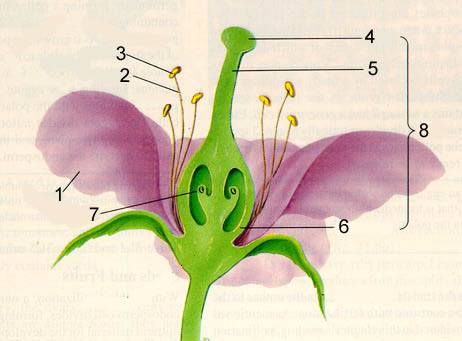
What is the name of flower part #1 ?
anther
pistil
filament
pedicle

What is the name of flower part #3 ?
sepal
pistil
stamen
petal

What is the name of flower part #4 ?
stamen
ovary
peduncle
ovule

What is the name of flower part #5 ?
anther
style
stigma
filament
What is the name of flower part #5 ?
anther
style
stigma
filament

What is the name of flower part #7 ?
stigma
stamen
ovule
pollen tube

What is the name of flower part #8 ?
stigma
receptacle
ovule
ovary

What is the name of flower part #10 ?
sepal
pollen tube
filament
stigma
What is the name of flower part #11 ?
pedicle
sepal
stamen
receptacle
What is the name of flower part #12 ?
style
ovule
stamen
pistil
This contains the male parts of the flower?
stamen
pistil
sepal
style
This is the flower stalk?
filament
sepal
pedicle
receptacle
The grains that contain the male sex cell?
Anther
pollen
ovule
petal
This part of the plant bears pollen?
anther
filament
pistil
stamen
This is the stalk of the pistil?
style
stigma
sepal
ovary
This is the base of the pistil, matures to become fruit?
ovule
ovary
style
stigma

Which of these are both male reproductive structures?
Stigma
Anther
Filament
Ovary

This part of a flower turns into fruit around a fertilized seed.
ovule
ovary
stamen
Pollination is the process by which the pollen grains are transferred from the ________ to the _________.
anther... filament
anther ... stigma
stigma ... ovary


The diagram represents a flower, the reproductive structure of some plants. Which structure is represented by the letter A in the diagram?
the stamen, a male structure which produces pollen
the pistil, a female structure which collects pollen and passes it to the ovary
the sepal, a modified leaf used for protection of the flower
the petals, decorative structures which attract pollinators
The function of the petal is to
attract pollintors
Egg production
Pollen production
Identify the structure:
A= Egg Production
B=Pollen Production
A = Pistil; B= Stamen
A=Petals; B=Ovary
A= Stamen; B=Pistil
Trace the path that pollen takes:
Anther --> Stigma --> Style --> Ovary
Ovary --> Stigma --> Anther --> Stamen
Anther --> Ovary --> Stamen --> Stigma

This structure is -
stamen
pistil
petals

This structure is -
stamen
pistil
petals
A plants roots grow thicker towards the river than away from the river. To what stimulus is the plant responding to?
touch
gravity
light
water
Roots can respond to the following:
touch
light
water
gravity
Which parts of the plant can respond to light?
leaves
flower
roots

The enlarged base of the pistil that stores the eggs of the plant is the ___.
ovary
ovule
stigma
style

The transfer of pollen, containing the sperm cells, to the female part of the flower.
seed disperal
pollination
germination
fertilization

The ovary, style, and the stigma make up the female part of a plant called the ?
stamen
petals
stem
carpel (pistil)

What is the green pigment that absorbs energy from sun in plants' leaves?
Sugar (Glucose)
Chlorophyll
Oxygen
Energy
How does the Stigma collect pollen?
In a reusable shopping bag
Through the leaves
Stigma contain sticky hairs that collect pollen when bee's land on the flower
Female sex cells are present inside
Ovary
Stigma
Ovule
Anther

Guards cells and the stomata controls which process for plants.
Respiration
Transpiration
Photosynthesis
Evaporation

Identify the process that a plant uses to release energy from food.
photosynthesis
reproduction
transpiration
respiration

This process mostly occurs in the leaves of a plant.
Photosynthesis
Respiration
Reproduction
Transpiration

These materials are needed for photosynthesis to take place in a plant.
carbon dioxide
water
sugar
oxygen
Respiration creates energy for the plant to...
grow and repair
limit loss of water
capture vitamins from sunlight
produce proteins
Identify the product(s) for respiration.
Water
oxygen
carbon dioxide
sugar

This structure takes in carbon dioxide during photosynthesis.
stomata
guard cells
roots
plant

In respiration glucose is broken down to release energy and the released energy allows the plant to...
release oxygen
form water molecules
perform vital functions
increase enzyme activity

