
 Worksheets
N6 Protein Basics
Total questions: 15
Worksheet time: 5mins
Name
Class
Date
1.

The bond that joins amino acids are called:
a)
Peptide Bonds
b)
Ester Bonds
c)
Glycosidic Linkages
d)
Phosphodiester Bonds
2.

If a methyl group (-CH3), which does not like water, were at the 'R', the amino acid would likely be:
a)
Hydrophobic
b)
Hydrophilic
c)
Ionic
d)
Acidic
3.

The diagram shows a bond forming between two amino acids. What is the name of this reaction?
a)
Condensation
b)
Hydrolysis
c)
Digestion
d)
Oxidation
4.
Amino acids all have the same general structure except for the:
a)
Amino Group
b)
Carboxyl Group
c)
'R' Group
d)
Carbonyl Group
5.

The reaction used to digest and break the bond in red is:
a)
Hydrolysis
b)
Dehydration Synthesis
c)
Oxidation
d)
Single Displacement
6.

The primary sequence of a protein refers to the:
a)
Order of amino acids
b)
α-Helix or β-Pleated Sheet
c)
Interaction of subunits
d)
Hydrogen Bonding
7.

The number of amino acids used to produce proteins for all living things is:
a)
20
b)
∞
c)
15
d)
42
8.

The structure of proteins can be changed by environmental factors such as temperature or pH.
a)
True
b)
False
9.

The sequence of amino acids is determined by:
a)
Genes
b)
Hydrogen Bonds
c)
Like Dissolves Like
d)
pH
10.
What kinds of food can you get protein from in your diet?
a)
Eggs
b)
Meat and Fish
c)
Nuts and Legumes
d)
All of the above
11.
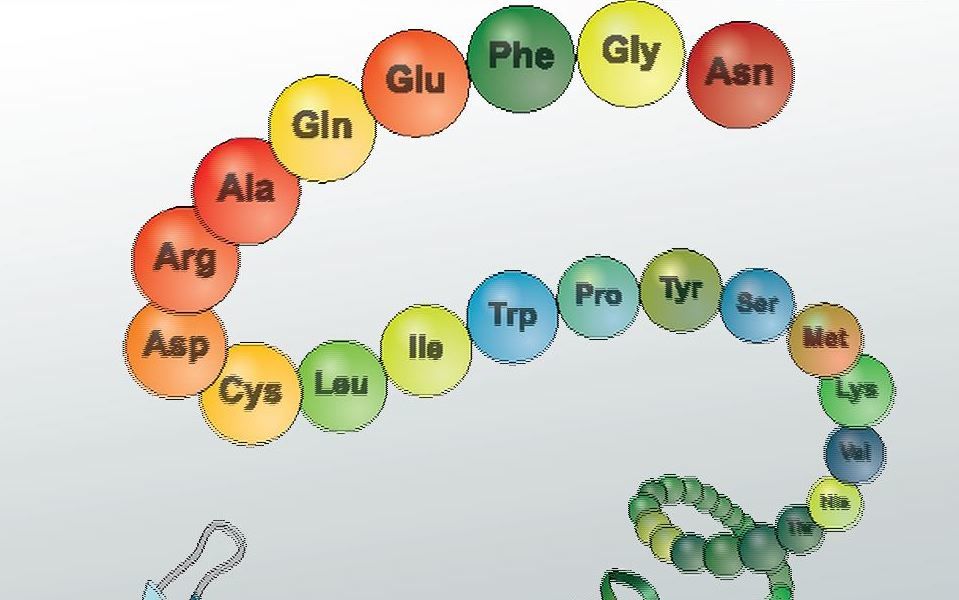
The name of the initial chain of monomers in a protein is called.....
a)
polypeptide
b)
polysaccharide
c)
polyester
d)
polynucleotide
12.
The level of protein structure that results from weak interactions between R groups and results in small twists and folds in the polypeptide chain
a)
primary structure
b)
secondary structure
c)
tertiary structure
d)
quaternary structure
13.
Which of the following are essential amino acids? (Check all that apply.)
a)
lysine
b)
leucine
c)
alanine
d)
glutamate
e)
histidine
14.
When a protein unfolds, it is
a)
Denatured
b)
Building
c)
Adding amino acids
d)
Making food
15.
Two or more polypeptides attached together and work as one unit
a)
Primary
b)
Secondary
c)
Tertiary
d)
Quaternary
100 %

