wayground logo

Free Printable Worksheets

NEW

Font size

S
M
L
XL
Worksheets

Unit 5 test review

Total questions: 55

Worksheet time: 2hrs 0mins

Name
Class
Date
1.
What atom matches this electron configuration?
1s2s2p3s2
a)
Neon
b)
Magnesium
c)
Aluminum
d)
Potassium
2.
Which is the electron configuration for an oxygen atom?
a)
1s22s22p63s23p64s2
b)
1s22s22p4
c)
1s22s22p6
d)
1s22s22p63s23p6
3.
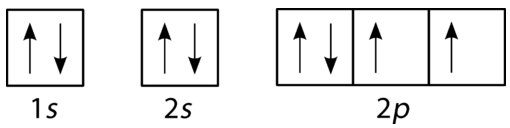
Which element is pictured?
a)
neon
b)
fluorine
c)
magnesium
d)
argon
4.
Electrons occupy orbitals of lowest energy first is part of what electron configuration rule?
a)
Hund’s Rule
b)
Aufbau Principle
c)
Pauli Exclusion Principle
5.
What atom matches this electron configuration?
1s22s22p63s23p64s23d10
a)
Zinc
b)
Copper
c)
Nickel
d)
Germanium
6.
The electron configuration of an atom is 1s22s22p6.  The number of electrons in the atom is 
a)
3
b)
6
c)
8
d)
10
7.
Which electron configuration belongs to Chlorine (Cl)?
a)
1s2s2p3s3p5
b)
1s2s2p3s3p6
c)
1s2s2p3s3p7
8.
Identify the Electron Configuration for Aluminum (Al)
a)
1s2s2p3s3p1
b)
1s2s2p3s3p3
c)
1s2s2p3s4p1
9.

What does Pauli exclusion principle state ?

a)

states that each electron occupies the lowest energy orbital available

b)

states that -no two electrons in the same orbital can have the same spin

c)

states that single electrons electrons with the same spin must occupy each-energy orbital before additional electrons with opposite spins can occupy the same orbitals

10.

What is the maximum number of electrons that an S orbital can have?

a)

1 electron

b)

2 electrons

c)

3 electrons

d)

4 electrons

11.

How many electrons can the d sublevel(orbital) hold?

a)

8

b)

10

c)

2

d)

4

12.

What is this element?

1s22s22p63s23p64s23d104p6

a)

Argon

b)

Krypton

c)

Selenium

d)

Bromide

13.
Which of the following is a p block element?
a)
Ca
b)
Ar
c)
Re
d)
Au
14.

There are 4 different types of subshells(orbitals) s,p,d,f

a)

true

b)

false

15.
Which electron configuration belongs to Copper (Cu)?
a)
1s2 2s2 2p6 3s2 3p6 4s2 3d8
b)
1s2 2s2 2p6 3s2 3p6 4s2 3d9
c)
1s2 2s2 2p6 3s2 3p6 4s2 3d10
16.
How many electron can be found in a p orbital?
a)
2
b)
3
c)
4
d)
6
17.
What is the electronic configuration of iron?
a)
1s22s22p63s23p64s23d6
b)
1s22s22p63s23p63d8
c)
1s22p63s23p64s23d6
d)
1s22s22p63s23p64s13d6
18.
What atom matches this electron configuration?
[Xe] 6s2 4f14 5d9
a)
Mercury
b)
Gold
c)
Platinum
d)
Thallium
19.
What is the shorthand electron configuration for Sulfur atom?
a)
[Ar] 3p4
b)
[He] 3s23p4
c)
[Ne] 3s23p4
d)
[Na] 3s23p3
20.
What noble gas should be used to write the shorthand configuration for Te?
a)
Ar
b)
Kr
c)
Xe
d)
Sb
21.
This orbital diagram represents:  
a)
C
b)
B
c)
N
d)
O
22.
This orbital diagram represents:  
a)
C
b)
B
c)
N
d)
O
23.
Which orbital shows a violation of Hund's Rule?
a)
A
b)
B
c)
C
d)
D
24.
Which orbital shows a violation of the Aufbau Principle?
a)
A
b)
B
c)
C
d)
D
25.
Which orbital shows a violation of the Pauli Exclusion Principle?
a)
A
b)
B
c)
C
d)
D
26.

What is the short hand configuration for iodine?

a)

[Ar]4s23d6

b)

[Ne]4s23d6

c)

[Kr]5s24d105p5

d)

[Kr]4s24d104p5

27.
A certain photon of light has a wavelength of 4.22x10⁻⁷nm. What is the frequency? (v=c/λ)
a)
7.11x10¹⁴ Hz
b)
7.11Hz
c)
1.41x10⁻¹⁵
d)
-1.41x10¹⁵
28.

A wave with a long wavelength will have a ______ frequency and _____ energy

a)
high, low
b)
high, high
c)
low, high
d)
low, low
29.
Which section of the spectrum is the ONLY one we can see?
a)
X-rays
b)
Visible Light
c)
Gamma Rays
d)
Ultraviolet Rays
30.
As the frequency of an electromagnetic wave increases, the amount of energy in that wave...
a)
increases.
b)
decreases.
c)
stays the same.
31.
The blue section of the wave is measuring _________________.
a)
wavelength
b)
crest
c)
trough
d)
amplitude 
32.
What happens to the energy of a photon as the frequency of the wave increases? 
a)
The energy increases
b)
The energy decreases
c)
The energy stays the same 
33.
What does the letter 'h' represent in the formula E = hv?
a)
Planck's constant
b)
Hydrogen
c)
Energy
34.
What is the energy of a quantum of light with a frequency of 7.39x10¹⁴Hz.(E=Hv)
a)
4.88x10¹⁹
b)
4.88x10⁻¹⁹
c)
2.22x10²³
d)
2.22x10⁻²³
35.
Certain blue lights have a frequencey of 6.91x10¹⁴Hz. What is the wavelength? (λ=c/v)
a)
4.34x10²¹
b)
4.34x10⁻²¹
c)
4.34x10⁻⁷
d)
2.07x10²³
36.

What is the wavelength, in nm, for a quantum of light with energy of 7.56x10⁻¹⁹J?

a)

262 nm

b)

200 nm

c)

2.64x10-45 nm

d)

756 nm

37.
A light has a wavelength of 5.06x10⁻⁷m. What is the frequency of the light? What is the color of light? (v=c/λ)
a)
16.87Hz, Red
b)
5.93Hz, Orange
c)
5.93x10⁻¹⁴Hz, Blue
d)
5.93x10¹⁴Hz, Green
38.

Which of the following colors of light have the highest energy

a)

red

b)

orange

c)

green

d)

purple

39.
The energy of an electron __________ as it moves further away from the nucleus
a)
increases
b)
decreases
40.
When an atom has all of its electrons in the lowest energy orbitals available, the atom is  
a)
in ground state
b)
in excited state
c)
giving off light energy
d)
unstable
41.

Light is emitted when electrons

a)

move from one atom to another.

b)

collide with one another, releasing energy.

c)

move from a lower energy level to a higher energy level.

d)

move from a higher energy level to a lower energy level.

42.

Flame tests can be used to identify an element. Each element emits characteristic waves of light when it is heated in a flame. What describes how the light is produced?

a)

Protons in the ground state lose energy and give off light.

b)

Protons in the ground state gain energy and are emitted from the nucleus, giving off light.

c)

Electrons in the ground state lose energy and move to an excited state, giving off light.

d)

Electrons in the ground state gain energy, move to an excited state, and give off light when they return to the ground state.

43.

In order to go from ground state to an excited state, an electron must

a)

emit energy

b)

absorb energy

c)

rotate

d)

wiggle

44.

When an electron returns to ground state from an excited state, the atom will

a)

emit energy

b)

absorb energy

c)

rotate

d)

wiggle

45.
Why are line emission spectra of elements called "atomic fingerprints"?
a)
They are all the same
b)
They are all unique
c)
They are all similar
d)
They all contain colored light
46.

How many orbitals are present in the 4p sub level?

a)

7

b)

5

c)

4

d)

3

47.

How many d orbitals make up the d subshell?

a)

1

b)

5

c)

3

d)

7

48.

Which quantum number represents the shape of the orbital?

a)

principal quantum number

b)

azimuthal (angular momentum) quantum number

c)

magnetic quantum number

d)

spin quantum number

49.

Which form of radiation has the highest frequency?

a)

radio waves

b)

ultraviolet

c)

x-ray

d)

gamma

50.

Heisenberg's Uncertainty Principle states that it is impossible to know both the ___________ and the __________ of a particle at the same time.

a)

velocity, position

b)

velocity, energy

c)

position, energy

d)

velocity, speed

51.

This states that no two electrons will have the same 4 quantum numbers in an atom or molecule. The two electrons of the same orbital must have opposite spin states.

a)

Pauli exclusion principle

b)

Hund's rule

c)

Aufbau principle

d)

None of the above

52.

How many orbitals are there in a p-sublevel?

a)

1

b)

3

c)

5

d)

7

53.

What sublevels are present in the 5th energy level of an atom?

a)

s

b)

p and d

c)

d and f

d)

s p and d

e)

s p d and f

54.

The f-block on the periodic table can hold ___ elements.

a)

3

b)

6

c)

18

d)

14

e)

10

55.
The quantum number "n" represents:
a)
electron spin
b)
orbital
c)
sublevel
d)
main energy level