
 Worksheets
1st 9 Week Review (5th grade)
Total questions: 100
Worksheet time: 2hrs 47mins
What is an observation?
A scientific statement based on ideas
Using your senses to notice what is going on around you
To be unaware of your surroundings
The question that you want an answer to.


What step does every scientific experiment begin with?
hypothesis
question/problem
procedures
conclusion
List the Scientific Process steps in order.
Observation, Question, Hypothesis, Experiment, Data, Conclusion
Conclusion, Observation, Experiment, Data, Hypothesis
Observation, Experiment, Hypothesis, Conclusion, Data, Question
None of the above

What is an observation?
Something you measure or detect with your senses.
The way you feel about something
An educated guess
A theory that has been disproved
The center of our Solar System
the Milky Way
Sun
Earth
Jupiter
Which planets are called "Inner Planets"?
Mercury
Venus
Earth
Mars
Uranus
The (a) is also called the Earth's "Natural Satellite"
Which is the largest planet in our galaxy?
Jupiter
Saturn
Uranus
Neptune
Which planet is called "The RED PLANET"?
Jupiter
Mars
Nepturn
Mercury
What is the 6th planet away from the Sun?
Neptune
Pluto
Earth
Saturn
Venus
Stars are very small and smaller than the sun.
True
False
Which planet is NOT an "Outer Planet"?
Saturn
Uranus
Jupiter
Mars
Neptune
Constants should be...
different
remain the same
kind of the same
none of the above
A student is conducting an experiment to see how a watering schedule affects the growth of grass. He conducts the experiment TWO times. His data are different each time, and he comes two different conclusions. What should he do next?
Forget about the entire investigation.
Get different kinds of plants and start over.
Repeat the experiment carefully one or more times.
Change the results so that they match.
What is the part of the experiment that has been treat or receives change?
control group
experimental group
How long does it take for the Earth to make 1 revolution around the sun?
a year
365 days
12 months
All of the above
How long does it take for the Earth to rotate?
1 month
1 day
1 year
2 weeks
Which characteristic DOES NOT describe the outer planets?
gaseous
larger
terrestrial (rocky)
takes longer to revolve around the sun
Which characteristic DOES NOT describe the inner planets?
Less moons
smaller
terrestrial (rocky)
cold

Full Moon
First Quarter Moon
Third Quarter Moon
New Moon

Full Moon
First Quarter Moon
Crescent Moon
New Moon

Full Moon
First Quarter Moon
Third Quarter Moon
New Moon

Full Moon
First Quarter Moon
Third Quarter Moon
Crescent Moon

Full Moon
First Quarter Moon
Crescent Moon
New Moon
You should repeat experiments more than once to get accurate resutls
True
False
The average weather conditions of a region--
daily temperature
weather
climate
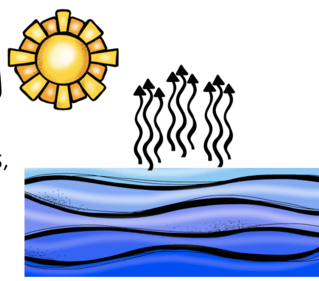
What is water doing when it changes to water droplets?
Evaporating
Condensing
Precipitating
When rainfall travels by land back into a body of water, _____________ occurrs.
condensation
precipitation
evaporation
transpiration
surface runoff
When rainfall travels by land back into a body of water, _____________ occurrs.
condensation
precipitation
evaporation
transpiration
surface runoff
When water vapor cools and becomes water droplets, __________________ is occuring.
condensation
precipitation
evaporation
transpiration
surface runoff
When there is TOO MUCH water vapor in the atmosphere, ______________ is produced.
Air Pressure
Humidity
Transpiration
Rainfall
Temperature
When plants give off water vapor into the atmosphere, _____________ is occurring.
Air Pressure
Humidity
Transpiration
Rainfall
Temperature
Which of the following statements describe climate?
the type of weather conditions on a certain day
a description of an ecosystem
condensation in the atmosphere
the usual weather in a place over time
A device that is used to measure atmospheric pressure is a ___________.
barometer
thermometer
hygrometer
anemometer
What can we use to measure wind speed?
thermometer
barometer
anemometer
rain gauge
hygrometer
What weather instrument measures rainfall?
Hygrometer
Barometer
Rain Gauge
Anemometer
Thermometer
What weather instrument measures humidity?
Hygrometer
Barometer
Rain Gauge
Anemometer
Thermometer
Where is the most Earth's water found?
A) underground
B) in the Earth's Oceans
C) in rivers and lakes
D) in polar ice caps
Precipitation is
A) rain
B) snow
C) hail
D) Sleet
E) All of the above
Which best describes climate?
A) Summers are usually hot and dry.
B) It rained last week.
C) Yesterday it was cold and windy.
D) It was hot for the entire month.
The farther away a location is from the equator, the _______________ it is.
A) hotter
B) colder
C) windy
D) grassier
What is the height of an area above sea level?
A) elevation
B) topography
C) latitude
D) longitude
Locations near or within the equator...
A) Have polar climates
B) Have temperate climates
C) Have tropical climates
D) have the worst weather
Ohio has all the seasons. Warm falls, snowy winters, rainy springs, and hot summers. This describes what type of climate?
A) Polar
B) Temperate
C) Tropical
D) Desert
It's extremely cold.
polar
temperate
tropical
It has a great diversity of flowers.
polar
temperate
tropical
It has a great diversity of flowers.
polar
temperate
tropical



What are the inner planets and out planets separated by?
Asteroid Belt
Orions Belt
Gucci Belt
The Milky Way
Which type of rock is most likely to contain fossils?
Sedimentary
Igeneous
Metamorphic
All rocks
What does renewable mean?
Cannot be replaced once used
made new again every day

Nonrenewable resources are replaced quickly.
True
False

Trees are renewable resources.
True
False

Water is a renewable resource.
True
False

The sun is a renewable resource.
True
False

Minerals are renewable resources.
True
False

Gold is a renewable resource.
True
False

Oil is not a renewable resource because ...
it comes from the ground.
it cannot be replaced.
it is too gooey.
it is not heavy enough.

Coal is a renewable resource.
True
False

Wind is a renewable resource.
True
False
What does the term nonrenewable energy sources mean?
Energy can be used more than once
Energy that can be replenished
Energy can be lost once used
What kind of energy is natural gas?
Renewable
Non renewable
What kind of energy is the sun?
renewable
non renewable


Rocks are renewable resources.
True
False


The process by which rock and soil are moved from one place to another is called-
Chemical weatherin
Erosion
Mechanical weathering
Deosition
The breaking down of rocks and other materials on the Earth's surface.
Weathering
Erosion
Deposition
Exfoliation

