wayground logo

Free Printable Worksheets

Font size

S
M
L
XL
Worksheets

1st Quarter Review

Total questions: 102

Worksheet time: 2hrs 55mins

Name
Class
Date
1.

What is freezing?

a)

The change of a solid into a liquid

b)

The change of a liquid into a solid

c)

The change of a liquid into a gas

d)

The change of a gas into a liquid

2.

What happens during condensation?

a)

Liquid changes into a gas

b)

Gas changes into a liquid

c)

Liquid changes into a solid

d)

Solid changes into a liquid

3.

What is the opposite of evaporation?

a)

Condensation

b)

Boiling

c)

Melting

d)

Freezing

4.

What happens to the mass of an ice cube as it melts into liquid water?

a)

The mass increases

b)

The mass decreases

c)

The mass stays the same

5.

The change of one state of matter to another is called a _____________.

a)

chemical change

b)

solid change

c)

liquid change

d)

phase change

6.

What are the four major phase changes?

a)

Freezing, Melting, Condensation, Evaporation

b)

Melting, Condensation, Evaporation, Heat

c)

Freezing, Melting, Condensation, Cooling

d)

Condensation, Evaporation, Freezing, Heating

7.

What is the opposite of freezing?

a)

Cooling

b)

Melting

c)

Evaporation

d)

Condensation

8.

What is the opposite of condensation?

a)

Melting

b)

Freezing

c)

Cooling

d)

Evaporation

9.

The chemical properties of the substance do not change during a phase change.

a)

True

b)

False

10.

Matter is not created nor destroyed during a phase change.

a)

True

b)

False

11.

Physical Properties are

a)

chemical changes

b)

are properties that can be observed without changing the matter's identity

c)

are properties that can be observed that change the matter into new matter with new properties

12.

True or False. States of matter are solids, liquids, and gasses

a)

True

b)

False

13.

The ability of sugar to dissolve in water is called

a)

malleability

b)

Density

c)

State

d)

solubility

14.


The amount of matter in a given space of volume

a)

density

b)

state

c)

volume

d)

mass

15.

What is the least dense liquid in this container?

a)

Honey

b)

vegetable oil

c)

lamp oil

d)

water

16.


Anything that has mass and takes up space

a)

Matter

b)

weight

c)

volume

d)

mass

17.

Most physical changes are easily reversible. Hint - Is it easy to melt and freeze ice?

a)

True

b)

False

18.

Which group of things will maintain their physical properties when mixed together?

a)

Pebbles and Wood Chips

b)

Pebbles, Powered soap and hot water

19.


Which group of things will maintain their physical properties when mixed together?

a)

copper wire, rubber ball and aluminum washer

b)

Lemon juice, water and sugar

20.

Which of the following best represents the three states of matter?

a)

Picture A

b)

Picture B

c)

Picture C

d)

Picture D

21.

Identify which item below best completes the table.

a)

Glass Window

b)

Gold Ring

c)

Paper Bag

d)

Styrofoam Cup

22.

The force that one surface exerts on another surface when two objects rub against each other?

a)

friction

b)

gravity

c)

inertia

d)

balanced force

23.

Pictures on the wall is hung by tape. The pictures was found on the ground. Which force acted upon the picture, causing it to fall?

a)

gravity

b)

friction

c)

magnetism

d)

evaporation

24.

A push or pull that can change the position or motion of an object/material is --

a)

magnetism

b)

motion

c)

force

25.

If you roll a toy car on different types of material. What are you testing by rolling the car on foil, felt, or carpeted material?

a)

gravity

b)

gravity and magnetism

c)

magnetism and friction

d)

friction

26.

If you rolled a golf ball, ping pong ball, and a tennis ball down a ramp. You record the observations. What should you do next?

a)

repeat with 3 different balls

b)

change the width of the ramp

c)

repeat this identical procedure several times

27.

A class was testing how far a train would travel after pushing it with different amounts of force. They recorded their results in the chart below.

Based on the data, how far would the train travel if it were pushed with 5 N of force?

a)

25 N

b)

15 N

c)

30 N

d)

31 N

28.

Two students were pulling on the rope below with the same amount of force. The man increased the amount of force he was using by 2 N and the woman increased the amount of force she was using by 4 N. Which BEST describes the motion that resulted after they increased force?

a)

The both moved farther from one another

b)

The man moved towards the woman

c)

The woman moved towards the man

d)

They both moved farther from one another

29.

If these boys are pulling with the same amount of force. What will happen?

a)

The boy in blue will win.

b)

They will not move at all.

c)

The boy in red will win.

d)

Both will fall down.

30.
If an object is stationary (not moving) the forces acting upon it are _____________
a)
unbalanced
b)
weak
c)
balanced
d)
Hulk Smash!
31.
a)
Balanced
b)
Unbalanced
32.
You and your dad are moving the couch from one side to another. Your dad pushes with a force of 35 N to the right and you push with a force of 25 N right. What is the net force on the couch?
a)
60 N right
b)
10 N left
c)
60 n right
d)
50 N left
33.

Which of the following objects will experience an unbalanced force?

a)

A bike rider on a smooth and level road, pedaling at a constant rate.

b)

A train pulling on another train, each with the same amount of force.

c)

A chair sitting on the floor with balanced forces acting in opposite directions.

d)

A ball rolling across the floor with friction acting in the opposite direction.
34.
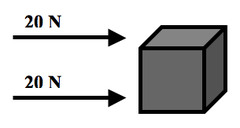
What is the net force?
a)
40 N left
b)
0 N Balalnced
c)
400 N right
d)
40 N right
35.
How will this object move? 
a)
It won't move. 
b)
It will move to the right. 
c)
It will move to the left. 
d)
It will move up. 
36.
Which of the blocks above has balanced forces acting on it?
a)
A
b)
B
c)
C
d)
D
37.
Justin blows his nose, but mucus seems to leak through the tissue.  He decides to test which tissue holds up the best while sneezing.  What is the independent variable?
a)
sneezing
b)
Justin
c)
amount of tissue
d)
type of tissue
38.
Why should an experiment be repeated?
a)
to form a hypothesis
b)
to reduce the chance of error
c)
to change controls
d)
to identify the problem
39.
Which is the dependent variable in Amelia's experiment?
a)
the number of bean plants in each group 
b)
the amount of water given daily to each plant 
c)
the height of each bean plant 
d)
the amount of fertilizer given to each group of bean plants
40.
In the paper airplane experiment, changing the size of the airplane would be which variable?
a)
Dependent
b)
Independent
c)
Control
d)
Conclusion
41.

Mr. McNeice wanted to know if different types of music affected infants's heart rates; so he played different types of music and checked their pulses. What is the dependent variable?

a)

type of music

b)

the infant's pulse

c)

how long they listend to music

d)

the infants age

42.
Electrical Energy is transferred to _____ Energy.
a)
Thermal
b)
Solar
c)
Electrical
d)
None
43.
Which energy transformation occurs in a toaster?
a)
chemical to electric
b)
electric to thermal
c)
kinetic to chemical
d)
thermal to potential
44.
Energy transformations occur when...
a)
energy is created through conduction
b)
energy changes from one form to another
c)
two forces slide together that are touching
d)
a chemical reaction takes place
45.
The picture shows a microwave oven. As a microwave oven is operated, electrical energy is transformed into all of the following types of energy EXCEPT —
a)
solar
b)
light
c)
thermal
d)
mechanical
46.
A hairdryer converts -- 
a)
electrical energy into chemical
b)
electrical energy into thermal
c)
chemical energy into mechanical
d)
thermal energy into mechanical
47.
Electrical -> Mechanical -> Sound 
a)
A triple beam balance measuring an object’s mass
b)
A pencil sharpener plugged into a wall outlet
c)
A projector displaying a diagram on the screen
d)
A working flashlight used to light up a dark corner
48.
Which of the following energy transformations occur when a lamp that is plugged into a wall socket is functioning correctly?
a)
Chemical to light
b)
Electrical to chemical
c)
Electrical to light
d)
Chemical to electrical
49.
Which of the following devices transforms electrical energy into mechanical energy?
a)
An e-reader
b)
a fan
c)
a manual pencil sharpener
d)
ipod
50.
Name the energy transformations taking place when I plug in my radio and it begins playing.
a)
Thermal to mechanical to electrical
b)
Radiant to chemical
c)
Electrical to sound
51.
What is Energy?
a)
The transfer energy when a force is applied over a distance.
b)
The ability to cause change or the ability to do work.
c)
The energy of an object has because of its motion.
52.
What is electrical energy?
a)
The energy that an electric current carries. When you plug something in, this energy flows.
b)
Energy carried in waves of vibrating matter. It cannot travel through empty space (it MUST have matter to travel)
c)
Energy stored in objects that are compressed or stretched like springs or rubber bands.
53.
What kind of energy does this device use?
a)
Chemical
b)
Electrical
c)
Thermal
d)
Chemical
54.

The electrical energy of the stove is transferred to _____ energy.

a)

Solar

b)

Thermal

c)

Potential

d)

Electrical

55.

Which items would have this energy transformation: electrical energy -> thermal energy and light energy?

a)

toaster

b)

candle burning

c)

windmill turning

d)

Iron for your clothes

56.
Light travels
a)
around corners
b)
in a straight line
57.
Light bounces when it is 
a)
reflected
b)
absorbed
c)
refracted
58.
Light bends when it is 
a)
refracted
b)
reflected
c)
absorbed
59.
soak up
a)
absorb
b)
reflect
c)
refract
60.
slowed down
a)
reflected
b)
refracted
c)
absorbed
61.
prism
a)
reflection
b)
refraction
c)
absorption
62.
black
a)
refracts
b)
absorbs
c)
reflects
63.
mirror
a)
absorbs
b)
reflects 
c)
refracts
64.
lenses
a)
reflect
b)
refract
c)
absorb
65.
smooth, shiny surfaces
a)
reflect
b)
refract
c)
absorb
66.
sunglasses and tinted windows
a)
refraction
b)
absorption
c)
reflection
67.
air into water
a)
reflecting
b)
refracting
c)
absorbing
68.
rainbow
a)
light is reflected
b)
light is refracted
c)
light is absorbed
69.
retains most light rays
a)
white
b)
black
70.
Which object would keep in the least light?
a)
White t-shirt
b)
Brown sock
c)
Orange jacket
d)
Black sweater
71.
Which of these best completes the circuit?
a)
rubber band
b)
metal nail
c)
leather shoelace
d)
wooden toothpick
72.
A fifth grade class constructed this circuit.  Which of these objects most likely made the light glow when connected to points X and Y?
a)
plastic straw
b)
cotton string
c)
aluminum foil
d)
rubber eraser
73.
The electrician in this picture is wearing rubber gloves for protection.  The purpose of the rubber gloves is to --
a)
keep the electrician dry
b)
create an electrical circuit
c)
produce electricity
d)
protect the electrician
74.
Which of these substances conducts electricity the best?
a)
wood
b)
brick
c)
copper
d)
plastic
75.
What material would be safest to use as an insulator to cover electrical wires?
a)
rubber
b)
tin
c)
aluminum
d)
water
76.
This image represents what type of circuit?
a)
open
b)
closed
c)
series
d)
parallel
77.
Will the light bulb in this circuit light and why/why not?
a)
yes, because it has two batteries
b)
no, because the switch is open
c)
yes, because it is in a circuit
d)
no, because the bulb is burned out
78.
What type of circuit is represented by the diagram?
a)
closed
b)
series
c)
open
d)
parallel
79.
If bulb 1 burns out, what will occur?
a)
bulbs 2 and 3 will go out
b)
bulbs 2 and 3 receive more volts
c)
bulbs 2 and 3 will stay lit
d)
nothing will happen
80.

A student builds a circuit made up of a battery, two light bulbs, and a switch. What will the student most likely observe in this circuit?

a)

Light bulb 1 and light bulb 2 will both be on

b)

Light bulb 1 will be off, but light bulb 2 will be on

c)

Light bulb 1 and light bulb 2 will both be off

d)

Light bulb 1 will be on, but light bulb 2 will be off

81.

The diagram shows a series circuit with three lit bulbs. How many of the bulbs will remain lit if the wire is cut a the point shown by the arrow?

a)

0

b)

1

c)

2

d)

3

82.

A group of students built the circuit shown above. The lightbulb does not glow. Which statement explains this observation?

a)

The battery is not charged

b)

The lightbulb is not part of a complete circuit

c)

The circuit does not have a switch

d)

The bell uses most of the energy from the battery

83.

Students constructed a circuit using different-colored lightbulbs. What will happen if Switch 3 is closed and the other switches are left open?

a)

Only the white bulb will operate

b)

None of the bulbs will operate

c)

Only the white and yellow bulbs will operate

d)

Only the red and blue bulbs will operate

84.

The diagram shows an electric circuit with four bells that a student plans to build. When the student connects the wire as shown, which of the bells will ring?

a)

Bell 1 only

b)

Bells 1 and 4 only

c)

Bells 3 and 4 only

d)

Bells 1, 2, 3, and 4

85.
Is the following photo of an open circuit or closed circuit? 
a)
A closed circuit which allows electricity to flow
b)
An open circuit which does not allow electricity to flow
86.
Why won’t the light bulb in the circuit pictured to the right light up?
a)
The wires from the second light bulb are not connected to the battery
b)
The wires are not connected between the light bulbs 
c)
The wires are not connected to both sides of the first light bulb
d)
The wires are too long to complete the circuit 
87.
What kind of circuit is this?
a)
series
b)
parallel
88.
What is a Parallel circuit? 
a)
Has only one path 
b)
Has more than one path 
c)
Allows energy to travel through easily 
d)
Has only one light bulb
89.

Label A

a)

condensation

b)

precipitation

c)

evaporation

90.

Label B

a)

condensation

b)

precipitation

c)

evaporation

91.

Label C

a)

condensation

b)

precipitation

c)

evaporation

92.

Label D

a)

condensation

b)

precipitation

c)

transpiration

93.

Label E

a)

condensation

b)

runoff

c)

transpiration

94.

Label F

a)

evaporation

b)

runoff

c)

transpiration

95.

Label G

a)

evaporation

b)

runoff

c)

transpiration

96.

Label H

a)

evaporation

b)

accumulation

c)

transpiration

97.

the process in which water pools in large bodies (like oceans, seas, and lakes)

a)

runoff

b)

accumulation

c)

evaporation

98.

the process in which water vapor (a gas) in the air turns into liquid water (use this term twice in the diagram)

a)

evaporation

b)

condensation

c)

transpiration

99.

the process in which liquid water becomes a water vapor (a gas)

a)

evaporation

b)

condensation

c)

transpiration

100.

the process in which water falls from clouds in the sky

a)

evaporation

b)

transpiration

c)

precipitation

101.

rain, snow melt, or other water that flows in surface streams, rivers or canals

a)

precipitation

b)

transpiration

c)

runoff

102.

the process in which some water within plants evaporates into the atmosphere

a)

precipitation

b)

evaporation

c)

transpiration