
Font size
 Worksheets
FIRE UPS 3.1
Total questions: 29
Worksheet time: 15mins
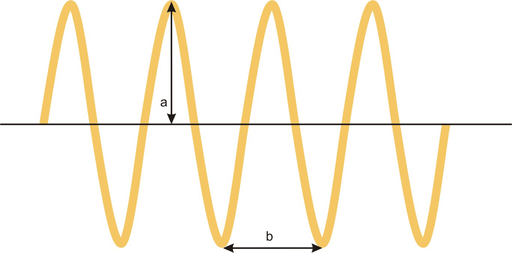
Energy can be transferred from one medium to another through _________.
vibrations
collision
frequency
nodes

A string is clamped at both ends and plucked so it produces a standing wave as shown above. How many nodes and antinodes are there?
2 nodes, 3 antinodes
3 nodes, 2 antinodes
4 nodes, 3 antinodes
3 nodes, 4 antinodes
The ____________________________ is produced by
the superposition of two progressive waves of
equal in amplitude and frequency, traveling in
opposite direction.
stationary wave
progressive wave
sound wave
constructive wave
What is Node?
Zero displacement
Back and forth displacement
Maximum displacement
Linear displacement
What is two factors that influence sound intensity?
node and antinode
amplitude and distance
string and open pipe
odd harmonics and all harmonics
The equation of a progressive wave is given by y = 0.1 sin (3x + 10t) where y and x are in meters and t in second. The direction of the wave is
leftwards
rightwards
upwards
downwards
The maximum velocity occurs where the ____.
potential energy is a maximum
kinetic energy is a minimum
displacement from equilibrium is equal to the amplitude of 0.4 𝑚
displacement from equilibrium is equal to zero
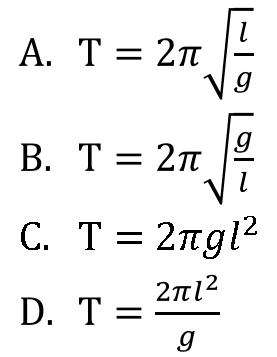
Based on your findings, which equation could best describe the pendulum’s period?
A
B
C
D
A mass M suspended from a string L undergoes SHM. Which of the following is true about the period of oscillations?
The period increases with increasing amplitude
The period increases with increasing mass
The period increases with decreasing length
The period increases with increasing length
Position at which the body would come to rest if it were to lose all of its energy refers to
equilibrium position
maximum displacement / amplitude
periodic position
good position
Torque is analogous to
kinetic energy
linear momentum
force
acceleration
Which of the following linear parameters equivalent to moment of inertia in rotational motion?
Mass
Momentum
Force
Acceleration
The SI unit for angular displacement is
meter
angular acceleration
radian
revolution
What is the Doppler Effect?
A change in frequency due to the relative motion of a wave source and an observer
When a wave overlaps with another wave
When a wave bounces off of another object
When a wave bends due to traveling through a different medium

When an ambulance move TOWARD a stationary observer it sounds ________ pitched.
high
low
medium
same
Which of the following is true about a rotating rigid body
Its centre of rotation is at rest
The centre of rotation is at the centre of mass
All points on the body are moving with the same linear velocity
Every points in the body are movng with the same angular velocity
In a simple harmonic motion, acceleration of a particle is proportional to
Rate of change of velocity
Displacement
Velocity
Direction
The wave number, k is inversely proportional to
Wavelength
Frequency
Energy
Amplitude
The SI unit for intensity of sound is
W-1
m-2
W m-2
W m-1
Which statement is FALSE about sound intensity?
Sound intensity is a scalar quantity.
The unit for sound intensity is watt per squared meter.
Sound intensity is power of sound waves per unit area.
Sound intensity depends on the frequency of the sound waves
The distance between two consecutive troughs or crests is known as
Phase Difference
Period
Wavelength
Frequency

Which of following graphs show the CORRECT variation of sound intensity, I with amplitude of the sound wave, A
B
A
D
C
Which statement is FALSE about progressive wave?
There are no nodes and antinodes.
For a plane waves, all particles are oscillating with the same amplitude.
Neighbouring particles vibrate with the same phases.
Continuous propagation of energy from the source to elsewhere.
Which statement is TRUE about standing wave?
Points on the nodes have maximum amplitude.
Points between two adjacent nodes are in phase.
Every point on the waves has the same amplitude.
Points on the antinodes have the highest frequency.
Which of the following is FALSE about simple harmonic motion?
The period of oscillation is always constant.
The resultant force is directly proportional to the displacement from the equilibrium position.
The acceleration is directly proportional to the displacement from the equilibrium position.
The acceleration is always constant.

