wayground logo

Free Printable Worksheets

Font size

S
M
L
XL
Worksheets

Grade 9 Science Exam Review

Total questions: 60

Worksheet time: 30mins

Name
Class
Date
1.

The living parts of an ecosystem are known as:

a)

Abiotic

b)

Biotic

c)

Biology

d)

Fungus

2.

How many atoms of sodium (Na) are in one molecule of baking soda?

a)

1

b)

2

c)

3

d)

4

3.
What color of star is the hottest?
a)
Blue
b)
Red
c)
Yellow
d)
Orange
4.

A group of similar organisms which are able to breed together and produce fertile offspring are known as:

a)

a population

b)

a community

c)

a species

d)

an ecosystem

5.

When electrons move through a circuit ____________ electricity is created.

a)

current

b)

electron

c)

solar

d)

static

6.
In the food chain, which of the pictures is a PRODUCER?
a)
Sun
b)
Plants
c)
Ladybug
d)
Chicken
7.
Any thing or organism that regulates the size of a population of another organism is known as __________.
a)
a limiting measure
b)
a limiting factor
c)
factorization
d)
materialization of precipitation
8.

What will happen if all of the frogs in a population die?

a)

The frogs' predators will decrease and the frogs' prey will increase

b)

The frogs' predators will increase and the frogs' prey will decrease

c)

Frogs would move in from a nearby pond

d)

This would never happen in a food web

9.

What are some abiotic factors that could be limiting factors in the Iowa River ecosystem?

a)

Temperature, fertilizer runoff from fields, drought or flood

b)

Invasive species, floods

c)

Temperature, predators, droughts, floods, over fishing

10.
The inner energy level can only hold ______ electrons.
a)
1
b)
0
c)
2
d)
18
11.
The characteristics or properties of metals include
a)
shiny and solid
b)
ductile and malleable
c)
lose electrons
d)
all of the above
12.
Which particle does not contribute mass to the atom?
a)
Proton
b)
Neutron
c)
Electron
d)
Nucleus
13.
Which particle contributes the negative charge to the atom?
a)
proton
b)
electron
c)
neutron
d)
nucleus
14.
Water is an element?
a)
true
b)
false
15.
Burning is always a chemical reaction.
a)
True
b)
false
16.

same number of protons, different number of neutrons

a)

atomic number

b)

mass number

c)

isotope

d)

ion

17.
What is the name of baby stars?
a)
Dwarf
b)
Supergiant
c)
Protostars
d)
Nebulas
18.
What is the name for a star pattern that is visible in the night sky?
a)
a meteoroid
b)
a solar system
c)
a star chart
d)
a constellation
19.

______________ are materials that electrical current cannot pass through.

a)

resistors

b)

circuits

c)

conductors

d)

insulators

20.
What do we use to classify the temperature, brightness, and size of stars?
a)
Color
b)
The star's shape
c)
H-R Diagram
21.
Scientists use spectra from stars to determine...
a)
the temperature of a star.
b)
the composition of a star.
c)
the star's distance from Earth.
d)
the star's movement.
22.
Stars that are closer appear to move more than distant stars due to the phenomenon called... 
a)
periphelion
b)
parallel
c)
prism
d)
parallax
23.
If a star is being observed from Earth and it's light has shifted towards the red side of the electromagnetic spectrum it would be...
a)
Moving towards the Earth
b)
Moving away from the Earth
c)
This is a trick question that cannot be answered
d)
It isn't a star, it is a very large strawberry.
24.
How long is Earth's rotation?
a)
one day
b)
one year
c)
one decade
d)
one hour
25.

A ________________ circuit is a circuit in which electrical current can follow only one path.

a)

parallel

b)

series

c)

silver

d)

battery

26.

A ______________ is sometimes added to a circuit, it opens and closes a circuit to turn resistors on and off.

a)

battery

b)

resistor

c)

current

d)

switch

27.
The unit for current is the 
a)
Volt
b)
Ohm
c)
Electron
d)
Amp
28.
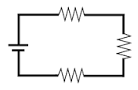
What type of circuit is pictured?
a)
series
b)
parallel
29.
What voltage is needed to cause a 2A current flow through a 10Ω resistor?
a)
5V
b)
0.2V
c)
20V
d)
200V
30.
Lightning is an example of _________.
a)
static electricity
b)
current electricity
c)
watts
d)
voltage
31.

Possible human solutions for limiting global warming and climate change are...

a)

being more energy-efficient

b)

using renewable sources of energy

c)

removing carbon from fossil fuel emissions

d)

all of the above

32.

MAIN greenhouse gas responsible for Climate Change is:

a)

nitrogen

b)

carbon

c)

carbon dioxide

d)

methane

33.

Which natural process removes carbon dioxide from the atmosphere?

a)

forest fires

b)

volcanic eruptions

c)

cellular respiration

d)

photosynthesis

34.

Which of the following have been changed or altered due to climate change ?

a)

droughts

b)

flooding

c)

melting of polar ice caps

d)

all of the above

35.

What is the process during which water evaporates from the leaves of plants and trees and goes up into the atmosphere as water vapor.

a)

Condensation

b)

Runoff

c)

Precipitation

d)

Transpiration

36.
Which of the following describes the role of nitrogen-fixing bacteria in the nitrogen cycle? Nitrogen-fixing bacteria convert
a)
nitrates intro nitrogen gas
b)
ammonia into proteins
c)
nitrogen gas into ammonia
d)
proteins into nitrates
37.

What step of the water cycle is shown in this picture?

a)

Condensation

b)

Runoff

c)

Precipitation

d)

Evaporation

38.
Animals obtain the nitrogen they need directly from the
a)
soil in their habitat
b)
air they breathe
c)
plants they eat
d)
bacteria living within them
39.

Why does cutting down trees increase global warming?

a)

trees soak up carbon dioxide and removing them causes more carbon to stay in the atmosphere

b)

trees provide shade which counteracts global warming

c)

trees absorbs the sun's energy without radiating back into the atmosphere

d)

trees drain greenhouse gases like methane from soil

40.
Bacteria fix nitrogen on plant roots. Plant roots provide sugar to bacteria. This is an example of
a)
mutualism
b)
parasitism
c)
commensalism
d)
competition
41.
Carbon can be found in...
a)
The atmosphere
b)
Soil
c)
Fossil fuels
d)
All of the above
42.

This reservoir of carbon is all the water on Earth including in the clouds, oceans, rivers, streams, and underground water supplies.

a)

Atmosphere

b)

Biosphere

c)

Hydrosphere

d)

Lithosphere

43.

Which scientist was the first person responsible for proposing the idea of atoms?

a)

Democritus

b)

John Dalton

c)

Ernest Rutherford

d)

J.J. Thomson

e)

Niels Bohr

44.

Which scientist was the first person responsible for proposing the discovery of the electron?

a)

Democritus

b)

John Dalton

c)

Ernest Rutherford

d)

J.J. Thomson

e)

Niels Bohr

45.

Which scientist's model is referred to as the Planetary model?

a)

Democritus

b)

John Dalton

c)

Ernest Rutherford

d)

J.J. Thomson

e)

Niels Bohr

46.

What symbol does Magnesium have?

a)

Mg

b)

Na

c)

M

d)

Mo

47.

Which group of the periodic table corresponds with the noble gases.

a)

10

b)

14

c)

16

d)

18

48.

The vertical (up and down) columns in the Periodic Table are called

a)

groups

b)

towers

c)

periods

d)

atomic numbers

49.

The elements shaded blue are called 

a)

metals

b)

nonmetals

c)

metalloids

d)

noble gases

50.

A solution looks the same throughout and is known as which type of mixture?

a)

Homologous

b)

Heterogenous

c)

Homogenous

d)

Elemental

51.

Moon Phases

a)
The moon phases are caused by the Earth's shadow
b)
The moon phases are caused by the Sun's shadow
c)
The moon phases are caused by the rotation of the moon
d)
The moon phases are caused by the alignment of the Earth, Moon, and Sun
52.

Solar Eclipse

a)
The moon passes between the sun and earth
b)
The earth passes between the sun and moon
c)
The sun passes between the earth and moon
d)
The earth, moon and sun are in a straight line
53.

Nebula

a)
A type of star
b)
A type of galaxy
c)
A type of planet
d)
A cloud of gas and dust in outer space
54.
Ancient Greeks believed, the earth to be the centr of the universe. What do we call this model?
a)
Ptolemic System
b)
Geocentric Universe
c)
Heliocentric Universe
d)
Copernican Model
55.
Astronomer Johannes Kepler...
a)
Published Almagest
b)
Invented the first Radio Telescope
c)
Suggested elliptical orbits for the planets
d)
Was made head astronomer for the Church
56.

If two objects are attracted...

a)

They are both positively charged.

b)

They are both negatively charged.

c)

One is positive and one is negative.

d)

They are both neutral or no charge.

57.
Rubbing a balloon on hair is an example of static charge build up created by....
a)
conduction
b)
friction
c)
induction
d)
hairduction
58.

Ms Phong rubbed two balloons with a piece of wool. What will happen when the balloons are brought near each other?

a)

The balloons will repel each other.

b)

The balloons will attract each other.

c)

The balloons will become positively (+) charged.

d)

The balloons will pop.

59.
a)

conduction

b)

induction

c)

friction

60.
What do we use astronomical units to measure?
a)
distances in our solar system
b)
How far our solar system is from others in our galaxy.
c)
The distances between galaxies. 
d)
The distance from one side of the universe to the other.