
 Worksheets
Islam Test Review (Includes Byzantine Questions)
Total questions: 63
Worksheet time: 45mins
Emperor Justinian revised the Roman laws which then became known as?
Justinian's Code
Hammurani's Code
The Da Vinci Code
Chaussard's Code
What issue was part of a bitter conflict between the Easter Christian Church and Western Christian Church?
Language Differences
Byzantine Emperors acceptance of authority of the Pope
the Roman Church's rejection of Justinian's code
None of the choices
Under the rule Justinian, the Byzantine Empire
expanded to its greatest extent (size)
was reduced in size
replaced Roman law with Muslim law
Which statement is true about the city of Constantinople?
It sat at the location of many trade system
It was able to prosper despite having no harbord
It cut all cultural ties with Rome
A form of art made from small pieces of stone, glass and/or title is better known as
Mosaic
Mural
Portrait
Sculpture
What was Justinian's main goal?
He wanted to restore the Old Roman Empire
He wanted to restore Alexander the Great's Empire
He wanted to spear Islam
He wanted to clear Bosporus
What area did Byzantine missionaries spread Orthodox Christianity to?
Russia
Turkey
Gaul
The Alps
The city of Constantinople was in key location on the strait that links the Mediterranean Seas with the _______.
Black Sea
Red Sea
Sea of Azov
Aegean Sea
Missionaries brought their religion to Slavic land. They aslo brought:
Cryllic Alphabet
Latin Alphabet
Greek Fire
Furs
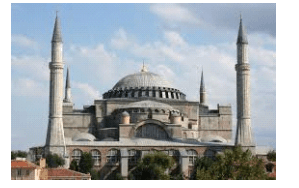
What is the Hagia Sophia?
A church
A castle
A towering statue
Shrine to Sophia I
What ruler of the Kievan Rus converted the nation to Christianity?
Vladimir the Great
Oleg
Justinian I
Drago the Bear
What empire did much of the laws of the Kievan Rus come from?
The Byzantine Empire
The Roman Empire
Norway
Aksum
The form of Christianity that developed in the Byzantine Empire became known as ___________.
Eastern Orthodox
Roman Catholic
Western Church
Judaism
The Byzantine capital was strategically located
where Europe meets Asia
on the Rhine River
South of the Might Tuna
between the Baltic Sea and the Black Sea
In 1054, a schism, or complete break, separated
the Eastern and Western Churches
The South Slaves
Greeks and Byzantines
Browns with Cleveland
The language used by the later Byzantine emperors was
Latin
Persian
Greek
Slavic
The Justinian code is considered a milestone because it
served as the model of European legal system
preserved many ancient Chinese legal decrees in writing
became the first democratic constitution
united Muslim and Roman worlds
Which of the following issues divided the Western and Eastern Churches?
practices of animal sacrifices
practices such as scalping
authority of the pope
belief in Jesus

Which group conquered Constantinople?
Persians
Huns
Ottoman Turks
Carthage

Which answer replaces the question mark?
Code of Justinian
Icons
10 Commandments
Hammurabi's Code


Who was the first emperor to convert to Christianity?
Justinian
Constantine
Theodora
Diocletian
Characteristics of the Eastern Church?
centered in Constantinople
close to capital (seat of power)
Greek language in liturgy (church service)
Latin language used in liturgy (church service)
Characteristics of the Western Church?
centered in Constantinople
centered in Rome
Greek language in liturgy (church service)
Latin language used in liturgy (church service)
Leader of the Eastern Church was called:
Patriarch
Pope
Pastor
Father
Leader of the Western Church was called:
Patriarch
Pope
Pastor
Father
Which Russian Czar (Tsar) threw off Mongol rule?
Ivan the Great
Justinian
Constantine
Mrs. Jones
Who is the founder and last prophet of Islam?
Abraham
Jesus
Muhammad
Siddhartha Gautama
What belief is shared by Jews, Christians, and Muslims?
Jesus is the son of God
Monotheism: there is only only God
Polytheism: there are plenty of gods
Muhammad is the last prophet
Islam began in Mecca on the ___________________.
Italian Peninsula
Arabian Peninsula
Balkan Peninsula
Iberian Peninsula
In the Islamic Empires, which language helped trade and encouraged innovations?
Arabic
Latin
Greek
Hindi
The list of basic acts and requirements for Muslims is called the:
Ten Commandments
Four Noble Truths
Eightfold Path
Five Pillars of Islam
According to Islam, the word of Allah (God) is written in the:
Bible
Qur'an (Koran)
Torah
Upanishads
After the prophet Muhammad's death, Islam spread ___________ to other places in Asia, North Africa, and Spain.
quickly
slowly
Which of these cities did Muslims not conquer and control?
Damascus
Baghdad
Jerusalem
Tours
Which scientific contribution was not from the Muslims?
Algebra
Arabic Numerals
Medical advancements
Silk
To preserve classical knowledge and to conduct further research, Muslim scholars translated ancient texts to Arabic and started some of the first...
Universities
Science labs
The cause of the Sunni/Shi'a split in Islam after Muhammad's death was a difference of opinion about—
prayer
expansion
gods
leadership


Which religion encourages followers to take a pilgrimage to this site?
Hinduism
Buddhism
Islam
Christianity

How did the area labeled on the map impact the spread of Islam?
It is the location of the Islamic capital during the Abbasid dynasty
It is the location of a major Islamic victory in Western Europe
The location marks the end of Islamic advancement into Western Europe
The location marks the location of a major Islamic city in Western Europe
Muslims greatest contribution to Western civilization was:
Using vaults and domes
Discovering that rays pass from objects to the eyes
Writing an encyclopedia of geography
Preserving and advancing knowledge from previous cultures

Which civilization created this architectural structure?
Egyptian
Roman
Islamic
Greek
What two empires were weak and as a consequence could not resist the influence of the Muslim rule?
Byzantine and Roman Empires
Byzantine and Persian Empires
Persian and Ottoman Empires
Persian and Greek Empires

What best fits the shaded area of the table?
Politics
Slavery
Code of Law
Architecture

