wayground logo

Free Printable Worksheets

Font size

S
M
L
XL
Worksheets

1.Quiz- Ch 7 Foundations of Chemistry

Total questions: 50

Worksheet time: 50mins

Name
Class
Date
1.

1. What is a compound?

a)

a) Several elements that have chemically bonded together

b)

a) Any substance with more than two atoms

c)

a) Any chemical process involving oxygen

d)

a) One element consisting of chemically bonded atoms

2.

What is the classification of mixture?

a)

pure substance

b)

compound and element

c)

homogeneous and heterogeneous

d)

compound and homogeneous

3.

An _______________ is made up of one or more of the same kind of atom chemically combined.

a)

atom

b)

molecule

c)

element

d)

compound

4.

A _____________ contains a variety of elements and compounds that are not chemically combined with each other.

a)

compound

b)

molecule

c)

element

d)

mixture

5.
What is matter?
a)
anything that has mass and takes up space
b)
a substance that consists of one type of atom
c)
a small particle that is a building block 
d)
the amount of mass per unit volume
6.
The melting point refers to
a)
the point at which a liquid turns into a gas.
b)
the point at which a solid turns into a liquid.
c)
a substances ability to conduct thermal electricity.
d)
the amount of space something takes up.
7.
Which of the following is an example of a size-dependent physical property?
a)
volume
b)
state of matter
c)
conductivity
d)
boiling point
8.
Which of the following terms best describes a change in shape, size, form, or state of matter in which the identity of the substance stays the same?
a)
chemical change
b)
element
c)
physical change
d)
conductivity
9.
What happens to the particles in a substance when thermal energy is removed?
a)
the particles move faster
b)
the particles speed does not change
c)
the particles move slower
10.
The ________________ is best described as particles are neither created nor destroyed during a physical or chemical change.
a)
Law of Conservation of Mass
b)
Chemical Reaction
c)
Chemical Equation
d)
Change in Thermal Energy
11.
A _______________ is a characteristic of matter that can only be observed when a substance becomes a different substance.
a)
chemical property
b)
chemical equation
c)
chemical change
d)
chemical reaction
12.
Which of the following is an example of a balanced equation?
a)
Na + 2Cl -> NaCl
b)
2Fe + S -> Fe2S
c)
CO2 + H2O -> CH4 + 2O2
d)
H2 + O2 -> H2O
13.
What particles of an atom are found in the nucleus?
a)
proton and electron
b)
electron and neutron
c)
proton and neutron 
d)
protons only
14.
Which of the following is a size-independent property?
a)
boiling point
b)
density
c)
magnetism
d)
all are size-independent properties
15.
What physical property can you use to separate a salt water solution?
a)
mass
b)
density
c)
magnetism
d)
boiling point
16.
 What is a sign that a chemical change has occurred?
a)
Size
b)
Shape
c)
Smell/Odor
d)
State of Matter
17.
Which of the following is showing conservation of mass?
a)
2CH4+2O2  > 2CO2+2H2O
b)
CH+ O2 --> CO2 + H2O
c)
CH+ 2O2 --> CO+ 2H2
d)
CH+ 2O--> 2CO+ 2H2O
18.
Which of the following is an example of a physical change?
a)
Burning
b)
DIssolving
c)
Rotting (fruit going bad)
d)
Rusting (like an old car)
19.

One example of a chemical change is

a)

filtering

b)

burning wood

c)

boiling water

d)

crushing a can

20.

Table sugar and table salt are examples of

a)

atoms

b)

elements

c)

mixtures

d)

pure substances

21.

The measurement of how much matter an object contains is its

a)

volume

b)

weight

c)

mass

d)

melting point

22.

All elements are composed of extremely small particles called

a)

compounds

b)

mixtures

c)

atoms

d)

molecules

23.

Which of the following is NOT an example of a chemical change?

a)

gas burning on a stove

b)

rust forming on an iron fence

c)

salt dissolving in a glass of water

d)

using electricity to break down water into hydrogen and oxygen

24.

Anything that has mass and takes up space is called

a)

matter

b)

energy

c)

heterogeneous

d)

homogeneous

25.

Lemonade consists of several substances that are NOT chemically combined, so lemonade is classified as a(n)

a)

element

b)

compound

c)

mixture

d)

pure substance

26.

How do liquid water, ice, and water vapor differ from each other?

a)

they are different states of matter

b)

they are different compounds

c)

they are made of different kinds of molecules

d)

they are made of different kinds of atoms

27.

Which contains only elements?

a)

A

b)

B

c)

C

d)

D

28.

Which contains a pure substance? (Choose all)

a)

A

b)

B

c)

C

d)

D

29.

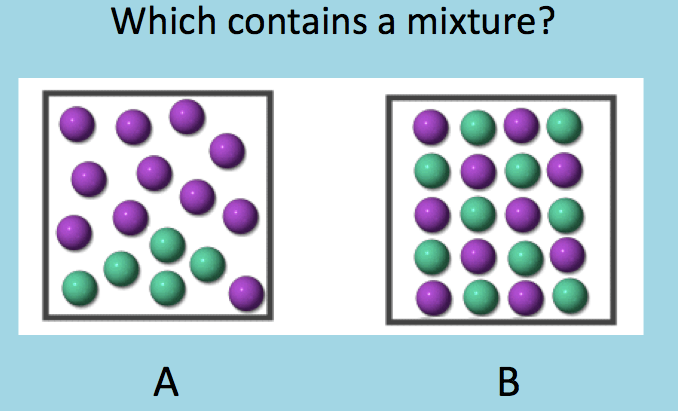
Which contains a mixture? (Choose all)

a)

A

b)

B

30.

Which contains a solid? (Choose all)

a)

A

b)

B

c)

C

d)

D

31.

Which contains a pure substance? (Choose all)

a)

A

b)

B

c)

C

d)

D

32.

Which is a heterogeneous mixture? (Choose all)

a)

1

b)

2

c)

3

d)

4

33.

In this diagram, X represents...

a)

A compound

b)

A mixture

c)

An atom

d)

An element

34.

In this diagram, Y represents...

a)

An element

b)

A molecule

c)

A compound

d)

A mixture

35.

___________________ are mixtures that have a uniform or same appearance throughout it.

a)

Heterogenous mistures

b)

Homogenous mixtures

c)

Solution mixtures

d)

Pure mixtures

36.

________________ are mixtures that have different parts that can be seen.

a)

Solution mixture

b)

Pure mixture

c)

Homogenous mixture

d)

Heterogenous mixtures

37.

A substance that is formed as the result of a chemical reaction is a __________________

a)

Product

b)

Reactant

c)

Starters

d)

Enders

38.
a copper penny turning greenish after a few years.
a)
Chemical Change
b)
Physical Change
39.

Which equation is balanced?

a)

PbO2 + 2H2--> H2SO4

b)

SO2 + H20 --> H2SO4

c)

2Na + 2H2O --> 2NaOH + H2

d)

2Na + 2H2O --> 2NaOH + H

40.
Balance this equation.
_Mg + _Cl--> _MgCl2
a)
1, 2,1
b)
already balanced
c)
2,1,1
d)
1,1,2
41.
In chemical reactions, what does the principle of conservation of mass mean?
a)
Matter is not created or destroyed.
b)
The total mass of the reactants is greater than the total mass of the products.
c)
The total mass of the reactants is less than the total mass of the products.
d)
Matter is not changed.
42.
At the end of chemical reactions, what is the total mass of the reactants compared to the total mass of the products?
a)
the product is doubled
b)
the product is half the mass of the reactants
c)
the mass is the same
d)
the mass changes depending on the reaction
43.
The substances at the beginning of a chemical equation are called the ____
a)
product
b)
yield
c)
chemical symbol
d)
reactants
44.

Identify the change shown in the picture.

a)

Irreversible physical change

b)

Irreversible chemical change

c)

reversible physical change

d)

reversible chemical change

45.

Which of the following is a example of physical change ?

a)

burning of wood

b)

photosynthesis

c)

melting of ice-cream

d)

ripening of fruit

46.

What does the picture represent ?

a)

physical change

b)

chemical change

47.

Is this an example of a physical or chemical change?

a)

physical

b)

chemical

48.
A __________ is a mixture that is formed when a solid is dissolved in a liquid.
a)
Chemical compound
b)
Solution
c)
Endothermic reaction
d)
Exothermic reaction
49.

How to separate salt and water?

a)

Decantation

b)

Filtration

c)

Evaporation

d)

Sieving

50.

How to separate needles and toothpicks?

a)

Decantation

b)

Distillation

c)

Magnetic Attraction

d)

Sieving