
 Worksheets
Pre UPS 3 DP014
Total questions: 37
Worksheet time: 53mins
What is the basic unit of Work?
kgm2s-2
kgms-2
kgms-1
kgm2s-3
Work is the ................ of force and displacement.
multiplication
cross product
dot product
division
From equation of W = F s cosθ, θ refers to the angle .....
from vector F to y axis
from vector F to x axis
from vector s to x axis
between vector F and vector s
Graphically, work of an object can be determine by refering the ....... of graph force-displacement.
x interception
y interception
gradient
area
Which requires more work – a person walking up stairs or a person running up stairs?
walking
running
they require equal work
no work is required for either because the movement is vertical

A light plastic cart and a heavy steel cart are both pushed with the same force for a distance of 1.0 m, starting from rest. After the force is removed, the kinetic energy of the light plastic cart is ________ that of the heavy steel cart.
greater than
equal to
less than
can't say unless we know how big the force is
This theorem states, "Whenever work is done, energy changes.
Work-Energy Theorem
The principle of conservation of energy
Newton's law of motion
The principle of conservation of momentum
Work is equal to ....
potential energy
kinetic energy
the change of kinetic energy
the rate of change of kinetic energy
Mechanical energy consists of .............. and ...............
heat, sound
kinetic energy, potential energy
gravitational potential energy, elastic potential potential energy
compression, rarefaction
The SI unit for energy is .....
Newton
Joule
Pascal
Watt
Choose incorrect statements about energy.
Energy cannot be created.
Energy cannot be distroyed.
Energy cannot be transformed into other type of energy.
energy obeys the conservation principle.
Normally, energy 'lost' to the surronding in the form of ....
heat
sound
kinetic
potential
If a system is isolated, the total energy of the system
Increases constantly.
Decreases constantly.
Is constant.
Depends on the work done on the system.
Depends on the work done by the system.

Rank in order, from largest to smallest, the gravitational potential energies of the balls.
1 > 2 = 4 > 3
1 > 2 > 3 > 4
3 > 2 = 4 > 1
3 > 2 > 4 > 1
A major league pitcher can throw a baseball with a kinetic energy of 150 J. How much work must the pitcher do to the ball to give it that much KE?
150 J
0
Can’t tell without knowing the mass of the ball

_________ moving or tending to move toward a center.
centripetal force
centrifugal force
speed
velocity
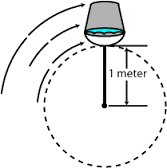
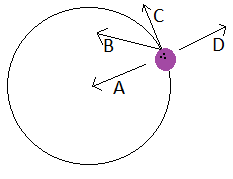
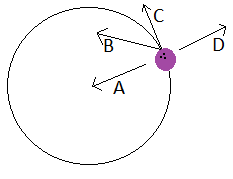
Which of the following represent the possible direction for speed of the moving ball in a circular motion?
A
B
C
D
Which of the following is not true about origin of centripetal forces?
When a aircraft banks to move in a horizontal circle, the vertical component of lift provides the centripetal foce.
A bicycle tilts to side when cornering so that the horizontal component of normal reaction provides the centripetal force.
Gravitation force by the Sun on Mars causes Mars to orbit about the Sun.
In a conical pendulum, the horizontal component of the tension in string provides the centripetal focre.

What is the angular speed of the hour hand in a clock?
(π/12) rad h−1
(π/24) rad h−1
(2π/12) rad h−1
(2π/60) rad h−1

Why do objects experience centripetal acceleration even though they can have a constant speed?
Because they are speeding up as they move in a circle
Because they are constantly changing direction and hence, velocity changes, and that net change is directed inward.
Because they are constantly changing both speed and direction
Because when you have 100 people pedaling, you can speed up more easily.
Which of the following definitions is correct?
Angular displacement is the rate of change of velocity.
Angular displacement is the rate of change of angular velocity.
Angular velocity is the rate of change of displacement.
Angular velocity is the rate of change of angular displacement.
"Angle undergoes from a fixed reference line" this statement refer to
Average angular velocity, 𝝎_𝒂𝒗
Angular displacement,𝜽
Instantaneous angular velocity, 𝝎
angular acceleration

The _______________________ supplies the centripetal force requirement for the car to move in a horizontal circle. Without it, the car would turn its wheels but would not move in a circle (as is the case on an icy surface).
friction force
centrifugal force
normal force
applied force

In this diagram, what do the red arrows represent?
the acceleration vector
the velocity vector
the centripetal force vector
the force of gravity
If an object is spinning around on a string and the string was suddenly cut, the object would move in a
curved path
straight line

