
Font size
 Worksheets
Thermal Energy Unit
Total questions: 62
Worksheet time: 38mins
Heat always moves from ____________ objects to ______________ objects.
Heat transfer stops when the objects have the same temperature.
When molecules slow down their movement, the ________________
space between them increases making the substance contract.
space between them increases making the substance expand.
space between them decreases making the substance contract.
space between them decreases making the substance expand.
When matter cools, its molecules ________________
speed up
move slower
become more disorganized
collect the coldness from its surroundings.
The expanding of matter when it is heated is known as
condensation
evaporation
thermal expansion
vaporization
If the atoms of an object are moving or vibrating slow, the object would feel...
If the atoms of an object are moving or vibrating fast, the temperature would be...
What is Thermal Contraction
A Potato
A decrease in a material's volume when its temperature decreases
The movement of fluids in a cycle because of convection
A material through which thermal energy does not flow easily.
Objects gain heat and _________. (Except for when ice melts into water)
expand
contract
it gains heat from the hot water by conduction and expands.
loses heat from the hot water by conduction and contracts.
Thermal expansion occurs when particles of matter move farther apart as temperature increase.
True
False

In a hand boiler the main reason the liquid moves around is because when heat from your hand is transferred to the boiler, ___________.
The liquid inside heats up and flows upwards.
The gas inside expands and pushes the liquid to the other side.
The solid inside melts and its liquids flows upward.

When temperature decreases, distance between molecules ____________.
increases
decreases
stays the same
Expansion joints save bridges from destruction by preventing any expansion from occurring.
True
False
When the teacher asks their students about how a hot air balloon works, they expect a very brief answer (1 sentence).
True
False
The type of heat transfer that happens through a substance by direct contact is ___________________.
Convection
Conduction
Radiation
Insulation
The kind of heat transfer that travels through space in electromagnetic waves is ______________________.
Insulation
Radiation
Conduction
Convection
___________________ is the type of heat transfer that occurs in fluids (liquids and gases), such as warm air rising and cold air sinking; creating wind.
Convection
Conduction
Radiation
Insulation
Which statement is true?
If the molecules are moving faster, the matter is colder.
If the molecules are moving slower, the matter is warmer.
If the molecules are moving faster, the matter is warmer.
The movement of molecules don't affect temperature
When you use a microwave, what is the main way that heat is transferred?
Convection
Conduction
Radiation
Insulation
The handle of a metal spoon warms up when it is placed in a hot bowl of soup because of
Convection
Conduction
Radiation
Insulation
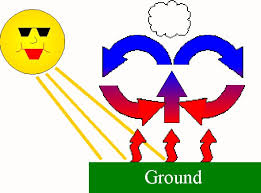
Warm air rises and the cool air sinks demonstrates this type of heat transfer.
conduction
convection
radiation
insulation
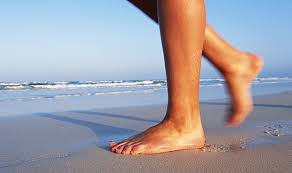
Walking on the warm sand sand with your bare feet demonstrates this type of heat transfer.
conduction
convection
radiation
insulation

A group of friends gather around a fire to stay warm.
conduction
convection
radiation
insulation
You get sunburned due to __________ from the sun.
conduction
convection
radiation
insulation

The candle will slowly heat the metal and transfer the heat directly to the man's hand. The heat transfer from the end of the metal to the hand is ______________.
conduction
convection
radiation
insulation
A chair is placed several feet from a fireplace. The fireplace has a glass screen. The side of the chair facing the fireplace gets warm because of
conduction
convection
radiation
insulation
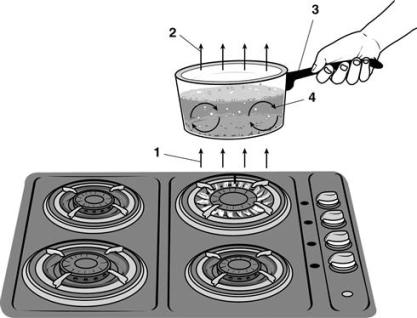

A winter jacket is a good example of a(n) . . .
Insulator
thermal conductor
thermal convector
radiator
Lighter colors are known for ________ heat transfer by radiation while dark colors are known for ________ heat transfer by radiation.
decreasing, increasing
increasing, decreasing
increasing, not affecting
not affecting, decreasing
___________________ is the type of heat transfer that occurs by the movement of a gas or liquid.
Convection
Conduction
Radiation
Insulation
Which state of matter takes the shape of its container and the volume of its container?
Solid
Liquid
Gas
All of these
Which state of matter takes the shape of the bottom of its container and has definite volume?
Solid
Liquid
Gas
All of these
A gas has __________________. Check all that apply
A lot of space between particles
Particles with no definite pattern to their locations.
Very little space between particles
Particles that hold a very definite pattern to their locations.
Particle that bounce all over the place at high speed.
When ________ water is placed on top of ________ water, convection will clearly be demonstrated very quickly. Choose all that apply.
hot, cold
cold, hot
cold, cold
hot, hot
Compared to solids and liquids, gases have ___________
more kinetic energy on average
less kinetic energy on average
the same amount of kinetic energy on average
no kinetic energy


When the lab or test asks you to explain a thermal energy (heat) transfer process, a very brief answer or phrase is expected.
True
False
Lighter colors are known for _______ radiation while dark colors are known for ________ radiation.
reflecting, absorbing
absorbing, reflecting
reversing, creating
creating, reversing

The graph shows the temperature of H2O in a container. When is it all liquid water?
between points A and B
between points B and C
between points C and D
between points B and E
The graph shows the temperature of H2O in a container. When is it a mixture of liquid water and steam?
between points D and E
between points B and C
between points C and D
between points C and E
The graph shows the temperature of H2O in a container. When is it only solid ice with no liquid water or steam?
between points A and B
between points B and C
between points C and D
between points A and C

