
 Worksheets
Energy & Phase Changes Unit Review
Total questions: 30
Worksheet time: 23mins
An increase in the temperature of a liquid in a closed container _____
decreases the vapor pressure of the liquid.
has no effect on the kinetic energy of the liquid.
causes the vapor pressure above the liquid to increase.
causes fewer particles to escape the surface of the liquid.
How can the boiling point of water be changed to 105°C?
By increasing the amount of heat.
By decreasing the amount of water.
By increasing the air pressure on the water.
By decreasing the air pressure on the water.
Which one of the following decreases as the strength of the attractive forces between molecules increases?
The vapor pressure of the liquid.
The normal boiling point.
The normal melting point.
The heat of vaporization.

In the image, line D represents water. If the pressure is 70 kPa, water would boil at what temperature?
32°C
70°C
92°C
100°C
Given below are the temperatures at which two different liquids have a vapor pressure of 400 mmHg:
Compound Z 64°C
Compound X -38°C
Which of the following statements is TRUE?
The intermolecular attractive forces are stronger in X than in Z.
Increasing the temperature will increase the vapor pressure of both liquids.
The normal boiling point of X will be higher than the normal boiling point of Z.
All the above.
A liquid placed in a closed container will evaporate until equilibrium is reached. At equilibrium which of the following statements is TRUE?
Once equilibrium is reached, the number of vapor molecules slowly decreases.
The number of vapor molecules remains essentially constant after equilibrium is reached.
At equilibrium, the reason the volume of the liquid remains constant is that the molecules have stopped evaporating.
None of the choices are true.
Xenon is a gas at room temperature, 25°C. Which of the following is most likely the boiling point of xenon gas (Xe)?
200°C
100°C
40°C
-190°C
Which process is taking place when the deposition of CO2 (carbon dioxide) gas occurs?
An endothermic process.
Neither endothermic nor exothermic.
Both endothermic and exothermic.
An exothermic process.

Which image most likely represents a liquid?
A
B
C

Refer to the Heating curve shown for Substance X. What is the freezing point of X?
-60°C
60°C
-100°C
0°C
Refer to the Heating curve shown for Substance X. What phase(s) is/are present between points C and D?
Solid and liquid
Liquid and gas
Liquid only.
Gas only.
Refer to the Heating curve shown for Substance X. How and why is the energy being affected between points A and B?
The energy is being released because it is going through an exothermic process.
The energy is being released because it is going through an endothermic process.
The energy is being absorbed because it is going through an exothermic process.
The energy is being absorbed because it is going through an endothermic process.

In the image shown, which section of the graph would one use Q=mHf to calculate the amount of heat lost during a phase change?
B-C
E-F
B-A
C-B

Refer to the Heating Curve for Substance X. Which statement correctly describes the energy of the particles during interval B-C?
Potential energy increases, and the average kinetic energy increases.
Potential energy decreases, and the average kinetic energy increases.
Potential energy remains the same, and the average kinetic energy increases.
Potential energy increases, and the average kinetic energy remains the same.

Referring to the Phase Diagram for Substance X, what phase(s) are present at 90°C and 0.5 atm?
Liquid and gas
Solid
Liquid
Gas
Referring to the Phase Diagram for Substance X, what is the normal boiling point for substance X?
45°C
60°C
100°C
110°C
Referring to the Phase Diagram for Substance X. If the temperature is held constant at 70°C, what happens if pressure is increased from 0.5 atm to 1.0 atm?
Substance X will change from a gas to a liquid.
Substance X will change from a liquid to a gas.
Substance X will change from a solid to a liquid.
Substance X will change from a liquid to a solid.

Referring to the image, if the pressure is held constant at 0.5 atm and the temperature is increased from 25°C to 85°C, _____
the substance will vaporize.
the substance will melt.
the triple point will move.
the substance will freeze.
Vaporization is a phase change that is _____
endothermic because a substance must absorb energy to change from a solid to a liquid.
endothermic because a substance must absorb energy to change from a liquid to a gas.
exothermic because a substance must release energy to change from a liquid to a solid.
exothermic because a substance must release energy to change from a liquid to a gas.
Determine the number of joules needed to raise the temperature of 10 g of ethanol from 25°C to the gaseous phase at 79°C. Use the following information:
Melting point = -117°C Boiling point = 79°C Specific heat 2.50 J/g°C
Heat of fusion = 100 J/g Heat of vaporization = 850 J/g
1350 J
8500 J
9850 J
7150 J
Use the following information to determine many joules are required to convert 25.0 g of ice at 0°C to steam at 100°C?
Melting point = 0°C Boiling point = 100°C Specific heat = 4.18 J/g°C Heat of fusion = 334 J/g Heat of vaporization = 2260 J/g
56500 J
10450 J
8350 J
8x10⁴ J
How many Joules are needed to release 100 grams of liquid water at 100°C to 0°C degrees?
Specific Heat of Water = 4.18 J/g C Q = mcΔT
-20000 J
-100 J
-41800 J
-53440 J
A student was completing a lab about heat transfer in metals compared to that of plastics. The student recorded information about the properties of the metals and plastics. Which of the following intensive properties would best determine which material is the best conductor?
Specific heat
Denisty
Mass
Color

An 18.0 g piece of an unidentified metal was heated from 21.5°C to 89.0°C. 292 J of heat energy was absorbed by the metal during the heating process. Using the information in the image, what is the identity of the metal?
Calcium
Iron
Copper
Silver
What is the phase change that describes water collecting on the side of a glass when it is filled with iced tea?
Vaporization
Sublimation
Evaporation
Condensation
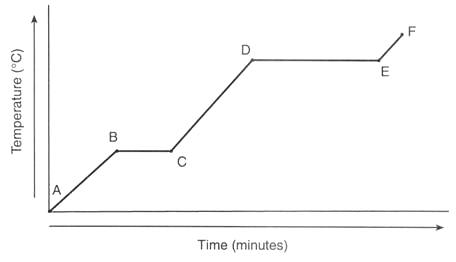
Between which points in the image does the temperature of the substance remain constant?
A-B only.
A-B, C-D, E-F
B-C only.
B-C, D-E
Melting and freezing occur at the same temperature.

A substance's heating curve is shown in the graph. What is its boiling point?
100°C
60°C
80°C
20°C

What phase change is occurring between points B and C if the graph is exothermic?
melting
freezing
boiling
condensation


