
 Worksheets
Periodic table review
Total questions: 50
Worksheet time: 25mins
What are the vertical columns on the periodic table called?
groups
periods
protons
valence electrons
how high I can jump

Which 2 atoms should be in the same group?
atom 1 and 2
atom 3 and 4
atom 1 and 4
atom 2 and 3
Which of the following is the special property of group 18?
They are all reactive metals
They are all stable metals
They chemically stable gases
They are a mix of reactive gases and solids
Nothing cause they are lame
Which particle of an atom or element will determine how it reacts with other elements or atoms?
protons
neutrons
electrons
valence electrons
The mood it's in that day
Which element would have similar properties as Nickel (Ni)?
Copper
Cobalt
Palladium
Strontium
Being worth 5 cents
Which element has similar properties as Phosphorus but has a larger atomic mass?
Nitrogen
Sulfur
Silicon
Arsenic
It's rude to ask an element about it's mass
Which element on the periodic table has 45 protons?
Scandium
Rhodium
Rhenium
Cesium
Which element is in group 18 and period 4?
Krypton
Argon
Xenon
Bromine
Kryptonite
How many protons would an atom of Zinc (Zn) have?
29
30
69
63
How many neutrons would an atom of Copper (Cu) have?
29
63
32
35
How many electrons would an atom of Gold (Au) have?
79
65
35
0
The atomic number tells us the number of ____________?
Neutrons
Protons
Electrons
Atoms
Elements in the same family have similar _______________.
Protons
Physical and Chemical Properties
Shape
Size
Last names
A table of elements arranged by the number of protons and other characteristics is called _______________
The Periodic Table
The Element Table
The Atom Table
The Chemical Table
The Picnic Table
Nonmetals that are fully inert and have very low reaction rates are called ______________
Halogens
Noble gases
Alkali Metals
Carbonic gases
A ________________________ is an electron located in the outer most shell.
Valkyrie electron
Halogen electron
Noble electron
Valence electron
Which family of elements are the most reactive?
Alkali Metals
Alkaline Earth Metals
Halogens
Noble Gases
My nextdoor neighbors
Which family of elements is the least reactive?
Alkali metals
Alkaline Metals
Halogens
Noble Gases
The __________________ of an element is the tendency to combine with other atoms & release energy.
Alkaline
Valence electrons
Periodic stability
Reactivity
How needy it is
A row on the periodic table is called?
Period
Group
Family
Element
Families or Groups are the vertical columns on the periodic table. How many Families/Groups are there?
18
7
12
32
The atomic mass is the ______________ + ____________ in the atom.
neutrons + electrons
protons + electrons
protons + neutrons
peanut butter + jelly
Metals are ___________.
Good Conductors of heat and electricity
Noble Gases
Bad Conductors of heat and electricity
Sometimes a gas
A type of rock music
Non-Metals are found ____________________.
To the left of the zig zag
To the right of the zig zag
Includes only the elements touching the zig zag
Metalloids have ___________________
Only properties of a metal
Only properties of a non-metal
Can have properties of both metals and non-metals
Cool alien technology
Ductile means and material can be drawn into a wire. Which type of element can do this?
Metals
Non-Metals
Metalloids
The ones in art class
Brittle means easily broken. Which type of element does this describe?
Metal
Non-metal
Metalloid
My heart :(
Periods are the rows of the periodic table. How many are there?
7
18
12
8 including TEAM time
the positively charged subatomic particle contained in the nucleus of an atom
proton
neutron
electron
matter
a subatomic particle, contained in the nucleus of an atom, having the same mass as a proton but no electrical charge
proton
neutron
electron
matter
A negatively charged subatomic particle that orbits the nucleus of an atom and is much smaller than protons and neutrons
proton
neutron
electron
matter
a unique number for each element that equals the number of protons in an atom of that element
element name
element symbol
atomic number
atomic mass

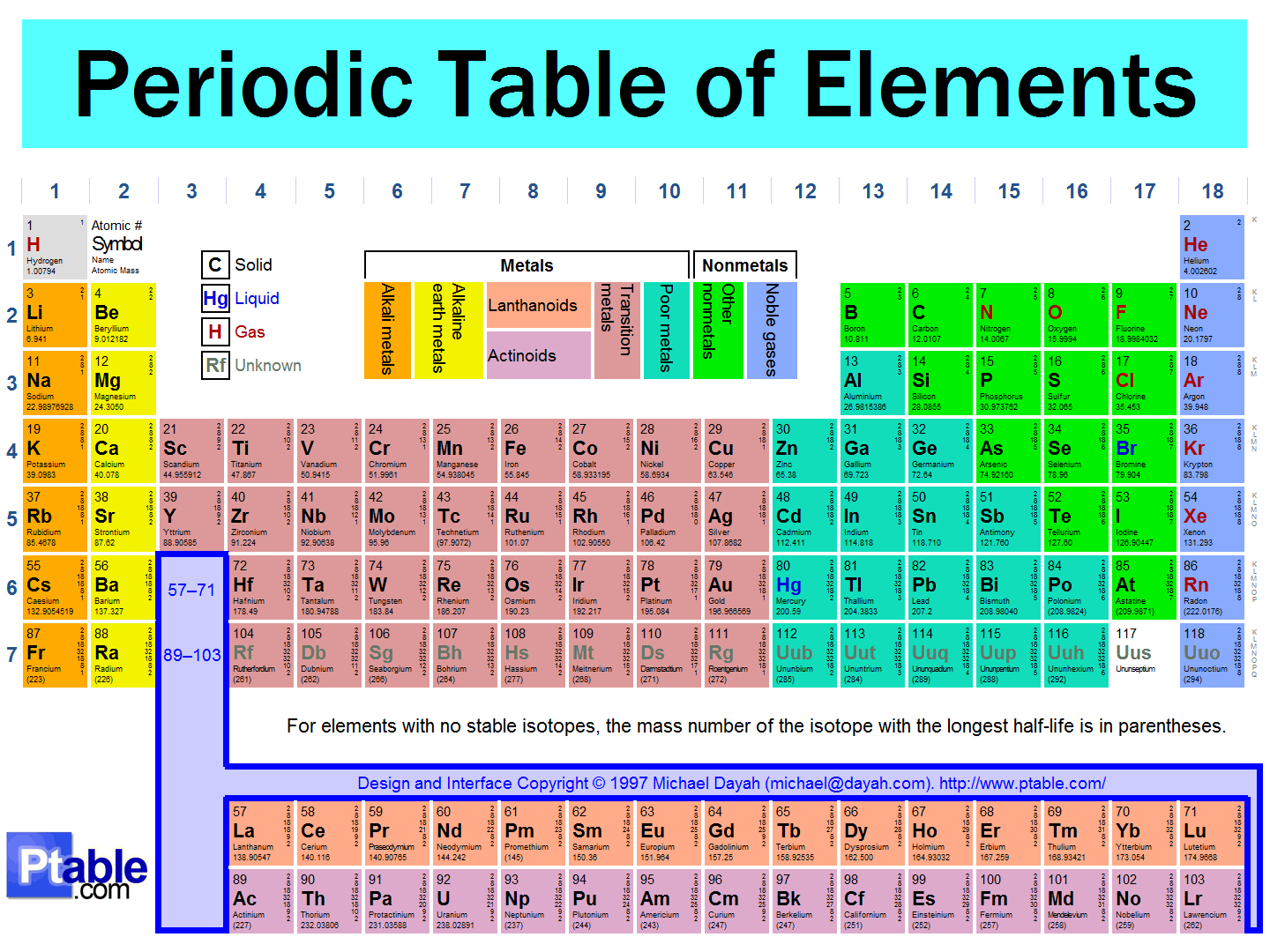
Where are metalloids found on the periodic table?
On the zigzag line
Left of the zigzag line
Right of the zigzag line
In space
What causes group 1 to be the most reactive group on the table?
They all have only one valence electron
They all have one open spot in their valence cloud
They have a full valence cloud
They are just total wild bois
What causes group 17 to be a very reactive group on the table?
They all have only one valence electron
They all have one open spot in their valence cloud
They have a full valence cloud
They are just totally loco
What causes group 18 to be completely unreactive/stable/inert?
They all have only one valence electron
They all have one open spot in their valence cloud
They all have a full valence cloud
They are just too cool for us
What is the general rule for reactivity (excluding group 17) on the periodic table?
The groups gradually become less reactive as you move left to right.
The groups gradually become less reactive as you move right to left.
It's random and unpredictable
The groups on the left and right are reactive but the middle groups are not.
What does the period number tell us about the elements on that row?
When they have science class
The number of electron clouds in each atom
The number of electrons in each atom
How many valence electrons they each have
What does the group number tell us about the elements on that row?
Where they sit at lunch
The number of electron clouds in each atom
The number of electrons in each atom
How many valence electrons they each have
Do elements in the same periods share similarities with each other?
No, they are not similar at all
Yes, they are very similar
Do elements in the same groups share similarities with each other?
No, they are not similar at all
Yes, they are very similar
Why are groups sometimes called "families"?
They have many similar properties
They were discovered by the same person
They are used for similar purposes in science
They look similar
Each of the following elements is touching the zigzag line on the periodic table. Which one is NOT a metalloid?
Aluminum
Boron
Germanium
Antimony
Helium is in group 18. How many valence electrons does a helium atom have?
2 valence electrons
8 valence electrons
18 valence electrons
4 valence electrons
Enough to make a balloon float
Each of these elements is found to the left of the zigzag line. Which of the following elements is NOT a metal?
Hydrogen
Mercury
Aluminum
Barium
Which of the following properties are found in nonmetals?
Malleable
Good conductors of energy
Insulators (bad conductors of energy)
Shiny luster
Which of the following properties are found in metals?
Shiny luster
Dull luster
Brittle
Poor conductors of energy
What special property do all metalloids have in common?
They are all semiconductors
They are shiny
They are good conductors of energy
They are very ductile
They are all from outer space

