Wayground logo

Free Printable Worksheets

Font size

S
M
L
XL
Worksheets

Unit 4 Gravitational Forces 2021

Total questions: 35

Worksheet time: 18mins

Name
Class
Date
1.

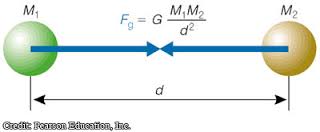
When placed at equal distances apart, the greatest gravitational attraction will be between two

a)

skateboards

b)

bowling balls

c)

school buses

2.

Which is needed to determine the amount of gravitational force between two objects?

a)

distance and mass

b)

weight and time

c)

area and weight

3.

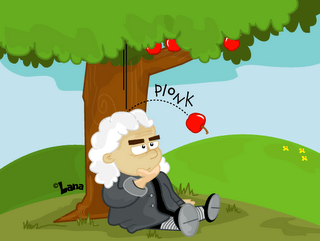
A student drops a bowling ball and an apple from a third-story window. Both objects hit the ground at the same time. From the experiment, the student should conclude that

a)

the apple weighs more than the bowling ball

b)

more air friction is acting on the apple than on the bowling ball

c)

gravity pulls on both objects, causing them to fall at the same time.
4.
What is gravitational force?
a)
It makes objects at rest start moving.
b)
It makes objects that are moving stop.
c)
The force of attraction between two objects.
d)
It pulls you into space.
5.
A baseball and bat are on the ground.   What is true?
a)
They attract each other with equal gravitational force.
b)
There is no gravitational force between them.
c)
The baseball will float because it's lighter.
d)
The bat will pull the baseball closer to itself.
6.
As the product of two objects' masses increases, the pull of gravity
a)
Increases
b)
Decreases
c)
Stays the same
7.
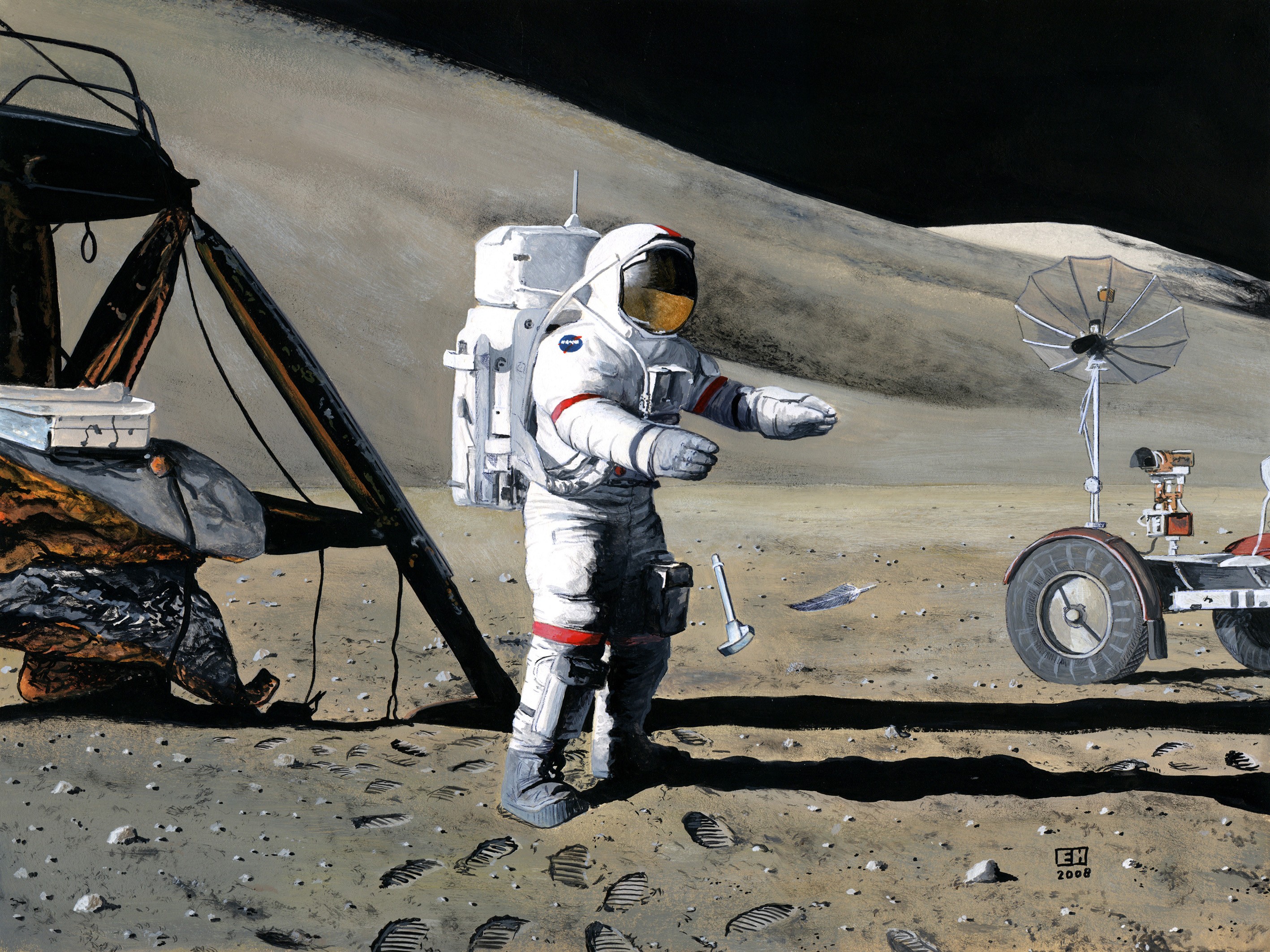
If a feather and a hammer are dropped at the same time on the moon, where there is no atmosphere, which one will hit the ground first?
a)
Neither, there is no gravity on the moon.
b)
hammer because it has more mass
c)
feather because it has less mass
d)
both will hit at the same time
8.
This FORCE pulls things.  It PULLS things into orbit around the sun. 
a)
Newton
b)
gravity
c)
weight
d)
path
9.
Complete the following statement: The farther away two planets are the _______ the gravitational force between them.
a)
more
b)
same
c)
dosen't matter
d)
less
10.
What is the definition of "weight"?
a)
measure of the force of gravity on your body
b)
the time it takes to get on a ride 
c)
the amount of matter in an object
d)
the size of an object
11.

On which celestial object (outer space) would your mass be the greatest?

a)

Earth

b)

Jupiter

c)

Sun

d)

Your mass doesn't change on different celestial objects
12.
On which celestial object would you weigh the most?
a)
Earth
b)
Jupiter
c)
Sun
d)
You would weigh the same on all celestial objects
13.

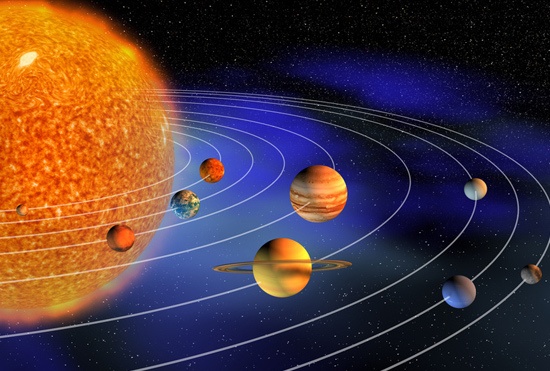
Why do all of the planets orbit the sun rather than Earth?

a)

the sun has more mass

b)

the sun is a star

c)

the Earth is heavier

d)

the sun is in the middle of the milky way
14.
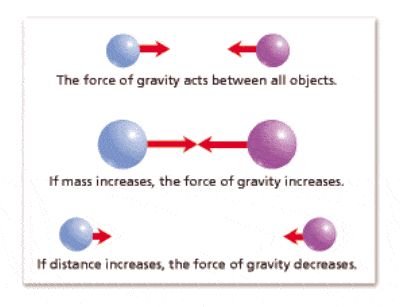
As mass increases, what happens to gravitational force?
a)
increases
b)
decreases
c)
stays the same
d)
i don't know
15.
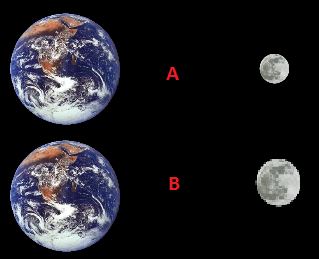
Which model has greater gravitational attraction (if any)
a)
Model A
b)
Model B
c)
Both Model A and Model B (same gravity)
16.
Which system has the greater gravitational attraction between the two objects (if any)?
a)
System A
b)
System B
c)
Same gravitational attraction fro System A and System B
17.
Planets orbit the Sun in a shape called a(n)
a)
circle
b)
ellipse
c)
focus
d)
perihelion
18.
An ellipse is drawn around two points called
a)
aphelion
b)
perihelion
c)
foci
d)
axis
19.
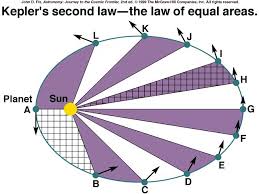
Where is the planet moving faster
a)
Position A to B
b)
Position B to C
c)
Position H to I
d)
Position I to J
20.
What has an eccentricity of zero
a)
a straight line
b)
a large ellipse
c)
a circle
d)
a small ellipse
21.
Kepler's 2nd Law deals with 
a)
the shape of the planets' orbits
b)
the speed/area the planet travels 
c)
the length of time it takes the planet to orbit the sun
22.
A planet moves __________ when it is farthest from the sun.
a)
faster
b)
slower
23.
Kepler's first law states that the orbits of the planets are oval in shape or 
a)
ellipses
b)
perfect circles
24.
The farther away a planet is from the sun, the _______ it takes it to orbit the sun once. 
a)
longer
b)
shorter
25.
What does Kepler's 1st Law state? 
a)
all planets move in elliptical shaped orbits around the sun
b)
all ellipses have foci
c)
not all ellipses have the same eccentricity
d)
the sun is located at one of the foci
26.
What does Kepler's 2nd Law state? 
a)
during a planet's orbit, the planet will sweep out equal areas in its orbit in equal amounts of time
b)
all areas are equal in space
c)
triangles have equal areas
d)
no two points in a planet's orbit are equal
27.

The velocity in which a body revolves around another body

a)

Speed

b)

motion

c)

orbital velocity

d)

Acceleration

28.

Which ellipse has an eccentricity closest to 0.0.

a)
b)
c)
29.

Which ellipse has an eccentricity closest to 1.0.

a)
b)
c)
30.
Which diagram shows a planet with the least eccentric orbit?
a)
1
b)
2
c)
3
d)
4
31.
What is eccentricity? 
a)
a measurement of how elliptical an orbit is. 
b)
a measurement of the distance between the planet and the sun
c)
a measurement of how long the planet takes to rotate around the sun
d)
none of these
32.
During which month is the earth moving the slowest? 
a)
July 
b)
March
c)
January
d)
September
33.
During what month is the earth moving the fastest around the sun? 
a)
July
b)
March
c)
January
d)
September
34.
What is true about the area between points A, B and the Sun, and the area between points H, I and the Sun?
a)
The area between A, B and the Sun is the largest.
b)
The area between H, I and the Sun is the largest
c)
Both areas are equal in size
d)
There is not enough information to determine the areas
35.
When a planet orbits the Sun, one of the foci of the elliptical orbit is 
a)
the axis
b)
the perihelion
c)
the center
d)
the Sun