Wayground logo

Free Printable Worksheets

Font size

S
M
L
XL
Worksheets

U4L2E1: Developmental and Anatomical Evidence

Total questions: 27

Worksheet time: 36mins
Name
Class
Date
1.
Structures with the same parts have different functions; suggests that organisms share a common ancestry
a)
vestigial structures
b)
homologous structures
c)
adaptive radiation
d)
fossil
2.
If an organism has a vestigial structure, that structure likely once had a function in a(n)
a)
close relative
b)
early ancestor
c)
unrelated organism
d)
embryological stage
3.
Some organisms that share a common ancestor have features that have different functions, but similar structures.  These are known as
a)
vestigial structures
b)
analogous structures
c)
homologous structures
d)
fossil structures
4.
Study of embryos of various organisms to show a common ancestor because of similarities in development
a)
natural selection
b)
embryology
c)
speciation
d)
evolution
5.
Which of the following is an example of a vestigial structure?
a)
the wings of a red-tailed hawk
b)
the hind limbs of a house cat
c)
the fins of sharks
d)
the tailbone of a human
6.
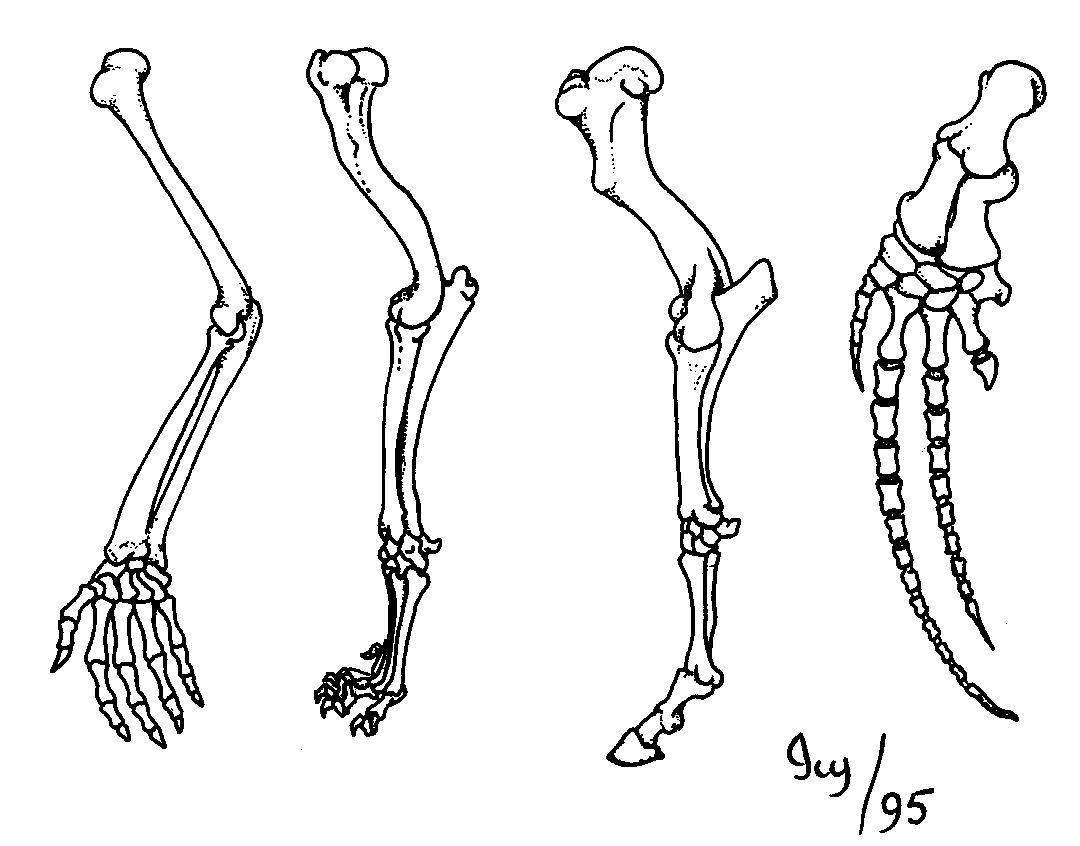
What type of structures are these?
a)
homologous
b)
vestigial 
c)
analogous
d)
fossil
7.
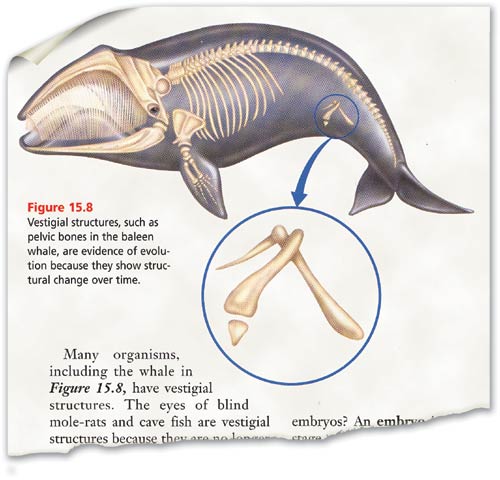
Whales are aquatic mammals that contain a pelvis bone.  Even though it does not aid in its movement, the function must have been used by a common ancestor of the whale.  Thus, the pelvis is referred to as a(n)
a)
vestigial structure
b)
analogous structure
c)
homologous structure
8.
How would you describe this evolution?
a)
Homologous structure
b)
Analogous structure
c)
Structural adaption
d)
Functional adaption
9.
When scientists compare animals currently living on different continents, they often find those with similar characteristics, who are not actually close relatives, living in similar environmental conditions even though they are geographically very distant. One example is the Anteater/Armadillos of the Americas and the Pangolin of Africa. What can we deduce from this evidence?
a)
Living things can adapt similarly to similar environments over time.
b)
Living things do not change over time
c)
They must all have the same recent common ancestor
d)
I don’t know
10.
What do the similarities of the structures suggest?
a)
a common ancestor
b)
grow at different rates
c)
evolved slowly
d)
lived a long time
11.
The diagram illustrates an embryonic stage of two organisms.

Which of the following can be determined by observing the embryos shown in the diagram
a)
The organisms share a common ancestry.
b)
The organisms belong to the same genus.
c)
The organisms are native to the same geographic areas.
d)
The organisms will grow into anatomically similar adults.
12.
The forelimbs of penguin, alligator, bat, human are which of the following?
a)
homologous structures
b)
vestigial structures
13.

The five species illustrated most likely have

similar limb structures because they all -

a)

share a common ancestor

b)

use their limbs for the same functions

c)

occupy the same level on the food pyramid

d)

adapted to the same environmental conditions

14.
Scientists compare the limbs of organisms to look for evidence of common ancestry. These limbs provide evidence of common ancestry because they -
a)
perform the same function
b)
are the same size
c)
have the same basic structure
d)
are parts of the same animal
15.
The similarities among early stages of the embryos provide evidence that -
a)
these organisms evolved from a common ancestor
b)
the organisms all retained their gills and tails
c)
the organisms belong to the same species
16.

Wisdom teeth is an example of ________________________.

a)

Homologous structures

b)

Vestigial structures

c)

Analogous structures

17.
What is the process by which populations change over time?
a)
Adaptation
b)
Phylogeny
c)
Evolution
d)
Biogeography
18.
Animals with a backbone are called what?
a)
Carnivores
b)
Herbivores
c)
Invertebrates
d)
Vertebrates
19.

Homologous structures have....

a)

Same structure, different function

b)

Different structure, same function

c)

Same structure, same function

d)

Different structure, different function

20.

Analogous structures have....

a)

Same structure, different function

b)

Different structure, same function

c)

Same structure, same function

d)

Different structure, different function

21.

A structure that had a function for a species' ancestor but is no longer used is called....

a)

Homologous

b)

Analogous

c)

Vestigial

d)

Embryological

22.

Two limbs that are both used for flight, but have different structure are....

a)

Homologous

b)

Analogous

c)

Vestigial

d)

Embryological

23.

Two limbs that have the same bone structure, but different uses are....

a)

Homologous

b)

Analogous

c)

Vestigial

d)

Embryological

24.

This line of evidence involves comparing the development of different vertebrate organisms

a)

Comparative Anatomy

b)

Fossil Record

c)

Embryology

d)

Genetics/DNA

25.

Which structure is shown in the picture?

a)

analogous structure

b)

homologous structure

c)

vestigial structure

d)

DNA

26.

Since their DNA is so similar, evolutionary theory implies that whales descended from land animals that were also the common ancestor to

a)

Ants

b)

Dinosaurs

c)

the Hippopotamus

d)

Fish

27.

Most recent ancestral species from which two different species evolved

a)

common ancestor

b)

relative dating

c)

fossil record

d)

analogous structures