Wayground logo

Free Printable Worksheets

Font size

S
M
L
XL
Worksheets

Grade 9 Science- Physics

Total questions: 80

Worksheet time: 3hrs 30mins

Name
Class
Date
1.

A horizontally-launched projectile arcs out and hits the ground below. The vertical displacement and the horizontal displacement are measured. What is the best equation to use to find the time the projectile was in the air?

a)

d→x=v→x⋅t\overrightarrow{d}_x=\overrightarrow{v}_x\cdot t

b)

d→y=+12⋅g⋅t2+v→yi⋅t\overrightarrow{d}_y=+\frac{1}{2}\cdot g\cdot t^2+\overrightarrow{v}_{yi}\cdot t

c)

v→yf=v→yi+g⋅t\overrightarrow{v}_{yf}=\overrightarrow{v}_{yi}+g\cdot t

d)

t=2⋅d→ygt=\sqrt{\frac{2\cdot\overrightarrow{d}_y}{g}}

2.

In the diagram, which letter represents the vertical displacement d→y\overrightarrow{d}_y  ?

a)

A

b)

B

c)

C

d)

D

3.
The more mass an object has, the faster it will fall.
a)
True
b)
False
4.
If you throw a baseball straight up, what is its velocity at the highest point?
a)
9.8 m/s2
b)
9.8 m/s
c)
0 m/s2
d)
0 m/s
5.
If you throw a baseball straight up, what is its acceleration at the highest point?
a)
9.8 m/s2
b)
9.8 m/s
c)
0 m/s2
d)
0 m/s
6.
What is the horizontal acceleration of a projectile?
a)
0 m/s2
b)
9.8 m/s2
7.
What is the vertical acceleration of a projectile?
a)
0 m/s2
b)
9.8 m/s2
8.
An object is projected horizontally from a cliff.  The time it takes to hit the ground is
a)
more than if it was just dropped
b)
less than if it was just dropped
c)
the same amount of time than if it was just dropped
d)
impossible to determine
9.
If I throw a crayon straight up at 12m/s, how fast is its speed when i catch it at the same height?
a)
6 m/s
b)
12 m/s
c)
18 m/s
d)
24 m/s
10.
As an object travels through the air, its vertical velocity 
a)
changes continuously
b)
remains the same
11.
When a ball is projected horizontally, what is its initial vertical velocity?
a)
10
b)
0
c)
not enough information given
12.
An object is shot from the ground (at 25 m/s) at 25 degrees and 65 degrees.  Which one has the greater range?   (assume no air resistance)
a)
25 degrees
b)
65 degrees
c)
same for both
13.
If a bullet is horizontally shot at the same moment another bullet is dropped from the same height, which will hit the ground first?
a)
Shot Bullet
b)
Dropped Bullet
c)
Hit at Same Time
14.
Two balls of the same mass begin at a height of 2m. One is released from rest while the other begins with a horizontal velocity of 5m/s. Which object its the ground first?
a)
Ball A
b)
Ball B
c)
Both balls his the ground at the same time
d)
unable to determine with information given
15.
A projectile is launched from a height with an initial velocity v0,x. The vf,x represents the final horizontal velocity before impact.
a)
v0,x = vf,x
b)
v0,x < vf,x
c)
v0,x > vf,x
d)
unable to determine
16.

A 5 N force is applied to a 3 kg ball to change its velocity from +9 m/s to +3 m/s. The impulse on the ball is ______ N s.

a)

-2.5

b)

-10

c)

-18

d)

-45

17.
A runner has a momentum of 670 kg m/s and is travelling at a velocity of 9 m/s. What is his mass?
a)
6030 kg
b)
0.0134 kg
c)
74.4 kg
d)
80 kg
18.
The purpose of crumble zones on a car is to
a)
decrease time of impact.
b)
increase force of impact.
c)
increase the time of impact.
d)
decrease the impulse during impact.
19.
If an air bag changes a 60 kg person's speed from 40.0 m/s to     0.0 m/s, what impulse must act on the person? 
a)
 2400 kg.m/s
b)
1.5 kg.m/s
c)
0.67 kg.m/s
d)
1500 kg.m/s
20.

The momentum of an object depends upon the object's ___________&_____________.

a)

size and shape

b)

mass and speed

c)

mass and veloctiy

d)

mass and energy

21.
The impulse-momentum theorem states that
a)
the impulse on an object is equal to the change in momentum it causes 
b)
the force on a moving object is equal to the magnitude of the impulse.
c)
the impulse on an object is greater than the change in momentum it causes 
d)
the impulse on an object is less than the change in momentum it causes
22.
The impulse is ______ the change in momentum
a)
greater than
b)
equal to
c)
less than
d)
always double
23.
The equation to calculate momentum is __________.
a)
p=mv
b)
p=1/2mv2
c)
p=mgh
d)
p=mg
24.
When the speed of an object is doubled, its momentum __________.
a)
remains unchanged 
b)
doubles
c)
quadruples
d)
decreases
25.

2 balls collide and bounce off of each other. During the collision total momentum remained constant and total kinetic energy remained constant. What type of collision is this?

a)

Inelastic Collision

b)

Elastic Collision

c)

Perfectly Inelastic Collision

d)

No collision occurred

26.

A piece of silly putty is dropped onto a skateboard as it rolls by. The putty sticks to the skateboard and moves the direction the board is moving. What type of collision is this?

a)

Inelastic collision

b)

Elastic Collision

c)

Perfectly Inelastic collision

d)

No collision

27.

A BMW rear ends a car at the stop light. Neither car sticks together. The momentum was conserved in the collision but the kinetic energy was not conserved. What type of collision is this?

a)

Elastic Collision

b)

Inelastic Collision

c)

Perfectly inelastic Collision

d)

No Collision

28.

If a collision is elastic which of the following must be true?

a)

Momentum is not conserved

b)

The objects are in an open system

c)

The total momentum is equal to 0

d)

Kinetic Energy is conserved

29.

If a collision is inelastic which of the following must be true?

a)

the total momentum of the system is conserved

b)

The total momentum of the system is not conserved

c)

The total momentum of the system is 0

d)

The total kinetic energy of the system is conserved

30.

Two carts collide. They stick together and continue moving. Is momentum conserved in this interaction?

a)

Yes

b)

No

31.

Two carts collide. They stick together and continue moving. Is total kinetic energy conserved in this interaction?

a)

Yes

b)

No

32.

Two cars collide in a car crash. During the crash the cars bumpers became dented and some thermal energy was given off in the crash. Was Total Kinetic Energy conserved in the crash?

a)

No

b)

Yes

33.

When two objects collide, their momentum after the collision is explained by ______.

a)

Newton’s first law of motion

b)

Newton’s second law of motion

c)

Newton’s third law of motion

d)

the conservation of momentum

34.

A real car moving at 10 km/h has more momentum than a toy car moving at the same rate because ______.

a)

its mass is greater

b)

its mass is less

c)

it moves faster

d)

of friction

35.

If an object with a mass of 12 kilograms is moving at 10 meters per second, what is its momentum?

a)

120 kg*m/s

b)

120 kg*m*s

c)

1.2 kg*m/s

d)

1.2 kg*m*s

36.

Newton's Second Law of Motion can be summarized by which equation?

a)

M = F/a

b)

F = ma

c)

F = m/a

37.

Which scenario would most likely occur when a cue ball strikes a pool ball that is at rest?

a)

The cue ball will stop making and also be at rest.

b)

The pool ball will accelerate in the same direction as the cue ball was initially moving.

c)

The cue ball will bounce back from the pool ball around the same velocity.

d)

The pool ball will accelerate to a velocity greater then the cue ball moving.

38.

What must occur for momentum to be transferred?

a)

Interaction between multiple masses.

b)

Interaction between a moving mass and a stationary mass.

c)

Multiple masses must combine to form one mass.

d)

Multiple masses must be moving in opposite directions.

39.
How much work is done in holding a 15 N sack of potatoes while waiting in line at the grocery store for 3 minutes?
a)
15 J
b)
45 J
c)
0 J
d)
5 J
40.
What is the difference between calculating power and work?
a)
Power takes into account the time it takes to complete a task
b)
Work takes into account the time it takes to complete a task
c)
Power is force/area
d)
Work is force/area
41.

The roller coaster car has a mass of 500 kg. It is pulled from position 1 to 2 (30 m) by a motor. At the top of the ride the vertical distance top to bottom is 20 m. The motor pulls the car with a 4000 N force. Calculate the work done getting the car to the top of the ride.

a)

100 000J

b)

120 000J

c)

800 000J

d)

90 000J

42.
Is this an example of work? 
A waiter carries a tray full of meals above his head by one arm straight across the room at constant speed. 
a)
True
b)
False
43.
Which situation is work not done?
a)
lifting a 20 pound box off the floor
b)
holding a 20 pound box above the floor
c)
sliding a 20 pound box across the floor
d)
sliding a 20 pound box up an inclined plane
44.
A battery converts what type of energy to another?
a)
sound to kinetic
b)
light to heat
c)
mechanical to electrical
d)
chemical to electrical
45.
Energy that is stored in bonds between atoms is:
a)
Mechanical energy
b)
Chemical energy
c)
Kinetic energy
d)
Nuclear energy
46.

What type of energy transformation takes place when you plug in a lamp and turn it on?

a)

electrical to radiant

b)

electrical to mechanical

c)

chemical to radiant

d)

mechanical to thermal

47.

The SI Unit for Energy is

a)

Joule

b)

Newton

c)

Calorie

d)

Watt

48.

the temperature at which a substance has no kinetic energy per particle to give up. The temperature corresponds to 0 K

a)

absolute zero

b)

freezing

c)

consdenstion

d)

32 K

49.

two strips of different metals, such as one of brass and one or iron, welded or riveted together in one strip

a)

heat pump

b)

Carnot efficiency

c)

Bimetallic strip

d)

Internal energy

50.

unit of heat. One calorie is the heat required to raise one gram of water one Celsius degree

a)

calorie

b)

kilocalorie

c)

joule

d)

regelation

51.
A(n) _____________ is a device for measuring temperature.
a)
thermometer
b)
barometer
c)
anemometer
d)
psychrometer 
52.
A slower particle has a lower energy than an identical, faster particle.
a)
True
b)
False
53.
The transfer of thermal energy between objects of different temperatures is called...
a)
temperature
b)
heat
c)
internal energy
d)
none of these
54.
When thermal energy is added to a substance, the substance's particles move:
a)
More rapidly at an increased diestance from each other.
b)
More rapidly with less distance between each other.
c)
More slowly with a greater distance between each other.
d)
More slowly with a reduced distance between each other.
55.
Heat transfer by conduction occurs when...
a)
particles bump into each other
b)
large numbers of atoms move from place to place
c)
atoms give off heat in the form of electromagnetic waves
d)
electromagnetic waves travel from place to place through a vacuum
56.
Heat transfer by convection occurs when...
a)
electrons bump into other electrons
b)
large numbers of atoms move from place to place
c)
atoms give off heat in the form of electromagnetic waves
d)
electromagnetic waves travel from place to place through a vacuum
57.
The second  law of thermodynamics states that entropy of a system  tends to ______________. 
a)
increase
b)
decrease
c)
stay constant
d)
fluctuate wildly
58.
Magnetism is generated by moving
a)
protons.
b)
electrons.
c)
neutrons.
d)
elements.
59.
What do the lines around this magnet represent?
a)
North Pole
b)
South Pole
c)
Magnetic Declination
d)
Magnetic Field
60.
If you place the North pole of a magnet next to the South pole of another magnet, they will:
a)
Attract
b)
Repel
c)
Do nothing
d)
Shatter
61.
On Earth, where is Magnetic North approximately located?
a)
The Equator
b)
The North Pole
c)
The South Pole
d)
New Brighton
62.
An electromagnet's poles may be reversed by:
a)
decreasing the voltage of the coil
b)
increasing the number of coils
c)
changing the direction of current flow
d)
altering the material used to make the coils
63.
If you cut a magnet in half, what happens to the poles?
a)
One half gets the North Pole, the other half gets the South Pole
b)
Both halves get only a North Pole
c)
Both halves get only a South Pole
d)
Both halves get a North pole and a South Pole
64.
What is responsible for the Magnetic Field around Earth?
a)
The Earth's crust
b)
The Earth's molton iron core
c)
The Earth's mantel
d)
The Sun
65.
What would we call a nail that can pick up a paperclip because it is touching a magnet?
a)
temporary magnet
b)
poles
c)
force
d)
detector
66.
What will happen when these magnets are brought close together?
a)
They will attract each other.
b)
They will repel each other.
c)
Both magnets will turn to the left
d)
Both magnets will turn to the right
67.
Iron, Nickel and cobalt are all __________________ materials
a)
Shiny
b)
poles
c)
magnetic
d)
cold
68.
Where is the strongest attraction force of the magnet?
a)
at the poles
b)
in the middle
c)
above the magnet
d)
below the magnet
69.
The space around a magnet where the force of a magnet can attract best is called__________
a)
magnetism
b)
bar magnet
c)
horseshoe magnet
d)
magnetic field
70.
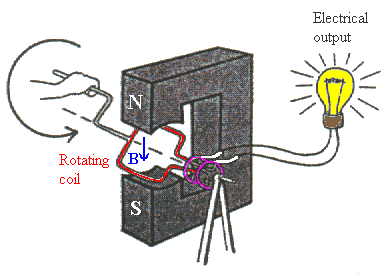
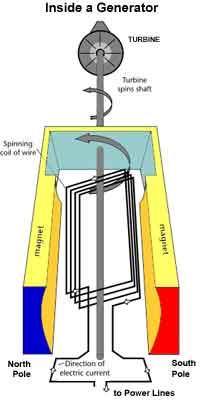
What is the transfer of electricity in a generator?
a)
Mechanical to Electrical 
b)
Physical to Potential 
c)
Electrical to Mechanical
d)
Yogurt to Light
71.
In large generators in power plants, ___________ rotate inside a coil of wire to produce an electric current.
a)
Wind
b)
Water
c)
Magnets
d)
Circuits
72.
Generators are devices that convert _____ energy into _____ energy.
a)
chemical; mechanical
b)
mechanical; electrical
c)
electrical; mechanical
d)
potential; kinetic
73.

Resources that are not able to be reproduced as quickly as they are used are called _____.

a)

renewable resources

b)

replaceable resources

c)

non renewable resources

d)

non replaceable resources

74.

Geothermal energy uses heat from ____ to produce electricity.

a)

the earth

b)

coal

c)

oil

d)

natural gas

75.

What are fossil fuels?

a)

coal, oil, uranium

b)

oil, natural gas, uranium

c)

coal, oil, natural gas

d)

geothemals, coal, natural gas

76.

Which of the following process is used in a turbine?

a)

Converting fuel into heat

b)

Converting thermal energy in steam to mechanical energy

c)

Electromagnetic induction

d)

Converting electrical energy into mechanical energy

77.

Name the type of power station.

a)

Thermal Power Station

b)

Nuclear Power Station

c)

Hydroelectric Power Station

d)

Biomass Power Station

78.

Uses Uranium in _______ power station.

a)

Hydroelectric

b)

Nuclear

c)

Oil

d)

Wave

79.

Renewable resources ...

a)

are not replaceable

b)

are used more frequently than non renewables

c)

are never going to run out

d)

going to run out

80.

How much of our total energy use comes from electricity?

a)

10%

b)

25%

c)

40%

d)

88%