
 Worksheets
Unit 3: Electricity Quiz
Total questions: 40
Worksheet time: 2hrs 33mins

The flow of electric charge in a circuit is called _______.
Heat
Sound
Electric Current
Magnetic
The word current means:
the difference in electrical potential between two places along an electrical circuit
the flow of electric charge
a flow of electrons that is always changing directions
a flow of electrons along a circuit in one direction
What is voltage?
the difference in electrical potential between two places along an electrical circuit
the flow of electric charge
a flow of electrons that is always changing directions
a flow of electrons along a circuit in one direction
What is Direct Current (DC)?
the difference in electrical potential between two places along an electrical circuit
the flow of electric charge
a flow of electrons that is always changing directions
a flow of electrons along a circuit in one direction
What is Alternating Current (AC)?
the technology that powers motors in electric cars
the flow of electric charge
a flow of electrons that is always changing directions
a flow of electrons along a circuit in one direction
We measure current in a standard unit called:
amperes
coulombs
voltage
Ohms
An electric circuit is a configuration of:
components, schematics, and electricity
components, wires, and electricity
printed circuit boards, schematics, and electricity
wires, capacitors, and electricity
The different electronic components in a circuit are connected using:
wires
schematics
a printed circuit board
a ground
A certain point in a circuit where the voltage is zero is called a:
printed circuit board
component
schematic
ground
A ground is usually the:
most positive terminal of the power supply
most negative terminal of the power supply
the point at which the circuit meets the actual ground
printed circuit board
Which of the following is NOT a passive component of a circuit board?
capacitor
resistor
connector
transistor
6
(I X R)
Voltage divided by Current
(V / I)
Current
Power
Resistance
Watts
Voltage divided by Resistance
(V / R)
Current
Power
Ohms
Watts
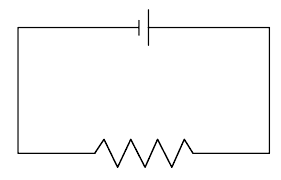
Which best describes a parallel circuit?
Electricity flows along one pathway.
The flow of electricity comes from one source.
Electricity flows along more than one pathway.
The flow of electricity comes from more than one source.
What is the voltage of a circuit with 4 ohms of resistance and 3 amps of current?
12 V
21 V
4/3 V
3/4 V
What is the current in a circuit with 6 ohms of resistance and a battery containing 24 Volts?
1/4 A
144 A
4 A
0.4 A
What is the resistance of a lightbulb that experiences 9 Volts and 3 amps of current?
1/3 ohms
3 ohms
27 ohms
9 ohms
A 3-V battery sends a current of 0.10 A through a light bulb. What is the resistance of the filament of the bulb?
.033 Ω
30 Ω
.3 Ω
300 Ω
A 10-V battery generates a current through a 5 Ω resistor. How much current does the battery generate?
2 A
50 A
2.5A
0.5
Calculate the VOLTAGE through a load, if a resistance of 500 Ω that has a current of 1.4 A flowing through it.
70 V
357 V
.0028 V
700 V
What voltage is needed to cause a 2A current flow through a 10Ω resistor?
What resistance is needed to cause a 50A current flow because of a 500V battery?
If the battery produced 12.6 Volts, what would be the current flow be for a 6 Ohm resistor?
2.1 Amps
2.4 Amps
1.71 Amps
15 Amps

