wayground logo

Free Printable Worksheets

NEW

Font size

S
M
L
XL
Worksheets

Earth Science-Ch. 9 Sec. 1-2 Plate Tectonics & Sea Floor Spreadi

Total questions: 35

Worksheet time: 12mins

Name
Class
Date
1.
What does the theory of continental drift state?
a)
The continents were once joined in a super-continent and have moved over time
b)
Continents are stationary and do not move
c)
The Earth is broken into lithospheric plates that move due to convection currents
d)
none of the above
2.
What evidence did Wegener use in his theory?
a)
Continents and fossils fitting together/matching-up like puzzle pieces 
b)
glacier scars and evidence from temperature
c)
mountain ranges and coal deposits line up across continents
d)
all of the above
3.
Why did no one believe Wegener's thoery?
a)
He could not explain HOW the continents moved
b)
He didn't have evidence
c)
His data was wrong
d)
He didn't use the right technology to gather data
4.
What two specific continents fit together most noticeably?
a)
Africa and North America
b)
South America and Europe
c)
South America and Africa
d)
Antartica and Africa
5.

How long ago is Pangaea believed to have existed?

a)
200-300 million years ago
b)
1000-2000 years ago
c)
10,000-20,000 years ago
d)
20-30 billion years ago
6.

How does evidence of glaciation in Africa support the Theory of Continental Drift?

a)

It shows that the continents must have been in a different location.

b)

It doesn't.

c)

It shows that it was colder at the equator in the past.

d)

It shows that it was warmer at the equator in the past.

7.
What is the force that moves the continents? 
a)
Conduction 
b)
Convection 
c)
Radiation 
d)
Conveyor belts 
8.
What is Pangaea?
a)
the name of a German scientist
b)
the name of the super-continent that existed millions of years ago
c)
another name for continental drift
d)
the name of an ancient fossil
9.
What type of evidence was NOT used by Alfred Wegener to support his continental drift hypothesis?
a)
evidence from landforms
b)
evidence from fossils
c)
evidence from human remains
d)
evidence from climate
10.
Who is the scientist who proposed Continental Drift Theory?
a)
Albert Einstein
b)
Alfred Wegener
c)
Isaac Newton
d)
John Dalton
11.
What are the remains of organism noticed by Wegener that are found the same in two continents?
a)
Leaves and flowers
b)
Ice and mountains
c)
Plants and animals
d)
Dinosaurs and reptiles
12.

Where did Wegener find plant fossils that today would not be able to survive on that type of land?

a)

North America

b)

Antarctica

c)

China

d)

India

13.

When Wegener looked at maps he noticed African and South American ____________ lined up.

a)

Lakes

b)

islands

c)

Hills

d)

Mountain Ranges

14.

What is the force that moves the continents?

a)

Conduction

b)

Convection

c)

Radiation

d)

Conveyor belts

15.

Originally the continental drift theory was not well received by other scientists. Why?

a)

There was a competing theory at the time that was more believable.

b)

There was no data showing the continents ever moved.

c)

The scientists did not know the force responsible for moving the continents.

d)

The scientist presenting the data was unreliable.
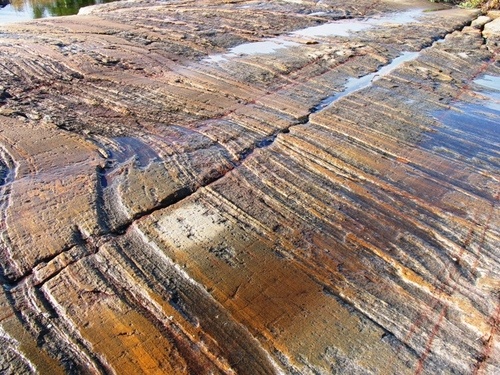
16.
This is a picture of glacier scars found in Africa.  What are these evidence for?
a)
Africa has always been near the equator
b)
Africa was once in an area of the Earth that had a very cold climate
c)
The continents have not moved
d)
sea floor spreading
17.

According to the continental drift hypothesis, the presence of similar fossils in South America and Africa supports which scientific idea?

a)

Animals easily and frequently travel from Africa to South America.

b)

Species of animals probably traveled between continents on natural rafts (such as trees destroyed in tsunamis).

c)

Land bridges once existed that connected the continents.

d)

South America and Africa were once connected together.

18.

The continents move very slowly, only a few __________per year.

a)

meters

b)

kilometers

c)

centimeters

d)

miles

19.

Glossopteris grew in warm, swampy areas, proving Antarctica used to have a ________________climate.

a)

warm and wet

b)

hot and dry

c)

cold and icy

d)

temperate

20.

What is the correct order (starting from the surface) of Earth’s layers?

a)

crust, outer core, inner core, mantle

b)

mantle, outer core, inner core, crust

c)

crust, mantle, outer core, inner core

d)

outer core, inner core, crust, mantle

21.

In sea-floor spreading, molten material rises from the mantle and erupts

a)

along the edges of all the continents.

b)

along mid-ocean ridges.

c)

in deep-ocean trenches.

d)

at the north and south poles.

22.

The process by which the ocean floor sinks beneath a deep-ocean trench and back into the mantle is known as _______

a)

convection.

b)

continental drift.

c)

subduction.

d)

conduction.

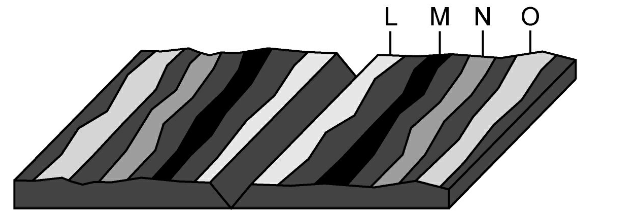
23.
Where would the oldest rock be found?
a)
L
b)
M
c)
N
d)
O
24.
How is it possible for new crust to be formed without increasing the surface area of the Earth?
a)
Crust is destroyed at the same time it is created
b)
New crust is underwater where it sinks
c)
New crust breaks more easily than old crust
25.
What causes the crust to move?
a)
convection
b)
conduction
c)
tension
d)
radiation
26.

What 3 kinds of evidence were used to prove that the seafloor spread?

a)

Rock formations, age of rocks, WWII shipwrecks

b)

Age of rocks, magnetic seafloor stripes, WWII ship logs

c)

Rock formations, magnetic seafloor stripes, age of rocks

d)

Fossils, mountain ranges, climate

27.
What technology was used during WWII to detect enemy submarines and produce the first map of the seafloor?
a)
Sonar
b)
Radar
c)
GPS
28.
Undersea mountain range.
a)
Rift
b)
Mid-ocean ridge
c)
seafloor spreading
d)
Continental drift
29.

Process by which new ocean crust forms.

a)

Seafloor spreading

b)

Continental drift

c)

Mid-ocean ridge

d)

Rift

30.
Magnetic field that points south.
a)
Modern polarity
b)
Past polarity
c)
Normal polarity
d)
Reversed polarity
31.
Why were magnetic patterns found on the ocean floor puzzling?
a)
They showed alternating bands of normal and reversed polarity.
b)
No rocks were magnetic.
c)
They did not show alternating bands of normal and reversed polarity.
d)
All rocks were magnetic.
32.
What is label G
a)
Trench
b)
Mid ocean ridge
c)
abyssal plain
d)
sea mount
33.
What are Mid-Ocean Ridges?
a)
A chain of underwater waterfalls 
b)
A chain of underwater volcanos
c)
A chain of underwater mountains
d)
A chain of underwater rocks
34.

This scientist was the first to propose seafloor spreading

a)

William Watts

b)

Harry Hess

c)

Alfred Wegener

d)

Tenzing Norgay

35.
Which is NOT evidence of sea-floor spreading?
a)
Molten magma constantly erupting
b)
Drilling samples of rock
c)
Magnetic stripes
d)
Fossil evidence