wayground logo

Free Printable Worksheets

Font size

S
M
L
XL
Worksheets

Pre-AP Electron Test Review 2021

Total questions: 55

Worksheet time: 13hrs 16mins

Name
Class
Date
1.
Includes all forms of electromagnetic radiation; the types of radiation differ in their frequencies and wavelengths.
a)
electromagnetic spectrum
b)
electromagnetic radiation
c)
photon
d)
photoelectric effect
2.

electrons can gain a packet or quantum of energy and when they do they become excited which is a lower energy level

a)
true
b)
false
3.

Which of the following has the most energy?

a)

Red

b)

Blue

c)

Green

d)

Violet

4.
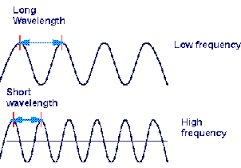
A wave with a large wavelength will have a ______ frequency and _____ energy
a)
high, low
b)
high, high
c)
low, high
d)
low, low
5.
Select the correct order of waves on the EMS from the longest wavelength to the shortest wavelength
a)
Radio, Micro, Infra, Visible, Ultra, X-ray, Gamma
b)
Gamma, X-ray, Ultra, Vis, Infra, Micro, Radio
c)
Vis, Micro, Infra, Ultra, X-ray, Gamma, Radio
d)
Micro, Radio, Vis, Infra, Ultra, X-ray, Gamma
6.

Which has the LONGEST wavelength and, therefore, the LOWEST frequency/energy

a)

Gamma Rays

b)

Ultraviolet

c)

Visible Light

d)

Infrared rays

7.

Wavelength and Frequency are related in that...

a)

they are always the same

b)

when one increases, the other decreases (inversely proportional)

c)

there is no correlation

d)

they both vary in an irregular pattern

8.

Put the visible light colors in order from SHORTEST wavelength (highest frequency) to longest wavelength (lowest frequency)

a)

Violet, Indigo, Blue, Green, Orange, Yellow, Red

b)

Red, Yellow, Green, Orange, Violet, Blue, Indigo

c)

Red, Orange, Yellow, Green, Blue, Indigo, Violet

9.

What electromagnetic wave do humans emit as heat energy?

a)

infrared light

b)

ultraviolet light

c)

visible light

d)

microwaves

10.

The highest part of the wave is called the _______________.

a)

Amplitude

b)

Wavelength

c)

Trough

d)

Crest

11.

The bottom part of the wave is called trough.

a)

True

b)

False

12.

_________________________ is the distance between a point on one wave and the identical point of the next wave.

a)

Amplitude

b)

Frequency

c)

Crest

d)

Wavelength

13.
States that each electron occupies the lowest energy orbital available.
a)
Pauli exclusion principle
b)
Heisenberg uncertainty principle
c)
Hund's rule
d)
Aufbau principle
14.
The arrangement of electrons in an atom, or where the electrons are at for an element.
a)
quantum mechanical model
b)
electron configuration
c)
atomic emissions spectrum
d)
electron-dot structure
15.
The lowest allowable energy state of electrons.
a)
principle energy level
b)
atomic orbital
c)
energy sublevel
d)
ground state
16.
States that single electrons must occupy each equal-energy orbital before a second electron with opposite spin can occupy the same orbital.
a)
Hund's rule
b)
Aufbau principle
c)
deBroglie equation
d)
Pauli exclusion principle
17.
States that a maximum of two electrons can occupy a single atomic orbital but only if the electrons have opposite spins.
a)
Hund's rule
b)
Pauli exclusion principle
c)
Heisenberg uncertainty principle
d)
Aufbau principle
18.
How do you start a electron configuration?
a)

1p6

b)

1d10

c)
1
d)

1s2

19.
how do write the electron config for carbon (c)
a)

1s2 2s2 2p6

b)

1s2 2s2 2p2

c)

1s1 2s1 2p1

d)

1p2 2p2 2s2

20.
write the electron config for iron (fe)
a)

1s2 2s2 2p6 3s2 3p6 4s2 3d6

b)

1s2 2s2 2p6 3s2 3p6 4s2 4d6

c)

1s2 2s2 3s2 4s2 4d6

d)

1p2 2p2 2s6 3p2 3s6 4p2 4d6

21.
what are the rings the electron orbit in called 
a)
orbital 
b)
energy level 
c)
engrgy ring 
d)
electron  circle 
22.
How many electrons can the first energy level hold?
a)
1
b)
2
c)
8
d)
0
23.
The Principle Energy Level is represents electrons distance away from the nucleus.
a)
False
b)
True
24.
___orbital has 14 total electrons. 
a)
S
b)
P
c)
F
d)
D
25.
What is the second energy level?
a)
n=3
b)
n=2
c)
n=1
d)
e=3
26.
Emission of light from an atom occurs when an electron
a)
drops from a higher to a lower energy level.
b)
   jumps from a lower to a higher energy level.   
c)
   moves within its atomic orbital.
d)
falls into the nucleus.
27.

What is the approximate frequency of a photon having an energy 5x10-19 J? (h = 6.626x10⁻³⁴ Js)

a)
3 x10-57 Hz
b)
7.5x10¹⁴ Hz   
c)
3x10-58 Hz
d)
1x10⁻¹⁰ Hz
28.
What atom matches this electron configuration?
1s22s22p63s23p64s23d10
a)
Zinc
b)
Copper
c)
Nickel
d)
Germanium
29.
What electron configuration matches an oxygen atom?
a)
1s22s22p63s2, 3p64s23d104p5
b)
1s22s22p4
c)
1s22s22p6
d)
1s22s22p63s23p64s23d1
30.
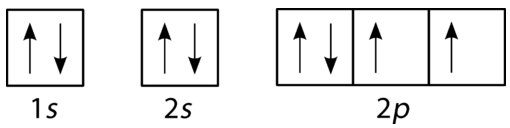
This orbital diagram represents:  
a)
C
b)
B
c)
N
d)
O
31.
This orbital diagram represents:  
a)
C
b)
B
c)
N
d)
O
32.

What is incorrect about this orbital diagram?

a)

Both arrows in the 2p box should be pointing up

b)

There is nothing incorrect with this diagram

c)

In the there should only be 1 orbital in the first 2p box and one in the 2nd 2p box

d)

All the arrows should be pointing up.

33.
How many electrons can the s sublevel hold?
a)
14
b)
10
c)
2
d)
6
34.

What is the speed of light?

a)

3.0x10⁸ ms

b)

3.0x10⁸ m/s

c)

6.626x10⁻³⁴ Js

d)

6.626x10⁻³⁴ J/s

35.

The frequency of violet light is 7.5x10¹⁴ Hz. What is its wavelength?

(a)  

36.

Violet light has a wavelength of

4.10 x 10⁻¹² m. What is the frequency?

(a)  

37.

All Electromagnetic waves carry

a)

energy

b)

light

c)

matter

d)

particles

38.

What is Planck's Constant?

a)

6.63x10⁻³⁴ Js

b)

6.63x10⁻³⁴ J/s

c)

3.0x10⁸ ms

d)

3.0x10⁸ m/s

39.
Put the visible light colors in order from longest wavelength to shortest wavelength
a)
Violet, Blue, Green, Orange, Yellow, Red
b)
Red, Yellow, Green, Orange, Violet, Blue
c)
Red, Orange, Yellow, Green, Blue, Violet
d)
Blue, Violet, Green, Yellow, Orange, Red
40.

The speed of a wave is its wavelength multiplied by its ___________

Or the formula

C = λ x ν

a)

amplitude

b)

vibration

c)

frequency

d)

reflection

41.

A blue light has a wavelength of 4x10^-7 m. What is its frequency, to one decimal place?

(a)  

42.

Calculate the energy of the lasers in a Blu-ray player, which emits at 4.05x10^-9 m. Please express it to 2 decimal places Also note, this is a step problem.

(a)  

43.

Calculate the energy of the shade of orange known as Safety Orange, 6.22x10^-9 m, and express it to 3 decimal places! Also note this a two step problem.

(a)  

44.

____________ occurs when an object takes in a light wave.

a)

Absorption

b)

Refraction

c)

Reflection

45.
Which has the SHORTEST wavelength and, therefore, the highest frequency/most energy
a)
Radio waves
b)
Ultraviolet Rays
c)
Gamma Rays
d)
X-rays
46.
1.  What is the shape of an s orbital?
a)
sphere
b)
dumbbell
c)
double dumbbell
d)
TOO COMPLEX TO KNOW IT.
47.
Who determined that it is not possible to simultaneously determine the electron's position and velocity?
a)
Pauli
b)
Hund
c)
Heisenberg
d)
Einstein 
48.

States that single electrons with the same spin must occupy each equal energy orbital before additional electrons with opposite spins can occupy the same orbital.

a)

Pauli’s Exclusion Principle

b)

Hund’s rule

c)

Aufbau Principle

49.

There must be one electron with the same spin in each orbital of the same energy before you can put two in the same orbital.

a)

Pauli’s Exclusion Principle

b)

Hunds Rule

c)

Aufbau Principle

50.
An electron occupies the lowest energy orbital that can receive it.
a)
Hund’s rule
b)
Pauli exclusion principle
c)
Bohr model of the atom
d)
Aufbau principle
51.

Researchers from the planet Zorba have discovered an atom with the following electron structure (shown as a shell model). Sketch the photoelectron spectrum that the researchers analyzed to obtain this knowledge of atomic structure.

a)

1s32s12p63s3

b)

1s32s12p43s3

c)

1s22s22p63s23p1

d)

1s22s22p63s2

52.
This is the correct dot diagram for sodium (Na)
a)
true
b)
false
53.
This is a correct dot diagram for oxygen (O)
a)
true
b)
false
54.
This is a correct dot diagram for fluorine (F)
a)
true
b)
false
55.

The arrow is pointing to the

a)

trough

b)

wavelength

c)

amplitude

d)

equilibrium