
 Worksheets
Unit 1 Characteristics of Life and Ecology
Total questions: 42
Worksheet time: 24mins
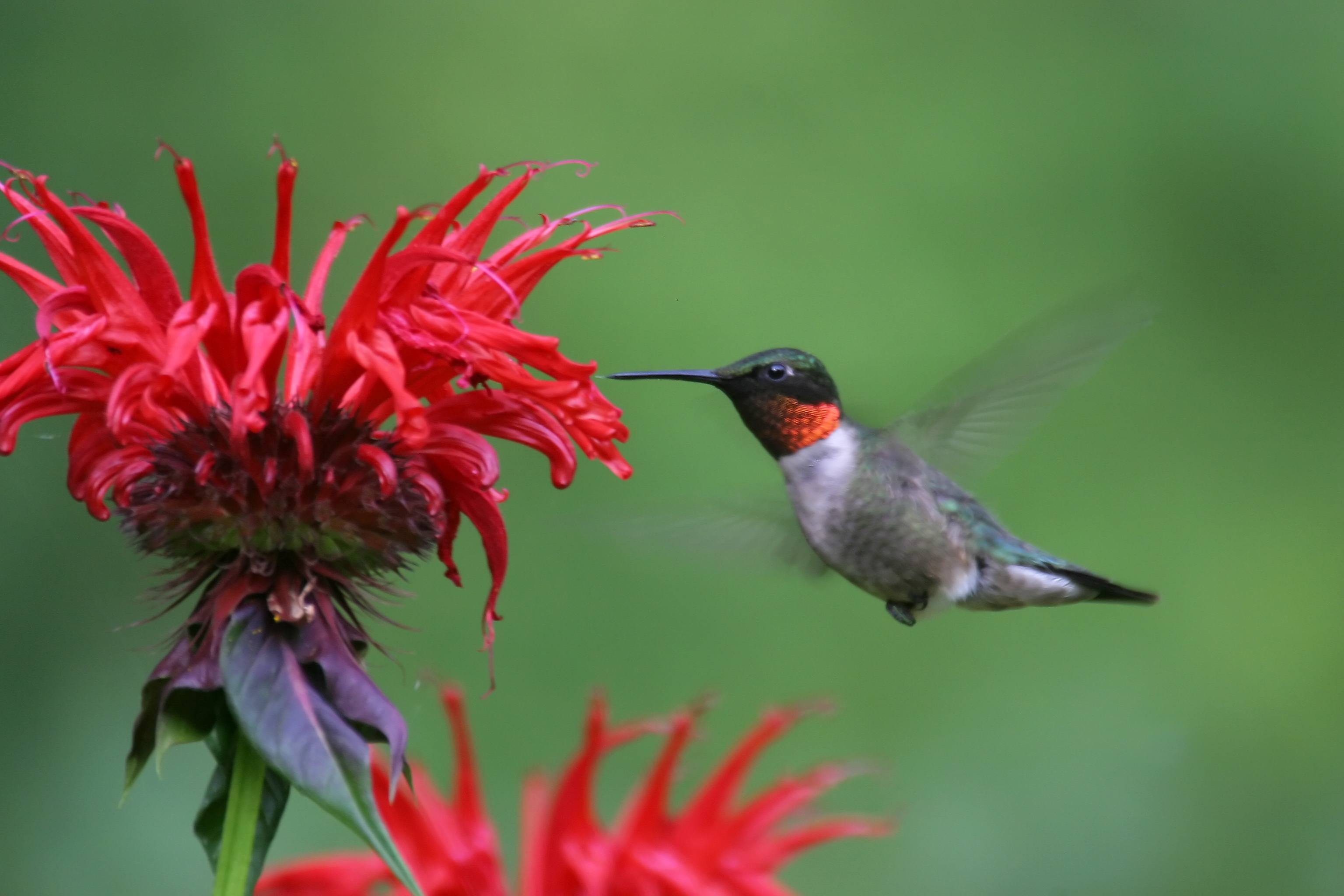
What type of symbiosis? Hummingbirds feed on nectar from flowers. The flowers are pollinated by hummingbirds as they move from flower to flower.
commensalism
mutualism
parasitism
predation

Aphids are tiny insects that live on and eat the leaves of plants, removing vital nutrients from the plants.
Predation
Parasitism
Commensalism
Mutualism
Which would most likely result in primary succession?
old forest growing
undisturbed prairie
pollution kills mountain lake species
a Newly formed volcanic island
Which would result in primary succession?
Flood destroying a habitat
Tornado destroying a crop leaving very little soil
Glacier retreating exposing bare rock
limiting factors
A remora attaches to a shark and has the benefit of scrap food from the shark. This relationship does not affect the shark.
mutualism
parasitism
commensalism
competition
Which of the following shows secondary ecological succession?
forest fire killing off smaller plants, then allows growth for others
rapid evolution of animal species
development of an ecosystem with only mature trees
a meteor impact that kills all ecosystems
Which provides the most energy?
carnivores
producers
omnivores
herbivores
What is another term of herbivore?
producer
consumer
omnivore
decomposer
Humans are omnivores, because they eat both plants and meat. Which level of the energy pyramid lacks that characteristic necessary to sustain humans?
bottom level
second level
third level
top level

A snake that eats a mouse which feeds primarily on seeds is an example of a
tertiary consumers
primary consumer
secondary consumer
producer

The shrimp feed on green algae (not pictured). Which would be the secondary consumer?
Osprey
Smelt
Perch
Pike

A virus kills off the population of perch in the area. What population would then increase?
pike
osprey
smelt
shrimp

A local park is using a pesticide to treat grass. Which organism is likely to suffer the worst effects from pesticide, due to biomagnification?
Grasshopper
Frog
Snake
Hawk

Removal of which of the organisms from the ecosystem would cause the greatest effects?
hawk
fox
frog
grasses

What would the be the long term effects if grasshoppers were removed from the ecosystem?
the snake population would increase
the frog and bird population would decrease
the rabbit population would decrease
the fox population would increase
What percent of energy is moved up each trophic level?
90%
100%
50%
10%

If a producer has 10,000 kcal of energy stored, how much would the tertiary consumer have?
10,000
1,000
100
10

If all of the grasses and blackberries are destroyed in a fire, how might the top of the pyramid change?
It will increase because the energy will increase
It will increase because the transfer of energy will be faster
It will decrease because there will not be enough energy to support the higher levels
It will decrease because there will be a higher number of organisms
Which organisms help convert gaseous nitrogen into ammonia in the nitrogen cycle?
bacteria
trees
grasses
squirrels

What would happen if humans prevented the process of denitrification from occuring?
Atmospheric nitrogen would decrease and the bacteria would die off
Atmospheric nitrogen would remain constant and the bacteria would remain constant
Atmospheric nitrogen would remain constant and the bacteria would increase
Atmospheric nitrogen would increase and bacteria would decrease

What would happen if humans dumped high amounts of animal waste into freshwater lakes?
nitrates in the water would increase causing algal blooms
nitrates in the water would decrease, causing fish to die off
nitrates in the water would stay the same, causing no effect
nitrates in the water would decrease then increase due to bacteria

How would the carbon cycle be disrupted if many plants on earth died off?
Water in the atmosphere would decrease, causing the atmosphere to become warmer
Carbon dioxide in the atmosphere would increase, causing the atmosphere to become warmer
Oxygen in the atmosphere would increase, causing the atmosphere to become warmer
Nitrogen in the atmosphere would increase, causing the temperature to become cooler

How would the carbon cycle be disrupted if human activities released an extremely large amount of carbon dioxide into the atmosphere?
Plants would have more difficulty with photosynthesis, causing them to die off
Plants and animals would have issues processing carbon dioxide, causing issues with soil
Animals would have issues breathing and would be years before the air contained healthy amounts of oxygen
Humans would have difficulty burning wood and fossil fuels and it would be years before the air contained healthy amounts of oxygen
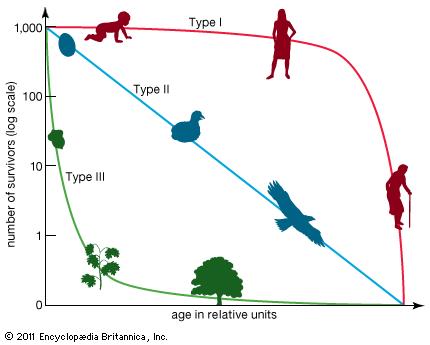
The mortality rate of organisms following a type I survivorship curve is __________.
fairly constant throughout life
higher in post-reproductive years
lower after the organisms become established
unrelated to age
What type of factor has an increasing impact as the population size increases?
density-independent
density-dependent
cohort effect
survivorship factor
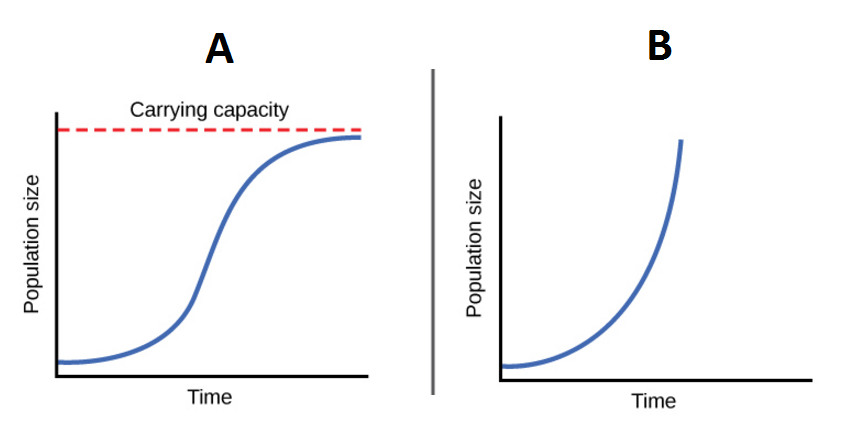
What type of growth model is shown in image A?
Exponential
Logistic
What type of growth model is shown in image B?
Exponential
Logistic
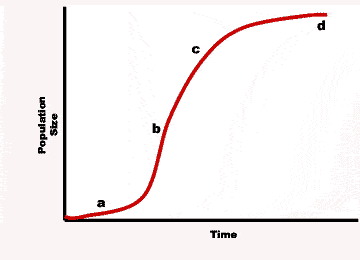
What point on the graph represents carrying capacity?
a
b
c
d
At carrying capacity, a population __________.
increases rapidly
increases slowly
decreases slowly
is in dynamic equilibrium
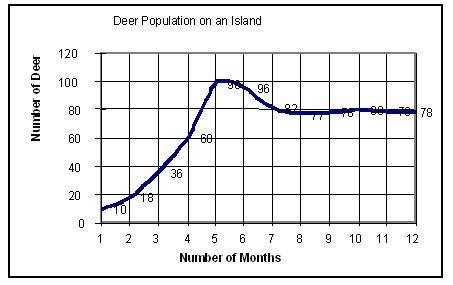
Which choice most closely approximates the deer population's carrying capacity based on the graph?
100
80
60
10
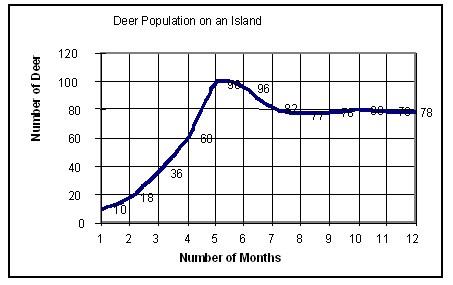
Which mathematical model most closely describes the population growth curve shown in deer population graph from the previous question?
logistic growth
exponential growth

Which population growth model most closely describes the human population in the modern age?
logistic growth
exponential growth
upward growth
tumor growth


Why do viruses need living hosts, such as bacteria or eukaryote cells?
Viruses have a cellular structure which never require a host.
Viruses depend on the host cells that they infect to reproduce.
Viruses depend on a host cell because they lack their own DNA or RNA.
The host cell is the source of food for the virus.
Cell theory states:
all living things are composed of one or more cells;
a cell is the smallest unit that still retains the properties of life;
and new cells only come from cells that already exist.
Based on cell theory, which of these answer choices would describe one reason a virus is considered nonliving?
A virus is too small to be considered a cell.
A virus does not contain genetic material.
A virus does not have a nucleus.
A virus cannot reproduce itself without a host

