wayground logo

Free Printable Worksheets

NEW

Font size

S
M
L
XL
Worksheets

Unit 1 Test Review

Total questions: 44

Worksheet time: 28mins

Name
Class
Date
1.

What step does every scientific experiment begin with?

a)

hypothesis

b)

question/problem

c)

background research

d)

conclusion

2.
True or False: Your hypothesis can never be wrong.
a)
True
b)
False
3.
The summary at the end of an experiment that explains the results. 
a)
conclusion
b)
procedures
c)
materials
d)
responding variable
4.
Another word for prediction or educated guess is: ________________
a)
hypothesis
b)
conclusion
c)
experiment
d)
data
5.
After a scientific experiment is performed, data is recorded, and conclusions are drawn, what should be done next?
a)
Share your research with other scientists
b)
Keep your research a secret
c)
Destroy all evidence of your experiment
6.

Every very proper hypothesis begins with what word?

a)

Does

b)

If

c)

Because

d)

Then

7.

Which of these contains the steps of the scientific method in the correct order?

a)

Ask a question, do background research, state your hypothesis, conduct an experiment, analyze data, make a conclusion

b)

State your hypothesis, ask a question, do background research, conduct an experiment, analyze data, make a conclusion

c)

Ask a question, state your hypothesis, do background research, conduct an experiment, make a conclusion, analyze data

d)

State your hypothesis, ask a question, do background research, make a conclusion, conduct an experiment, analyze data

8.
I must follow all instructions, written and verbal, about the laboratory procedures given by the teacher.
a)
True
b)
False
9.
When in the lab...
a)
long sleeves and loose clothing should be rolled up
b)
closed toe shoes should be worn
c)
long hair should be pulled back
d)
all of the above
10.
Which of the following IS considered safety equipment in our classroom?
a)
Eyewash Station
b)
Emergency Shower
c)
Fire Extinguisher
d)
All of the Above.
11.
When is it OK to eat or drink in the lab?
a)
Always
b)
Never
12.
What type of cell has a nucleus? 
a)
eukaryotic
b)
prokaryotic 
13.
What type of cell does not have a nucleus?
a)
eukaryotic 
b)
prokaryotic 
14.
In what organelle is the genetic material found inside?
 
a)
Endoplasmic Reticulum
b)
Golgi Complex
c)
Nucleolus
d)
Nucleus
15.
Every living organism is made up of one or more cells
a)
True
b)
False
16.
Which of the following are NOT found in animal cells
a)
chloroplasts and cytoplasm
b)
chloroplasts and cell wall
c)
cell wall and cell membrane
d)
mitochondria and nucleus
17.

Which of the following converts food into energy for the cell?

a)

vacuole

b)

mitochondria

c)

cytoplasm

d)

cell membrane

18.

Which organelle conducts photosynthesis?

a)

Vacuole

b)

Mitochondria

c)

Cytoplasm

d)

Chloroplast

19.
Which of the following is the smallest unit of life that can carry out all life functions?
a)
the mitochondria
b)
the vacuoles
c)
the nucleus
d)
the cell
20.
Which cell structure is found in plant and animals cells and controls what can come into or leave a cell?
a)
cell membrane
b)
cytoplasm
c)
nucleus
d)
vacuole
21.
Which of the following is the correct order of organization in living things from most basic (simple) to most complex?
a)
a.  Organism, cell, tissue, organ, organ system
b)
a.  Organ system, organ, tissue, cell, organism
c)
a.  Cell, tissue, organ, organ system, organism
d)
a.  Cell, organ, tissue, organ, organism, organ system
22.
A group of similar cells that come together to perform a specific function is a/an
a)
organ
b)
organism
c)
organ system
d)
tissue
23.
When a group of organs work together to perform a particular function they create a/an
a)
organ system
b)
organism
c)
tissue
d)
organ
24.
The smallest level of organization of life in an organism
a)
tissue
b)
cell
c)
organ
d)
organ system
25.
A group of cells that work together
a)
organ system
b)
organism
c)
organ
d)
tissue
26.
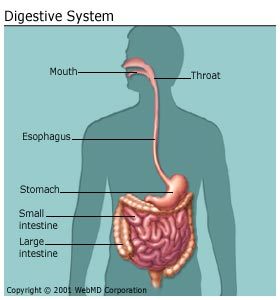
This is a example of........ 
a)
organ system
b)
cells
c)
organ
d)
tissue
27.
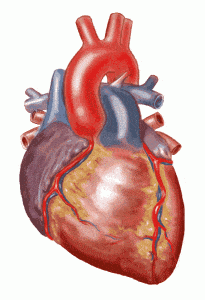
This is a example of ........
a)
cell
b)
organ system
c)
organ
d)
tissue
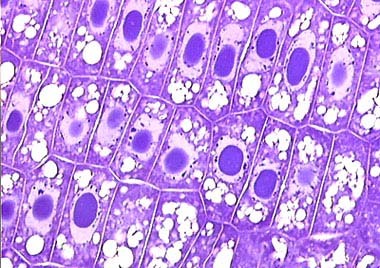
28.
This is a example of ........
a)
cell
b)
tissue
c)
organ 
d)
organ system
29.
Which statement about photosynthesis is correct?
a)
Plants get the energy they need for photosynthesis from water.
b)
Plants get the energy they need for photosynthesis from soil.
c)
Plants get the energy they need for photosynthesis from sunlight.
d)
Plants do not require energy to perform photosynthesis.
30.
What is the "waste" gas (product) produced during photosynthesis?
a)
oxygen
b)
nitrogen
c)
helium
d)
hydrogen
31.
What are the products of photosynthesis?
a)
water and carbon dioxide
b)
oxygen and glucose
c)
oxygen and carbon dioxide
d)
oxygen and water
32.
What is the pigment in chloroplasts that performs photosynthesis?
a)
Chlorosynthesis
b)
Chlorophyll
c)
ADP
d)
Electron Transport
33.
Plants need ________ for photosynthesis
a)
oxygen
b)
soil
c)
carbon dioxide
d)
sugar
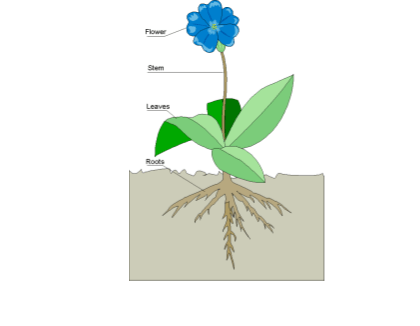
34.
Which plant part absorbs water and nutrients?
a)
Leaf
b)
Stem
c)
Roots
d)
Flower
35.
What is the structure labeled #5?
a)
Vacuole
b)
Chloroplast
c)
Mitochondria
d)
Lysosome
36.
What is the structure labeled #9?
a)
Cell Wall
b)
Cytoplasm
c)
Chloroplast
d)
Mitochondria
37.
What is the structure labeled #8?
a)
Vacuole
b)
Golgi body
c)
Nucleus
d)
Lysosome
38.
What is the structure labeled #4?
a)
Vacuole
b)
Cell wall
c)
Cytoplasm
d)
Cell membrane
39.
What is the structure labeled #10?
a)
Cell membrane
b)
Cell wall
c)
Cytoplasm
d)
Centriole
40.
Jellylike space between the membrane and the nucleus.
a)
cell wall
b)
chloroplast
c)
cytoplasm
d)
mitochondria
41.
Directs all cell activities through the DNA located there.
a)
Lysosomes
b)
Nucleus
c)
ribosomes
d)
Mitochondria
42.

Label B

a)

cell membrane

b)

ribosome

c)

lysosome

d)

mitochondria

43.
Label D
a)
mitochondria
b)
ribosome
c)
vacuole
d)
endoplasmic reticulum
44.
Label I
a)
nucleolus
b)
lysosome
c)
cytoskeleton
d)
nucleus