Wayground logo

Free Printable Worksheets

Font size

S
M
L
XL
Worksheets

Theory of evolution by natural selection

Total questions: 115

Worksheet time: 2hrs 41mins

Name
Class
Date
1.

What word describes a trait that helps an organism survive in its environment?

a)

natural selection

b)

mutation

c)

camouflage

d)

adaptation

2.
Where the better adapted organisms survive to pass traits along to offspring.
a)
Evolution
b)
Natural Selection
c)
Extinction
d)
Artifical Selection
3.
Why are advantageous traits more likely to be passed onto offspring?
a)
Because they are more likely to survive and reproduce.
b)
Because they come from dominant alleles.
c)
Because they come from recessive alleles.
d)
Because the trait is an acquired phenotype.
4.
Species have evolved into two different species when...
a)
the populations are separated geographically
b)
the populations look different
c)
the populations can no longer interbreed
d)
the populations adapt
5.
Evolution means...
a)
Change over time in a population.
b)
That everything is the same.
c)
That organisms never change.
d)
Negative traits are acquired in populations.
6.
Which is not an example of an adaptation?
a)
A bird's beak allows it to crack open hard nuts.
b)
A zebra's stripes allow it to confuse its predators.
c)
A frog's large hind legs allow it to jump from danger.
d)
A cat sleeps on the sofa to avoid the vacuum cleaner.
7.
Do organisms "decide" to evolve and change?
a)
Yes, they know they need to change to survive 
b)
No, they change because of natural selection
8.
Which best describes the role of mutations in natural selection?
a)
Mutations help an organism to better survive in their environment
b)
An organism may acquire a helpful mutation by interacting with the environment
c)
A mutation may result in an adaptive trait that makes an organism more likely to survive and reproduce
d)
Organisms with certain traits are more likely to win competitions for mutations
9.

The Theory of Evolution was proposed by what scientist?

a)

Charles Darwin

b)

Albert Einstein

c)

Steven Hawking

d)

Isaac Newton

10.

The theory of evolution by natural selection means that what is changing over time?

a)

The inherited traits of a population.

b)

The speed of a species

c)

Hair color and eye color

d)

Attractive features.

11.
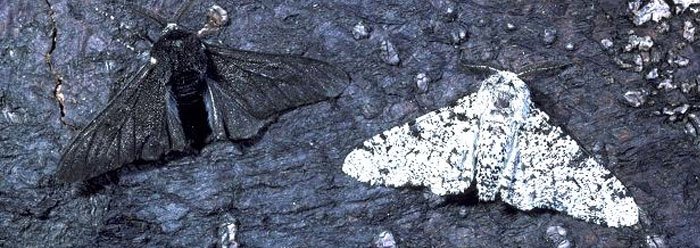
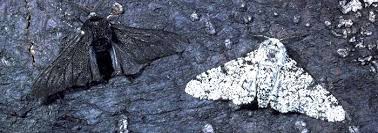
The trees these moths used to live on were white, but have been covered in soot from coal factories. Which moth will be more successful in this environment?
a)
Dark moth
b)
Light moth
c)
Both will be equally successful
d)
Neither will be successful
12.
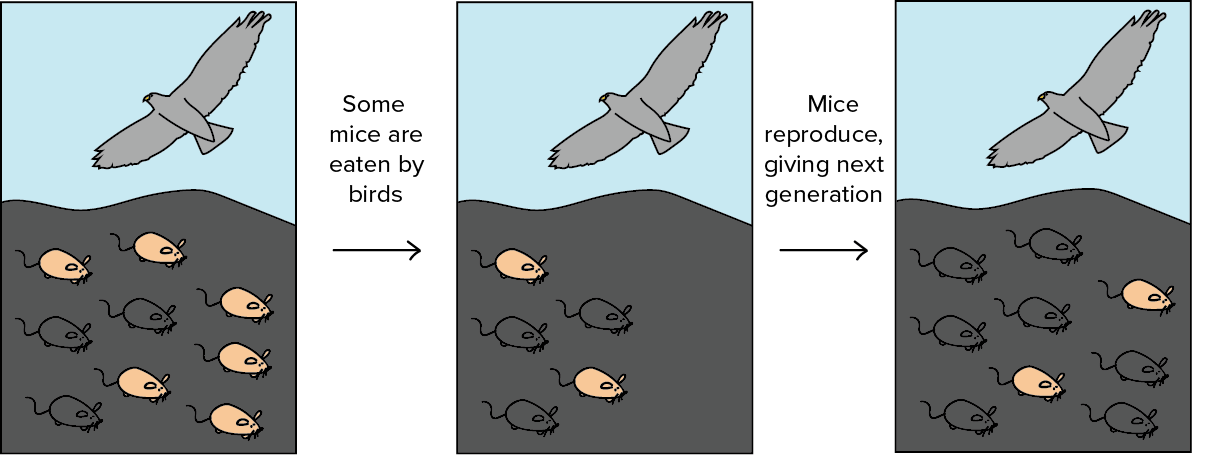
Why is the mouse population changing over time?
a)
The light mice can reproduce more successfully than the dark mice
b)
The hawks eat more dark mice than light mice because the dark mice taste better
c)
The hawks eat more light mice than dark mice because they can see the light mice more easily
d)
The hawks eat more dark mice than light mice because they can see the dark mice more easily
13.

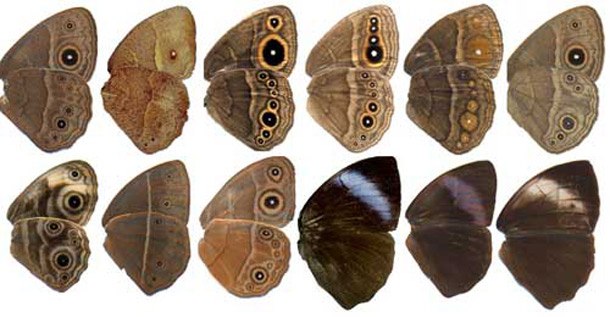
These moths are all the same species. The differences between their wings is an example of ________________

a)

Natural Selection

b)

Genetic Variation

c)

Homeostasis

d)

Extinction

14.

Natural selection is where ___________ decides which traits should be passed on

a)

Nature

b)

Humans

15.
Mutations are important because they bring about
a)
death of the organism in which they develop
b)
genetic variation needed for a population to evolve
c)
benefits for the individual, not for the population
d)
Hardey-Weinberg equilibrium within a population
16.

Which of the following is a term for a group of similar organisms that can reproduce fertile offspring?

a)

individual

b)

population

c)

species

d)

fossil

17.

Which of the following is an inherited trait.

a)

A bear searches in a different river than the other bears

b)

A bird has slightly longer wings than most of it's population

c)

A tortoise lives to be 200 years old

d)

A polar bear dies of starvation

18.

Which term refers to the passing of genetic characteristics (traits) from parent to offspring?

a)

Variation

b)

Heredity

c)

Natural Selection

d)

Overproduction

19.
A relative who lived in the past.
a)
Charles Darwin
b)
Speciation
c)
Ancestor
d)
Descendant
20.
The process of selecting a few organisms with desired traits to serve as parents of the next generation.  Selective breeding of plants and animals to promote the occurrence of desirable traits in offpsring.
a)
Evolution
b)
Natural Selection
c)
Generation Time
d)
Artificial Selection
21.
English natural scientist who formulated a theory of evolution by natural selection (1809-1882).
a)
Darwin
b)
Wallace
c)
Linnaeus
d)
Lamarck
22.
An original species from which all other species evolved.
a)
Fossil
b)
Natural Selection
c)
Descendant
d)
Common Ancestor
23.
New features that do not appear in fossils of ancestors.
a)
Derived traits
b)
Extinct
c)
Genetic Variation
d)
Species
24.
One who is descended lineally from another, as a child, grandchild, etc.
a)
Genetic trait
b)
Descendant
c)
Survival of the Fittest
d)
Ancestor
25.
Change in a kind of organism over time; process by which modern organisms have descended from ancient organisms.
a)
Extinction
b)
Genetic variation
c)
Natural Resources
d)
Evolution
26.
A term that typically describes a species that no longer has any known living individuals
a)
Generation Time
b)
Fossil Record
c)
Extinct
d)
Speciation
27.
Preserved remains or traces of ancient organisms.
a)
Natural Selection
b)
Fossil
c)
Adaptation
d)
Derived trait
28.
The information provided by fossils about the Earth's history.
a)
Fossil Record
b)
Extinction
c)
Evolution
d)
Genetic Variation
29.
The period between the birth of one generation and the birth of the next generation.
a)
Speciation
b)
Natural Selection
c)
Generation Time
d)
Ancestor
30.
A trait passed from parent to offspring through DNA.
a)
Natural Resources
b)
Survival of the Fittest
c)
Genetic variation
d)
Genetic trait
31.
Differences among individuals in the composition of their genes or other DNA segments.
a)
Natural Selection
b)
Derived traits
c)
Genetic Variation
d)
Adaptation
32.
Materials found in nature that are used by living things.
a)
Natural resources
b)
Derived Traits
c)
Fossils
d)
Species
33.
Process by which individuals that are better suited to their environment survive and reproduce most successfully; also called survival of the fittest.
a)
Extinction
b)
Speciation
c)
Natural Selection
d)
Artificial Selection
34.
Formation of new species.
a)
Speciation
b)
Trait
c)
Fossil record
d)
Ancestor
35.
A group of similar organisms that can breed and produce fertile offspring.
a)
Fossils
b)
Species
c)
Descendants
d)
Evolution
36.
Process by which individuals that are better suited to their environment survive and reproduce most successfully; also called natural selection.
a)
Survival of the Fittest
b)
Extinction
c)
Derived trait
d)
Artificial Selection
37.
A characteristic that improves an individual's ability to survive and reproduce in a particular environment.
a)
Ancestor
b)
Adaptation
c)
Descendant
d)
Fossil
38.
A characteristic that an organism can pass on to its offspring through its genes.
a)
Trait
b)
Speciation
c)
Adaptation
d)
Natural Selection
39.

The process in which organisms with traits well suited to an environment are more likely to survive and to produce offspring is

a)

Natural selection.

b)

Genetic principles.

c)

Origin of species.

d)

Trait mechanism.

40.

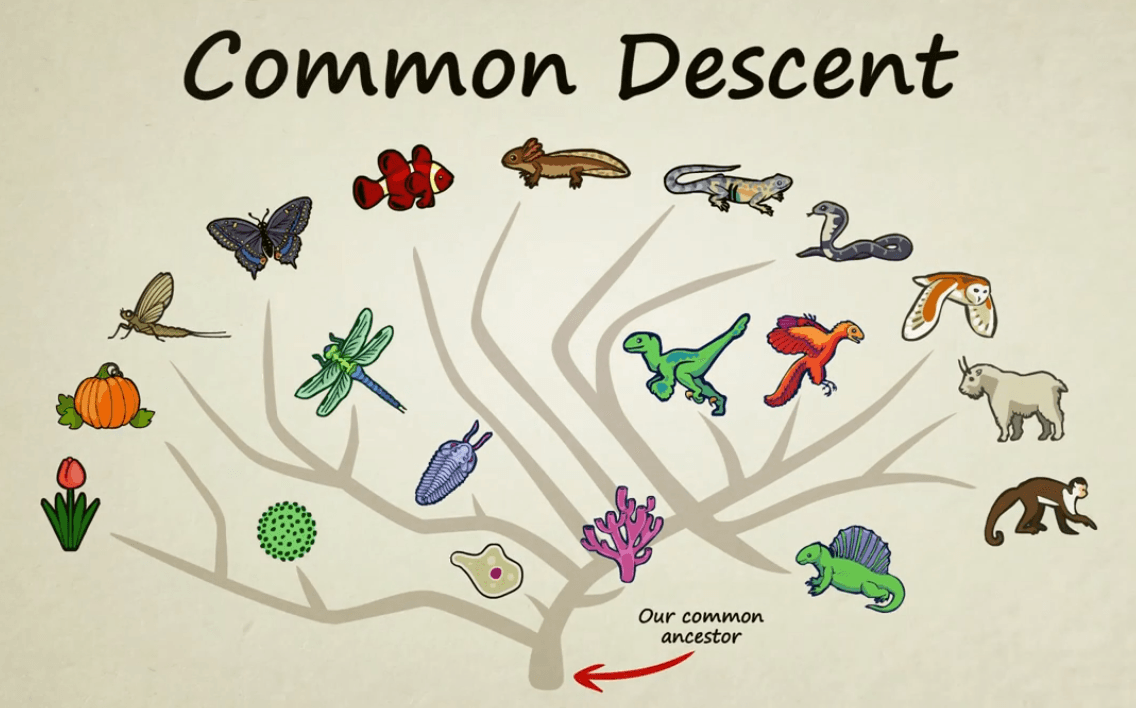
The theory of ‘common descent with modification’ states that all modern organisms

a)

can change in response to environmental change

b)

are descended from a single ancestral species

c)

can be arranged in a linear order from “least evolved” to “most evolved”

d)

Have not changed over time

41.

The breeding of organisms for desired characteristics.

a)

natural selection

b)

variations

c)

selective breeding

d)

ancestor

42.

Characteristics of an organism that enable it to survive.

a)

variation

b)

adaptation

c)

artificial selection

d)

natural selection

43.

Explains how populations change as their environment changes.

a)

ancestor

b)

selective breeding

c)

artificial selection

d)

natural selection

44.

Slight differences in the appearance of individual members of a species.

a)

variations

b)

adaptations

c)

ancestors

d)

natural selection

45.

An adaptation that involves the way an organism behaves.

a)

structural adaptation

b)

functional adaptation

c)

natural selection

d)

behavioral adaptation

46.

An adaptation that enables a species to blend in with its environment.

a)

behavioral adaptation

b)

natural selection

c)

functional adaptation

d)

camouflage

47.

An adaptation the involves internal body systems that affect biochemistry.

a)

behavioral adaptation

b)

functional adaptation

c)

structural adaptation

d)

camouflage

48.

An adaptation that involves color, shape, and other physical characteristics.

a)

structural adaptation

b)

functional adaptation

c)

behavioral adaptation

d)

natural selection

49.

The resemblance of one species to another species.

a)

camouflage

b)

mimicry

c)

ancestor

d)

variations

50.

The results of selective breeding.

a)

natural selection

b)

variations

c)

artificial selection

d)

ancestors

51.

A person who studies plants and animals by observing them.

a)

gardener

b)

florist

c)

botanist

d)

naturalist

52.

Name of the ship that Darwin sailed on his trip around the world.

a)

Pinta

b)

HMS Poodle

c)

HMS Beagle

d)

Santa Maria

53.

Island chain where Darwin observed many varieties of species.

a)

Hawaiian

b)

South American

c)

Galapagos

d)

Philipines

54.

All the observable traits and characteristics of the organism.

a)

Genotype

b)

phenotype

c)

karyotype

d)

prokaryotic

55.

Darwin thought all the Galapagos tortoises shared a common __________ that came to one of the islands millions of years ago.

a)

variation

b)

behavior

c)

ancestor

d)

offspring

56.

A beneficial __________ in neck length spreads throughout a tortoise population through natural selection.

a)

offspring

b)

species

c)

ancestor

d)

variation

57.

The process by which populations of organisms with variations that help them survive in their environments live longer, compete better, and reproduce more than those that do not have the variation.

a)

Evolution

b)

natural selection

c)

adaptation

d)

extinction

58.

An inherited trait that increases an organisms chance of surviving and reproducing in its environment.

a)

variation

b)

species

c)

natural selection

d)

adaptation

59.
Natural selection and evolution work on what level of life organization?
a)
individuals
b)
biomes
c)
populations
d)
ecosystems
60.
Which term refers to the process by which individuals that are better suited to the environment survive and reproduce therefore passing down their genes to their offspring? 
a)
Evolution 
b)
Variation 
c)
Adaptation
d)
Natural Selection 
61.
When an organism completely dies out, it is called.....
a)
Adaption
b)
Extinction
c)
Fossilization
d)
Mutation
62.
The gradual change in species over time is...
a)
Evolution
b)
Nucleotide 
c)
Adaptation
d)
Natural Selection
63.
To adjust to a changing environment
a)
Mutation
b)
Adapt
64.
Darwin wrote that organisms with traits that are best suited to the environment will ________________
a)
increase in number
b)
become extinct
65.
Another word for adapt is ____________.
a)
change
b)
create
66.
Which term refers to the process by which individuals that are better suited to the environment survive and reproduce therefore passing down their genes to their offspring? 
a)
Evolution 
b)
Variation 
c)
Adaptation
d)
Natural Selection 
67.
The white feathers of a snowy owl allow it to blend in with its environment during the winter months (snow). This is an example of ________________
a)
Species
b)
Environmental Change
c)
Adaptation
d)
Variation
68.
Genetic differences between organisms of the same species
a)
Variation
b)
Adaptation
c)
Behavior
d)
Environment
69.
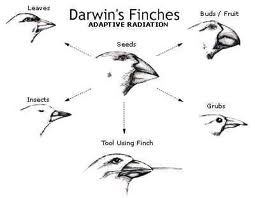
What is the advantage of having different shaped beaks?
a)
To look different from other species.
b)
To be able to eat the food readily available in the environment.
c)
To protect itself against predators.
d)
To protect itself against prey.
70.
The struggle for existence against other members of an organisms species is
a)
Competition
b)
Natural Selection
c)
gene flow
d)
genetic drift
71.
Remains of ancient organisms are called
a)
Extinctions
b)
Fossils
c)
Mutations
d)
Variations
72.
Who was the naturalist that traveled the world to study plants and animals?
a)
Albert Einstein
b)
Charles Darwin
c)
Charles Barkley
d)
Isaac Newton
73.
A well-tested concept that explains a wide range of observations is called a(an):
a)
hypothesis
b)
experiment
c)
cause and effect
d)
scientific theory
74.
Inherited trait that helps an organism survive is a(n) __________.
a)
Fossil
b)
Adaptation
c)
Ancestor
d)
Natural selection
75.
What is another name for natural selection?
a)
survival of the smartest
b)
survival of the fastest
c)
survival of the biggest
d)
survival of the fittest
76.
What is a change in an organism that allows for it to survive in its environment?
a)
homologous
b)
vestigial
c)
variation
d)
adaptation
77.
What is an organism that has similar characteristics and can reproduce?
a)
species
b)
organism
c)
embryology
d)
vestigial 
78.
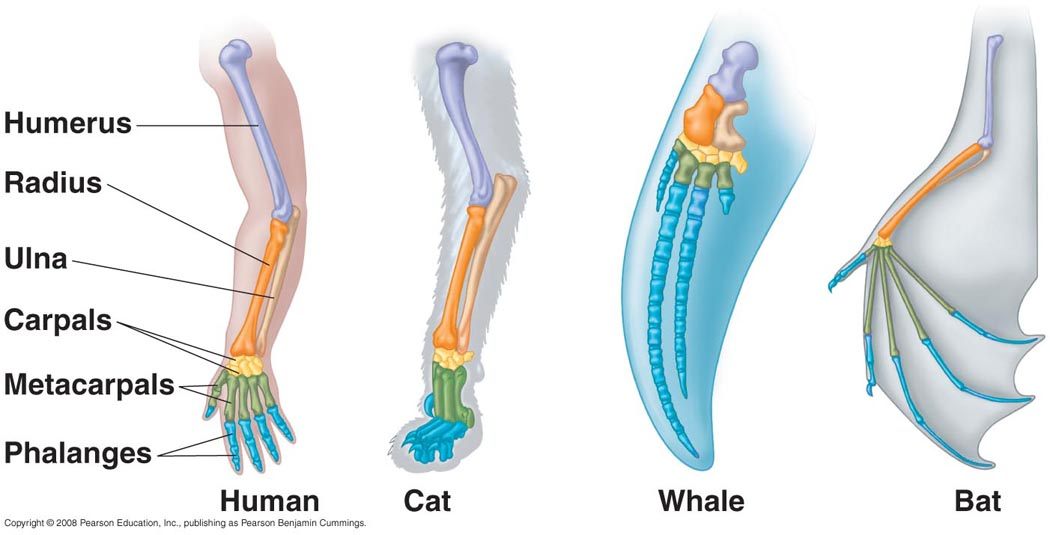
What is this an example of?
a)
diversity of species
b)
variation
c)
vestigial structures
d)
DNA studies
79.
Predict which moth would increase in population
a)
light 
b)
dark
80.
Why do frogs and other organism reproduce so many eggs or offspring?
a)
so that their babies can have friends to play with
b)
the more offspring the more likely the offspring will survive
c)
the more offspring the less likely offspring will survive 
d)
the more offspring the less competition
81.
Almost all adaptations started off as?
a)
selective breeding
b)
physiological
c)
structural
d)
mutation
82.
A change in the DNA of an organism.
a)
meoisis
b)
mutagen
c)
evolution
d)
mutation
83.
You look at two species and see very similar DNA. What does this likely tell you?
a)
These are the same animal.
b)
These animals have a common ancestor.
c)
These animals are not likely related.
d)
These animals are likely becoming one species.
84.
The differences among a species, like different bird beaks, are called
a)
genes.
b)
variations.
c)
traits.
d)
theories.
85.
Which of the following means "genetic change over time"
a)
natural selection
b)
speciation
c)
evolution
d)
fitness
86.
The famous scientist who came up with the theory of natural selection
a)
Jacobson
b)
Skubal
Einstein
c)
Darwin
d)
Curie
87.
What is an example of a vestigial structure of a HUMAN?
a)
Femur
b)
Wisdom Teeth
c)
Brain
d)
Finger
88.
What is it called when better adapted organisms survive to pass traits along to their offspring.
a)
Evolution
b)
Natural Selection
c)
Extinction
d)
Artifical Selection
89.
A trait that helps a species survive
a)
characteristic
b)
adaptation
c)
survival trait
d)
pizza trait
90.
Why are advantageous traits more likely to be passed onto offspring?
a)
Because they are more likely to survive and reproduce.
b)
Because they look cooler.
c)
Because they come from recessive alleles.
d)
Because the trait is an acquired phenotype.
91.

Which animals and features did Darwin study on his journey to the Galapagos Islands?

a)

Finches' wings

b)

Finches' beaks

c)

Lizards' claws

d)

Penguins' feet

e)

Tortoise necks

92.
What is the advantage of having different shaped beaks?
a)
To look different from other species.
b)
To be able to eat the food readily available in the environment.
c)
To protect itself against predators.
d)
To protect itself against prey.
93.
If an organism has a vestigial structure, that structure likely once had a function in a(n)
a)
close relative
b)
early ancestor
c)
unrelated organism
d)
embryological stage
94.
Bird wings and butterfly wings are an example of
a)
Homologous structure
b)
Analogous structure
c)
Mimicry
d)
Camoflague
95.
Some organisms that share a common ancestor have features that have different functions, but similar structures.  These are known as
a)
vestigial structures
b)
analogous structures
c)
homologous structures
d)
fossil structures
96.
How are camels especially suited to their environment? Choose best
a)
Their humps make them good pack animals for humans
b)
Their long eyelashes make them look pretty
c)
They can go long without water
d)
They get along well with other animals
97.
Which of the following is most likely an example of a favorable mutation?
a)
Mutation that allows rabbits to run faster
b)
Mutation that changes color of a rabbit's fur to bright orange
c)
Mutation that changes rabbit's eyes
d)
Mutation that gives rabbit a third ear
98.
The term "fittest" from the phrase "survival of the fittest" means..
a)
best adapted organisms
b)
biggest organisms
c)
smarter organisms
d)
fastest organisms
99.

Can natural selection change the genetic makeup of individuals in a population?

a)

yes, because the genes are exposed to the environment

b)

no, because it selects based on physical characteristics

100.

Fill in the missing word:

Reproduction -> mutation -> ________________ -> selection

a)

mutation

b)

natural

c)

competition

d)

variation

101.
Try this analogy:  Mutation::variation as   adaptation::_________________
a)
natural selection
b)
genetic diversity
c)
artificial selection
d)
sexual reproduction
102.
Since the 1800s humans have stopped burning coal, and the trees have returned to their original color. Which moth will be more successful in this environment?
a)
Dark moth
b)
Light moth
c)
Both will be equally successful
d)
Neither will be successful
103.
The trees these moths used to live on were white, but have been covered in soot from coal factories. Which moth will be more successful in this environment?
a)
Dark moth
b)
Light moth
c)
Both will be equally successful
d)
Neither will be successful
104.
Nature has a way of causing organisms that inherit advantageous traits to survive and reproduce more successfully than the ones that don't. This process is known as...
a)
natural selection
b)
genetic variation
c)
adaptation
d)
overproduction
105.
A lion makes more cubs than the Sahara Desert can support (there's not enough prey around), so only a few of the cubs survive to become adults. They live on to reproduce.
Of the four parts of natural selection, which is this an example of?
a)
overproduction
b)
genetic variation
c)
selection
d)
adaptation
106.
Due to a mutation, some jaguars inherit larger jaw sizes than other jaguars within that population and this trait is passed down from parent to offspring. This gives those jaguars an advantage when it comes to hunting down turtles as prey.
Of the four parts of natural selection, which is this an example of?
a)
overproduction
b)
genetic variation
c)
selection
d)
adaptation
107.
Tigers with larger paws hunt deer more easily to survive in an environment where resources are limited. As a result, the tigers with larger paws are “selected” (the larger paws become more common in the next generation of tigers).
Of the four parts of natural selection, which is this an example of?
a)
overproduction
b)
genetic variation
c)
selection
d)
adaptation
108.
A beetle's ability to camouflage (blend in) with a nearby leaf allows it to escape a hungry frog's appetite.
Of the four parts of natural selection, which is this an example of?
a)
overproduction
b)
genetic variation
c)
selection
d)
adaptation
109.
Populations of species which do not adapt to their environment can eventually become...
a)
stronger
b)
humans
c)
extinct
d)
angry
110.
Four present-day realities that some scientists use to support Darwin's theory of evolution?
a)
fossils
DNA
common bone structures
developmental similarities
b)
fossils
DNA
common bone structures
saliva
c)
fossils
common bone structures
plants
developmental similarities
d)
H2O
DNA
common bone structures
developmental similarities
111.
In both the past and the present, humans have selected plants or animals for breeding based on desirable traits. This process is known as...
a)
artificial selection
b)
natural selection
c)
farming
d)
cropping
112.
term used to describe the idea of changing from one kind of organism into another kind of organism
a)
micro-evolution
b)
adaptation
c)
macro-evolution
d)
extinction
113.
term used to describe small gradual changes within a certain kind of organism (speciation)
a)
micro-evolution
b)
adaptation
c)
macro-evolution
d)
extinction
114.
the process in which populations change over time
a)
basketball
b)
natural selection
c)
evolution
d)
mutation
115.
I formed the theory of evolution by natural selection after my research of various species of finches on the Galápagos Islands. Who am I?
a)
Reginald Punnett
b)
Charles Darwin
c)
Mr. St. Louis
d)
Gregor Mendel