Worksheets
Exploring Food Chains and Webs
Total questions: 114
Worksheet time: 2hrs 16mins
In a fun school project, Dian and her friend Susi are diving into the fascinating world of food chains! They discover that producers play a vital role in creating energy for all living things. Can you help them figure out what producers are in a food chain?
Producers are animals that consume other organisms.
Producers are organisms that create their own food, such as plants and algae.
Producers are organisms that decompose dead matter.
Producers are organisms that rely on external sources for food.
Rudi and Indah were diving into the wonders of ecosystems in their biology class. They discovered that all energy for an ecosystem kicks off at the...
(a)
In her exciting science class, Siti is on a quest to discover the wonders of plants! Can you help her name one fantastic example of a producer? Choose wisely!
Carrot
Mushroom
Fish
Sunflower
Dedi and Rina are diving into an exciting school project about the Energy Pyramid! Can you help them understand how energy flows through different organisms?
Show path of energy from one organism to another
the sun
Shows amount of energy moving up trophic levels
Overlapped food chains: more realistic
In the exciting world of food chains, what roles do our friends Dimas and Rizal play? Let's find out!
Consumers are organisms that obtain energy by eating producers or other consumers in a food chain.
Consumers are only herbivores in a food chain.
Consumers produce energy for the food chain.
Consumers do not interact with producers in a food chain.
Nisa, Susi, and Lina are diving into the fascinating world of ecosystems! Can you help them identify the three types of consumers they discovered during their studies?
Predators, Prey, Parasites
Filter feeders, Detritivores, Symbionts
Herbivores, Carnivores, Omnivores
Producers, Decomposers, Scavengers
Adi and Nur were exploring the wonders of their school garden when they stumbled upon the fascinating world of decomposers! They discovered that these tiny heroes play a vital role in keeping the ecosystem healthy. Can you guess what the main function of decomposers is in an ecosystem?
Decomposers recycle nutrients and break down dead organic matter in an ecosystem.
Decomposers are primary consumers in the food chain.
Decomposers produce energy through photosynthesis.
Decomposers create new organic matter from inorganic substances.
During a fun science project, Laila and Rudi were excitedly discussing the amazing roles of different organisms in an ecosystem. They wanted to come up with a cool example of a decomposer. What did they think of?
Animal (e.g., rabbit)
Fungus (e.g., mushroom)
Plant (e.g., fern)
Mineral (e.g., granite)
In a lively biology class, Rizky, Joko, and Sari are on a quest to uncover the secrets of how energy flows through a food chain! They discover that energy travels from the mighty producers to the hungry consumers, but wait—there's a twist! Energy gets lost at each step of the way. Can you help them understand how energy flows through a food chain?
Energy does not get lost as it moves through the food chain.
Energy is transferred equally at all trophic levels.
Energy flows from producers to consumers in a food chain, with energy loss at each trophic level.
Energy flows only from consumers to producers.
Rahman and Dian were diving into the fascinating world of ecosystems in their biology class. They discovered that understanding how energy flows through different organisms is crucial, and that's where trophic levels come into play! But what exactly is a trophic level?
A trophic level is a type of plant.
A trophic level refers to the size of an ecosystem.
A trophic level is a position in a food chain that represents the feeding relationships among organisms.
A trophic level is a measure of biodiversity.
Hey there, Nita! As you dive into the fascinating world of the food chain in your local pond, can you guess how many trophic levels are typically found in a food chain? Let's see if you can outsmart your friends Adi and Faisal!
1 to 2
4 to 5
6 to 7
2 to 3
In a fun school project, Mega is diving into the wonders of the local ecosystem! She discovers that a food chain is like a straight path showing how energy flows from one organism to another, while a food web is more like a bustling city, illustrating the complex interactions between various organisms. Can you help Mega understand the difference between a food chain and a food web?
A food chain shows only herbivores, while a food web shows only carnivores.
A food chain includes multiple species, while a food web includes only one species.
A food chain is a linear sequence of energy flow, while a food web is a complex network of interconnected food chains.
A food chain is a complex network, while a food web is a simple sequence.
Imagine Rina, Siti, and Rahman are exploring the vibrant ecosystem of their local park! How do food webs help them understand the exciting interactions happening all around them?
Food webs only show the number of species in an ecosystem.
Food webs illustrate the physical structure of habitats.
Food webs demonstrate ecosystem interactions by showing the relationships and energy flow between producers, consumers, and decomposers.
Food webs are solely focused on the behavior of individual organisms.
Hey Adi and Susi! Imagine you're exploring the vibrant ecosystem of Tiara's garden. What do you think happens to energy as it climbs up the trophic levels in this magical place?
Energy decreases as it moves up trophic levels.
Energy increases as it moves up trophic levels.
Energy remains constant across trophic levels.
Energy is completely lost at each trophic level.
Hey Nita and Angga! Have you ever wondered why producers are the superheroes of energy flow in our ecosystems?
Producers do not play a role in the food chain.
Producers are only important for plant growth.
Producers are essential for energy flow as they convert solar energy into chemical energy, supporting all other trophic levels.
Producers consume energy from other organisms.
Hey Mega, Rudi, and Titi! Have you ever wondered how those tiny decomposers work their magic in Siti's garden? Let's find out!
Decomposers only affect plant growth by competing for nutrients.
Decomposers recycle nutrients by breaking down dead matter and returning essential nutrients to the soil.
Decomposers primarily consume living organisms for sustenance.
Decomposers produce energy through photosynthesis.
Imagine Faisal and Sari are exploring the wonders of Tiara's garden. What do you think would happen to the ecosystem if all the decomposers decided to take a vacation?
The ecosystem would suffer from nutrient depletion, reduced biodiversity, and potential collapse.
Decomposers would become more abundant.
The ecosystem would thrive with more plants.
Nutrient levels would increase significantly.
Rizal, along with his friends Susi and Dewi, is on an exciting adventure studying different types of animals in the forest. They discover that a herbivore...
Eats dead organisms and turns them into nutrients
Eats producers and consumers
Eats consumers
Eats producers
Yuni and Angga are on an exciting adventure to explore the wonders of the environment! As they dive into the fascinating world of ecosystems, they discover the vital role of producers. Can you help them figure out what the primary source of energy for these amazing producers is?
Water
Soil nutrients
Sunlight
Carbon dioxide
Adi and Agus are having a lively debate about the fascinating world of eaters in the animal kingdom! Can you help them figure out which of the following best describes omnivores?
Organisms that only eat plants
Organisms that only eat animals
Organisms that eat both plants and animals
Organisms that decompose dead matter
Hey Titi and Susi! Have you ever wondered what role apex predators play in our ecosystems? Let's dive into this exciting topic!
Apex predators have no significant impact on the ecosystem.
Apex predators help maintain the balance of populations within the ecosystem.
Apex predators only affect herbivore populations.
Apex predators increase the number of producers in an ecosystem.
One sunny day, Hadi, Siti, and their friend Agung were having a lively discussion about the starting source of energy for all food chains. Can you guess what it is?
grass
bug
sun
mushrooms

Agung and Laila are exploring a vibrant forest ecosystem. They discover that mushrooms are hard at work breaking down dead organic matter. What role do these fungi play in the food chain?
Producer
Consumer
Decomposer

One sunny day, Agus, Siti, and Dimas are exploring the park when they spot a magnificent tree towering above them. Can you guess what important role this tree plays in the ecosystem?
Producer
Consumer
Decomposer
In a fun school project, Rina and her friend Agus are diving into the fascinating world of ecosystems! They discover that herbivores are like the superheroes of the food chain. Can you guess what their primary role is in this amazing ecosystem?
Herbivores are responsible for decomposing dead matter.
Herbivores consume producers and transfer energy to higher trophic levels.
Herbivores are the main source of energy for apex predators.
Herbivores do not interact with other organisms in the ecosystem.
Dian and Agus were having a lively chat about the amazing roles of different organisms in their school garden. Can you help them figure out how scavengers differ from decomposers?
Scavengers consume dead organisms, while decomposers break down organic matter into nutrients.
Scavengers are primary producers, while decomposers are consumers.
Scavengers only eat living organisms, while decomposers only eat dead matter.
Scavengers and decomposers perform the same function in an ecosystem.
While exploring the wonders of nature, Angga and Ina stumble upon the fascinating world of biodiversity and its role in food chains. What exciting discovery do they make about its impact?
Biodiversity has no impact on food chains.
Biodiversity increases the resilience of ecosystems and supports various food chains.
Biodiversity only affects the number of producers in an ecosystem.
Biodiversity reduces competition among species in food chains.
Hey Arif and Angga! Let's dive into the wild world of food webs! What do you think is the primary role of herbivores in this ecosystem?
Herbivores are responsible for producing energy in the ecosystem.
Herbivores consume plants and transfer energy to higher trophic levels.
Herbivores decompose dead organic matter.
Herbivores are the main predators in a food web.
Hey Laila and Angga! How do omnivores contribute to the balance of an ecosystem? Let's find out!
Omnivores only consume plants, affecting herbivore populations.
Omnivores eat both plants and animals, helping to regulate multiple trophic levels.
Omnivores do not interact with other organisms in the ecosystem.
Omnivores are primarily responsible for energy production.
Imagine Indah, Mega, and Dewi are on an exciting adventure in their local forest! What do you think would happen if the forest started losing its biodiversity, affecting the food chain?
It would have no effect on the food chain.
It would lead to increased competition and instability in the ecosystem.
It would enhance the resilience of the ecosystem.
It would only affect the number of producers in the food chain.

In a fun school project, Susi and Rudi are exploring the fascinating food chain in a meadow. They discover that one of the organisms they encounter is a producer. Can you guess which of the following organisms is a producer?
grass
rabbit
fox
snake

During a fun school project, Nita discovered that deer munch on grass, which is a type of plant. Can you guess which of the following gets its energy directly from a producer like grass?
Sun
Plants
Deer
Snake
In a fun school project, Dian and Wawan are diving into the fascinating world of ecosystems! They discover that producers are like the superheroes of the food chain. Can you guess what their superpower is?
To decompose organic matter
To convert solar energy into chemical energy
To consume other organisms
To recycle nutrients
In a fun school project, Yuni and her friends Lina, Adi, and Angga are diving into the fascinating world of a local ecosystem! They are on a mission to discover the different living things around them. Can you help them identify which of the following is an example of a producer?
Lion
Mushroom
Grass
Eagle
In a fun school project, Nisa, Indah, and Joko are diving into the fascinating world of ecosystems! They learn that in a food chain, different organisms play unique roles. Can you guess what producers are in a food chain?
Producers are animals that consume other organisms.
Producers are organisms that rely on other organisms for food.
Producers are organisms, like plants and algae, that produce their own food and form the base of a food chain.
Producers are decomposers that break down dead matter.
Hey Eko and Joko! Let's dive into the wild world of food chains! What role do consumers play in this exciting ecosystem?
Consumers are organisms that obtain energy by eating producers or other consumers in a food chain.
Consumers do not interact with producers in a food chain.
Consumers produce energy for the food chain.
Consumers are only herbivores in a food chain.
In a lively local ecosystem, Mega and Rudi were fascinated to see that rabbits munch on grass and other plants. Can you guess what a primary consumer is in this delightful scenario?
An organism that feeds on other consumers.
A plant that produces its own food.
A decomposer that breaks down organic matter.
An organism that feeds on primary producers.
Faisal and Nisa are diving into the fascinating world of food chains in their biology class! They discover that energy has a wild journey as it travels up the food chain. Can you guess what happens to energy as it climbs higher?
Energy increases as it moves up the food chain.
Energy remains constant as it moves up the food chain.
Energy is completely transferred to the next level in the food chain.
Energy decreases as it moves up the food chain.
One sunny day, Sari and Eko were exploring a small pond and discovered an amazing food chain! They saw how the tiny algae were gobbled up by small fish, which then became a tasty meal for the larger fish. Can you tell them what a food chain is?
A series of organisms each dependent on the next as a source of food
A network of interconnected food webs
A group of animals that live together
A type of ecosystem

Hey Wawan, in the magical forest ecosystem that Lina studies, where does the energy adventure begin in this food chain?
Plant
Sun
Deer
Wolf
Imagine Hadi and Agus are enjoying a day by the river when they discover that the water is contaminated. What impact do you think toxic substances in that water could have on them?
Toxic substances can harm health, cause diseases, and lead to economic burdens.
Toxic substances improve health and well-being.
Toxic substances have no effect on consumers.
Toxic substances are beneficial for economic growth.
Why is it super important for Surya, Agus, and their friend Tiara to dive into the fascinating world of food webs in their biology class?
Food webs are only relevant to marine ecosystems.
Understanding food webs is unnecessary for studying individual species.
It is important to understand food webs to grasp the interconnections and energy flow in ecosystems.
Food webs only describe the behavior of predators.
Hey Rizky and Tiara! What fun and creative things can you do to protect our precious food chains and webs?
Increase pesticide use to eliminate pests.
Encourage monoculture farming practices.
Reduce protected areas for wildlife.
Conserve habitats and promote biodiversity.
Rizal, Siti, and Agung are diving into the fascinating world of ecosystems in their biology class! They discover that a food chain is like a simple story of energy flowing from one organism to another, while a food web is more like a thrilling novel, showcasing the intricate connections between various organisms. Can you spot the main difference between a food chain and a food web?
A food chain is more complex than a food web
A food web shows multiple food chains and their connections
A food chain includes decomposers, while a food web does not
A food web is linear, while a food chain is not
Hey Dedi, Heri, and Nita! Have you ever wondered how energy travels through a food chain? Let's explore this together!
From top predators to primary producers
From the sun to producers to consumers
In a circular motion
Randomly between organisms
One sunny day, Adi, Faisal, and Laila are by the local pond, excitedly observing the fascinating world of organisms interacting with each other. Can you help them figure out which of the following organisms is most likely to be a secondary consumer in this food chain?
Grasshopper
Frog
Grass
Eagle
In a small garden, Nita and Dian are on a quest to discover the fascinating world of organisms! As they observe a sequence of creatures, each one relies on the next for its meal. Which of the following best describes this captivating food chain?
A network of interconnected food webs
A sequence of organisms each dependent on the next as a source of food
A group of organisms that share the same habitat
A collection of organisms that do not interact with each other
which one is a Producer?


Nita and Ina are exploring the wonders of nature! Can you help them complete the food chain? What comes after the rabbit?
a rock
a fox
a plant
an egg

In a fun school project, Dewi and Nisa are diving into the exciting world of food webs! Can you help them identify which organism in their food web munches on plants? Which one is the herbivore?
Frog
Grasshopper
Mouse
Snake

In our vibrant local ecosystem, Rudi wonders how the shrew provides energy for the _______?
cricket
grasshopper
frog
snake

Look at the food web of a pond ecosystem.
Which food chain shows the correct flow of energy in the pond
of the food web?


Explain the role of decomposers in maintaining ecosystem balance.
They produce energy from sunlight
They recycle nutrients back into the soil
They compete with producers for sunlight
They consume primary consumers
What is the primary role of producers in a food chain?
To decompose dead organisms
To produce energy from sunlight
To eat other animals
To compete with consumers
Which of the following is an example of a consumer in a food chain?
Grass
Rabbit
Sunlight
Water
Which of the following scenarios best illustrates a food web interaction?
A rabbit eating grass
A hawk eating a snake, which eats a frog, which eats insects
A tree absorbing sunlight
A mushroom decomposing a log
How do humans impact food chains and webs?
Humans disrupt food chains and webs by altering habitats, overexploiting resources, and introducing pollutants.
Humans enhance food chains by increasing biodiversity.
Humans have no effect on food chains and webs.
Humans only impact food chains through agricultural practices.
What is a food chain?
A food chain is a diagram showing the nutritional value of food.
A food chain is a type of cooking method.
A food chain is a sequence of organisms each dependent on the next as a source of food.
A food chain is a list of all the foods in a grocery store.
Define a food web.
A food web is a diagram showing the life cycle of a plant.
A food web is a type of food that is eaten by humans.
A food web is a network of feeding relationships among various organisms in an ecosystem.
A food web is a single linear chain of organisms.
What role do producers play in a food chain?
Producers are the top predators in a food chain.
Producers are the primary consumers in a food chain.
Producers rely on other organisms for energy.
Producers convert sunlight into energy and form the base of the food chain.
How does energy flow through a food chain?
Energy flows from producers to consumers in a food chain, with energy loss at each trophic level.
Energy is constant at all trophic levels.
Energy flows only from consumers to producers.
Energy is lost only at the producer level.
Why are food webs more complex than food chains?
Food chains are more detailed than food webs.
Food webs are more complex than food chains because they represent multiple interconnected feeding relationships among organisms.
Food chains show all possible feeding relationships.
Food webs only include herbivores and carnivores.
Which of the following is true about the energy available to organisms at higher trophic levels in a food chain?
Energy increases as you move up the trophic levels.
Energy remains constant across all trophic levels.
Energy decreases as you move up the trophic levels.
Energy is not transferred between trophic levels.
Which of the following organisms is a producer?
grass
rabbit
fox
snake
Which of the following gets it's energy directly from a producer?
Sun
Plants
Deer
Snake
What is the main role of consumers in a food chain?
To produce energy from sunlight
To break down dead organisms
To eat other organisms for energy
To recycle nutrients back into the soil
What role do decomposers play in an ecosystem?
They produce food for other organisms
They consume primary consumers
They break down dead material and recycle nutrients
They provide energy for producers
Identify the role of scavengers in an ecosystem.
Scavengers produce energy from sunlight.
Scavengers consume dead animals, helping to recycle nutrients.
Scavengers are primary producers.
Scavengers decompose organic matter.
Analyze a simple food web and determine the impact of removing a top predator.
The prey population may increase, leading to overconsumption of producers.
The prey population will decrease, leading to more producers.
The producers will become top predators.
The food web will become more stable.
What is the difference between a food chain and a food web?
A food chain is a complex network, while a food web is a simple linear path.
A food chain shows one path of energy flow, while a food web shows multiple paths.
A food chain includes all organisms, while a food web includes only producers.
A food chain is only found in aquatic environments, while a food web is terrestrial.
Which of the following best describes a primary consumer in a food chain?
An organism that produces its own food
An organism that eats producers
An organism that eats other consumers
An organism that decomposes organic material
How do food webs differ from food chains?
Food webs are linear, while food chains are complex networks.
Food webs show multiple interconnected food chains, while food chains show a single path of energy flow.
Food webs only include producers, while food chains include all trophic levels.
Food webs are found only in aquatic environments, while food chains are found on land.

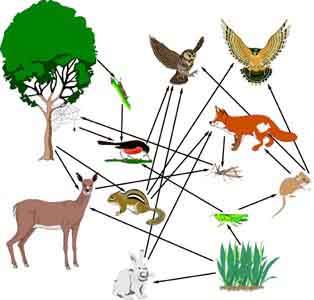
Which of these is a possible Food Chain for this Ecosystem?
grass → fly → frog
frog → fly → grass
grass ← fly ← frog
fly → frog → snake
_______ are organisms that eat plants.

Which best describes what a Food Chain shows you?
A food chain shows the energy flow through an ecosystem
A food chain shows food flowing through an ecosystem
A food chain shows consumers fighting other consumers
A food chain shows who eats who

What some of the Secondary Consumers in this Food Web?
Owl
Fox
Mouse
Bird
Rabbit


Animals that eat a variety of meats, fruits, and vegetables are
producers.
carnivores.
omnivores.
herbivores.
In a food web, arrows point in just one direction because they show
which animal is bigger.
which animals are related.
how energy goes to the animal that is eating.
how energy goes to the animal that is eaten.
Photosynthetic autotrophs are organisms that
consume producers for energy.
manufacture their own food from sunlight.
consume primary consumers for energy.
consume secondary consumers for energy.
Photosynthetic autotrophs are organisms that
consume producers for energy.
manufacture their own food from sunlight.
consume primary consumers for energy.
consume secondary consumers for energy.

One path that energy can travel through an ecosystem is called?
Leveling
Food Chain
Eating
Mechanical Transfer

All the ways that energy can move and be transferred through an ecosystem is called?
Food Chain
Spider Web
Gold Chain
Food Web

Each organism that gets its energy from producers are called?
Primary Consumers
Primary Producers
Secondary Consumers
Primary Decomposers

Organisms that have 4 arrows from the producers are called?
Primary Consumers
Secondary Consumers
Tertiary Consumers
Quaternary Consumers

In a food web the energy lost is usually in the form of?
Sound
Heat
Light
Gas

In this food chain the owl is a?
Producer
Primary consumer
Tertiary Consumer
Autotroph

Why do you think it is called an energy pyramid?
Because there are MORE animals at the top
Because there are LESS organisms at the bottom
Because there is MORE energy at the top
Because there are LESS animals at the top

What do you think you would be on the food pyramid?
At the bottom producing food
In the middle as a primary consumer
At the top as a tertiary consumer
Humans are not on the food pyramid

I eat the grass in the field and I am scared of the birds eating me. I am probably a?
Producer
Autotroph
Primary consumer
Tertiary consumer

What is the prey of the snake?
the grasshopper
the frog
the eagle
the grass

A producer in this food chain is ...
the grass
the grasshopper
the frog
the snake
Which of the following is an example of aquatic habitats?
desert
rivers
grassfield
rainforest
A habitat should provide these for the living things, except ....
shelter
food
water
clothes

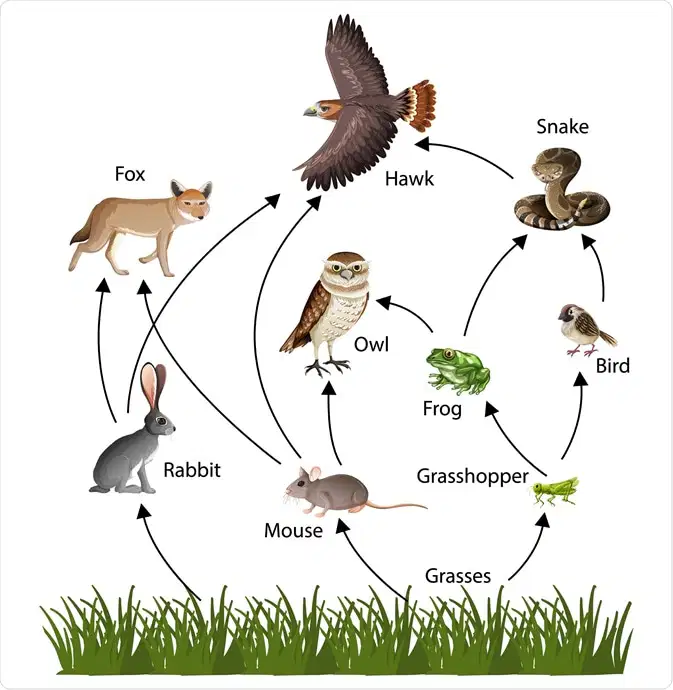
A food web is a model that shows how different ___________ are connected.
predators and prey
food chains
plant
animals

Which organism is the top consumer?
wolf
phyton
eagle
thursh
Which of the following is NOT a consumer?