wayground logo

Free Printable Worksheets

Font size

S
M
L
XL
Worksheets

Forces and Fields

Total questions: 119

Worksheet time: 1hrs 1mins

Name
Class
Date
1.

What is an object that attracts, or pulls on, materials that contain iron?

a)

magnet

b)

force

c)

field

d)

poles

2.

How do magnets interact with other magnets?

a)

opposite charges attract

b)

opposite charges repel

c)

like charges attract

d)

like charges repel

3.

What is the push or pull exerted by magnets?

a)

magnetic force

b)

electric force

c)

gravitational force

d)

electromagnetic force

4.

Which of the following statements is true?

a)

Magnets can have two north poles.

b)

Magnets can have two south poles.

c)

Magnets don't always have poles.

d)

All magnets have north and south poles.

5.

Why are most materials not magnetic?

a)

The poles are oriented in all directions.

b)

The poles are lined up.

c)

The poles are backwards.

d)

The poles are upside down.

6.

What are areas where like poles of the atoms point in the same direction?

a)

gravitational domains

b)

electric domains

c)

magnetic domains

d)

ferromagnetic domains

7.

What are materials that form magnetic domains called?

a)

domain magnets

b)

ferromagnetic materials

c)

domain materials

d)

magnetic ferros

8.

Which of the following are ferromagnetic materials?

a)

iron

b)

wood

c)

nickel

d)

cobalt

9.

We can see magnetic domains without a microscope.

a)

true

b)

false

10.

In a small iron particle made of 200 atoms, the north poles of 100 atoms are pointed right and the north poles of another 100 atoms are pointed left. Which statement describes the net magnetic force exerted by the iron particle?

a)

The net magnetic force is about zero.

b)

The net magnetic force is less than zero.

c)

The net magnetic force is 100 times stronger as the force of the atoms.

d)

The net magnetic force is 200 times as strong as the force of the atoms.
11.
The attractive force between two magnets increases. Which statement explains why this would happen?
a)
The like poles of the magnets are pointed at each other and move farther apart.
b)
The like poles of the magnets are pointed at each other and move closer together.
c)
The unlike poles of the magnets are pointed at each other and move farther apart.
d)
The unlike poles of the magnets are pointed at each other and move closer together.
12.
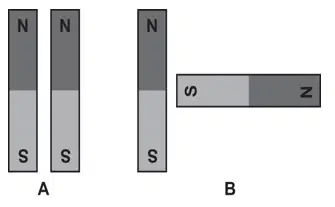
Kim has two bar magnets. First, she places them beside one another, as shown in Picture A. Then, she moves one of the bar magnets so they are placed as shown in Picture B. How did the magnetic force change?
a)
The bars go from attracting each other to repelling each other.
b)
The bars go from repelling each other to attracting each other.
c)
The bars go from repelling each other to the second bar rotating.
d)
The bars go from attracting each other to the second bar rotating.
13.
Which of these determines whether or not a material is magnetic?
a)
the density of the material
b)
the weight of the material on Earth
c)
the alignment of atoms in the material
d)
the number of elements that make up
14.
A student claims that all magnets have two magnetic poles. Which of these observations would best support her claim?
a)
Iron is attracted to a magnet but not to other pieces of iron.
b)
When a bar magnet is cut in half, each half has a north pole and a south pole.
c)
The north pole of a compass needle is attracted to the south pole of a bar magnet.
d)
The strength of the magnetic force from a bar magnet decreases as the magnet is pulled away from another object.
15.
Angela tries to pick up a copper penny using a bar magnet, but the penny does not move. Next, she tries to pick up an iron nail using the bar magnet, and the nail lifts up toward the magnet. Which of the following best describes a ferromagnetic material like iron?
a)
Ferromagnetic materials do not conduct electricity.
b)
Ferromagnetic materials always produce a magnetic force.
c)
Ferromagnetic materials are nonmetals that produce magnetic forces.
d)
Ferromagnetic materials have magnetic domains that align with a magnetic field.
16.
A magician wants to use magnets to create a new illusion for her show. She plans to hide strong magnets in her shoes and inside a special rug on the stage. When she tests the illusion, she finds that her shoes stick to the rug. What will happen if she flips the poles of the magnets in each of her shoes?
a)
Her shoes will float above the rug.
b)
Her shoes will still be stuck to the rug.
c)
Her shoes will no longer be affected by the rug.
d)
Her shoes will stick to each other instead of to the rug.
17.
Why can some objects be magnetized by rubbing one pole of an existing magnet in one direction along the object?
a)
The motion of the existing magnet against the object aligns the magnetic domains of the object.
b)
The motion of the existing magnet against the object scrambles, or unaligns, the magnetic domains of the object.
c)
The motion of the existing magnet against the object generates an electric current that transforms the object into an electromagnet.
d)
The motion of the existing magnet against the object wears away the object’s surface, exposing the naturally occurring magnets underneath.
18.
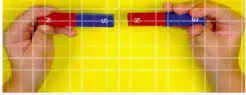
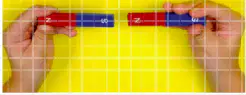
If the magnet on the right is flipped so that the south pole is on the left, the magnetic force will be ______. As the magnets are moved closer together, the magnetic force between them will become _____.
a)
attractive, stronger
b)
attractive, weaker
c)
repulsive, stronger
d)
repulsive, weaker
19.
If the two magnets were cut in half along the line between the red and blue pain, which statement would describe the four bars that are produced?
a)
Each piece would have one magnetic pole and a nonmagnetic pole.
b)
Each piece would have a north pole and a south pole.
c)
Two pieces would only have south poles and the other two pieces would only have north poles.
20.
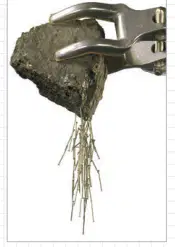
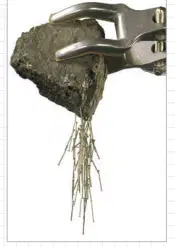
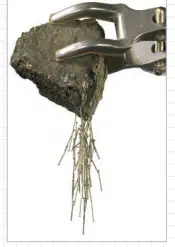
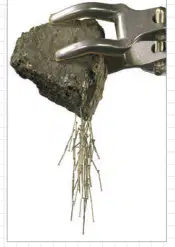
Which statements describe the iron-containing rock and the nails?
a)
The rock is a magnet.
b)
The nails are attracted to magnets.
c)
Most of the magnetic domains in the rock are randomly oriented.
d)
Most of the magnetic domains in the rock are aligned with each other.
21.
Removing half of the rock would _____ the magnetic force.
a)

increase

b)

decrease

c)

not affect

22.
Moving the rock and nails higher would ______ the magnetic force.
a)

increase

b)

decrease

c)

not affect

23.
Increasing the distance between the rock and the nails would ______ the magnetic force.
a)

increase

b)

decrease

c)

not affect

24.
Using copper nails instead of iron nails would ________ the magnetic force.
a)
increase
b)
decrease
c)
not affect
25.
Replacing the rock with a similarly sized stronger magnet would _______ the magnetic force.
a)
increase
b)
decrease
c)
not affect
26.
Which object would be attracted by a magnet?
a)
an iron nail
b)
a latex balloon
c)
a piece of paper
d)
an aluminum paper clip
27.
The end of one bar magnet is placed near the end of another bar magnet. The two ends seem to push each other apart. Which of these statements is true?
a)
The two ends are like poles.
b)
The two ends are unlike poles.
c)
There are like charges on the two ends.
d)
There are unlike charges on the two ends.
28.
Which of these is a ferromagnetic material?
a)
aluminum
b)
copper
c)
diamond
d)
iron
29.
Sometimes the north and south poles of atoms in a material will line up. What is the term for the region where this occurs?
a)
domain
b)
ferromagnetic
c)
magnetic field
d)
magnetic pole
30.
Why are certain materials, such as copper and aluminum, not magnetic?
a)
The individual atoms that make up the materials do not have magnetic fields.
b)
The individual atoms that make up the materials align themselves into domains.
c)
The magnetic fields of the individual atoms that make up the materials cancel each other out.
d)
The magnetic fields of the individual atoms that make up the materials are highly unstable and easily lost.
31.
Which of these is an example of a force that acts at a distance?
a)
An airplane experiences friction as it moves through air.
b)
A book experiences a normal force as it rests on a table.
c)
A soccer ball experiences a force as it is kicked across a field.
d)
A magnet is pushed away when it is brought near the end of another magnet.
32.
A repelling force occurs between two charged objects when the charges are of ______________.
a)
like signs
b)
unlike signs
c)
equal magnitude
d)
unequal magnitude
33.
When Bethany walks across a carpet, her socks pick up many electric charges. Later in the day, these charges are no longer present on her socks. What most likely happened to the charges?
a)
The charges disappeared.
b)
The charges switched signs.
c)
The charges transferred to another object.
d)
The charges broke apart into smaller particles.
34.
During a lightning storm, the bottom of a cloud gains a strong negative electric charge. Which of these describes the charge at the top of a tall metal pole directly under the cloud?
a)
The top of the pole would have no charge.
b)
The top of the pole would have a positive charge.
c)
The top of the pole would have a negative charge.
d)
The charge of the pole would not be affected by the charge of the cloud.
35.
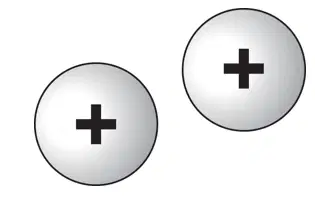
This image shows two circular objects. Each object has an electric charge, as shown. Which statement describes the force that is exerted on the objects due to their electric charge?
a)
There is a force pushing both objects to the left.
b)
There is a force pulling the objects toward each other.
c)
There is a force pushing the objects away from each other.
d)
There is no force on the objects due to their electric charge.
36.
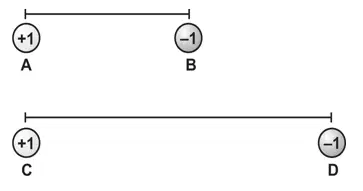
The diagram shows two pairs of charged objects. Objects A and B are interacting with each other, and objects C and D are interacting with each other. Based on the diagrams, which statement is true?
a)
There are no electric forces because the charges in each pair of objects cancel.
b)
The electric force between A and B is smaller than the electric force between C and D.
c)
The electric force between A and B is greater than the electric force between C and D.
d)
The electric force between A and B is identical in magnitude to the electric force between C and D.
37.
What happens when a rubber rod is rubbed with a piece of fur, giving the rod a negative charge?
a)
Negative charges are moved from the rod to the fur.
b)
Negative charges are moved from the fur to the rod.
c)
Negative charges are added to the rod, and the fur remains neutral.
d)
Positive charges are removed from the rod, and the fur remains neutral.
38.
The distance between a positively charged object and a negatively charged object increases. If everything else remains constant, what happens to the electric force between the objects?
a)
The electric force decreases.
b)
The electric force increases.
c)
The electric force remains constant.
d)
There is not enough information to answer this question.
39.
An object is most likely to become electrically charged by gaining or losing which type of particles?
a)
neutral particles
b)
positive particles
c)
negative particles
d)
none of the above
40.
All charged objects create an electric field around them. What two factors determine the strength of the two electric fields upon the charged objects creating them?
a)
how charged the object creating the field is and the mass of the two charged objects
b)
how charged the object creating the field is and the distance between the two charged objects
c)
how charged the object creating the field is and whether the objects are positively or negatively charged
d)
how charged the object creating the field is and the density of the two charged objects
41.
Which of these best describes electric charge?
a)
a force that causes objects to heat up
b)
a high-voltage material that can cause damage to objects
c)
a fundamental property that causes electric and magnetic interactions
d)
a particle that moves freely through matter and causes static electricity to build up on objects
42.
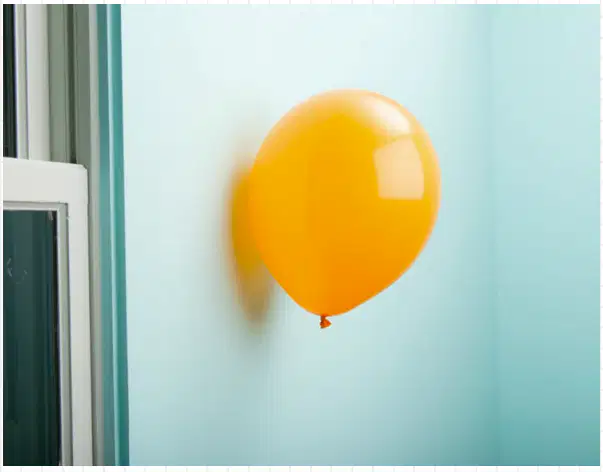
The wall did not seem to have a charge until the negatively charged balloon was put near it. How did the wall become charged?
a)
The wall transferred electric charges to the balloon.
b)
The balloon transferred electric charges to the wall.
c)
Positive charges in the wall moved to align with the balloon's negative charges.
d)
The wall gained positive charges to balance the balloon's extra negative charges.
43.
What causes your hair to stand up when you touch the sphere of a Van de Graaff generator?
a)
gravity
b)
buoyancy
c)
electric discharge
d)
static electricity
44.
The sphere of the Van de Graaff generator builds up positive charge on its surface. If you touch the sphere, you will gain _____ charges.
a)
positive
b)
negative
c)
no
45.
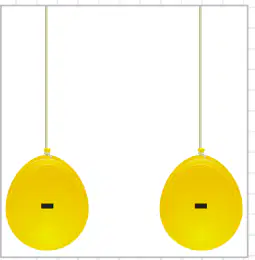
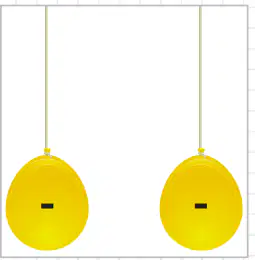
Both balloons are _____ charges. A force pushes the balloons away from each other because they are ______ charged.
a)
negatively, oppositely
b)
negatively, similarly
c)
positively, oppositely
d)
positively, similarly
46.
Which statements describe how the electric force affects the balloons? Choose all that apply.
a)
The balloons are pulled together by the electric force.
b)
The balloons are pushed apart by the electric force.
c)
The balloons stick together once they are touching because they need to be in contact to be affected by the electric force.
d)
If the balloons move closer together, the electric force acting on them increases.
e)
If one of the balloons becomes positively charged, the electric force increases.
47.
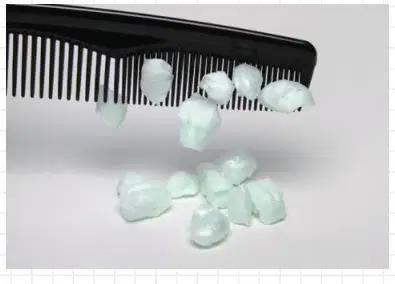
What is the charge of the comb?
a)

+

b)

-

c)

0

48.
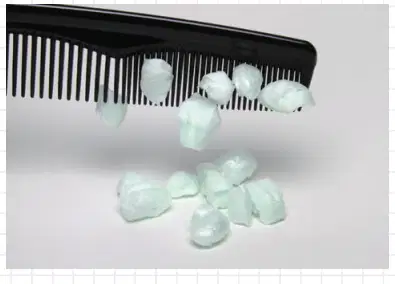
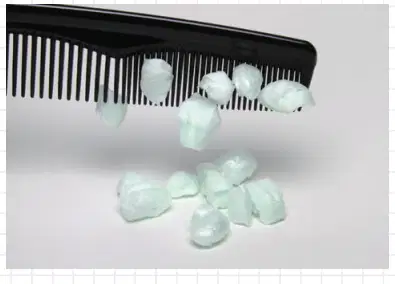
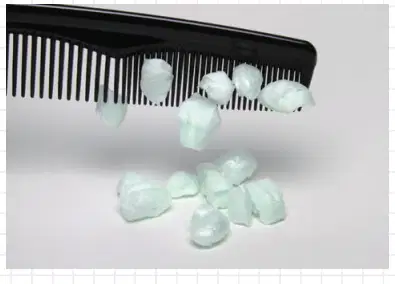
What is the charge of the side of a packing peanut that is not touching the comb?
a)

+

b)

-

c)

0

49.
What is the charge of the side of a packing peanut that is touching the comb?
a)

+

b)

-

c)

0

50.
The packing peanuts are removed from the comb and placed on the table. Then the positively charged wool cloth is held close to the packing peanuts. What will happen to the packing peanuts?
a)

They will stick to the wool cloth.

b)

They will be pushed away from the wool cloth.

c)

They will not be affected by the wool cloth.

51.

What is a physical property of matter that causes matter to experience a force when placed in an electromagnetic field?

a)

electric charge

b)

magnetic charge

c)

neutral charge

d)

positive charge

52.

If an object is neutral, it has _____.

a)

more positive than negative charges

b)

more negative than positive charges

c)

the same amount of positive and negative charges

d)

only positive charges

53.

If an object is positively charged, it has _____.

a)

more positive than negative charges

b)

more negative than positive charges

c)

the same amount of positive and negative charges

d)

only positive charges

54.

If an object is negatively charged, it has _____.

a)

more positive than negative charges

b)

more negative than positive charges

c)

the same amount of positive and negative charges

d)

only positive charges

55.

New electric charges can be created.

a)

true

b)

false

56.

Electric charges can move from one object to another.

a)

true

b)

false

57.

What is the force of attraction or repulsion between objects due to their charges?

a)

magnetic force

b)

electric force

c)

attractive force

d)

force fields

58.

An object with a charge of +1 generates the same strength of electric force as on object with a charge of -1.

a)

true

b)

false

59.

What determines the magnitude of the electric charge?

a)

positive charges

b)

negative charges

c)

extra positive or negative charges

d)

positive charges - negative charges

60.
A small bar magnet is shown. A compass is placed beside the magnet so that the center of the compass is next to the center of the magnet. Which of these is true?
a)
The north pole of the compass needle points at the magnet’s south pole.
b)
The south pole of the compass needle points at the magnet’s north pole.
c)
The north pole of the compass points in the same direction as the magnet’s south pole.
d)
The north pole of the compass needle points in the same direction as the magnet’s north pole.
61.
Two aluminum balls are 5 cm apart. One is negatively charged, and the other is positively charged. A small magnet is placed between the two balls but is not touching either of them. The aluminum balls remain stationary. Which statement describes the electric and magnetic fields?
a)
There is a magnetic field due to the magnet and no electric field.
b)
There is a magnetic field between the two balls and no electric field.
c)
There is an electric field between the two balls and no magnetic field.
d)
There is an electric field around each ball and a magnetic field due to the magnet.
62.
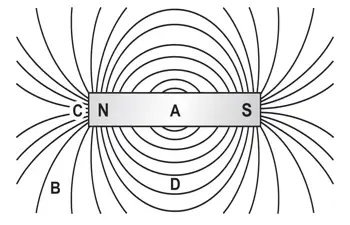
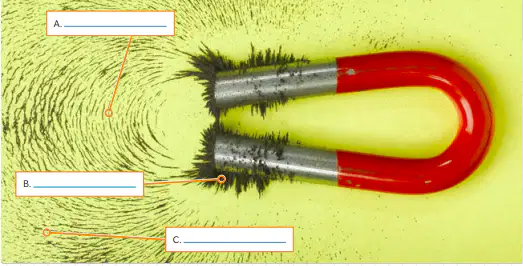
The diagram shows the magnetic field surrounding a magnet. Where is the magnetic force the strongest?
a)
Position A
b)
Position B
c)
Position C
d)
Position D
63.
A positively charged pith ball is hanging from a string. A negatively charged rod is then held a short distance away. How will the pith ball be affected?
a)
It will not be affected because only the rod has an electrical field.
b)
The fields on the pith ball and the rod will interact, causing an attractive force.
c)
The fields on the pith ball and the rod will interact, causing a repulsive force.
d)
It will not be affected because the pith ball and the rod are not touching.
64.
Which of these best describes a magnetic field?
a)
a measure of the length of a magnet
b)
the force that pushes two magnets away from each other
c)
an invisible region that surrounds the north pole of a magnet
d)
a region around a magnet in which magnetic forces can affect magnetic objects
65.
Stephan claims that Earth has both a gravitational field and a magnetic field. Which statement best supports his claim?
a)

Any object will fall to the ground.

b)

A bar magnet will fall to the ground.

c)

Any object will fall to the ground, and a compass can be used for navigation.

d)

A compass points in the direction of both the magnetic and gravitational fields.
66.
A student is brushing her hair. As the hairbrush is brought near her head, the hair seems to reach toward the hairbrush. Which of the following is the best explanation?
a)
Two electric fields are interacting.
b)
Two magnetic fields are interacting.
c)
Two gravitational fields are interacting.
d)
Two electromagnetic fields are interacting.
67.
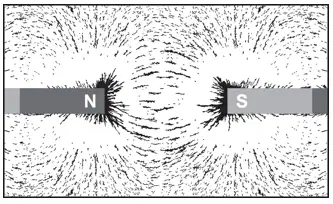
Where is the magnitude of force around this object the greatest?
a)
The magnitude is greatest close to the poles.
b)
The magnitude is greatest far from the poles.
c)
The magnitude is equal at all points on the field.
d)
The magnitude is greatest halfway between poles.
68.
The direction of field lines models the ______ of the forces acting in the field.
a)
strength
b)
direction
c)
spaces
d)
charges
69.
The closer the field lines are to one another, the _______ the field is.
a)
stronger
b)
weaker
70.
Which of these is the best definition of electromagnetism?
a)
the use of electrical energy to produce magnets
b)
the use of magnets to generate electric current
c)
the interaction between electricity and magnetism
d)
the appearance in nature of objects that have both electric and magnetic fields
71.
An electromagnet is made by wrapping many turns of wire around an iron bar and causing a current to flow through the wire. How would increasing the electrical current affect the electromagnet?
a)
It would make the magnetic field of the magnet weaker.
b)
It would make the magnetic field of the magnet stronger.
c)
It would decrease the flow of electricity in the iron bar.
d)
It would increase the flow of electricity in the iron bar.
72.
Which of these correctly describes electric current?
a)
the amount of electric charge on an object
b)
the rate at which electric charges pass a given point
c)
the buildup of electric charge on the surface of an object
d)
the amount of energy it takes to move a unit of electric charge between two points
73.
Which statement describes how electromagnetism is used in an electric generator?
a)
Moving a magnet in a coil of wire produces visible light.
b)
Magnets convert electric energy into mechanical energy.
c)
Magnets detect the presence of electric currents in nature.
d)
Moving a magnet in a coil of wire generates an electric current.
74.
Two parallel wires have electrical current running through them in opposite directions. Which statement describes the force between the two wires?
a)
There are no electric or magnetic forces on the wires.
b)
There is a magnetic force pulling the wires toward one another.
c)
There is an electric force pulling the wires toward one another.
d)
There is a magnetic force pushing the wires away from one another.
75.
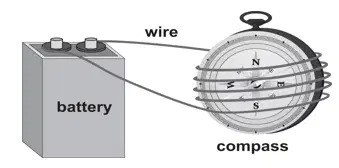
Olga wants to test if the battery shown in the diagram still produces an electric current. She wraps a wire around a compass and connects each end to the battery as shown in the diagram. She claims that this device has properties similar to an electromagnet. Which of these statements about what happens when electric charges flow through the wire best defends this claim?
a)
The voltage of the battery increases.
b)
The compass becomes demagnetized.
c)
The compass becomes electrically charged.
d)
The charges produce a magnetic field concentrated inside the coil of wire.
76.
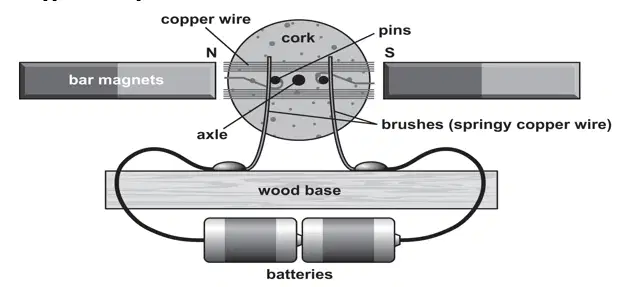
Juan wants to make a motor using simple materials. He wraps copper wire around a small piece of cork and uses a pin to secure the cork to an axle balanced between two bar magnets, as shown in the diagram. Two brushes made of springy copper wire just touch two metal pins in the cork that are used to hold the ends of the copper wire in place. When he connects the copper wire to the batteries, he expects to see the cork spin. Why does Juan expect to see the cork spin?
a)
The magnetic field produced by the current flow in the coil of wire changes the poles of the bar magnets.
b)
Electric charges produced by the current flow are pushed into the bar magnets, causing the cork to move in the opposite direction.
c)
The cork moves so the electric field produced by the current flow in the coil of wire aligns with the magnetic field of the bar magnets.
d)
The cork moves so the magnetic field produced by the current flow in the coil of wire aligns with the magnetic field of the bar magnets.
77.
Which of these best describes how a powerful electromagnet could be used in a junkyard?
a)
It could move heavy objects made of iron.
b)
It could convert electrical energy into mechanical energy.
c)
It could light up the area so workers can see at night.
d)
It could provide a voltage source for old electronic equipment.
78.
Daniel has a long piece of copper wire. He shapes the wire into a coil. What could Daniel do to create an electric current in the wire?
a)
shake the wire very quickly
b)
submerge the wire into a pan of hot water
c)
move a bar magnet in and out of the wire coil
d)
connect the two free ends of the wire so that they form a closed path
79.
What would be the effect of bringing a negatively-charged metal ball near an iron bar?
a)
The bar would become negatively charged and repel the metal ball.
b)
The bar would become positively charged and attract the metal ball.
c)
A magnetic north pole would be generated on the bar, and it would repel the metal ball.
d)
A magnetic south pole would be generated on the bar, and it would attract the metal ball.
80.

What is the area surrounding an object in which another object is pulled toward the object?

a)

electric field

b)

gravitational field

c)

magnetic field

d)

directional field

81.

Gravitational field lines point _____ the object that is exerting the force.

a)

away

b)

toward

82.

What is the area around a charged object in which another charged object is affected by the electric force?

a)

gravitational field

b)

electric field

c)

magnetic field

d)

directional field

83.

Electric field lines always point ____ positive charges and ______ negative charges.

a)

away from, toward

b)

toward, away from

84.

What is the area around a magnet in which magnetic forces affect magnetic objects?

a)

gravitational field

b)

magnetic field

c)

electric field

d)

directional field

85.

A magnetic field is strongest ____ each pole of the magnet.

a)

near

b)

farthest from

86.

Magnetic field lines point _____ the north pole and ____ the south pole.

a)

toward, away from

b)

away from, toward

c)

away from, away from

d)

toward, toward

87.

What causes Earth's electric field?

a)

positive charges in the upper atmosphere

b)

negative charges in the upper atmosphere

c)

positive charges at Earth's surface

d)

negative charges at Earth's surface

88.

Why don't we notice Earth's electric field?

a)

The field is stronger at higher altitudes.

b)

The field is weaker at higher alttitudes.

c)

The field is weaker near Earth's surface.

d)

The field is stronger near Earth's surface.

89.

What is a continuous flow of electric charges from one region to another?

a)

electric current

b)

magnetic current

c)

field currents

d)

wave currents

90.

What device is used to measure current?

a)

ammeter

b)

scale

c)

thermostat

d)

compass

91.

What is the interaction between electricity and magnetism?

a)

electromagnetism

b)

electric force

c)

magnetic force

d)

magnetric force

92.

What is a long, straight coil of wire?

a)

solenoid

b)

electromagnet

c)

inducer

d)

ammeter

93.

What is a coil of wire around an iron core?

a)

solenoid

b)

electromagnet

c)

magnet

d)

ampere

94.

Increased number of loops in the wire of an electromagnet ______ the current.

a)

decreases

b)

increases

95.

When a magnet moves quickly near a wire, the magnetic field around the wire changes by a ____ amount.

a)

small

b)

large

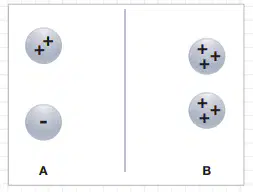
96.

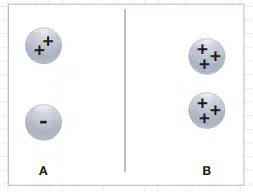
The distances between the charges in _______ is greater.

a)

Pair A

b)

Pair B

c)

They are the same.

97.

The strength of the gravitational field is the same at the surface of the sun, Earth, and the moon.

a)

true

b)

false

98.

The strength of the sun's gravitational field decreases as the distance from the sun increases.

a)

true

b)

false

99.

The moon's gravitational field does not affect Earth.

a)

true

b)

false

100.

The gravitational field at Earth's surface is greater than the gravitational field at the moon's surface.

a)

true

b)

false

101.

Where is the strength of the magnetic field strongest?

a)

Point A

b)

Point B

c)

Point C

102.

Where is the strength of the magnetic field weakest?

a)

Point A

b)

Point B

c)

Point C

103.

Fields decrease in strength as distance increases.

a)

true

b)

false

104.

The rate of change in a field's strength with distance is constant. Each increase in distance has the same effect on the strength of the field.

a)

true

b)

false

105.

What factors might affect the amount of current displayed on an ammeter?

a)

the number of loops in the solenoid

b)

the speed of the magnet's movement

c)

the magnet used

d)

whether the magnet touches the solenoid

106.

Warming a magnet unaligned some of the magnetic domains.

a)

true

b)

false

107.

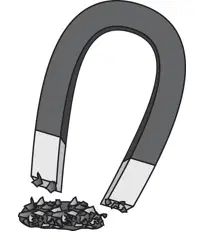
The picture shows two magnets interacting with uncharged iron filings. What relationship is shown in the picture?

a)

Electric force between like ends is attractive.

b)

Magnetic force between like ends is attractive.

c)

Electric force between opposite ends is attractive.

d)

Magnetic force between opposite ends is attractive.

108.

Kim has a loop of wire and a magnet. Which of these will create the largest electric current in the loop?

a)

Wrap the wire tightly around the magnet.

b)

Place the magnet in the center of the wire.

c)

Move the magnet quickly through the loop.

d)

Spin the loop of wire slowly above the magnet.

109.

A balloon is rubbed with a piece of cloth. Which statement describes the transfer of charges?

a)

Negative charges from the cloth were transferred to the balloon.

b)

Balloons always have more negative charges than positive charges.

c)

Negative charges appeared when the cloth was rubbed on the balloon.

d)

Some of the positive charges on the balloon disappeared when it was rubbed by the cloth.

110.

A student is using a compass to investigate magnetic forces. Which of these will cause the compass to change direction?

a)

plastic bottle cap

b)

wooden block

c)

wire he is using to charge his chromebook

d)

wire going from the wall to an unlit lamp

111.

Which is a question that could be asked about an electromagnet that can lead to a practical experiment about the magnitude of a force produced?

a)

How will adding more batteries affect the electromagnet?

b)

How large must the nail be in order to wrap the wire around it 100 times?

c)

How can the electromagnet be modified to pick up large objects such as cars?

d)

How can the electromagnet be built to ensure safety while handling in the classroom?

112.

An indicator that a field exists between two objects is ____.

a)

The objects are pulled toward each other.

b)

The objects are pulled away from each other.
113.

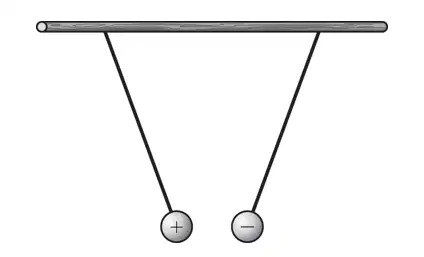
Where is the field strongest in this photo?

a)

to the left of the positive charge

b)

to the right of the negative charge

c)

directly between the two balls

114.

Increasing the number of times a wire is wrapped around a nail in an electromagnet will ____ the force of the electromagnet.

a)

decrease

b)

increase

115.

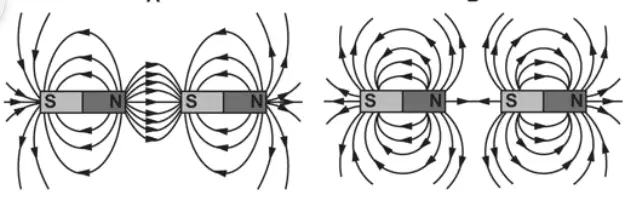
Which diagram represents the magnetic fields between the two magnets?

a)

diagram A

b)

diagram B

116.

Which pair has a stronger electric force?

a)

Pair A

b)

Pair B

117.

The magnitude of the electric charge in _____ is greater.

a)

Pair A

b)

Pair B

118.

Which of the following statements are true?

a)

Electric currents only exist when charges are free to move.

b)

Electric currents are caused by anything that causes charges to move.

c)

Electric currents supply power to almost all electronics.

d)

Electric currents can exist when charges are not moving.

119.

A build up of negative charges cause static electricity when they move to a positively charged object.

a)

true

b)

false