wayground logo

Free Printable Worksheets

Font size

S
M
L
XL
Worksheets

Characteristics and Classification of Organisms

Total questions: 114

Worksheet time: 3hrs 18mins

Name
Class
Date
1.
Term used to describe a one-celled organism is ________________
a)
multicellular
b)
cellular
c)
single organism
d)
unicellular
2.
Are human beings prokaryotic or eukaryotic?
a)
prokaryotic
b)
eukaryotic
3.
Which describes an  organism that produces its own food
a)
heterotroph
b)
chef
c)
autotroph
d)
homeostasis
4.
How many parents are necessary for asexual reproduction?
a)
2
b)
0
c)
3
d)
1
5.
How does a heterotroph get energy?
a)
by eating other organisms
b)
from photosynthesis
c)
from chemosynthesis
d)
they don't need energy
6.
How do we classify organisms into different Kingdoms?
a)
randomly sort organisms
b)
based on similar characteristics of the organisms
c)
grouped by how the organisms are different from one another
d)
based on how they reproduce
7.
Name the Kingdom:
Cannot be classified as plant, animal or fungi (ex. slime, mold, and protozoa)
a)
Plantae
b)
Eubacteria
c)
Archaebacteria
d)
Protista
8.
Name the Kingdom:
Includes yeast, mushrooms, and ringworm
a)
Eubacteria
b)
Fungi
c)
Anamalia
d)
Protista
9.
Name the Kingdom:
multicellular, autotroph
a)
Anamalia
b)
Fungi
c)
Plantae
d)
Protista
10.
a)

Prokaryotic cell

b)

Eukaryotic cell

11.

No Nucleus

a)

Prokaryotic cell

b)

Eukaryotic cell

12.

How many parents are necessary for sexual reproduction?

a)

2

b)

0

c)

3

d)

1

13.

In sexual reproduction, what percent DNA does the offspring get from each parent?

a)

10%

b)

25%

c)

50%

d)

100%

14.

In asexual reproduction, what percent DNA does the offspring get from the parent?

a)

10%

b)

25%

c)

50%

d)

100%

15.

Which rapid form of reproduction could also be called cloning?

a)

sexual

b)

asexual

16.
How do MOST autotrophs get their food?
a)
chemosynthesis
b)
by eating other animals
c)
photosynthesis
d)
by eating plants
17.
Name the Kingdom:
multicellular, eukaryotic, heterotroph, lives everywhere
a)
Fungi
b)
Plantae
c)
Anamalia
d)
Protista
18.
Name the Kingdom:
true bacteria
a)
Eubacteria
b)
Archaeabacteria
c)
Fungi
d)
Anamalia
19.
Name the Kingdom:
multicellular, autotroph
a)
Anamalia
b)
Fungi
c)
Plantae
d)
Protista
20.
Name the Kingdom:
Unicellular, prokaryotic, found in extreme environments
a)
Archaeabacteria
b)
Protista
c)
Fungi
d)
Plantae
21.
Name the Kingdom:
Includes the most common kind of bacteria found everywhere.
a)
Eubacteria
b)
Protista
c)
Fungi
d)
Archaebacteria
22.
Name the Kingdom:
provides food for heterotrophs
a)
Animalia
b)
Protista
c)
Eubateria
d)
Plantae
23.
Which one is unicellular
a)
prokaryotic cells
b)
eukaryotic cells
24.

____________ are organisms that must consume other organisms in order to obtain energy.

a)

Heterotrophs

b)

Eukaryotes

c)

Autotrophs

d)

Unicellular

25.

These organisms are composed of many cells

a)

Unicellular

b)

Multicellular

c)

Carnivores

d)

Herbivores

26.
An example of an autotroph is a(n) __________ and an example of a heterotroph is a(an) __________________.
a)
ant; fungus
b)
plant; bear
c)
fungus; lion
27.
Which is NOT a characteristic that all living organisms share? 
a)
Ability to reproduce 
b)
Ability to grow 
c)
Ability to respond to their environment 
d)
Ability to dominate an ecosystem 
28.
When you step out into the cold, your body shivers in order to keep its temperature at 98.6F.
a)
All living things use energy
b)
All living things contain cells
c)
All living things maintain homeostasis
d)
All living things grow
29.
Before a soccer game Charlie always eats a big dinner. Which characteristic of life does this face best describe? 
a)
living things use energy
b)
living things reproduce
c)
living things grow and develop
d)
living things are based on a universal genetic code
30.
Organisms that must consume or decompose other organisms in order to get food energy are called 
a)
autotrophs
b)
heterotrophs
c)
producers
d)
plants
31.

Anything that causes a reaction or change in an organism or any part of an organism

a)

heredity

b)

homeostasis

c)

Stimulus

d)

Metabolism

32.

Reproduction that does not involve the union of sex cells and in which a one parent produces offspring that are genetically identical to the parent

a)

asexual reproduction

b)

sexual reproduction

c)

asexual reprodoction

d)

reproduce

33.
This domain is characterized by ancient bacteria that can live in extreme environments, such as volcanoes.
a)
Archaea
b)
Bacteria
c)
Eukarya
d)
Prokarya
34.

I am single celled, and I only have one parent. My cell does not have an organized nucleus. Sometimes I cause diseases. Other times I am a decomposer.

a)

Bacteria

b)

Archaea

c)

Animalia

d)

plants

35.

I am eukaryotic

I am an autotroph

I am multicellular

What am I?

a)

Plant

b)

Animal

c)

Eubacteria

d)

Unicorn

36.

I am eukaryotic

I reproduce sexually

I am multicellular

I am heterotrophic

What kingdom do I belong to?

a)

Plantae

b)

Animalia

c)

Protista

d)

Fungi

37.
Kingdom Plantae is
a)
autotroph
b)
heterotroph
c)
trophy wife!
38.
Kingdom Archaebacteria is...
a)
unicellular
b)
multicellular
c)
bigger than life!
d)
really pretty, just so pretty.
39.
Members of  Kingdom Animalia are...
a)
heterotrophs.
b)
autotrophs
40.
My Kingdom includes mushrooms and yeast!
a)
Animalia
b)
Plantae
c)
Eubacteria
d)
Fungi
41.
How many kingdoms are there?
a)
2
b)
3
c)
6
d)
8
42.
Do prokaryotes have a nucleus? 
a)
yes
b)
no
43.
Seaweed, algae, slime, mold and mildew are examples of
a)
Plants
b)
Protist
c)
Fungi
d)
Archaea
44.
Which kingdom is prokaryotic?
a)
Animalia
b)
Archaebacteria
c)
Planta
d)
Fungi
45.
In what kingdom would you find trees and flowers?
a)
Plantae
b)
Fungi
c)
Eubacteria
d)
Animalia
46.
Eukaryotic cells always have a _______________.
a)
Nucleus 
b)
Plant
c)
no nucleus 
d)
heart 
47.

What are the 2 ways organisms reproduce

a)

sensationally and accidentally

b)

sexually and multiply

c)

asexually and totally

d)

sexually and asexually

48.

One way in which a plant life cycle is like an animal life cycle is that both plants and animals -

a)

use seeds to reproduce

b)

live for hundreds of years

c)

lay eggs that hatch

d)

grow larger over time

49.

The life cycle of a darkling beetle is shown here.


Which stage represents the change from larva to adult?

a)

A

b)

B

c)

C

d)

D

50.

What is the response in the following situation: You are thirsty so you go get something to drink.

a)

sweating

b)

getting something to drink

c)

thirst

d)

exercisnig

51.

The stimulus in the following situation: The dog starts barking because there is someone walking up to the door.

a)

dog barking

b)

someone is walking up to the door

c)

dog

d)

door

52.

Basic unit of structure and function in an organism

a)

heart

b)

blood

c)

cell

d)

stimulus

53.

Two word naming system for organisms

a)

genus

b)

species

c)

binomial nomenclature

d)

levels of classification

54.

First word in an organism's scientific name

a)

species

b)

genus

c)

kingdom

d)

domain

55.

Second word in an organism's scientific name

a)

species

b)

genus

c)

kingdom

d)

domain

56.

The study of how organisms are classified

a)

taxonomy

b)

spontaneous generation

c)

biogenesis

d)

I can't think of anything to put here

57.

Producing offspring

a)

reproduction

b)

development

c)

growth

d)

response/stimulus

58.

Becoming larger

a)

reproduction

b)

development

c)

growth

d)

response/stimulus

59.

Becoming more complex

a)

reproduction

b)

development

c)

growth

d)

response/stimulus

60.

One parent, genetically identical to the parent

a)

asexual reproduction

b)

sexual reproduction

61.

Two parents, genetically different from the parents

a)

asexual reproduction

b)

sexual reproduction

62.

grouping similar objects together

a)

classifying

b)

observing

c)

predicting

d)

inferring

63.

Which of the following is NOT a characteristic of organism?

a)

heart

b)

made of cell(s)

c)

respond to surroundings

d)

grow and develop

64.

What is wrong with the following scientific name?


Marmota monax

a)

Monax should be in CAPS

b)

Both words should be in italics

c)

Nothing is wrong

65.

Which of the following is the correct way to write the black bear scientific name?

a)

Ursus-Americanus

b)

Black bear

c)

Ursus americanus

d)

Ursus - americanus

66.
Characteristics- multicellular, autotrophic, nucleus, reproduce sexually and asexually
This organisms is most likely a member of which kingdom?
a)
Fungi
b)
Eubacteria
c)
Plantae
d)
Animalia
67.
Characteristics: Heterotroph, multicellular, cells have a nucleus, reproduces sexually, is able to move itself
Which kingdom does this organism most likely belong too?
a)
Animalia
b)
Fungi
c)
Protista
d)
Eubacteria
68.
Any living thing is called an
a)
organ
b)
organization
c)
organism
69.
A change in an organism's surroundings that causes it to react is called
a)
a stimulus.
b)
a response.
c)
development. 
d)
energy.
70.
A plant grows toward the light. The plant's action is an example of 
a)
reproduction.
b)
a response.
c)
a stimulus.
d)
development. 
71.
A cat mates and produces kittens. This is an example of
a)
homeostasis
b)
reproduction
c)
growth and development
d)
stimuli
72.
A plant using sunlight to make food to use or a deer eating leaves from a shrub are examples of
a)
Movement
b)
Respiration
c)
Sensitivity
d)
Nutrition
73.
Living things do all the following EXCEPT:
a)
Respond to stimulus
b)
Grow and develop
c)
Maintain homeostasis
d)
They do not change
74.

A scientist finds a seashell. She wants to classify the shell. What two different characteristics would she examine to classify the seashell?

a)

blood characteristics and naming characteristics

b)

chemical characteristics and DNA characteristics

c)

physical characteristics and environmental characteristics

d)

physical characteristics and chemical characteristics

75.

Which of the following identifies the levels of classification in the correct order?

a)

domain, kingdom, phylum, class, order, family, genus, species

b)

genus, species, domain, kingdom, phylum, class, order, family

c)

domain, kingdom, genus, species, phylum, class, order, family

d)

genus, species, phylum, class, order, family, domain, kingdom

76.

Linnaeus's contributions most helped develop which area of science?

a)

medicine

b)

taxonomy

c)

chemistry

d)

microbiology

77.

Felicia's teacher gives her the following list of types of organisms. 1. Fern 2. yeast 3. Algae 4. insects Felicia needs to identify the kingdom for each type of organism. In what order could she list the kingdoms for organisms 1 through 4?

a)

Plantae, Fungi, Protista, Animalia

b)

Animalia, Protista, Plantae, Fungi

c)

Plantae, Protista, Fungi, Animalia

d)

Fungi, Plantae, Protista, Animalia

78.

As Carolus Linnaeus was growing up, he was interested in botany and in the names of plants. His ideas have influenced generations of biologists. How did Carolus Linnaeus contribute to modern classification systems?

a)

He identified the three domains of life.

b)

He developed two-part scientific names.

c)

He standardized common names of organisms.

d)

He used chemical characteristics to classify organisms.

79.
2. What is the scientific study of how organisms are classified and named called?    
a)
Classification
b)
Taxologist
c)
Taxology
d)
Taxonomy
80.
1. Organizing rocks according to their similarities is an example of the process of ______________   
a)
 Taxonomy
b)
Sorting
c)
Classification
d)
Grouping
81.
3. Which word in an organism’s complete scientific name is capitalized?    
a)
Second
b)
First
c)
Both
d)
Neither
82.
4. What is the broadest, least specific level in the levels of classification called?  
a)
Class
b)
Species
c)
Kingdom 
d)
Domain
83.
5. To identify an unfamiliar organism,you could use a field guide or a ______________? 
a)
Taxonomic key
b)
Key 
c)
Dictionary
d)
Scientist
84.
6. What is the smallest group in Linnaeus’s classification system? 
a)
 Genus
b)
Species
c)
  Domain
d)
Kingdom
85.
7. The number of organisms in each group __________ as you move down the levels of classification. 
a)
Stays the Same
b)
 Increases
c)
Decrease
86.
8. Organisms in the same family are _______ closely related than organisms in the same order.   
a)
Less
b)
More
c)
Never
d)
Always
87.
9. Linnaeus classified organisms according to ____________ in observable features.   
a)
Similarities
b)
Differences
c)
Age
d)
Height
88.
10. Can a Felis concolor mate with a Felis domesticus? 
a)
Yes 
b)
No 
c)
Maybe
89.

Bacteria are always...

a)

Unicellular

b)

Multicellular

c)

Heterotrophs

d)

Autotrophs

90.

Which two kingdoms are entirely multicellular?

a)

Animalia and Plantae

b)

Animalia and Protista

c)

Protista and Plantae

d)

Fungi & Protista

91.

To say that an organism is heterotrophic means...

a)

it cannot reproduce asexually

b)

it cannot make its own food

c)

it cannot breathe oxygen gas

d)

It can reproduce either sexually or asexually

92.
Moss belongs in the kingdom...
a)
Fungi
b)
Plantae
93.
Choose the correct way to write the scientific name for humans:
a)
homo sapiens
b)
Homosapiens
c)
Homo sapiens
d)
Homo Sapiens
94.
Most animals in this phylum have a backbone.
a)
Arthropoda
b)
Chordata
c)
Annelida
d)
Mollusca
95.
The scientific name for an organism is made from the:
a)
class and family name
b)
genus and species name
c)
domain and kingdom name
d)
kingdom and phylum name
96.
Term given to describe the 2 name naming system is:
a)
dichotmous key
b)
binomial nomenclature
c)
2 scientific names
d)
binomial key
97.
The 8 levels of classification, most broad to most specific.
a)
Domain, Genus, Family, Order, Class, Phylum, Kingdom, Species
b)
Domain, Species, Kingdom, Genus, Phylum, Family, Class, Order
c)
Domain, Kingdom, Phylum, Class, Order, Family, Genus, Species
d)
Order, Kingdom, Species, Domain, Phylum, Family, Class, Genus
98.
An illustration and a dichotomous key are given. What is the correct classification for this organism?
a)
Class Insecta
b)
Order Amblygygi
c)
Order Araneae
d)
Order Scorpiones
99.
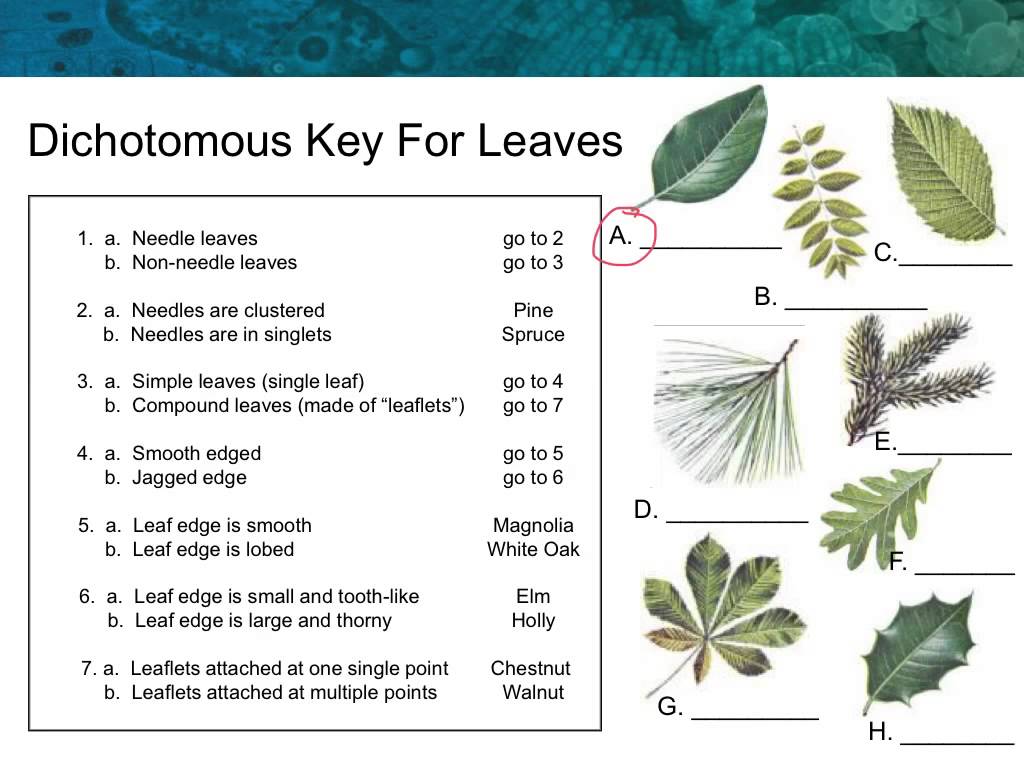
A dichotomous key for trees is provided. Hikers found a tree that has large brown cones and single sharp needles. What species of tree have the hikers found?
a)
Juniper
b)
Pine
c)
Spruce
d)
Fir
100.
Which of the following organisms are MOST closely related?
a)
organisms that share a domain
b)
organisms that share a family 
c)
organisms that share a genus 
d)
organisms that share an order  
101.
What is the most specific level of classification?
a)
Family
b)
Domain
c)
Species
d)
Carolus Linnaeus
102.

The scientist credited with Binomial Nomenclature is

a)

John Ray

b)

Charles Darwin

c)

Aristotle

d)

Carolus Linneaus

103.
A table of arachnid and insect characteristics is shown. Which characteristic could be used to distinguish between
arachnids and insects?
a)
Jointed legs
b)
Body segments
c)
Presence of eyes
d)
Presence of antennae
104.
A dichotomous key for trees is provided. Hikers found a tree that has large brown cones and single sharp needles. What species of tree have the hikers found?
a)
Juniper
b)
Pine
c)
Spruce
d)
Fir
105.
What is a dichotomous key used for in science?
a)
To organize biomes
b)
Classify organisms
c)
Identify bacteria only
d)
None of these
106.

Organisms are the same ___________ when they can have offspring, then those can have more offspring.

a)

Class

b)

Family

c)

Species

d)

Phylum

107.

Which is not a kingdom?

a)

Anamalia

b)

Plantae

c)

Virusae

d)

Fungi

108.

The organisms Panthera leo and Panthera tigris are the same

a)

species

b)

genus

c)

cat

d)

family

109.
How are Bacteria and Archaea similar?
a)
They are both multicellular
b)
They are both Prokaryotes
c)
They both have peptioglycan
110.
Fungi are usually...
a)
Multicellular
b)
Unicellular
111.
Fungi are...
a)
Eukaryotes
b)
Prokaryotes
112.
Who is the closest relative to the birds?
a)
crocodiles
b)
sharks
c)
fish
d)
amphibians
113.
The 7 levels of classification, most broad to most specific.
a)
 Genus, Family, Order, Class, Phylum, Kingdom, Species
b)
Species, Kingdom, Genus, Phylum, Family, Class, Order
c)
Kingdom, Phylum, Class, Order, Family, Genus, Species
d)
Kingdom, Species, Domain, Phylum, Family, Class, Genus
114.
The term used to describe the scientific study of how living things are classified.  
a)
Classification
b)
Organization
c)
Domain
d)
Taxonomy