
 Worksheets
Organisms, Earth Science, and Solar System Review
Total questions: 115
Worksheet time: 1hrs 17mins


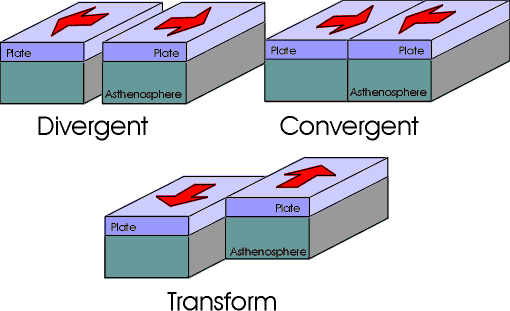
The Great Rift Valley in Africa and the Mid-Ocean Ridge were all created by this boundary
Divergent
Convergent
Reform
Transform

What tectonic plate is pictured?
North American
Eurasian
Indo-Australian
South American

What type of boundary is this?
Divergent
Convergent
Transform

What type of Boundary is this? What event will occur at this boundary?
Transform / Earthquakes
Subduction / Volcano Eruption
Tornado / Rain
Mountain Building / Volcanism
At which type of boundary will you find an ocean basin?
Convergent
Divergent
Transform


Which continent is highlighted in blue on the map?
Africa
The Pacific Ocean
North America
South America

The diagram shows a model of the movement of two tectonic plates. When the plates collide, on plate often moves below the other plate. The rising magma that can result from this type of plate movement may produce-
fossil layers
volcanic islands
deep-sea sediment
seafloor spreading

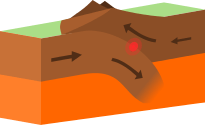
At what type of boundary would you find a volcano?
Divergent
Convergent
Transform

At which type of boundary are you most likely to find an underwater trench?
Convergent
Divergent
Transform
Volcanic islands are formed by...
Divergent boundaries
Convergent boundaries
Transform boundaries

A mid-ocean ridge is formed at _______________ boundaries.
Convergent
Divergent
Transform
Tectonic plates are caused by...
Crust moving upward
Mantle moving upward

What tectonic plate is pictured?
South American
African
North American
Eurasian
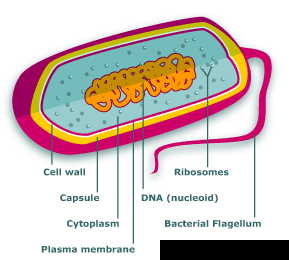
The following picture shows which type of cell?
Prokaryote
Eukaryote

The following picture shows which type of cell?
Prokaryote
Eukaryote

The following picture shows which type of cell?
Prokaryote
Eukaryote
What type of cell has a membrane bound nucleus?
eukaryotic
prokaryotic
What type of cell does not have a membrane bound nucleus?
eukaryotic
prokaryotic

A prokaryotic cell has DNA
True
False

Which of the following does a prokaryotic cell NOT have?
DNA
membrane bound nucleus
ribosomes
genetic information
What is the level of organization in an ecosystem from LEAST complex to MOST complex?
ecosystem, community, population, organism
ecosystem, population, community, organism
organism, population, community, ecosystem
organism, community, population, ecosystem

The YELLOW level of the pyramid represents...
population
community
ecosystem
organism
The GREEN level of the pyramid represents...
population
community
ecosystem
organism
The ORANGE level of the pyramid represents...
population
community
ecosystem
organism
The PURPLE level of the pyramid represents...
biosphere
community
ecosystem
organism
A living or once-living organisms in an ecosystem is a...
population
biotic factor
abiotic factor
community
Which of the following is NOT an abiotic factor?
sun
temperature
soil
grass
Temperature, light, air, water, and soil are all _____ parts of the environment.
alive
biotic
abiotic
living
The factors in an ecoysystem that have never had the ability to live.
Biotic Factor
Abiotic Factor
Biome
Community

I'm unicellular, autotrophic, and have a nucleus. What kingdom do I belong to?
Animalia
Archaebacteria
Protista
Fungi
This kingdom is eukaryotic, only multicellular, only heterotrophic, and only reproduces sexually.
Protista
Plante
Fungi
Animalia
I have a nucleus, am an autotroph, and am multicellular. What kingdom do I belong to?
Animalia
Archaebacteria
Plantae
Fungi

What do ALL living organisms have in common?
They are all made of cells.
They all have a heartbeat.
They all breathe air.
They all have a nucleus.

Animals are...
eukaryotic and autotrophic
eukaryotic and heterotrophic
prokaryotic and autotrophic
prokaryotic and heterotrophic
The types of domains are...
Bacteria, Archaea, Eukarya
Animalia, Plantae, Fungi, Protista
Animalia, Plantae, Fungi, Protista, Bacteria, Archaea
The types of kingdoms are...
Bacteria, Archaea, Eukarya
Animalia, Plantae, Fungi, Protista
Animalia, Plantae, Fungi, Protista, Bacteria, Archaea
I am multicellular, eukaryotic, and perform photosynthesis. What kingdom do I belong in?
Bacteria
Protista
Plantae
Animalia
I am multicellular, eukaryotic, eat other organisms for food, and goes through sexual reproduction. What kingdom do I belong in?
Bacteria
Protista
Plantae
Animalia

Which layer is the thinnest?
V
Z
Y
X

The hottest layer of the earth is the...
Crust
Mantle
Outer Core
Inner Core
The coolest layer of the earth is the...
Crust
Mantle
Outer Core
Inner Core
The thickest layer of the earth is the...
Crust
Mantle
Outer Core
Inner Core
The thinnest layer of the earth is the...
Crust
Mantle
Outer Core
Inner Core

Which layer is the densest?
Z
X
W
V

Which layer of the earth is composed of molten material?
Crust
Mantle
Outer Core
Inner Core
Which layer of the earth is composed of SOLID material?
Crust
Mantle
Outer Core
Inner Core
Which layer of the earth is composed of fluid LIQUID material?
Crust
Mantle
Outer Core
Inner Core

Which layer is represented by the number 1?
outer core
inner core
mantle
crust

Which layer of the Earth is represented by the number 3?
crust
inner core
mantle
outer core

Which layer is represented by the number 4?
crust
inner core
outer core
mantle

Which layer of the Earth is represented by the number 2?
crust
outer core
mantle
inner core
Most metal material is found in the...
Crust
Mantle
Core (Inner and Outer)
The MOST dense layer is the...
Crust
Mantle
Outer Core
Inner Core
What is useful about using a model to show the layers of the Earth?
We can use the exact same materials as the Earth in a model.
We can watch the convection currents happen in a model.
We can create models to be the same size as the Earth.
We can use models to show the same shape of the Earth at a smaller scale.


What type of rock goes through COMPACTION?
Sedimentary
Metamorphic
Igneous
What type of rock goes through erosion?
Sedimentary
Metamorphic
Igneous
Heating, Melting, and Cooling are required to make...
Sedimentary rock
Metamorphic rock
Igneous rock
Heat and pressure is required to make...
Sedimentary rock
Metamorphic rock
Igneous rock
Magma is used to form...
Sedimentary rock
Metamorphic rock
Igneous rock
Weathering is used to form...
Sedimentary rock
Metamorphic rock
Igneous rock
This type of rock can be formed by deposited sediments.
Sedimentary
Metamorphic
Igneous
Sally found a rock with many imprints of sea shells by the beach. The print was so clear that she could see the outline of each shell, just like a fossil. What type of rock did she find?
Sedimentary
Metamorphic
Igneous
Can be a very rough rock, like concrete.
Sedimentary
Metamorphic
Igneous
Fossils are found in...
Sedimentary rock
Metamorphic rock
Igneous rock
Magma cooling gives us...
Sedimentary rock
Metamorphic rock
Igneous rock
Hardness, color, luster and streak helps us identify properties of..
Rocks and minerals
Elements
Chemicals
A sedimentary rock went through heat and pressure over many years. What happened?
It became igneous rock.
It became metamorphic rock.
It stayed sedimentary rock.
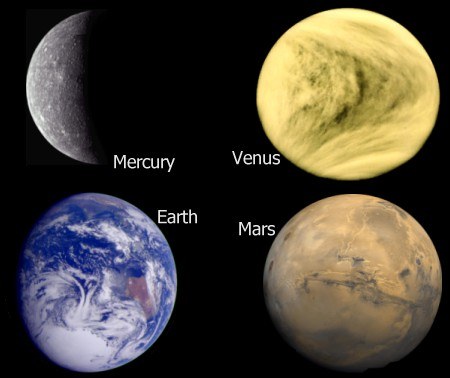
These are the 4 planets closest to the sun (Mercury, Venus, Earth, Mars).
inner planets
outer planets
dwarf planets
solar planets
The outer planets are different from the terrestrial planets because they
have smaller atmospheres
are less dense
are made of gas
are more colorful

Where is the Asteroid Belt located in the Solar System?
near Neptune
between Mercury and Venus
between Mars and Jupiter
around the Sun
Which planet takes the least amount of time to orbit the sun?
Mercury
Earth
Mars
Neptune
Which planet takes the most amount of time to orbit the sun?
Mercury
Earth
Mars
Neptune
Planets that are _______ the sun take the least amount of time to orbit.
closer to
farther from
Planets that are _______ the sun take the most amount of time to orbit.
closer to
farther from
Which of the following affects a planet's orbital period around the sun?
Distance
Mass
Compostion
Weight
The gravity of smaller objects control larger objects
True
False
The gravity of larger objects control smaller objects
True
False
What is the force that holds moons in orbit?
Gravity from their planet
Gravity from other planets
Gravity from the sun
Which planet is least affected by the suns gravity?
Mercury
Neptune
Earth
Jupiter
Which planet is most affected by the suns gravity?
Mercury
Neptune
Earth
Jupiter
The Earth moves around the ...
Earth
Moon
Sun
The Earth does not revolve around any object
The Sun moves around the...
Earth
Moon
Sun
The Sun does not revolve around any object
Smaller objects have ________ gravitational pull than larger objects.
more
less
Larger objects have ________ gravitational pull than smaller objects.
more
less

