
 Worksheets
Science HP Mia 1st Semester
Total questions: 109
Worksheet time: 2hrs 49mins
Name
Class
Date
1.
The natural chemical or physical processes that breaks down rock on Earth's surface.
a)
weathering
b)
erosion
c)
deposition
d)
jackhammering
2.
The process by which water, ice, wind or gravity moves weathered rock and soil from one place to another.
a)
weathering
b)
erosion
c)
deposition
d)
dumptruck
3.
How might a weathered mountain appear different than an unweathered mountain?
a)
Weathered mountain would be taller.
b)
Weathered mountain would be rounder and less jagged.
c)
Weathered mountain would be more jagged and less rounded.
d)
Weathered mountain would have no trees.
4.
Select the answer that shows the order of events a rock goes through.
a)
erosion, weathering, deposition
b)
weathering, erosion, deposition
c)
deposition, weathering erosion
d)
erosion, deposition, weathering
5.
What is the process that picks up and moves weathered rocks?
a)
deposition
b)
landslide
c)
weathering
d)
erosion
6.
Weathering causes rocks and minerals to break into smaller pieces. Which event is the best example of weathering?
a)
a raindrop splashing in a lake
b)
a snowball rolling down a mountain
c)
a tree root growing into the crack of a rock
7.
Over long periods of time, deposition may change the Earth’s surface by _____.
a)
forming new land features
b)
breaking down large rocks into smaller ones
c)
washing away beaches
d)
severely draining topsoil
8.
How does freezing water cause the weathering of rocks? The freezing water—
a)
keeps the rocks in place
b)
makes the rocks last longer
c)
expands cracks and breaks rocks
d)
causes rocks to fall in landslides
9.
The process that breaks down rocks and other materials on Earth's surface is called
a)
weathering
b)
erosion
c)
soil conservation
d)
decomposition
10.
Which type of climate will have faster chemical weathering?
a)
Hot and Wet
b)
Cold and Dry
c)
Hot and Cold
d)
Cold and Wet
11.
Water getting into cracks, freezing, and breaking the rocks or pavement apart is called?
a)
Weathering
b)
Erosion
c)
Deposition
12.
Waves dropping sand on the beach is called?
a)
Weathering
b)
Erosion
c)
Deposition
13.
What is silt?
a)
fine bits of clay and sand
b)
mud at the bottom of the river
c)
decomposed plants and animals
d)
rocks in riverbeds
14.
What is one thing that can't be silt?
a)
sawbust
b)
pebbles
c)
pine needles
d)
scrap plastic
15.
Soil formation begins with the weathering of_______.
a)
Humas
b)
Subsoil
c)
Litter
d)
Rock
16.
The two main factors that determine the rate of weathering are the TYPE of rock and_____.
a)
Music
b)
Climate
c)
Size of rock
d)
Weight of rock
17.
The movement of rocks and weathered materials is called_________.
a)
Chemistry
b)
Physical
c)
Weathering
d)
Erosion
18.
Soil layers are called horizons because...
a)
The layers are all different
b)
The layers are vertical
c)
The layers are horizontal
d)
The layers are above one another
19.
Which type of rock do we find fossils in?
a)
Igneous
b)
Sedimentary
c)
Metamorphic
d)
All of them
20.
What is weathering?
a)
Breaking rocks down
b)
Moving sediment
c)
Dropping sediment
d)
Compacting sediment
21.
What is deposition?
a)
Breaking down rocks
b)
Moving Sediment
c)
Dropping Sediment
d)
Compacting sediment
22.
Put the sediments in order from smallest sized particles to largest
a)
clay, silt, sand, gravel
b)
silt, clay, gravel, sand
c)
gravel, sand, silt, clay
23.

Rock made of layers of compressed sediments
a)
metamorphic rock
b)
igneous rock
c)
sedimentary rock
d)
school house rock
24.

Sediment that is left behind in rivers lakes and oceans
a)
weathering
b)
erosion
c)
cementation
d)
deposition
25.
What rock is made from sand?
a)
Siltstone
b)
Gravel
c)
Sandstone
26.

Fossils are made by
a)
Plants dying
b)
Animals or plants are imprinted on a layer of sedimentary rock
c)
Breaking down of rocks
27.

The breakdown of rock into smaller particles from the effects of wind, water and ice
a)
erosion
b)
cementation
c)
pressure
d)
weathering
28.

Wind, water, ice and gravity carry sediments away
a)
weathering
b)
deposition
c)
erosion
d)
cementation
29.
Sediment that is left behind in rivers lakes and oceans
a)
weathering
b)
erosion
c)
cementation
d)
deposition
30.

Decay or decomposition means to
a)
break into smaller parts
b)
make into larger parts
c)
destroy something
d)
fix something
31.
Intrusive Igneous rocks will be
a)
coarse grain
b)
fine grain
32.
What do we call where Igneous rocks form?
a)
location
b)
destination
c)
origin
d)
spawn point
33.
If a rock is formed from lava, what will the grains be?
a)
coarse
b)
fine
34.
A type of rock that forms from the cooling of molten rock at or below the surface of the earth
a)
Igneous Rock
b)
Metamorphic Rock
c)
Sedimentary Rock
d)
chemical Rock
35.
Igneous rock that forms from lava on Earth's surface
a)
Organic Rock
b)
Intrusive Rock
c)
Clastic Rock
d)
Extrusive Rock
36.
The process by which igneous rocks are formed...
a)
heat and pressure deep underneath earth's surface
b)
melting and cooling of magma
c)
compaction and cementation of sediments
37.
The process by which igneous rocks are formed...
a)
heat and pressure deep underneath earth's surface
b)
melting and cooling of magma
c)
compaction and cementation of sediments
38.
A slow cooling igneous rock will have _____ crystals
a)
large
b)
small
c)
average
d)
black
39.

One common use for the igneous rock granite is...
a)
building material
b)
cutting tools
c)
abrasion in polishing
d)
cement
40.

One common use for the igneous rock obsidian is...
a)
building material
b)
cutting tools
c)
abrasion in polishing
d)
cement
41.
Which terms best describe igneous rocks?
a)
light and easily broken
b)
soft and smooth
c)
hard and dense
d)
soft and dense
42.
_____ is an igneous rock made up of the minerals quartz, mica, feldspar, and hornblende.
a)
granite
b)
basalt
c)
pumice
d)
gneiss
43.
How do coarse-grained igneous rocks form?
a)
from sedimentary rocks changed under pressure
b)
from large rock particles cemented together
c)
from rapidly cooling lava
d)
from slowly cooling magma
44.
Is lava above or below ground
a)
below
b)
above
45.
What does igneous rock form from?
a)
both magma and lava
b)
sand
c)
pressure
d)
water
46.
What two characteristic help identify igneous rock?
a)
composition and course
b)
composition and texture
c)
fine and course
d)
hi
47.
Which of the following is a metamorphic rock?
a)
schist
b)
basalt
c)
limestone
d)
shale
48.
Which of the following is a metamorphic rock?
a)
obsidian
b)
granite
c)
gneiss
d)
sandstone
49.
Which of the following is a metamorphic rock?
a)
conglomerate
b)
pumice
c)
obsidian
d)
marble
50.
Which of the following is a metamorphic rock?
a)
basalt
b)
obsidian
c)
slate
d)
pumice
51.
When metamorphic rocks are formed, the extreme pressure is usually caused by the _______.
a)
gravity in the atmosphere
b)
collision of tectonic plates
c)
the fiery hot magma in the Earth's mantle
d)
weight of the mountains
52.
When metamorphic rocks are formed, the extreme heat is usually caused by the _______.
a)
gravity in the atmosphere
b)
collision of tectonic plates
c)
the fiery hot magma in the Earth's mantle
d)
weight of the mountains
53.
Sedimentary rocks are formed by ___.
a)
existing rocks are baked and squeezed by pressure
b)
small pieces of rock are compacted and cemented together
c)
magma or lava cools and hardens
d)
igneous rocks are broken into pieces
54.
Metamorphic rocks are formed by ___.
a)
existing rocks are baked and squeezed by pressure
b)
small pieces of rock are compacted and cemented together
c)
magma or lava cools and hardens
d)
igneous rocks are broken into pieces
55.
Igneous rocks are formed by ___.
a)
existing rocks are baked and squeezed by pressure
b)
small pieces of rock are compacted and cemented together
c)
magma or lava cools and hardens
d)
igneous rocks are broken into pieces
56.
Which of the following best describes the type of environment a metamorphic rock forms in
a)
High heat, low pressure
b)
Low heat, high pressure
c)
High heat, high pressure
d)
Low heat, low pressure
57.
Magma is molten rock ________ the ground
a)
Above
b)
Below
58.
Lava is molten rock ________ the ground
a)
Above
b)
Below
59.
The rock appears frothy (little holes from bubble). This rock must have cooled...
a)
Slowly
b)
Quickly
60.
What is the meaning of “metamorphic”?
a)
fire-formed
b)
sedimentation
c)
change form
d)
lithification
61.

Use the diagram to help you: What is the process that helps existing rock form into metamorphic rock?
a)
compaction/cementation
b)
heat/pressure
c)
weathering/erosion
d)
melting
62.
How do scientists group sedimentary rocks?
a)
By what they are made of
b)
By their color
c)
By the size of mineral crystals
d)
By the "layers" or "clumps" of minerals
63.
Clastic Sedimentary Rocks are made of _____
a)
Bits of rock
b)
The remains of dead organisms
c)
Chemicals left behind by evaporating water
64.
Organic Sedimentary Rocks are made of _____
a)
Bits of rock
b)
The remains of dead organisms
c)
Chemicals left behind by evaporating water
65.
Chemical Sedimentary Rocks are made of _____
a)
Bits of rock
b)
The remains of dead organisms
c)
Chemicals left behind by evaporating water
66.
What rock is made from sand?
a)
Siltstone
b)
Gravel
c)
Sandstone
67.
Which one heats and cools fastest?
a)
land
b)
sea
c)
both are the same rate
d)
air
68.
The cycle that powers the ocean currents, weather, and tectonic plates it called
a)
conduction current
b)
radiation
c)
condition current
d)
convection current
69.
Energy for convection on the Earth comes from...
a)
The sun
b)
The moon
c)
Solar winds
d)
The ocean
70.
What are the two layers in the Earth in which convection currents occur?
a)
crust and core
b)
inner core and outer core
c)
outer core and mantle (asthenosphere)
d)
outer core and lithosphere
71.
What causes convection currents to occur in the Mantle?
a)
heat from the crust
b)
heat from the mantle
c)
heat from the core
d)
heat from the sun
72.
How does a convection cell affect the crust material above it?
a)
It doesn't affect the crust material.
b)
It moves the crust material in the opposite direction.
c)
It moves the crust material in the same direction.
d)
I have no idea.
73.
Why do cold materials sink?
a)
Because they are more dense.
b)
Because they are less dense.
c)
Cold materials don't sink, they float.
74.
Which is less dense - a cold material or a hot material?
a)
A hot material
b)
A cold material
c)
There is no way to know.
75.
Produced when sediments fill in a cavity made when an object decayed
a)
cast
b)
mold
c)
original remains
76.
Remains, imprints or traces of once-living organisms
a)
water
b)
superposition
c)
fossils
77.
In what kind of rock can fossils be found?
a)
Sedimentary Rocks
b)
Igneous Rocks
c)
Metamorphic Rocks
d)
Granite
78.
What are the 3 main fossil fuels?
a)
Coal, Oil, and Gasoline
b)
Coal, Oil, and Natural Gas
c)
Electricity, Gasoline, Petroleum
d)
Coal, Oil, Non-renewable Resources
79.
A student creates a model of the formation of fossil fuels by first placing a layer of leaves, representing organic matter, in the bottom of a cup. What step will come next in the model?
a)
Pouring water over the leaves to model washing away by rivers
b)
adding sand on top of the leaves to model burial in sediments
c)
Burning the leaves to model the decay of organic matter
d)
Putting the leaves in the freezer to model conditions on top of mountains
80.
Fossils give us evidence about which of the following?
a)
plants and animals that lived long ago
b)
how weathering and erosion break down rocks
c)
the other planets in our solar system
d)
the transfer of energy from one form to another
81.
Finding the fossils of trees in an area that is currently a desert without much life might tell us that the area, millions of years ago -
a)
was heavily eroded by strong winds
b)
received enough rain to support a forest
c)
suffered very powerful earthquakes
d)
was destroyed by the impact of meteorites
82.
Finding fossils in an area can help us learn what about that location?
a)
Which places in the region receive the most sunlight
b)
The effect of the climate on the formation of the soil
c)
How modern plants and animals interact there
d)
The kinds of organisms that lived there long ago
83.
An area is currently a forest. What evidence would best indicate that this area was covered by water millions of years ago?
a)
An increase in rainfall in the forest over time
b)
The presence of plants in the forest that need water to live
c)
Fossils of fish discovered in rock below the forest
d)
Insects in the forest that lay their eggs in the water
84.
The age of a rock layer compared to the other rock layers around it is called
a)
Absolute Age
b)
Relative Age
c)
Comparative Age
d)
Layer Age
85.
According to the Law of Superposition, if sedimentary rock layers are deposited in a time sequence, which layer is the oldest layer?
a)
The layer on top
b)
The layer on the bottom
c)
A middle layer
d)
A layer that crosses other layers
86.

Choose the correct order of relative ages for the rock layers below, starting with the youngest, and finishing with the oldest layer.
a)
A, E, B, C, D
b)
A, B, C, D, E
c)
E, A, D, C, B
d)
E, D, C, B, A
87.
Relative age dating is used to determine the...
a)
actual age of an event
b)
length of time between two events
c)
age of one event in comparison with other events
d)
rate at which a gologic process occurs
88.
Relative age dating is used to determine the...
a)
actual age of an event
b)
length of time between two events
c)
age of one event in comparison with other events
d)
rate at which a gologic process occurs
89.
The age of a rock compared to the ages of other rocks is the rock's
a)
absolute age
b)
geologic age
c)
sedimentary age
d)
relative age
90.
The number of years that have passed since the rock formed is the rock's
a)
relative age
b)
law of superposition
c)
absolute age
d)
index fossil
91.

To be considered an index fossil, it had to have lived for a relatively short period of time.
a)
True
b)
False
92.
Which statement is true about the fossil record?
a)
It is a record of all living things
b)
It shows how our climate has remained the same over time
c)
It provides evidence for history of life on Earth
d)
It does not support the theory of evolution
93.
The best index fossils have which two traits?
a)
widespread geographically, long lifespan
b)
widespread geographically, short lifespan
c)
specific place, long lifespan
d)
specific place, short lifespan
94.
Index fossils help determine relative age through correlating rock layers.
a)
True
b)
False
96.
To be considered an index fossil, it had to have lived for a relatively short period of time.
a)
True
b)
False
96.
To be considered an index fossil, it had to have lived for a relatively short period of time.
a)
True
b)
False
97.
An organism that no longer exists on Earth is called
a)
Decayed
b)
Evolved
c)
Extinct
d)
Preserved
98.
Which statement is true about the fossil record?
a)
It is a record of all living things
b)
It shows how our climate has remained the same over time
c)
It provides evidence for history of life on Earth
d)
It does not support the theory of evolution
99.
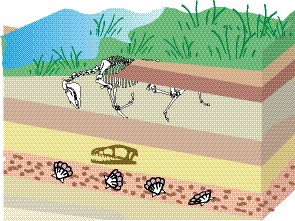
According to the law of superposition, the oldest fossils are found
a)
At the top of the rock layers
b)
Near the bottom of the rock layers
c)
In the middle of the rock layers
d)
Somewhat near the surface
100.
The Law of Superposition helps scientists to determine what?
a)
The absolute age of rock layers
b)
The age of fossils
c)
The relative age of rock layers
d)
the super powers of rocks
101.
What is Half-life?
a)
The amount of time it takes for some of the nuclei in a sample of the isotope to decay
b)
The amount of time it takes for half the electrons in a sample of the isotope to decay
c)
The amount of time it takes for half the nuclei in a sample of the isotope to decay
d)
the amount of time it takes to double the nuclei in a sample of the isotope to decay
102.

If one-fourth of the carbon-14 is remaining then how many half-lives have passed?
a)
1
b)
2
c)
3
d)
4
103.
541 Mya - 485 Mya. World is covered in oceans. This period is known for the rapid appearance of multicellular animals
a)
Ordovician
b)
Devonian
c)
Cambrian
d)
Silurian
104.

Longest subdivision marked by major extinctions
a)
Eons
b)
Eras
c)
Epochs
d)
Periods
105.

Geologic time charcterized by types of life that existed at that time
a)
Periods
b)
Epochs
c)
Eras
d)
Eons
106.

Longest part of Earth's history covering 4.5 bya to 544 mya
a)
PreCambrian
b)
Paleozoic
c)
Mesozoic
d)
Cenozoic
107.

Jellyfish appeared in the
a)
Precambrian
b)
Paleozoic
c)
Quaternary
d)
Devonian
108.
What are the four eras in order from oldest to newest?
a)
Pre-Cambrian Time, Paleozoic Era, Mesozoic Era, Cenozoic Era
b)
Pre-Cambrian Time, Mesozoic Era, Paleozoic Era, Cenozoic Era
c)
Cenozoic Era, Mesozoic Era, Paleozoic Era, Pre-Cambrian Time
d)
Mesozoic Era, Pre-Cambrian Time, Cenozoic Era, Paleozoic Era
109.
Of the 4 eras, which one lasted the longest?
a)
Pre-Cambrian Time
b)
Paleozoic Era
c)
Cenozoic Era
d)
Mesozoic Era
100 %

