wayground logo

Free Printable Worksheets

Font size

S
M
L
XL
Worksheets

Meteorology Unit Review

Total questions: 111

Worksheet time: 2hrs 10mins

Name
Class
Date
1.
Layer of Earth's atmosphere where it rains
a)
thermosphere
b)
mesosphere
c)
stratosphere
d)
troposphere
2.
Layer of Earth's atmosphere in which we live
a)
thermosphere
b)
mesosphere
c)
stratosphere
d)
troposphere
3.

Earth's ozone layer is important because it absorbs

a)

visible light

b)

harmful ultraviolet radiation (UV light)

c)

x-rays

d)

radio waves

4.

Identify the 2 main gases in Earth's atmosphere

a)

Nitrogen

b)

Oxygen

c)

Methane

d)

Carbon Dioxide

5.

The ozone layer is in this layer of the atmosphere:

a)

Stratosphere

b)

Thermosphere

c)

Exosphere

d)

Troposphere

6.

This is the layer where meteors, or shooting stars, burn up.

a)

Troposphere

b)

Stratosphere

c)

Mesosphere

d)

Thermosphere

7.
The coldest layer.
a)
troposphere
b)
thermosphere
c)
exosphere
d)
mesosphere
8.

What layer contains the Aurora Borealis?

a)

Thermosphere

b)

Troposphere

c)

Stratosphere

9.

Our atmosphere is important because...

a)

it provides gases, like oxygen, for organisms to breathe

b)

it keeps the planet warm (at a just right temperature)

c)

it protects us from small meteors

d)

it has ozone, which protects us from UV radiation

10.

Satellites orbit Earth in this layer of the atmosphere:

a)

Troposphere

b)

Mesosphere

c)

Thermosphere

d)

Exosphere

11.

Which gas in the stratosphere absorbs ultraviolet light in incoming sunlight?

a)

Ozone (O3)

b)

Oxygen (O2)

c)

Water vapor (H2O)

d)

Argon (Ar)

12.

Most of Earth's water vapor and weather is found in which layer of the atmosphere?

a)

Troposphere

b)

Stratosphere

c)

Thermosphere

d)

Exosphere

13.

This gas has increased the most and traps heat

a)

Ozone

b)

Water Vapor

c)

Methane

d)

Carbon Dioxide

14.

This gas evaporates and doesn't allow the sun's heat to flow back into space too quickly

a)

Carbon Dioxide

b)

Nitrous Oxide

c)

Water Vapor

d)

Methane

15.

Which is NOT a greenhouse gas?

a)

carbon dioxide

b)

methane

c)

oxygen

d)

nitrous oxide

16.

What is one thing that greenhouse gases do?

a)

Release heat into space.

b)

Cause plants to die immediately.

c)

Trap heat in the Earth´s atmosphere.

d)

Make people healthy.

17.

The definition of Air pressure is...

a)

The air above you going up through the atmosphere.

b)

The force that air molecules push down on a surface.

c)

The molecule of the air push in all directions down, up and side ways.

d)

None of the above

e)

All of the above

18.

Air pressure is the ............... of the weight of a ................ of air pushing on an area.

a)

volume, surface

b)

result, column

c)

atoms, molecule

d)

density, pressure

19.
What happens to air pressure as you move upward into the atmosphere?
a)
increases
b)
decreases
c)
stays the same
20.
A device that is used to measure atmospheric pressure is a ___________.
a)
barometer
b)
thermometer
c)
kilometer
d)
micrometer
21.
Air pressure is greater _______.
a)
at the top of the mountain
b)
at the bottom of the mountain
c)
at the center of the mountain
22.
What is altitude?
a)
how much something weighs
b)
the distance above sea level
c)
how big something is
d)
how far away something is
23.
What happens to the amount of oxygen molecules as altitude increases?
a)
fewer molecules
b)
more molecules
c)
same amount of molecules
d)
nothing happens to the molecules
24.
How do we name air masses?
a)
Water and temperature
b)
Air pressure
c)
Humidity and temperature
d)
Cold and warm
25.
How do we characterize an air mass that forms over the ocean?
a)
Dry
b)
Wet
c)
Cold
d)
Warm
26.
How do we characterize an air mass that forms over land?
a)
Dry
b)
Wet
c)
Cold
d)
Warm
27.
How do we characterize an air mass that forms over near the equator?
a)
Dry
b)
Wet
c)
Cold
d)
Warm
28.
How do we characterize an air mass that forms near the poles?
a)
Dry
b)
Wet
c)
Warm
d)
Cold
29.
What types of air masses form over oceans?
a)
Maritime
b)
Continental
c)
Polar
d)
Tropical
30.
What's the humidity and temperature of a continental tropical air mass?
a)
Wet and cold
b)
Dry and warm
c)
Wet and warm
d)
Dry and cold
31.
What's the humidity and temperature of a maritime tropical air mass?
a)
Wet and cold
b)
Dry and warm
c)
Wet and warm
d)
Dry and cold
32.
A wet and cold air mass would be a...
a)
Maritime polar
b)
Continental polar
c)
Maritime tropical
d)
Continental tropical
33.
A dry and cold air mass would be...
a)
Maritime polar
b)
Continental polar
c)
Maritime tropical
d)
Continental tropical
34.
A dry and hot air mass would be...
a)
Maritime arctic
b)
Maritime tropical
c)
Continental tropical
d)
Continental polar
35.
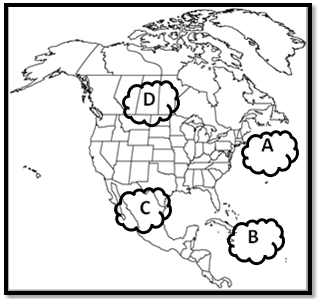
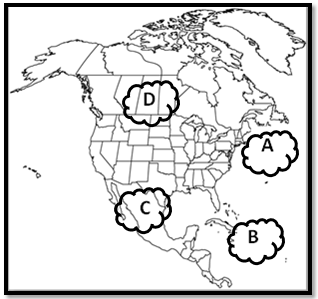
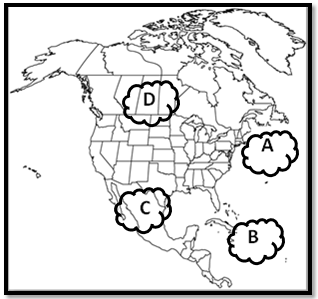
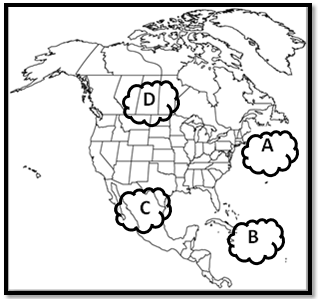
Which type of air would you find at air mass A?
a)
cold, dry
b)
warm, humid
c)
warm, dry
d)
cold, humid
36.
Which type of air would you find at air mass B?
a)
cold, dry
b)
warm, humid
c)
warm, dry
d)
cold, humid
37.
Which type of air would you find at air mass C?
a)
cold, dry
b)
warm, humid
c)
warm, dry
d)
cold, humid
38.
Which type of air would you find at air mass D?
a)
cold, dry
b)
warm, humid
c)
warm, dry
d)
cold, humid
39.
Where would you find a tropical maritime air mass?
a)
over the ocean, near the equator
b)
over the ocean, near the poles
c)
over a continent, near the equator
d)
over a continent, near the poles
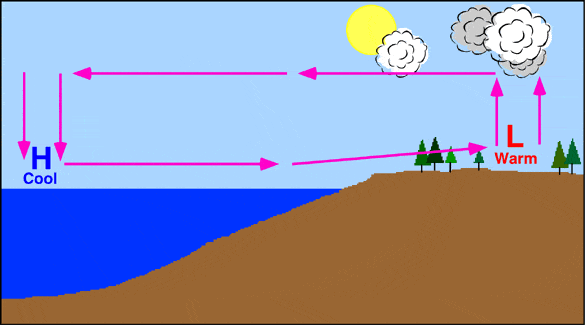
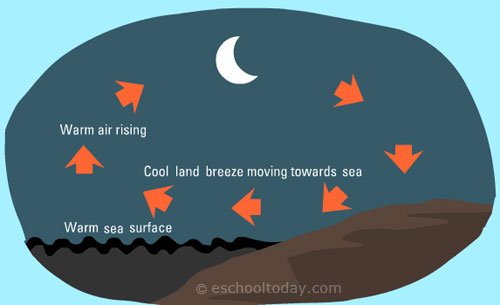
40.
What kind of breeze is this & what time of day/night would it form?
a)
Land breeze - daytime
b)
Land breeze - nighttime
c)
Sea breeze - daytime
d)
Sea breeze - nighttime
41.
Why does warm air rise?
a)
Warm air is more dense than cooler air.
b)
Warm air has more pressure than cooler air.
c)
Warm air is less dense than cooler air.
d)
Warm air has a higher dew point than cooler air.
42.
Do sea breezes typically happen during the day or night?
a)
Day
b)
Night
43.
Do land breezes typically happen during the day or night?
a)
Day
b)
Night
44.
During a land breeze which way does the wind blow?
a)
from the sea to the land
b)
from the land to the sea
45.
During a sea breeze which way does the wind blow?
a)
from the land to the sea
b)
from the sea to the land
46.
Is this a land or a sea breeze?
a)
land breeze
b)
sea breeze
47.
Is this a land or a sea breeze?
a)
land breeze
b)
sea breeze
48.
Where does the initial source of energy come from that creates winds?
a)
the moon
b)
the sun
c)
the Earth's surface
d)
the rotation of the Earth
49.
Why do land breezes occur at night?
a)
Land cools off slower than water, so the air above water is cooler.
b)
Water cools off faster than land, so the air above land is warmer.
c)
Land heats up slower than water, so the air stays cooler during the day.
d)
Water cools off slower than land, so the air above water is warmer.
50.
What does symbol # 3 mean?
a)
stationary front
b)
occluded front
c)
warm front
d)
cold front
51.
A front is
a)
where warm air is cooling at earth's surface
b)
a line where hot and cold air are separating
c)
a line where two different air masses meet
d)
where cold air is rising and forming rain clouds
52.
What does symbol # 4 mean?
a)
stationary front
b)
occluded front
c)
warm front
d)
cold front
53.
What does symbol # 1 mean?
a)
stationary front
b)
occluded front
c)
warm front
d)
cold front
54.
This is the symbol for which type of front?
a)
cold front
b)
warm front
c)
stationary front
d)
occluded front
55.
What does this symbol on a weather map indicate? 
a)
High pressure system
b)
Low pressure system
c)
Cold front
d)
Warm front
56.
What does this symbol on a weather map indicate? 
a)
High pressure system
b)
Low pressure system
c)
Cold Front
d)
Warm Front
57.
What does this weather instrument (shown here) measure?
a)
wind speed
b)
air pressure
c)
amount of fallen rain
d)
temperature
58.
Winds are caused by differences in 
a)
precipitation
b)
humidity
c)
air pressure
d)
turbulance
59.
This weather instrument measures air pressure.
a)
anemometer
b)
barometer
c)
rain gauge
d)
wind vane
60.
In a high pressure area, the weather will likely be
a)
warmer and clear skies
b)
warm but cloudy
c)
cold and rainy
d)
cold and clear
61.

In this system, you can expect stormy weather

a)

High Pressure System

b)

Low Pressure System

62.

This pressure system might bring fair weather

a)

High Pressure

b)

Low Pressure

63.

This system might bring clear skies

a)

High Pressure

b)

Low Pressure

64.

This pressure system might bring thunder, lightning, and heavy rain

a)

High Pressure System

b)

Low Pressure System

65.

This system has cool, dry air

a)

High Pressure System

b)

Low Pressure System

66.

This pressure system brings warm, humid air

a)

High Pressure System

b)

Low Pressure System

67.

The amount of water vapor in the air is called

a)

precipitation

b)

wind

c)

humidity

d)

transpiration

68.
The barometer shows the air pressure is dropping.  What kind of weather will likely pass through our area in the coming days?
a)
clear, fair weather
b)
cloudy, rainy weather
69.
A storm is currently passing through the town.  However, the barometer shows a rise in air pressure, what system is on the way?
a)
High Pressure System
b)
Low Pressure System
70.
What is the Coriolis Effect and how does it effect global winds?
a)
Curving of winds due to rotation of earth curves wind counterclockwise in Northern Hemisphere and clockwise in the Southern Hemisphere
b)
Movement of ocean currents caused by earth rotation' counterclockwise in Northern Hemisphere and clockwise in Southern Hemisphere
c)
curve of global winds caused by global rotation clockwise in Northern Hemisphere and counterclockwise in Southern Hemisphere
71.
How does the Coriolis Effect influence hurricanes and cyclones
a)
determines how powerful they will be
b)
determines where they will go
c)
determines where they form
d)
determines the direction of the wind rotation
72.
The two most important things to hurricanes are
a)
high pressure and cool water
b)
low pressure and cool water
c)
low pressure and warm water
d)
high pressure and warm water
73.
In the Northern Hemisphere, hurricane winds blow
a)
harder than in the Southern Hemisphere
b)
counterclockwise
c)
clockwise
d)
less than in the Southern Hemisphere
74.

Air always wants to move from areas of ______________ pressure to _______________ pressure.

a)

low to high

b)

high to low

c)

doesn't matter

d)

huh?

75.

The transfer of heat through the circulation of a liquid or a gas.

a)

convection

b)

radiation

c)

conduction

76.

If the Earth did not rotate, wind

a)

Sink and move toward the poles.

b)

move in a straight line

c)

Stay stationary.

d)

None of the above.

77.
Convection takes place because
a)
warm air is more dense than humid air
b)
warm and cold air have the same density
c)
cold air is less dense than warm air
d)
cold air is more dense than warm air
78.
What Causes differences in air pressure around earth ? 
a)
Warm air rises at the equator, and cold air sinks at the poles.
b)
Equator gets over heated 
c)
Snow 
79.
Warm air exerts _____________ pressure than cold air.
a)
the same
b)
more
c)
less
80.
Wind is caused mainly by air pressure differences that result from...
a)
a. uneven heating of the Earth's atmosphere.
b)
b. absorption of ultraviolet radiation by Earth's land masses.
c)
c. radiation of heat from Earth's land masses to water bodies.
d)
d. rotation of Earth on its axis.
81.
Why do hurricanes lose so much of their power when they hit land?
a)
they run into high pressure which kills hurricanes
b)
land is cooler than water therefore the hurricane loses the energy it needs from warm temperatures
c)
the land breezes shear the hurricane therefore making it harder for it to stay together
d)
the hurricane no longer receives heat and moisture from the warm ocean it uses for fuel
82.
What is the definition of CONDUCTION?
a)
When heat is transferred from objects like rays of light or electromagnetically.
b)
a  hot liquid or air that  expands, becomes less dense, and rises or becomes more dense, and sinks.
c)
When heat transfers from objects that are touching.
d)
When heat transfers through the heater or AC in your house.
83.
What kind of heat transfer happens when the sun is heating your body?
a)
Conduction
b)
Radiation
c)
Convection
d)
Density
84.
What heat transfer happens when you burn your hand by touching a fire?
a)
Radiation
b)
Conduction
c)
Convectio
d)
I don't know!!!!!!!!!!!
85.
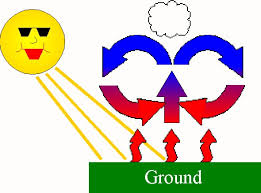
Warm air rises and the cool air sinks demonstrates this type of heat transfer. 
a)
conduction
b)
convection
c)
radiation
d)
Insolation 
86.
Ironing a shirt is an example of...
a)
condensation
b)
conduction
c)
convection
d)
radiation
87.
Johnny accidentally grabbed the handle of the hot pot.
a)
conduction
b)
convection
c)
radiation
88.
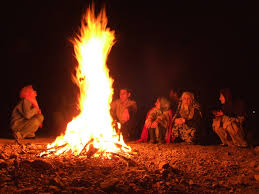
A group of friends gather around a fire to stay warm.
a)
conduction
b)
convection
c)
radiation
89.
Transfer of thermal energy through "space"
a)
conduction
b)
convection
c)
radiation
90.
The way the heat is moving from the hot coffee is called...
a)
convection
b)
radiation
c)
insulation
d)
conduction
91.
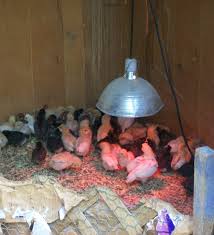
The baby chickens are kept warm from the heat lamps demonstrates this type of heat transfer. 
a)
conduction
b)
convection
c)
radiation
92.
A toaster toasting bread is an example of 
a)
condensation
b)
conductio
c)
convection
d)
radiation
93.
What happens when ice cubes melt in a glass?
a)
Heat travels from the ice to the warmer water.
b)
No energy is transferred.
c)
Heat is transferred from the warmer water to the ice cubes.
d)
The water warms up due to the humidity
94.

What type of storm forms in the western Pacific Ocean?

a)

Hurricane

b)

Typhoon

c)

Cyclone

d)

Tornado

95.

What is the minimum speed for a storm to be considered a cyclone or hurricane?

a)

39 mph

b)

74 mph

c)

100 mph

d)

157 mph

96.

Hurricanes form in areas of _____ pressure.

a)

High

b)

Low

97.

Which ingredient is not necessary for a thunderstorm to form?

a)

Moisture

b)

Instability

c)

Lifting Mechanism

d)

Wind

98.

The worst tornados would be categorized as

a)

F0

b)

F1

c)

F5

d)

T5

99.
What storm is a funnel shaped cloud?
a)
tornado
b)
hurricane
c)
thunderstorm
100.
Which storm forms over water?
a)
tornado
b)
hurricane
c)
thunderstorm
101.
Which of these would you NOT expect from a thunderstorm?
a)
lightning
b)
strong wind
c)
storm surge
d)
heavy rain
102.
What happens if a hurricane moves over land or cold ocean water?
a)
it will get stronger
b)
it will get weaker
c)
it will upgrade its category
d)
it will morph into a typhoon
103.
What are tornadoes?
a)
a storm with thunder and lighting and typically also heavy rain or hail
b)
a storm that can be the same as thunderstorms, but can be even more dangerous
c)
a mobile, destructive vortex of violently rotating winds having the appearance of a funnel shaped cloud and beneath a large storm system.
d)
a huge storm with strong winds and storm surges
104.
What are thunderstorms?
a)
a storm with thunder and lighting and typically also heavy rain or hail
b)
a storm that can be the same as thunderstorms, but even more dangerous
c)
a mobile, destructive vortex of violently rotating winds having the appearance of a funnel shaped cloud and advancing beneath a large storm system.
d)
a huge storm with strong winds and storm surges
105.
A severe storm that involves high winds and forms over water is:
a)
tornado
b)
thunderstorm
c)
hurricane
d)
blizzard
106.
What do hurricanes feed on?
a)
warm tropical water
b)
hot water
c)
cold artic water
d)
rain
107.
This person studies the Earth's atmosphere and monitors and forecasts the weather
a)
Seismologist
b)
Meteorologist
c)
Volcanologist
d)
Geologist
108.
What is the scale used to measure hurricanes?
a)
MPH scale
b)
Fujita Scale
c)
Weight Scale
d)
Saffir/Simpson Scale
109.
Which type of severe event is most likely to occur when a cold front moves in behind warm, moist air?
a)
Blizzard
b)
Hurricane
c)
Tornado
d)
Drought
110.
How do the conditions for a tornado differ from the conditions for a hurricane?
a)
Tornadoes never form when there is rain, while hurricanes always form with rain.
b)
Tornadoes form under low pressure, while hurricanes form under high pressure
c)
Tornadoes form in a stable atmosphere, while hurricanes form in an unstable atmosphere 
d)
Tornadoes form over land, while hurricanes form over bodies of water
111.
What is storm that contains storm surges and has wind speeds of 74 mph - 200 mph?
a)
thunderstorms
b)
severe thunderstorms
c)
tornadoes
d)
hurricanes