
 Worksheets
Water Cycle
Total questions: 116
Worksheet time: 2hrs 24mins
When water vapor is cooled and forms droplets of liquid water
Condensation
Evaporation
Transpiration
Runoff

________________ is movement of water past the soil going deep into the groundwater.
Evaporation
Transpiration
Percolation
Sublimation
__________________ is the process by which moisture is carried through plants from roots to small pores on the underside of leaves, where it changes to vapor and is released to the atmosphere. It is essentially evaporation of water from plant leaves.
Transpiration
Percolation
Infiltration
Plant Uptake

evapotranspiration
What is an aquifer?
a body of permeable rock which can contain or transmit groundwater.
a well in which water is under pressure especially : one in which the water flows to the surface naturally.
confining layer
solid rock underlying loose deposits such as soil or alluvium.
Hailey learned that clouds form through a process called condensation. Which of the following is NOT an example of condensation?
Liquid water is cooled and forms solid frozen ice
Water vapor in the air cools and forms liquid water on the outside of a glass
Gaseous water is cooled and forms liquid water
Water vapor in the air cools and forms dew on the ground
Which of the following is in the correct order?
Evaporation -> Transpiration -> Groundwater
Precipitation -> Condensation -> Evaporation
Evaporation -> Sublimation -> Precipitation
Condensation -> Precipitation -> Runoff
True or False - All of the water on Earth is recycled through biogeochemical cycles.
True
False
Water can change to gas through which process?
Evaporation
Sublimation
Transpiration
All answer choices are correct
What is the source of energy for the Water Cycle?
Ocean
Wind
Moon
Sun
Select the three main parts of the Water Cycle.
Precipitation
Condensation
Evaporation
Ground Water
Jack noticed that a puddle was gone that was there on his walk to school. What happened to the puddle?
It evaporated
It melted
It condensed
Snow and hail are examples of (a)
When water evaporates, it changes from a liquid to a (a)
What percent of water on Earth is fresh?
70%
3%
13%
97%
When water evaporates into the atmosphere, the next stage of the Water Cycle is condensation?
True
False
Match the state of matter with the correct name of the water.
Liquid water (a)
Water Vapor (b)
Ice (c)
occurs when the sun heats water up and it becomes vapor in the air.
Evaporation
the opposite of evaporation; it occurs when air cools and the vapor collects into liquid form.
Condensation
condensation falling onto land in the form of rain, sleet, hail, snow, and mist. Only 10% of water evaporated falls as precipitation.
Precipitation
the downward movement of water from the land surface into the soil or porous rock. Ground water begins as precipitation. Once water infiltrates the soil it can move vertically and horizontally through the soil.
Infiltration
is the water that exists for long periods below the Earth’s surface.
Groundwater storage
Approximately what percentage of Earth is covered with water?
3%
25%
75%
97%
Earth's freshwater is located in
Lakes
Rivers
Oceans
Soil
Glaciers
Water that evaporates from the ocean contains salt.
True
False
The process of water that is added to the atmosphere from plants is called
Condensation
Evaporation
Precipitation
Transpiration
The water cycle has no beginning or end.
True
False
he highest percentage of earth's fresh water is located which 2 places?
lakes
oceans
glaciers
soil
ice caps

Evaporation
A
Condensation
B
Precipitation
C
Transpiration
D
Groundwater
E
Water vapor leaves a plant in the biosphere and goes into the atmosphere through
transpiration
respiration
precipitation
evaporation
biosphere
all the water on Earth
regions that contain all the living things on Earth
the envelope of gases that surrounds Earth
living things on land
_____ moves underground to the ocean
sea water
groundwater
lake water
rain drops
What happens when water vapor loses thermal energy?
it expands into millions of droplets that form clouds
it condenses into millions of droplets that form clouds
it condenses into millions of droplets that form lakes and rivers
it expands on the surface of plants and goes into the air
atmosphere
all the water on Earth
regions that contain all the living things on Earth
the envelope of gases that surrounds Earth
living things on land
When is energy absorbed during the water cycle?
during evaporation
during transpiration
during condensation
during precipitation
hydrosphere
all the water on Earth
regions that contain all the living things on Earth
the envelope of gases that surrounds Earth
living things on land
____ happens when liquid turns into a gas on Earth's surface
evaporation
condensation
respiration
transpiration
How does energy from the Sun drive evaporation?
it slows down the water molecules and breaks their bonds
it makes the water molecules too big
it speeds up the water molecules and breaks their bonds
it speeds up the water molecules and creates new bonds
reservoirs
water storage areas during the water cycle
places reserved for water usage by humans and animals
made from water and ice that are too big to remain suspended in air
made up of water droplets or ice crystals that are so small they remain suspended in the air
Which statement does NOT apply to the water cycle?
it has no beginning
it has no end
it is continuous
it very rarely changes
clouds
water storage areas during the water cycle
places reserved for water usage by humans and animals
made from water and ice that are too big to remain suspended in the air
made up of water droplets or ice crystals that are so small they remain suspended in the air
Where does water from mountains or land NOT end up?
lakes
rivers
the ocean
space (unless sent there by a volcanic eruption!)
Which of the following drive the movement of water in the water cycle? (choose all that apply)
sunlight
transpiration
gravity
evaporation
Where is groundwater stored?
in lakes and rivers
in underground lakes
in cracks and pores beneath Earth's surface
in mid-ocean ridges
Evaporation adds water to the
biosphere
atmosphere
lithosphere
geosphere
What effect does the sun have on surface water?
It causes it to boil
It causes it to rain
It causes it to sink
It causes it to evaporate
When water vapor is cooled and forms droplets of liquid water
Condensation
Evaporation
Transpiration
Runoff
What is precipitation?
Sweat from our bodies on hot days
Warm rain but not cold snow or sleet
Gas that we use in furnaces or ovens
Any form of water that falls from the sky
The process when plants release water vapor from their leaves is called _____________.
precipitation
evaporation
transpiration
condensation

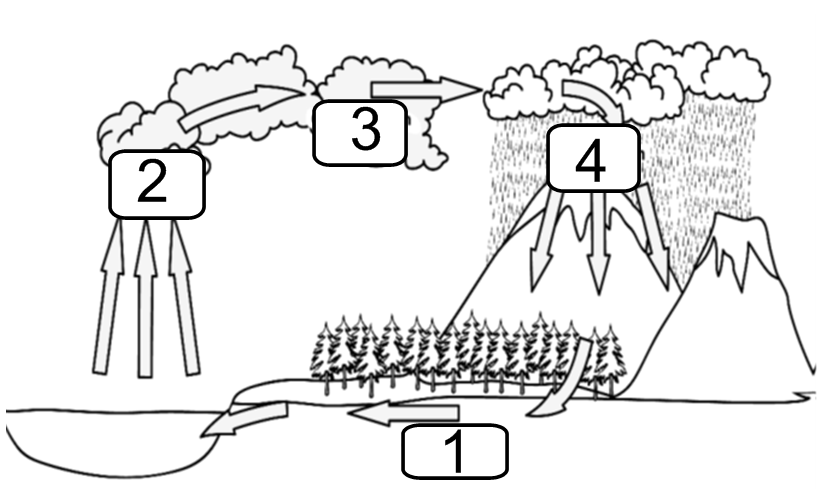
What step of the water cycle does this picture show?
Condensation
Runoff
Precipitation
Evaporation

What are formed when water vapor condenses and come together?
Clouds
Mountains
Transpiration
Valleys

Is precipitation any form of water that falls back to earth?
Yes
No
When clouds fill with water and can't hold anymore, the water falls from the clouds as -
precipitation
clouds
When water falls from clouds in liquid or solid form
precipitation
condensation
accumulation
evaporation
Water than flows downward on land
runoff
transpiration
evaporation
condensation
water vapor given off by plants
runoff
transpiration
evaporation
condensation
water collecting in a lake or ocean over a long period of time
condensation
evaporation
transpiration
accumulation or collection
When water turns from liquid form to a gas
evaporation
precipitation
condensation
transpiration
When water vapor turns into a liquid
condensation
runoff
transpiration
evaporation
What word do we give to water when it is the form of a gas
ice
rain
snow
water vapor
Which of the following is associated with transpiration
plants
animals
rocks
humans
Warm water heats up to form water vapor in what process
evaporation
condensation
run off
What do water droplets form?
condensation
humidity
clouds
runoff

What is this
precipitation
evaporation
condensation

What is this?
precipitation
evaporation
condensation

What is this?
evaporation
precipitation
condensation
Where is most of Earth's water?
in oceans and glaciers
underground
in clouds
Is the temperature on a glacier hot or cold?
hot
cold
Which would evaporate, a lake or a rock?
a lake
a rock
Only a small amount of water goes through the water cycle.
True
False
When water evaporates, it changes from a solid to a gas.
True
False
When water changes from a solid to a liquid, it _________.
freezes
melts
What happens to rain after it falls?
It goes into rivers.
It goes into glaciers.
What covers most of Earth's surface?
water
rocks
mountains
plants
The water cycle makes more water for Earth.
True
False
Plants need fresh water. But, people can drink salty water.
True
False
Which one would evaporate, a rock or a puddle?
a rock
a puddle
What causes water to change forms?
energy
luck
Does water ever disappear completely?
Yes, it disappears.
No, it changes form.
________ is the process where liquid water turns into water vapor due to heat from the sun.
Condensation
Transpiration
Sublimation
Evaporation
_________ is water released from clouds in the form of rain, freezing rain, sleet, snow, or hail.
Condensation
Precipitation
Evaporation
Sublimation
Most precipitation falls as _________.
Snow
Freezing Rain
Rain
Hail
Clouds play a significant role in the movement and storage of water on our planet
True
False
The water on our planet is the same water that was here millions of years ago. However, it is continuously moving and being recycled through the water cycle.
True
False
___________% of Earth’s water can be found in the oceans.
50%
30%
10%
70%
Water is stored in:
Rivers
Lakes
Clouds
All the above
Water vapor is which state of matter?
Solid
Liquid
Gas
_________ is the process of water vapor turning back into a liquid upon cooling.
Condensation
Runoff
Transpiration
Sublimation
________________is the process where solid water (ice) is directly converted into water vapor (gas).
Condensation
Evaporation
Sublimation
Ice Ice baby
Precipitation is the process of water falling out of clouds in our atmosphere and returning back to Earth.
True
False
The evaporation of water out of the leaves of plants happens during which step?
Condensation
Evaporation
Transpiration
Runoff
When snow melts, the water that is not soaked up by the ground will runoff or flow to another location.
True
False
Some of the water that precipitates does not runoff into the rivers and is absorbed by the plants or gets evaporated. It moves deep into the soil. This is called Sublimation.
True
False
How is your day going?
Rain, snow, sleet, and hail are all types of?
Precipitation
Runoff
Condensation
Water Vapor
What does evaporation produce?
Precipitation
Rain or Snow
Water Vapor
Condensation
______ is the process through which water falls from clouds in the form of rain, snow, and freezing rain.
Precipitation
Condensation
Sublimation
Evaporation
When water evaporates from a plant's leaves, this process is called _____.
Precipitation
Transpiration
Condensation
Evaporation
Water that has soaked into the ground is known as ______.
Precipitation
Groundwater
Runoff
Water Vapor
Hailey learned that clouds form through a process called condensation. Which of the following is NOT an example of condensation?
Liquid water is cooled and forms solid frozen ice
Water vapor in the air cools and forms liquid water on the outside of a glass
Gaseous water is cooled and forms liquid water
Water vapor in the air cools and forms dew on the ground
Which of the following is in the correct order?
Evaporation -> Transpiration -> Groundwater
Precipitation -> Condensation -> Evaporation
Evaporation -> Sublimation -> Precipitation
Condensation -> Precipitation -> Runoff
Which process allows water to return to the Earth's surface?
Evaporation
Transpiration
Condensation
Precipitation
The biogeochemical cycle that includes cloud, rain, rivers and oceans is known as the ____ ____.
Water Cycle
Nitrogen Cycle
Carbon Cycle
Nutrient Cycle
True or False - The water cycle always starts with the water evaporating from the ocean or lakes.
True
False
True or False - All of the water on Earth is recycled through biogeochemical cycles.
True
False
Water can change to gas through which process?
Evaporation
Sublimation
Transpiration
All answer choices are correct
True or False - The water cycle recycles water through both the living and non-living parts of an ecosystem.
True
False

