Worksheets
5.0 Waves
Total questions: 35
Worksheet time: 30mins

Displacement-time graph in Diagram 2 shows an oscillation of a loaded jigsaw blade in air. What will the graph likely be if it is oscillated the same way on the moon?


Diagram 3 shows an experiment carried out by Sarah to investigate a wave phenomenon using Barton’s pendulum. Sarah observed that when pendulum X oscillates, pendulum C oscillates with maximum amplitude. The wave phenomenon involved is
inertia
resonance
damping
momentum

Diagram 4 shows a boy swinging on a swing at the playground. Amplitude of the swing decreases with time due to damping. Which of the following graphs represents the oscillation of the swing which undergoes damping?


Diagram 5(a) shows an incident wavefronts of a plane wave approaching a barrier. Diagram 5(b) shows reflected wavefronts of the plane wave reflects by the barrier. Which of the following statements is true about the incident and reflected waves?
The incident wave has the same speed as the reflected wave.
The incident wave has a longer wavelength than the reflected wave.
The incident wave has a higher frequency than the reflected wave.
The incident wave has same direction as the reflected wave.

A ship in Diagram 7 uses an echo sounder to send pulses of ultrasound downwards to the seabed. The time taken for each echo to return is 1.4 s and the speed of sound in water is 1 400 m s-1. What is the depth of the water?
540 m
620 m
700 m
980 m

Diagram 7 shows a reflected sound wave is received by a receiver. What is the value of reflected angle, r?
15o
30o
60o
90o

Diagram 8 shows a plane wavefront travels from region x to region y. Which of the following is true regarding the wavelength in region x and region y?
Region x = 20.0 cm
Region y = 25.0 cm
Region x = 15.0 cm
Region y = 33.3 cm
Region x = 20.0 cm
Region y = 33.3 cm
Region x = 15.0 cm
Region y = 25.0 cm

Diagram 9 shows a ripple tank being used to investigate waves in water. The water wave travels from an area of deep water to an area of shallow water. Which of the following about the wave motion from deep water to shallow water is correct?
Frequency and speed remain unchanged. Wavelength has changed.
Frequency and wavelength remain unchanged. Speed has changed
Speed remains unchanged. Wavelength and frequency have changed
Frequency remains unchanged. Speed and wavelength have changed.

Diagram 10 shows a student can hear the sound from the radio even though he stands beside the building. Name the wave phenomenon involved.
Reflection
Refraction
Diffraction
Interference
Which diagram shows the phenomenon of wave diffraction?


Diagram 11 shows a set up apparatus in a Young’s double slit experiment. A red light source is used to form red fringes on the screen. If the red-light source is replaced by a blue light source, the
brightness of the fringes increases.
thickness of the fringes increases.
distance between fringes increases.
number of fringes increases.

Diagram 12 shows the interference wave patterns formed by waves from two coherent sources, S1 and S2 . Which combination is correct?
Constructive interference = R
Destructive interference = Q
Constructive interference = P
Destructive interference = Q
Constructive interference = Q
Destructive interference = R
Constructive interference = R
Destructive interference = P

Diagram 13 shows Ali uses a remote control to change the TV channel. State the type of wave used in the remote control.
Infrared
Radio wave
Microwave
Ultraviolet
Arrange the electromagnetic waves in order of increasing frequency
Ultraviolet rays, infrared rays, microwaves, gamma rays.
Microwaves, infrared rays, ultraviolet rays, gamma rays
Infrared rays, microwaves, ultraviolet rays, gamma rays
Microwaves, gamma rays, infrared rays, ultraviolet rays

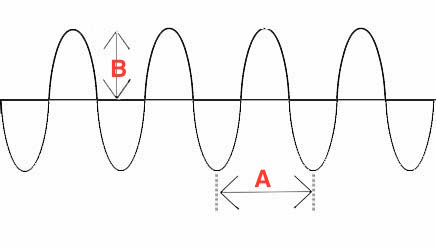
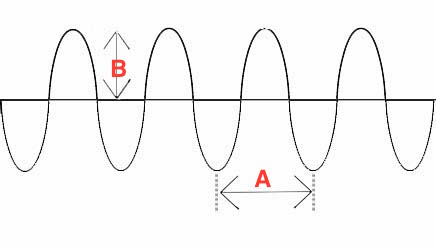
Diagram 1 shows a displacement-distance graph of a water wave in a ripple tank. If the motor vibrates with a constant frequency and produces 5 complete waves in one second, calculate the speed of the wave.
16 cm s–1
28 cm s–1
80 cm s–1
140 cm s–1