wayground logo

Free Printable Worksheets

Font size

S
M
L
XL
Worksheets

CHEMISTRY- END OF TERM EXAMS (GRADE 10)

Total questions: 188

Worksheet time: 5hrs 6mins

Name
Class
Date
1.
Type of mixture that has the SAME COMPOSITION in every part.
a)
Homogenous
b)
Heterogeneous
2.
Chocolate milk is an example of a
a)
homogeneous mixture
b)
heterogeneous mixture
3.
Type of mixture that DOESN'T HAVE the same composition in every part.
a)
Homogeneous
b)
Heterogeneous
4.
Chicken noodle soup is an example of a
a)
homogeneous mixture
b)
heterogeneous mixture
5.
Gases have...
a)
A definite shape and volume
b)
A definite shape but no definite volume
c)
No definite shape but a definite volume
d)
No definite shape or volume
6.
What is the variable for this number 22.4 L
a)
P
b)
T
c)
n
d)
V
7.
What is the variable for this number 32oC
a)
P
b)
T
c)
n
d)
V
8.
What is the variable for this number 9.10 atm
a)
P
b)
T
c)
n
d)
V
9.
What is the variable for this number 122 K
a)
P
b)
T
c)
n
d)
V
10.
What is the variable for this number 1.5 mol
a)
P
b)
T
c)
n
d)
V
11.
Which law helps us find the moles of gas in a sample?
a)
Charles Law
b)
Boyle's Law
c)
Combined Gas Law
d)
Ideal Gas Law
12.
Calculate the volume that a 0.323-mol sample of a gas will occupy at 265 K and a pressure of 0.900 atm.
a)
7.18 L 
b)
7.81 L
c)
4.63 L
d)
4.36 L
13.
Determine the Kelvin temperature required for 0.0470 mol of gas to fill a balloon to 1.20 L under .998 atm pressure. 
a)
0 K 
b)
107 K 
c)
207 K 
d)
307 K 
14.

What does R stand for

a)

Ideal gas constant

b)

Real gas constant

c)

Temperature constant

d)

Ideal gas law

15.
If n and T are held constant, the ideal gas law reduces to 
a)
Charles' law
b)
Boyle's law
c)
Avogadro's principle
d)
zero
16.
The ideal gas law is an equation that relates the  what  variables to a constant of R.
a)
volume, pressure, temperature
b)
volume, temperature, pressure, amount of gas particles
c)
volume, pressure
d)
volume, temperatue
17.
What pressure, in atm, is exerted by 2.50 L of gas containing 1.35 mol at 320 K?
PV=nRT
a)
14.19 atm
b)
16.53 atm
c)
18.42 atm
d)
22.54 atm
18.
Determine the Celsius temperature of 2.49 moles of gas contained in a 1.00-L vessel at a pressure of 143 kPa. 
a)
-266 degrees C
b)
-622 degrees C
c)
622 degrees C 
d)
266 degrees C
19.

Which is a correct unit for R?

a)

L.atm/mol.k

b)

L.atm

c)

mmHg/mol.K

d)

L.atom/mol

20.
How many moles of propane gas are in a 7.0 L tank at 20°C and 5.45atm of pressure?
a)
0.629 mol
b)
1.59 mol
c)
23.2 mol
d)
917 mol
21.
What pressure, in atm, is exerted by 2.50 L of gas containing 1.35 mol at 320 K?
PV=nRT
a)
14.19 atm
b)
16.53 atm
c)
18.42 atm
d)
22.54 atm
22.
Determine the number of moles in a container of gas at STP with a volume of 99.2 L. 
a)
2222.08 moles
b)
4.43 moles
c)
22.4 moles 
d)
76.8 moles
23.
What about gasses can be measured?
a)
Pressure and Volume
b)
Temperature, Volume, and Pressure
c)
Volume and Temperature
d)
Pressure, Temperature, Volume, and Moles
24.
If the pressure exerted by a gas at 25 degrees C in a volume of 0.044 L is 3.81 atm, how many moles of gas are present?
a)
.002766 mole
b)
.0069 mol
c)
2.766 mol
d)
9.887 mol
25.
In order to solve gas law calculations, temperature must be measured in:
a)
Fahrenheit
b)
Celsius
c)
Kelvin
d)
It doesn't matter 
26.
Determine the Kelvin temperature required for 0.0470 mol of gas to fill a balloon to 1.20 L under .998 atm pressure. 
a)
0 K 
b)
107 K 
c)
207 K 
d)
307 K 
27.
Calculate the volume that a 0.323-mol sample of a gas will occupy at 265 K and a pressure of 0.900 atm.
a)
7.18 L 
b)
7.81 L
c)
4.63 L
d)
4.36 L
28.
At STP, what is pressure in atmospheres?
a)
1 atm
b)
10 atm
c)
0 atm
d)
100 atm
29.
As number of moles goes up, volume 
a)
goes down.
b)
goes up.
c)
stays the same
30.
If the pressure exerted by a gas at 25 degrees C in a volume of 0.044 L is 3.81 atm, how many moles of gas are present?
a)
.002766 mole
b)
.0069 mol
c)
2.766 mol
d)
9.887 mol
31.
At 17 °C, a 0.80 mole sample of a gas exerts a pressure of 1.2 atmospheres. What is the volume of the container?
a)
22.9 Liters
b)
2355 Liters
c)
0.0630 Liters
d)
15.9 Liters
32.
A 7.50 liter sealed jar at 18 °C contains 0.125 moles of oxygen and 0.125 moles of nitrogen gas. What is the pressure in the container?
a)
7.38 atm
b)
0.796 atm
c)
0.684 atm
d)
0.398 atm
33.
When 0.250 moles of a gas is placed in a container at 25 °C, it exerts a pressure of 700 mm Hg. What is the volume of the container?
a)
0.557 Liters
b)
6.57 Liters
c)
8.74 Liters
d)
0.0087 Liters
34.
The mass of one mole of substance is called...
a)
molecular mass
b)
mole constant
c)
molar mass
d)
atomic weight
35.
What is the molar mass of sodium?
a)
11
b)
23
c)
45.98
d)
3
36.
The molar mass of an element is equal to its...
a)
Atomic mass
b)
Atomic number
c)
Oxidation number
d)
Valence electrons
37.
What is the molar mass of table salt (NaCl)?
a)
116.886 g/mol
b)
35.453 g/mol
c)
22.990 g/mol
d)
58.443 g/mol
38.
How many particles are in a mole?
a)
602
b)
602 million
c)
602 moles
d)
6.02 x 10²³
39.

2Al + 6HCl --> 2AlCl3 + 3H2

Aluminium reacts with hydrochloric acid. How many grams of aluminum are necessary to produce 11 L of hydrogen gas at STP?

a)

13

b)

8.8

c)

0.99

d)

1.0

40.

Mg3N2 + 3H2O ––> 3 MgO + 2NH3

If 10.3 g of magnesium nitride is used, what volume of ammonia gas would be collected at 20˚C and 0.989 atm?

a)

4.9 L NH3

b)

4.96 L NH3

c)

0.261 L NH3

d)

0.26 L NH3

41.

1Mg + 2H2O --> Mg(OH)2 + H2

What volume of hydrogen will be produced at STP by the reaction 67.3 g of magnesium?

a)

62.0 L

b)

0.12 L

c)

2.77 L

d)

1.15 L

42.

Mg3N2 + 3H2O ––> 3 MgO + 2NH3

If 10.3 L of ammonia gas at 20.0˚C and 0.989 atm is created, how many liters of water at STP are required?

a)

0.423 L H2O

b)

14.2 L H2O

c)

0.204 L H2O

d)

10.3 L H2O

43.

2CO + O2 −-> 2CO2

How many liters of carbon dioxide at STP are produced from 10.0 L of carbon monoxide at STP?

a)

10.0 L

b)

20.0 L

c)

5010 L

d)

0.0199

44.

When solving for gas stoichiometry problems which of the following is correctly matched?

a)

STP conditions; molar mass

b)

NON STP conditions; PV=nRT

c)

STP conditions; PV=nRT

d)

NON STP conditions; 22.4 moles

45.

2CO + O2 −-> 2CO2

How many liters of carbon monoxide at 25.0oC and 8.56 mmHg are needed to react with 12.30 L of oxygen gas at STP?

a)

3.14 L

b)

318 L

c)

2390 L

d)

200 L

46.

2Cu2S + 3O2 → 2Cu2O + 2SO2

This reaction uses 18.2 g of copper (I) sulfide. What volume of sulfur dioxide gas would be collected at 237°C and 10.7 atm?

a)

0.446 L

b)

57 L

c)

0.207 L

d)

0.21 L

47.

2NaN3 → 2Na + 3N2

At what pressure(atm) is the nitrogen gas sample that is collected when 48.4 g of NaN3 decomposes? The temperature of the gas is 25.0°C and the volume is 18.4 L.

a)

151 atm

b)

1130 atm

c)

0.125 atm

d)

1.48 atm

48.

2Cu2S + 3O2 → 2Cu2O + 2SO2

This reaction uses 18.2 g of copper (I) sulfide. What volume of sulfur dioxide gas would be collected at 237°C and 10.7 atm?

a)

0.446 L

b)

57 L

c)

0.207 L

d)

0.21 L

49.

2NaN3 → 2Na + 3N2

At what pressure(atm) is the nitrogen gas sample that is collected when 48.4 g of NaN3 decomposes? The temperature of the gas is 25.0°C and the volume is 18.4 L.

a)

151 atm

b)

1130 atm

c)

0.125 atm

d)

1.48 atm

50.
You have 3.5 L of H2 (g) at STP. How many moles of gas are there?
a)
22.4 mol
b)
22.4 L
c)
0.16 mol
d)
0.16 L
51.

Assume that 5.6 L H2 at STP reacts with excess CuO according to the following equation:

CuO (s) + H2 (g) ---> Cu (aq) + H2O (l)


How many moles of Cu are produced?

a)

0.250 mol

b)

2.50 mol

c)

25.0 mol

d)

25.00000 mol

52.

Which mole ratio is correct for the given chemical equation?


2N2 (g) + 5O2 (g) -----> 2N2O5 (g)

a)

2 mol N2 to 5 mol N2O5

b)

2 mol N2 to 2 mol N2O5

c)

5 mol O2 to 2 mol NO2

d)

None are correct.

53.
How do I change from moles to liters?
a)
divide by 22.4
b)
multiple by Avo number
c)
multiply by 22.4
d)
multiply by molar mass
54.
How do I move from grams to moles
a)
multiply by molar mass
b)
divide by molar mass
c)
multiply by Avo number
d)
divided by Avo number
55.
How many liters are in a mole?
a)
6.022x10^23
b)
1
c)
Molar Mass
d)
22.4
56.
How many grams are in a mole?
a)
6.022x10^23
b)
1
c)
Molar Mass
d)
22.4
57.
In the ideal gas law, _____ represents moles of a gas.
a)
T
b)
V
c)
R
d)
n
58.
What is standard temperature?
a)
0K
b)
0oC
c)
173 K
d)
173.15 K
59.
Which of the following is NOT a value for standard pressure?
a)
101.3 kPa
b)
760 mm Hg
c)
1 atm
d)
1 torr
60.
What is the molar volume of an ideal gas at STP?
a)
1 mol = 22.4 L
b)
1 mol = 0.0821 L
c)
1 mol = 1 L
d)
1 mol = 273 L
61.
What is the volume of 2 moles of gas at STP?
a)
22.4 L
b)
44.8 L
c)
11.2 L
d)
2 L
62.
What precipitate forms when you mix lead (II) nitrate with sodium chloride?
a)
sodium nitrate 
b)
lead (II) chloride 
c)
sodium lead
d)
chloride nitrate 
63.
Which is the correct net ionic equation for the reaction of AgNO3 and CaCl2?
a)
Ca2+(aq) +  2Cl- (aq) → CaCl(s)
b)
Ag+(aq)  +  Cl- (aq) → AgCl(s)
c)
Ag +  Cl  →  AgCl
d)
Ag+  +  Ca2+   →Ag2Ca (s)
64.
Which of the following does NOT form a precipitate?
a)
Pb(NO3)2(aq) + 2KI(aq) 
b)
Sr(NO3)2 (aq) + K2SO4(aq) →
c)
AgNO3(aq) + Na2S(aq) →
d)
 Pb(NO3)2(aq) + AgNO3(aq) →
65.
What are the spectator ions in the reaction of sodium chloride with silver nitrate?
a)
silver and nitrate
b)
sodium and chloride
c)
sodium and nitrate
d)
silver and chloride
66.
In the reaction Zn + H2O → ZnO2 + H2 which element is oxidized? 
a)
Zinc
b)
Hydrogen
c)
Oxygen
d)
None
67.
What substance is oxidized in the following reaction? 
Fe+2 + MnO4  → Fe+3 + Mn+2   
a)
Fe+2
b)
Mn+3
c)
Mn+2
d)
MnO4
68.
What is the oxidation number of N in NO2-1?
a)
-3
b)
+4
c)
-2
d)
+3
69.
What is oxidation number of Mn in MnO2?
a)
0
b)
+2
c)
-2
d)
+4
70.
What is oxidation number of Cr in Cr2O72-?
a)
-2
b)
+2
c)
+6
d)
+12
71.
In this equation,
CuCl2 + NaOH  → Cu(OH)2 + NaCl
Which product is insoluble?
a)
copper(II) hydroxide
b)
sodium chloride
c)
sodium hydroxide
d)
copper(II) chloride
72.
Which of these results in the formation of a precipitate?
a)
AgNO3(aq)  +  NaOH(aq)→
b)
BaNO3(aq)  +  CaCl2(aq)→
c)
NaNO3(aq)  +  KOH(aq)→
d)
More than one of these form precipitates
73.
Which of these results in formation of a precipitate?
a)
BaNO3(aq)  +  NaCl(aq)→
b)
KNO3(aq)  +  LiOH(aq)→
c)
Zn(NO3)2(aq)  +  NaOH(aq)→
d)
NaNO3(aq)  +  Ba(OH)2(aq)→
74.
What is the result of the reaction between potassium bromide and ammonium sulfide?
a)
potassium sulfide precipitates
b)
ammonium bromide precipitates
c)
potassium ammonium precipitates
d)
no precipitate is formed
75.
Which pair could be spectator ions?
a)
NH4+ and Cl-
b)
Ca+2 and OH-
c)
Ag+ and Br-
d)
Sr+2 and CO3 -2
76.
What are the spectator ions in this reaction?
CuCl2(aq) + NaOH(aq) → Cu(OH)2(s) + NaCl(aq)
 
a)
Cu2+ and OH1-
b)
Na2+ and Cl2-
c)
Na1+ and Cl1-
d)
Na1+ and OH1-
77.
In this equation,
CuCl2 + NaOH  → Cu(OH)2 + NaCl
Which product is insoluble?
a)
copper(II) hydroxide
b)
sodium chloride
c)
sodium hydroxide
d)
copper(II) chloride
78.
What is the result of the reaction between potassium bromide and ammonium sulfide?
a)
potassium sulfide precipitates
b)
ammonium bromide precipitates
c)
potassium ammonium precipitates
d)
no precipitate is formed
79.

What is the correct net ionic equation for the reaction between HBr(aq) and LiOH(aq)?

a)

2 H+(aq) + O2-(aq) → H2O(l)

b)

2 H2 (aq) + O2(aq) → 2 H2O(l)

c)

2 H2 (g) + O2(g) → 2 H2O(l)

d)

H+(aq) + OH-(aq) → H2O(l)

80.

What is the net ionic equation for the reaction between K3PO4 (aq) and CuSO4 (aq)

a)

2 K+(aq) + SO42-(aq) → K2SO4 (s)

b)

K+(aq) + SO42-(aq) → KSO4 (s)

c)

2 Cu2+(aq) + 3 PO43-(aq) → Cu3(PO4)2 (s)

d)

Cu2+(aq) + PO43-(aq) → CuPO4 (s)

81.

Which term best describes solid potassium chloride being dissolved in water, as shown in the equation below?

KCl(s) → K+(aq) + Cl-(aq)

a)

dissociation

b)

precipitation

c)

displacement

d)

synthesis

82.

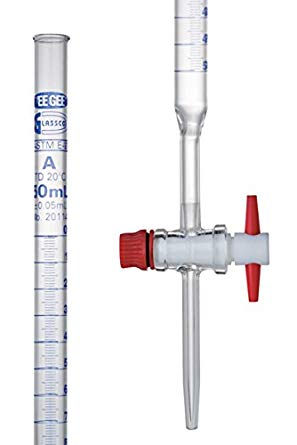
What is this piece of apparatus called

a)

Pipette

b)

Burette

c)

Janette

d)

Cuvette

83.

What is the reading on this burette?

a)

24.0cm3

b)

25.8cm3

c)

24.2cm3

d)

23.9cm3

84.

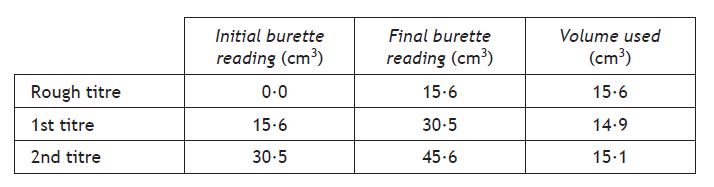
What is the average titre needed for neutralisation?

a)

25.2cm3

b)

59.7cm3

c)

25.0cm3

d)

25.4cm3

85.

Calculate the average volume of acid needed for this neutralisation

a)

15.2cm3

b)

15.0cm3

c)

35.5cm3

d)

30.1cm3

86.

30cm3 of NaOH is neutralised by 12.3cm3 of 0.2mol/l HCl. What is the concentration of the NaOH.

a)

82 mol/l

b)

0.82 mol/l

c)

0.49 mol/l

d)

0.082 mol/l

87.
The reaction of perchloric acid (HClO4) with lithium hydroxide (KOH) is described by the equation
HClO4 + KOH → KClO4 + H2O
Suppose 100 mL of perchloric acid is neutralized by exactly 50,0 mL of 1.0 M of Potassium hydroxide. What is the concentration of the perchloric acid?
a)
0.5M
b)
50M
c)
2.0M
d)
1.0M
88.
A 50.0 mL sample of Ca(OH)2 is neutralized by 300.0 mL of HCl solution with a pH of 1.3. Calculate the molarity of the Ca(OH)2 solution.
a)
1.0 M
b)
0.50 M
c)
0.15 M 
d)
0.30 M
89.
What is the molarity of a NaOH solution if 11.6 mL of 3 M HCl was used to neutralize 25 mL of NaOH?
a)
1.392 M
b)
0.155 M
c)
0.718 M
90.
How many milliliters of 0.360 M H2SO4 are required to neutralize 25 mL of 0.1 M Ba(OH)2?
a)
6.944 mL
b)
0.144 mL
c)
0.069 mL
91.

Calculate the volume of a 0.15 M Ba(OH)2 solution required to completely neutralize 45 ml of a 0.29 M HNO3 solution.

a)

43.5 ml

b)

87 ml

c)

23.3 ml

d)

51.9 ml

92.
acid + base ₋>
a)
salt + hydrogen
b)
salt + water
c)
salt + carbon dioxide + water
d)
salt
93.
HCl + NaOH → 
a)
NaH + ClOH
b)
NaCl + H2
c)
NaCl + H2O
d)
NaCl + Cl2
94.
I am titrating 1M HCl with 1M NaOH.  I have 25mL of HCl. How much NaOH will I need?
a)
2.5mL
b)
5mL
c)
25mL
d)
50mL
95.
What is the endpoint of a titration
a)
Where the amount of acid and base are balanced according to the equation
b)
Where there is no base
c)
At the end
96.
what is the reading on this burette?
a)
4.40mL
b)
3.50mL
c)
3.60mL
d)
4.50mL
97.
Identify the products of the chemical equation
3 LiOH + H3PO4
a)
Li3PO4 + 3 H2O
b)
LiPO4 + 3 H2O
c)
Li(PO4)3 + 3 H2O
d)
BOY + La + N2
98.
How many moles of Ca(OH)2 are needed to neutralize three moles of HCl? 
a)
8
b)
1.5
c)
6
d)
3
99.
Changes the color of indicators.
a)
Acids
b)
Bases
c)
All
100.
If phenolphthalein turns bright pink, it indicates
a)
an acid 
b)
a base
c)
a neutral
101.

Why is indicator added to a titration?

a)

To test for acids

b)

to show the endpoint

c)

to prove a reaction has happened

d)

to show a colour

102.

When should you stop a titration?

a)

When you have added equal volumes

b)

When the indicator changes colour

c)

When you run out of solution

d)

When the solution is no longer acidic

103.

What is the reading on this burette?

a)

24.0cm3

b)

25.8cm3

c)

24.2cm3

d)

23.9cm3

104.

What is the correct sequence to clean a conical flask?

a)

deionised water, tap water, solution to be filled

b)

tap water, deionised water, solution to be filled

c)

tap water, deionised water

d)

deionised water, tap water

105.

Hot to remove air bubble in the burette?

a)

no need to remove air bubbles

b)

shake the burette vigorously until the air bubble disappear

c)

tap the burette gently until the air bubble disappear

d)

open the tap to flush out the air bubbles

106.

During titration, when there are droplets of solution on the walls of the conical flask, you should .................

a)

ignore as it won't affect the results

b)

rinse the wall of the conical flask with solution in the burette

c)

rinse the wall of the conical flask with deionised water

d)

rinse the wall of the conical flask with tap water

107.

During titration, you should swirl the conical flask constantly.

a)

TRUE

b)

FALSE

108.

All burette readings are recorded to nearest 0.01 cm3.

a)

TRUE

b)

FALSE

109.

Consistent readings are titre values that are within 0.30cm3 apart.

a)

TRUE

b)

FALSE

110.

NH3 + H2O → NH4+ + OH-

NH3 is a Bronsted Lowry

a)

Acid

b)

Base

c)

conjugate acid

d)

conjugate base

111.

Which of the following is a neutralization reaction?

a)

2Na + Cl2 → 2NaCl

b)

CH4 + 2O2 → CO2 + 2H2O

c)

HCl + KOH → KCl + H2O

d)

CaCO3 → CO2 + CaO

112.

What is the pH of a reaction between a strong acid and strong base?

a)

0

b)

5

c)

10

d)

7

113.

HNO3 + H2O → H3O+ + NO31-

NO31- is the conjugate base of

a)

H2O

b)

HNO3

c)

H3O+

d)

none of the above

114.

HCO3- + H2O → H3O+ + CO32-

Water is acting as

a)

a Bronsted Lowry base

b)

a Bronsted Lowry acid

c)

a strong acid

d)

a weak acid

115.

HC2H3O2 + H2O → H3O+ + C2H3O21-

HC2H3O2 is acting as

a)

a conjugate base

b)

a Bronsted Lowry base

c)

a Bronsted Lowry acid

d)

none of the above

116.

Which of the following is a strong base?

a)

NH3

b)

Zn(OH)2

c)

HCl

d)

CsOH

117.

Which of the following is a strong acid?

a)

NaOH

b)

HCl

c)

HF

d)

H2O

118.

HBr is the conjugate acid of

a)

Br1-

b)

Br2

c)

H2Br

d)

none of the above

119.

What is the conjugate base of H2SO4?

a)

SO42-

b)

H2SO3

c)

HSO31-

d)

HSO41-

120.

What does pH measure?

a)

strength of an acid

b)

strength of a base

c)

strength of both acids and bases

d)

concentration of H+ ions

121.

As the pH of a solution gets lower, the solution becomes more _____.

a)

acidic

b)

basic (or alkaline)

c)

neutral

d)

ionic

122.

Predict the products of this reaction.

HCl + Ca(OH)2

a)

NaCl

b)

CaCl2

c)

CaCl2 + H2O

d)

H2O

123.

How many times can you retake this quiz?

a)

as many times as you want

b)

unlimited

c)

to infinity and beyond

d)

ALL these answers are correct

124.

The pH of 4 solutions were measured in a lab. Which solution is the most acidic?

a)
b)
c)
d)
125.

The pH of 4 solutions were measure in a lab. Which of the solutions is the most basic (alkaline)?

a)
b)
c)
d)
126.

Which term refers to the amount of acid or base dissolved in a solution?

a)

concentrated or dilute

b)

strong or weak

c)

neutral or charged

d)

acid or base

127.

A chemical reaction between an acid and a base, forming a salt and water is known as ____.

a)

ionization

b)

concentration

c)

neutralization

d)

animation

128.

Sodium hydroxide (NaOH) is known as a strong base. Which statement is true about NaOH after dissolving in solution?

a)

few OH- ions; many NaOH molecules

b)

many OH- ions; few NaOH molecules

129.

What does Universal Indicator measure?

a)

the pH of a solution

b)

the color of an acid-base solution

c)

the strength of a neutral solution

130.

Which salt is formed in a reaction between HBr and LiOH?

a)

LiBr

b)

BrLi

c)

NaCl

d)

NaOH

131.

Equal amounts of an acid and a base are mixed in a beaker. When neutralization is complete, what is in the beaker besides salt?

a)

acid only

b)

base only

c)

water

132.

A redox reaction is NOT:

a)

all reactions

b)

a combustion reaction

c)

a reduction-oxidation reaction

d)

a reaction in which electrons are transferred from one atom to another

133.

Combustion and single-replacement reactions are __________ redox reactions.

a)

always

b)

never

c)

sometimes

d)

mostly

134.

_____________ synthesis and decomposition reactions involve the transfer of electrons.

a)

All

b)

Most

c)

No

d)

Some

135.

Defined as the loss of electrons.

a)

oxidation

b)

reduction

c)

redox

d)

OIL RIG

136.

Cl2 + 2e- --> 2Cl - is an example of:

a)

a chemical reaction

b)

redox

c)

oxidation

d)

reduction

137.

These keep track of the movement of electrons.

a)

(+) and (-) signs

b)

oxidation numbers

c)

coefficients

d)

subscripts

138.

An increase in oxidation number.

a)

more acidic

b)

reduction

c)

less basic

d)

oxidation

139.

A decrease in oxidation number.

a)

concentrated

b)

reduction

c)

oxidation

d)

dilute

140.

What is the oxidation number of C in SrCO3?

a)

-4

b)

+2

c)

-6

d)

+4

141.

What is the oxidation number of Cr in Cr2O72- ?

a)

+14

b)

+6

c)

-6

d)

-14

142.

What is the reducing agent here: N2 + 3H2 --> 2NH3

a)

N2

b)

H2

c)

NH3

d)

2NH3

143.

What is a half-reaction of this equation, Na + Cl --> NaCl ?

a)

Cl + e- --> Cl-

b)

Cl - e- --> Cl-

c)

Na --> Na + e-

d)

Na° + Cl°--> Na+1Cl-1

144.

Choose all the statements which contain correct definitions of reduction

a)

the removal of oxygen

b)

the removal of hydrogen

c)

the removal of electrons

d)

the decrease in oxidation state

145.

The ionic equation shows the reaction between zinc (Zn) and hydrochloric acid.

Zn + 2H+ -> Zn2+ + H2

What change takes place in the zinc?

a)

It gains electrons

b)

Its oxidation state increases

c)

It is reduced

d)

It gains hydrogen

146.

When a gas changes iron (III) oxide to iron (II) oxide, it shows that the gas is

a)

a reducing agent

b)

an oxidizing agent

c)

a combustible gas

d)

a diffusible gas

147.

In the reaction, Fe2O3(s) + 3CO(g) → 2Fe(l) + 3CO2(g)

a)

carbon monoxide is reduced

b)

carbon monoxide is the oxidising agent

c)

iron(III) oxide is oxidised

d)

iron(III) oxide is the oxidising agent

148.

Name the oxidising agent in the following reaction:

nitrogen + hydrogen -> ammonia

a)

nitrogen

b)

hydrogen

c)

ammonia

149.

Check all the equations whereby the underlined substances has been oxidized.

a)

carbon dioxide + carbon -> carbon monoxide

b)

iron (II) oxide + aluminium -> aluminium oxide + iron

c)

copper (II) oxide + ammonia -> copper + nitrogen + water

d)

hydrogen + oxygen -> water

150.
What is oxidation number of Cr in Cr2O72-?
a)
-2
b)
+2
c)
+6
d)
+12
151.
What is oxidation number of H in CaH2?
a)
+1
b)
-1
c)
0
d)
+2
152.
2Pb(NO3)2   -->   2PbO +  4NO2  +  O2
a)
Synthesis
b)
Decomposition
c)
Single Displacement
d)
Combustion
153.
What type of reaction is the following? 
Zn(s) + 2Cu(NO3)2(aq) ---> 2Cu(s) + Zn(NO3)2(aq)
a)
double displacement
b)
single displacement
c)
precipitation
d)
neutralization
154.

The reduction process involves

a)

Increase in oxidation number

b)

Decrease in oxidation number

c)

No change in oxidation number

d)

Sometimes increase and sometimes decrease in oxidation number

155.

Which of following is correct about given reaction:-

Cl2 + H2S → S + 2HCl

a)

Cl2 is oxidising agent in the reaction.

b)

Cl2 undergo oxidation.

c)

H2S is oxidising agent.

d)

H2S undergo reduction

156.

Choose the RIGHT statement

a)

in a redox reaction, there must be addition or removal of oxygen

b)

the nature of redox reaction is the increase of element's oxidation number

c)

if the oxidation number of an element changes, it is a redox reaction

d)

an oxidising agent is oxidised in a redox reaction

157.

Which compound has manganese with oxidation number +6?

a)

K2MnO4K_2MnO_4

b)

KMnO4KMnO_4

c)

MnO2 MnO_{2\ }

d)

MnCl2 MnCl_{2\ }

158.

Which particles DOES NOT have reducing power?

a)

chloride ion

b)

hydrogen ion

c)

chlorine water

d)

hydrogen gas

159.

In which reaction below, the oxidation number of nitrogen changes from +5 to +2?

a)

2NO+O22NO2 2NO+O_2\longrightarrow2NO_{2\ }

b)

N2+3MgMg3N2N_2+3Mg\longrightarrow Mg_3N_2

c)

4NH3+5O24NO+6H2O4NH_3+5O_2\longrightarrow4NO+6H_2O

d)

Cu+4HNO3Cu(NO3)2 +2NO+2H2OCu+4HNO_3\longrightarrow Cu\left(NO_3\right)_{2\ }+2NO+2H_2O

160.

The correct description about redox reaction is

a)

Oxygen is definitely present

b)

The oxidising agent itself carries out oxidation

c)

Oxidation takes place before reduction

d)

Electron transfer definitely takes place

161.
2 NaBr + 1 Ca(OH)2 ----> 1 CaBr2 + 2 NaOH
a)
Synthesis (or combination)
b)
Decomposition
c)
Single displacement
d)
Double displacement
162.
2 NH3+ 1 H2SO4 ----> 1 (NH4)2SO4
a)
Synthesis (or combination)
b)
Decomposition
c)
Single displacement
d)
Double displacement
163.
3 Pb + 2 H3PO4 ----> 3 H2 + 1 Pb3(PO4)2
a)
Synthesis (or combination)
b)
Decomposition
c)
Single displacement
d)
Double displacement
164.
1 Li3N + 3 NH4NO3 ----> 3 LiNO3 + 1 (NH4)3N
a)
Synthesis (or combination)
b)
Decomposition
c)
Single displacement
d)
Double displacement
165.
2 NO2 ----> 2 O2 + N2
a)
Synthesis (or combination)
b)
Decomposition
c)
Single displacement
d)
Double displacement
166.
O3  ----> O. + O2
a)
Synthesis (or combination)
b)
Decomposition
c)
Single displacement
d)
Double displacement
167.
2 MgI2 + Mn(SO3)2 ----> 2 MgSO3 + MnI4
a)
Synthesis (or combination)
b)
Decomposition
c)
Single displacement
d)
Double displacement
168.
2 RbNO3 + BeF2 ----> Be(NO3)2 + 2 RbF
a)
Synthesis (or combination)
b)
Decomposition
c)
Single displacement
d)
Double displacement
169.
MgCl2 + Li2CO3 ----> MgCO3 + 2 LiCl
a)
Synthesis (or combination)
b)
Decomposition
c)
Single displacement
d)
Double displacement
170.
A solution is a kind of ________. 
a)
mixture 
b)
compound 
c)
element 
d)
stuff 
171.

Something that gets dissolved is a

a)

solute

b)

solution

c)

science

172.

Something that dissolves stuff is called a

a)

Option 1

b)

solvent

c)

solute

173.

A water-based solution is also known as an

a)

orange solution

b)

aqueous solution

c)

plot solution

174.

__________ electrolytes break apart completely and conduct electricity very well.

a)

Strong

b)

Weak

c)

Acid

175.

__________ electrolytes only break apart partly and conduct electricity a little bit.

a)

Strong

b)

Weak

c)

Acid

176.

Things that don't conduct electricity at all in a solution are called_______________.

a)

acid

b)

science

c)

nonelectrolytes

177.

Unit(s) used to describe concentration of solutions is/are

a)

g/mol

b)

molar

c)

liter

d)

mol/dm3

178.

Calculate the molarity of the solution if enough water is added to 50.00 mL 4.20 M NaCI solution to make a final volume of 2.80 L solution.

a)

0.043 M

b)

0.075 M

c)

67.50 M

d)

75.00 M

179.

Predict the compound which is not a salt from the following list

a)

sodium chloride

b)

lithium hydroxide

c)

potassium nitrate

d)

lead (II) carbonate

180.

A strong electrolyte is...

a)

When the solvent is in high concentration

b)

When a chemical reaction happens

c)

When the ionic compounds dissociate completely into cations and anions

d)

When the ion doesn't dissociates completely and the compound is not changed

181.

When an electrolyte does not contain cations and anions it's called...

a)

A weak electrolyte

b)

A non electrolyte

c)

An ionic compound

d)

A solute

182.

What conducts electricity in a solution?

a)

Cations and Anions

b)

Solutes

c)

Electrons

d)

Protons

183.

What is the molarity of a solution containing 4 moles of KCl in 2.5 L of solution?

a)

1.6 M

b)

0.63 M

c)

10 M

d)

2.6 M

184.

A student is making 1.0 L of a 0.5 M aqueous solution of calcium bromide, CaBr2. Student puts the 0.5 moles of CaBr2 and then puts in how much water?

a)

exactly 1.0 L of water

b)

exactly 0.5 L of water

c)

enough water to make 0.5 L of solution

d)

enough water to make 1.0 L of solution

185.

What mass of solute is needed to make 100.0 g of a 3.4% solution?

a)

3.4 g

b)

34 g

c)

2941 g

d)

0.34 g

186.

What is the molarity of a solution containing 4 moles of KCl in 2.5 L of solution?

a)

1.6 M

b)

0.63 M

c)

10 M

d)

2.6 M

187.

What mass of HCl is needed to make 4L of a 3M solution?

a)

437.52g

b)

12g

c)

0.329g

d)

36.46g

188.

What mass of NaOH is needed to make 500mL of a 5.0M solution?

a)

100g

b)

100,000g

c)

10,000g

d)

1,000g