wayground logo

Free Printable Worksheets

Font size

S
M
L
XL
Worksheets

Review for Finals

Total questions: 186

Worksheet time: 45hrs 3mins

Name
Class
Date
1.
What is the study of the composition, structure, and properties of MATTER?
a)
Chemistry
b)
Biology
c)
Geology
d)
Physics
2.
Anything that takes up space and has mass is known as _______________.
a)
Matter
b)
Molecules
c)
Compounds
d)
Stuff
3.

Branch of chemistry that deals carbon containing compound

a)

Biochemisty

b)

Analytical Chemistry

c)

Organic Chemistry

d)

Inorganic Chemistry

4.

A branch of chemistry that deals with compounds that do not contain carbon.

a)

Organic Chemistry

b)

Inorganic Chemistry

c)

Physical Chemistry

d)

Physical Chemistry

5.
A series of steps used by scientists to solve a problem or answer a question. 
a)
scientific method
b)
recipe
c)
data collection
d)
metric system
6.
Which is NOT a step in the scientific method?
a)
Make observation
b)
Form a theory
c)
Collect data
d)
Form a hypothesis
7.
This variable in an experiment is the one being changed by the scientist. 
a)
dependent variable
b)
independent variable
c)
data
d)
control group
8.
What is a hypothesis?
a)
A hypothesis is the right answer to an experiment.
b)
A hypothesis is the wrong answer to an experiment.
c)
A hypothesis is an educated guess.
d)
I don't know.
9.
If you increase the amount of spinach you eat, then you will increase the iron in your blood. 
What's the dependent variable?
a)
increase the amount of iron in your blood
b)
spinach you eat
10.
How many sig figs are there?
100.00
a)
1
b)
3
c)
4
d)
5
11.
How many sig figs are there?
100000000
a)
1
b)
9
c)
10
12.
How many sig figs are there?
4004
a)
1
b)
2
c)
3
d)
4
13.
How many sig figs are there?
0.000008
a)
1
b)
2
c)
6
d)
7
14.
How many sig figs are there?
0.00400
a)
1
b)
3
c)
5
d)
6
15.
How many sig figs are there?
9009.00
a)
2
b)
4
c)
5
d)
6
16.
How many sig figs are there?
4000.
a)
1
b)
3
c)
4
17.
What is the first significant figure in 0.0457?
a)
4
b)
5
c)
0
d)
7
18.
What is 78.5 rounded to one significant figure?
a)
79
b)
78.5
c)
70
d)
80
19.
Round off 509.96 to 4 significant figures.
a)
509.9
b)
509.0
c)
510.0
d)
510
20.
How would you write 4.3756 x 10in standard form?
a)
437,560,000
b)
0.00043756
c)
43,756
d)
4,3756
21.

How would you write 0.0005 in scientific notation?

a)

50 x 10-5

b)

5 x 10⁻⁴

c)

5 x 10³

d)

.5 x 103

22.

How do you write

8.317 x 10⁶

in standard form?

a)

8,371,000

b)

83,170,000

c)

837,100

d)

8,317,000

23.
Which of the following is correct scientific notation?
a)
20.35 x 10⁴
b)
.2035 x 104
c)
2035 4
d)
2.035 x10⁴
24.
Express the following in scientific notation:
.000457
a)
457 x 106
b)
457 x 10-6
c)
4.57 x10⁴
d)
4.57 x 10⁻⁴
25.

Convert to scientific notation:

520,000,000

a)

52 x 107

b)

5.2 x 10⁻⁷

c)

5.2 x 10⁸

d)

0.52 x 10⁹

26.

What is scientific notation?

a)

A long way to write really short numbers

b)

A short way to write really large or really small numbers

c)

I don't know...

d)

None of the above

27.

How close a measurement is to the accepted value is called..

a)

Accuracy

b)

Precision

c)

Significant

d)

Estimate

28.
When a measurement is repeatable and consistent it is said to have...
a)
High precision
b)
Low precision
c)
High accuracy
d)
Low accuracy
29.
This bullseye demonstrates...
a)
High Accuracy & High Precision
b)
High Accuracy & Low Precision
c)
Low Accuracy & High Precision
d)
Low Accuracy & Low Precision
30.
The students measured length during a science experiement, they got 12 cm. But the actual measurement was 14.25 cm. What was the percent error?
a)
15.79%
b)
18.75%
c)
2.25%
d)
18%
31.
The deer population is estimated to be 17,600 in northern Illinois, but an actual count was 21,300. What is the percent error?
a)
21%
b)
17.37%
c)
17.4%
d)
21.02%
32.
Jessie estimates the weight of her cat to be 8 pounds.  The actual weight of the cat was 10 pounds.  Find the percent error.  
a)
15%
b)
20%
c)
25%
d)
30%
33.
Convert from meters to cm:  9 meters
a)
900 cm
b)
90 cm
c)
0.9 cm
d)
0.09 cm
34.
Convert 17 m to cm:
a)
0.17 cm
b)
0.017 cm
c)
1,700 cm
d)
170 cm
35.
Convert 300 meters to centimeters:
a)
3000 cm
b)
0.3 cm
c)
30,000 cm
d)
3 cn
36.
1000 grams = _____ kilograms
a)
0.0001
b)
1,000,000
c)
10
d)
1
37.
490,000 g =____ kg
a)
490
b)
49
c)
4,900
d)
0.49
38.
648 g = ____ mg
a)
6,480
b)
64,800
c)
648,000
d)
64.8
39.
Jack has a rock. The rock has a mass of 14g and a volume of 2cm3. What is the density of the rock?
a)
7 mL
b)
7 g/cm3
c)
28 g/cm3
d)
1/7 g/cm3
40.
What is the volume of 150 grams of lead if it has a density of 11.3 g/cm3?
a)
13.3 g
b)
13.3 cm3
c)
.075 g
d)
1695 cm3
41.
What Is Matter?
a)
Anything That has weight and takes up space.
b)
Anything that you can see or taste.
c)
What you can touch.
d)
you and go throught this.
42.
A gas
a)
has a definite shape but no definite volume
b)
has a definite volume but no definite shape
c)
has fast-moving particles
43.
Which state of matter has tightly packed molecules?
a)
solid
b)
liquid
c)
gas
44.
Define a liquid.
a)
Indefinite shape, indefinite volume
b)
Definite shape, definite volume
c)
Found in stars
d)
Definite volume, indefinite shape
45.
Blue Color: Chemical or Physical Property
a)
Chemical Property
b)
Physical Property
46.
Which one of these is a chemical property?
a)
melting point
b)
boiling point
c)
color
d)
flammability
47.
Ability to rust is this type of property:
a)
Physical property
b)
Chemical property
48.
Which is NOT a physical property?
a)
odor
b)
reacts with acid
c)
ability to conduct electric current
d)
hardness
49.
Physical properties are
a)
properties that can be observed without changing the identity of the substance
b)
properties that describe how a substance changes into a completely different substance
50.
which one is the definition of chemical property?
a)
a property or characteristic of a substance that is observed during a reaction where the chemical composition of a substance is changed
b)
any change that results in the formation of new chemical substances
c)
combustibility
51.

Which set of properties, intensive or extensive, are based on the size of a sample?

a)

intensive

b)

extensive

52.

A 10 pound block of ice takes longer to melt than a 10 pound bag of ice cubes. What kind of property is this?

a)

Extensive

b)

Intensive

c)

Both are correct

53.

Properties that DO depend on the amount of matter present.

a)

Mass

b)

Hardness

c)

Extensive

d)

Intensive

54.

Properties that depend on the identity of substance.

a)

Mass

b)

Hardness

c)

Extensive

d)

Intensive

55.

Which of the following is an intensive property?

a)

Color

b)

Mass

c)

Volume

d)

Weight

56.

What does it mean for a material to be ductile?

a)

can be hit with a mallet and not be broken

b)

can be easily bent

c)

can be drawn out into a wire

d)

shrinks when wet

57.

What doe it mean for a material to be malleable?

a)

can be hit with a mallet and not break

b)

can be easily bent

c)

shrinks when wet

d)

can be drawn out into a wire

58.

What kind of physical property is this? Color

a)

intensive

b)

extensive

59.

What kind of physical property is this? Temperature

a)

intensive

b)

extensive

60.

Freshly brewed black coffee

a)

Heterogeneous

b)

Homogeneous

61.

Sausage and mushroom pizza

a)

Heterogeneous

b)

Homogeneous

62.

Air

a)

Heterogeneous

b)

Homogeneous

63.

Milk

a)

Heterogeneous

b)

Homogeneous

64.

Blood

a)

Heterogeneous

b)

Homogeneous

65.

Chicken noodle soup

a)

Heterogeneous

b)

Homogeneous

66.

A salad with lettuce, cheese, seeds, tomatoes, broccoli, and other vegetables

a)

Heterogeneous

b)

Homogeneous

67.

Coca-Cola

a)

Heterogeneous

b)

Homogeneous

68.

Fruit salad

a)

Heterogeneous

b)

Homogeneous

69.

Kool-Aid

a)

Heterogeneous

b)

Homogeneous

70.

James wants to seperate the salt from the water in his glass of salt water. What seperation method should James use?

a)

Magnets

b)

Evaporation

c)

Filter

d)

Using his hands

71.

What mixture could you use this tool to best separate that mixture?

a)

Sugar and Salt

b)

Sand and rocks

c)

Apples and grapes

72.
What cannot be broken down into other substances?
a)
Compound
b)
Mixture
c)
Solids
d)
Element
73.
What is made up two or more elements that are chemically combined?
a)
Element
b)
Mixture
c)
Compound
d)
Solids
74.
Which of the following an element?
a)
Carbonic Acid
b)
Copper
c)
Iron and Copper
d)
Water
75.
How many elements are represented in the compound?
Na2CO3
a)
1
b)
2
c)
3
d)
4
76.
These contain only one kind of atom. 
a)
element 
b)
compound 
c)
mixture 
d)
water 
77.
Carbon Dioxide is a ______ 
a)
compound 
b)
element 
c)
mixtures 
d)
Battle of Bunker Hill 
78.
What is Fe?
a)
Boron
b)
Fluorine
c)
Francium
d)
Iron
79.
The element oxygen, represented by the symbol O, is classified as
a)
a pure substance
b)
a compound
c)
a mixture
d)
a solution
80.
What is a compound?
a)
an atom with more electrons than protons
b)
a substance in which the atoms of two or more elements are combined together
c)
an atom with more neutrons than protons
d)
a substance in which the atoms of three or more elements are combined together
81.
The chemical combination of two or more different kinds of atoms in fixed amounts is called a(n)
a)
orbit
b)
compound
c)
mixture
d)
element
82.

Subatomic particles with a negative charge

a)

Electrons

b)

Neutrons

c)

Protons

d)

Quarks

83.
subatomic particles found on the outermost shell & responsible for the atom's reactivity
a)
neutrons
b)
valence electrons
c)
isotopes
d)
ions
84.
Subatomic particles with a positive charge
a)
neutrons
b)
atomic mass
c)
protons
d)
isotopes
85.
Measure mainly of the nuclear particles: protons + neutrons
a)
Subatomic Particles
b)
Atomic Number
c)
Atomic Mass
d)
Gluons
86.
Subatomic particles that are neutral in charge
a)
Neutrons
b)
Protons
c)
Nucleus 
d)
Electrons
87.
The smallest particle of an element that shows all the properties of that element.
a)
Subatomic Particles
b)
Atom
c)
Quarks
d)
Gluons
88.
Composition of compounds can be separated.
a)
True
b)
False
89.
Compounds are made up of two or more atoms physically combined.
a)
True
b)
False
90.
How many elements are represented in the compound?
Na2CO3
a)
1
b)
2
c)
3
d)
4
91.
Which of the following is not a compound?
a)
HCl
b)
Cl
c)
NaCl
d)
CO2
92.
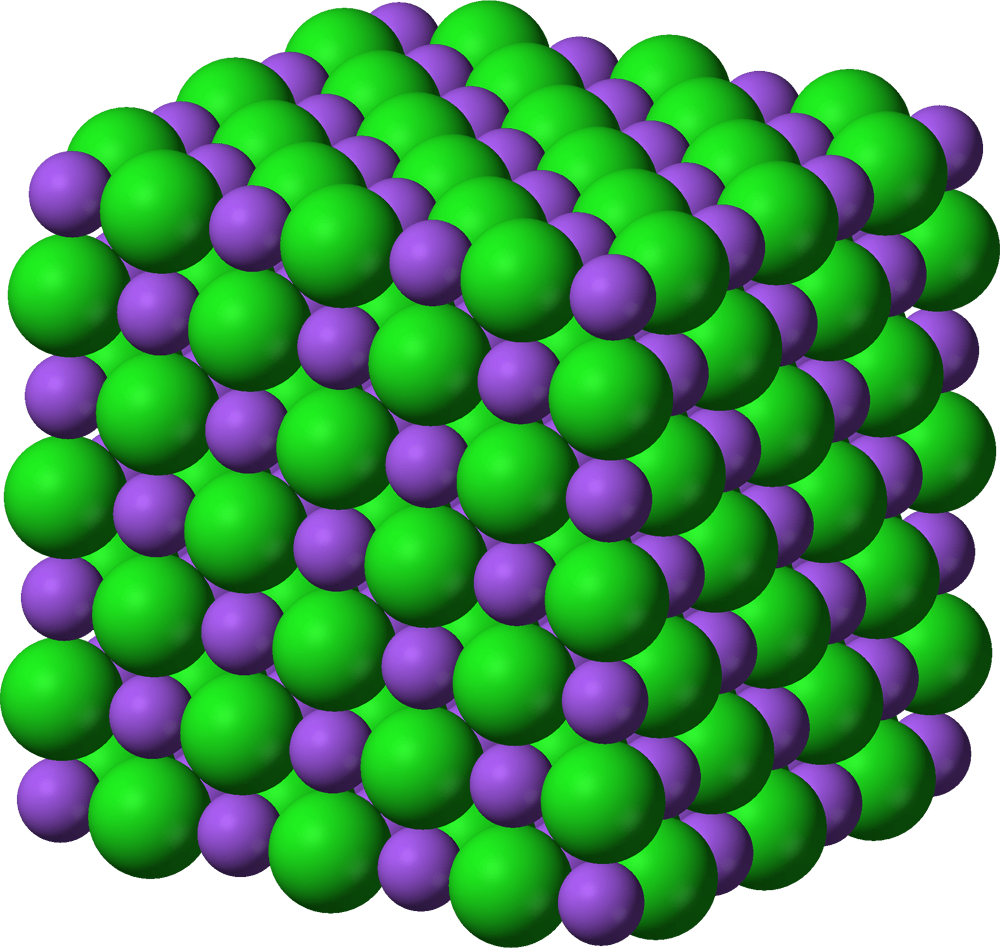
Does this picture show a compound?
a)
No
b)
Yes
93.
How many carbon atom/s are present in the compounds CaCO3?
a)
1
b)
2
c)
3
d)
4
94.
What is made up two or more elements that are chemically combined?
a)
Element
b)
Mixture
c)
Compound
d)
Solids
95.

Subatomic particles with a negative charge

a)

Electrons

b)

Neutrons

c)

Protons

d)

Quarks

96.
Discovered the nucleus of the atom through the Gold Foil Experiment
a)
Rutherford
b)
Chadwick
c)
Thomson
d)
Dalton
97.
Discovered the electron within the atom
a)
Thomson
b)
Chadwick 
c)
Schrodinger & Heisenberg
d)
Dalton
98.
Created the Planetary Model of the atom
a)
Bohr
b)
Dalton
c)
Rutherford
d)
Chadwick
99.
Believed that atoms of the same element are identical to each other
a)
Bohr
b)
Rutherford
c)
Dalton
d)
Thomson
100.

What does the nucleus of an atom contain?

a)

Electrons and neutrons

b)

Protons and neutrons

c)

Neutrinos and positrons

d)

Electrons and megatrons

101.
What are the 3 subatomic particles that make-up the atom?
a)
protons, neutrons, and isotopes
b)
neutrons, isotopes, and electrons
c)
positives, negatives, and electrons
d)
protons, neutrons, and electrons
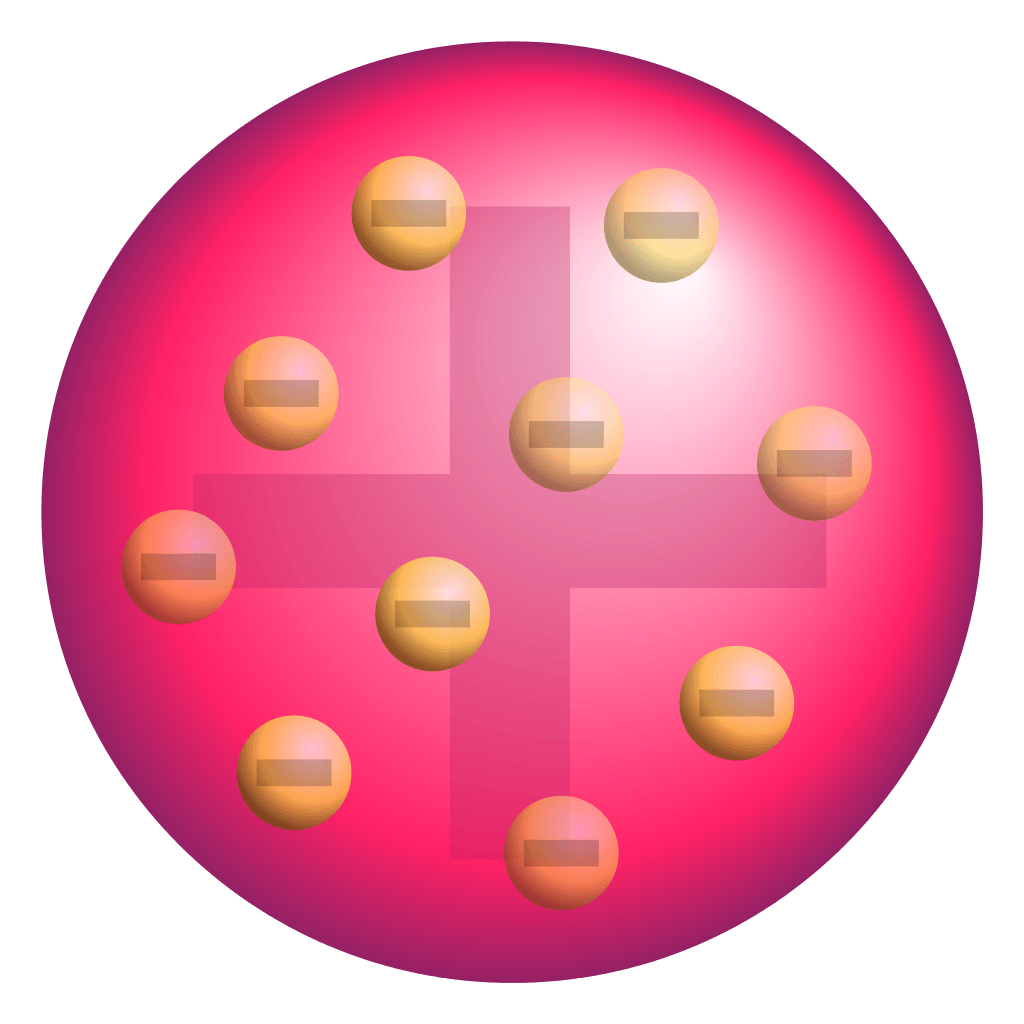
102.

Who's model does this picture represent?

a)

Dalton 1803-1808

b)

Thomson 1897

c)

Rutherford 1911

d)

Bohr 1913

103.

Who's model does this represent?

a)

Dalton 1903-1808

b)

Rutherford 1911

c)

Thomson 1897

d)

Bohr 1913

104.
This was the first model of the atom ever proposed. It was simple and described atoms as tiny spheres that could not be broken down into smaller pieces.
a)
Democritus's model of the atom
b)
The "Plum Pudding Model" of the atom
c)
The "Rutherford Model" of the atom
d)
The "Quantum Mechanical Model" of the atom
105.
This model was developed after J.J. Thompson discovered electrons, a particle smaller than an atom. Is shows electrons floating freely in a positive space.
a)
The "Plum Pudding Model" of the atom
b)
The "Rutherford Model" of the atom
c)
Democritus's model of the atom
d)
The "Quantum Mechanical Model" of the atom
106.
What atom matches this electron configuration?
1s2s2p3s2
a)
Neon
b)
Magnesium
c)
Aluminum
d)
Potassium
107.
Which is the electron configuration for an oxygen atom?
a)
1s22s22p63s23p64s2
b)
1s22s22p4
c)
1s22s22p6
d)
1s22s22p63s23p6
108.

What is the maximum number of electrons that an orbital can hold?

a)

1 electron

b)

2 electrons

c)

3 electrons

d)

4 electrons

109.

What is the maximum number of electrons that an orbital can hold?

a)

1 electron

b)

2 electrons

c)

3 electrons

d)

4 electrons

110.

How many orbitals are there in a d subshell?

a)

1

b)

3

c)

5

d)

7

111.

How many orbitals are there in a p subshell?

a)

2

b)

1

c)

4

d)

3

112.

The maximum number of electrons that a d subshell can hold.

a)

8

b)

10

c)

2

d)

4

113.

What is the element represented by this electron configuration?

1s22s22p63s23p6

4s23d104p6

a)

Argon

b)

Krypton

c)

Selenium

d)

Bromide

114.

What element matches this electron configuration?

[Xe] 6s2 4f14 5d9

a)

Mercury

b)

Gold

c)

Platinum

d)

Thallium

115.

What is the noble gas configuration for Sulfur atom?

a)

[Ar] 3p4

b)

[He] 3s23p4

c)

[Ne] 3s23p4

d)

[Na] 3s23p3

116.
How many electrons can the first energy level hold?
a)
1
b)
2
c)
8
d)
0
117.

Which element is represented by this orbital notation?

a)

neon

b)

fluorine

c)

magnesium

d)

argon

118.

What noble gas should be used to write the shorthand configuration for (52Te) Tellurium?

a)

Ar

b)

Kr

c)

Xe

d)

Sb

119.

Which element is considered to be part of the the p block element?

a)

Ca

b)

Ar

c)

Re

d)

Au

120.

Electron arrangement that uses arrows

a)

Electron configuration

b)

Shorthand configuration

c)

Lewis dot structure

d)

Orbital notation

121.

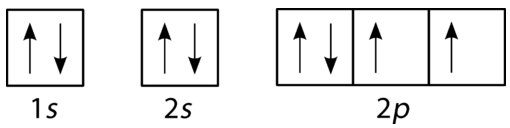
What is incorrect about this orbital diagram?

a)

Both arrows in the 2p box should be pointing up

b)

There is nothing incorrect with this diagram

c)

There should only be 1 orbital in the first 2p box and one in the 2nd 2p box

d)

All the arrows should be pointing up.

122.

What element is represented by this orbital diagram?

a)

Carbon (C)

b)

Boron (B)

c)

Nitrogen (N)

d)

Oxygen (O)

123.

What element matches this electron configuration?

1s22s22p63s23p64s23d10

a)

Zinc

b)

Copper

c)

Nickel

d)

Germanium

124.
Electrons occupy orbitals of lowest energy first is part of what electron configuration rule?
a)
Hund’s Rule
b)
Aufbau Principle
c)
Pauli Exclusion Principle
125.

What does Pauli exclusion principle state ?

a)

states that each electron occupies the lowest energy orbital available

b)

only two electrons can occupy an orbital and they must have opposite spin.

c)

every orbital in a subshell gets one electron before any orbitals get two electrons; and the single electrons have parallel spin

126.

What does Hund's rule states ?

a)

every orbital in a subshell gets one electron before any orbitals get two electrons; and the single electrons have parallel spin

b)

states that each electron occupies the lowest energy orbital available

c)

only two electrons can occupy an orbital and they must have opposite spin

127.

What is the correct representation for an orbital which has an "n" value of 4 and an "L" value of 2?

a)

4d

b)

4s

c)

4f

d)

4p

128.

What is quantum number "L" equal to in a p subshell?

a)

0

b)

1

c)

2

d)

3

129.

What quantum number describes the main energy level of an orbital?

a)

l

b)

m

c)

s

d)

n

130.

Which of the following sets of quantum numbers (n, l, ml, and ms) describes the last electron of Na?

a)

2, 1, 0, -½

b)

2, 0, 0, -½

c)

3, 1, 1, +½

d)

3, 0, 0, +½

131.

Which set of Quantum numbers is not allowed

a)

(3,1,1,-1/2)

b)

(2,1,-2,+1/2)

c)

(4,2,-1,-1/2)

132.

The vertical (up and down) columns in the Periodic Table are called

a)

groups

b)

towers

c)

periods

d)

atomic numbers

133.
The Modern Periodic Table of Elements is arranged by
a)
atomic mass
b)
atomic number
c)
valence electrons
d)
number of isotopes
134.
Sodium (Na) is found in period 
a)
3
b)
2
c)
4
d)
1
135.

In a neutral atom what information does an atomic number gives you?

a)

only the number of electrons

b)

only the number of protons

c)

only the number of neutrons

d)

the number of both electrons and protons in an atom.

136.

The biggest group of elements on the periodic table are classified as _____________________.

a)

metals

b)

nonmetals

c)

metaloids

d)

halogens

137.

The total number of groups/families that a periodic table has.

a)

15

b)

16

c)

17

d)

18

138.

Group 1 or group 1A is also called as ____________.

a)

halogens

b)

noble gases

c)

alkali

d)

alkaline earth

139.

What is the name of group number 2?

a)

transition metals

b)

halogens

c)

metaloids

d)

alkaline earth

140.

In what group number are the noble gases belong?

a)

17

b)

18

c)

14

d)

15

141.

Elements that are in groups 3 - 12 of the periodic table are called ___________________.

a)

noble gases

b)

halogens

c)

metalloids

d)

transition metals

142.
The atoms along the staircase are called 
a)
metals
b)
nonmetals
c)
metalloids
d)
noble gases
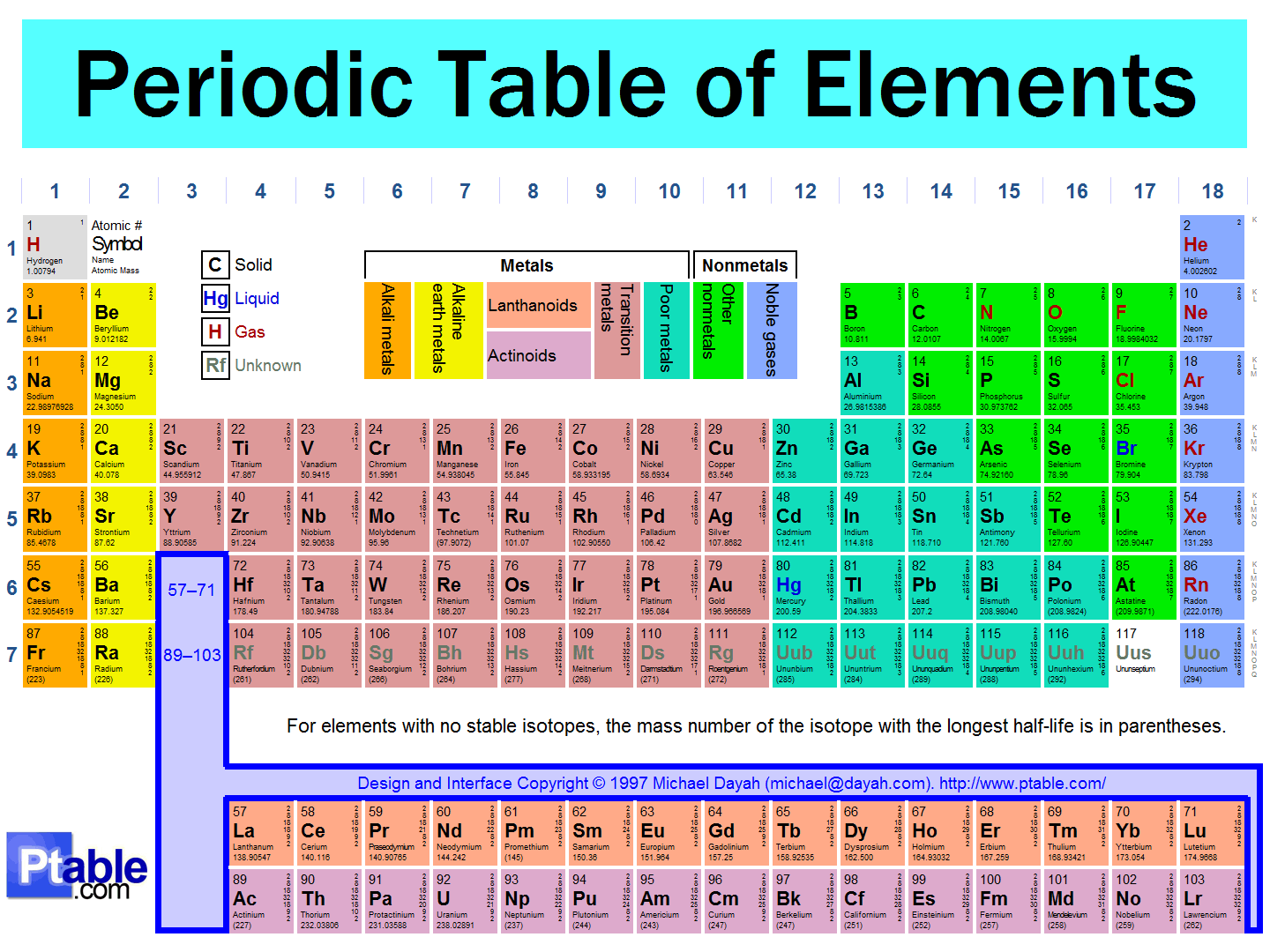
143.

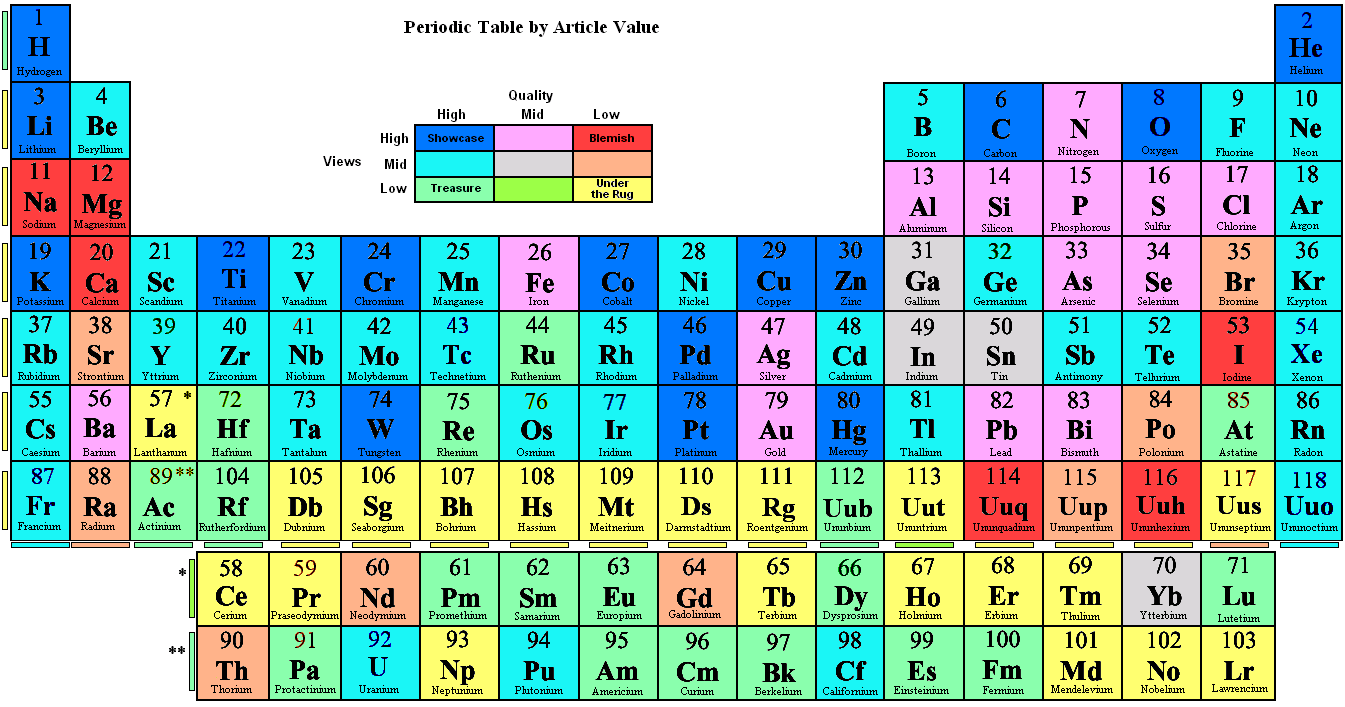
Which color on the image of the periodic table corresponds with the halogens.

a)

red

b)

black

c)

blue

d)

orange

144.

Which color on the image of the periodic table corresponds with the lanthanides.

a)

red

b)

black

c)

blue

d)

orange

145.

Which color on the image of the periodic table corresponds with the noble gases.

a)

red

b)

black

c)

blue

d)

orange

146.

Mendeleev first ordered the periodic table of elements by increasing

a)

atomic number

b)

atomic mass

c)

atomic symbol

d)

atomic weight

147.
ammonium phosphate
a)
(NH4)3PO4
b)
NPO4
c)
NH4PO4
d)
NH4(PO4)3
148.
zinc fluoride
a)
ZnF2
b)
ZnF
c)
Zn2F
d)
Zn2F4
149.
aluminum sulfite
a)
Al2(SO3)3
b)
Al2(SO4)3
c)
AlSO3
d)
Al3(SO3)2
150.
sliver phosphide
a)
Ag3P
b)
Ag3PO4
c)
Ag3PO3
d)
AgP
151.
Ca(CN)2
a)
Calcium Cyanide
b)
Calcium Dicyanide
c)
Calcium Dicarbon Dinitrogen
d)
Calcium Thiocyanate
152.
Sr(OH)2
a)
Strontium Hydroxide
b)
Strontium Hydride
c)
Strontium Dihydroxide
d)
Strontium Dioxygen Dihydride
153.
What is the formula for iron(II) carbonate?
a)
Fe2CO3
b)
FeCO3
c)
Fe2CO2
d)
FeCO4
154.
Name this compound: 
NaBr
a)
Bromide sodide
b)
Sodium bromide
c)
Sodium bromate
d)
Sodium bromite
155.
Name this compound: 
NH4F
a)
Ammonia fluoride
b)
Ammonium fluorite
c)
Ammonia fluorate
d)
Ammonium fluoride
156.
Name this compound: 
Ca2CO3
a)
Calcium carbon oxide
b)
Calcium(II) carbonate
c)
Calcium carbonate
d)
Carbonate(I) calcide
157.
Name this compound: 
KF
a)
Potassium fluoride
b)
Potassium fluorite
c)
Fluorine potasside 
d)
Potassium fluorate
158.
The chemical formula of magnesium hydroxide is
a)
MgOH₂
b)
Mg(OH)₂
c)
Mg(OH)
d)
MgH₂
159.

What is the charge on the nitrogen in: NaN3

a)

1+

b)

1-

c)

3+

d)

3-

e)

None of these.

160.

What is the charge on the iron in: iron (II) oxide

a)

2+

b)

2-

c)

1+

d)

1-

e)

None of these.

161.
Ba+2, Br-1
a)
BrBa
b)
Br2Ba2
c)
BaBr2
d)
Br2Ba
162.
The correct chemical formula for magnesium phosphide is
a)
MgP
b)
Mg₂P₃
c)
Mg₃P₂
d)
Mg₃(PO₄)₂
163.
The name of FeCl₂ is
a)
iron chloride
b)
iron (II) chloride
c)
iron (I) chloride
d)
iron dichloride
164.
What is the chemical formula for Tetrasulfur pentoxide?
a)
SO
b)
S4O
c)
S4O5
d)
S5O4
165.
What is the name of C3Cl?
a)
Carbon octachloride
b)
Tricarbon octachloride
c)
Carbon trichloride
d)
Octacarbon trichloride
166.
What is the chemical formula for Nitrogen triiodide?
a)
NI
b)
N3I
c)
NI3
d)
None of these
167.

What is the chemical formula for Tetraphosphorous Pentachloride ?

a)

4P5Cl

b)

PCl

c)

P4Cl5

d)

none of the above

168.
Pb(NO3)2
a)
Lead nitrate
b)
Lead (II) nitrate
c)
Lead nitrite
d)
Lead (I) nitrate
169.
How many valence electrons are in an atom of Se?
a)
2
b)
8
c)
6
d)
5
170.
How many valence electrons are in an atom of Ba?
a)
2
b)
8
c)
4
d)
1
171.
Which has the greater EN: 
Cl or Al?
a)
Cl
b)
Al
172.
Which has the greater EN: 
N or C?
a)
C
b)
N
173.
Which of the following will have a higher electronegativity than arsenic (As)?
a)
Carbon (C)
b)
Neon (Ne)
c)
Antimony (Sb)
d)
Germanium (Ge)
174.
Which of the following will have a lower ionization energy than Scandium (Sc)?
a)
Helium (He)
b)
Titanium (Ti)
c)
Calcium (Ca)
d)
Magnesium (Mg)
175.
Which atom has the largest atomic radius?
a)
potassium
b)
rubidium 
c)
francium
d)
cesium
176.
As you move down the periodic table atoms get bigger.  This is because ____________.
a)
The atoms have more mass.
b)
The atoms have more protons.
c)
The atoms have more energy levels
d)
The atoms have more nuetrons
177.
The element with the smallest ionization energy in Period 6 is - 
a)
Rn
b)
Cs
c)
Os
d)
Tm
178.
What is the name of family I
a)
Alkaline Earth Metals
b)
Boron Family
c)
Alkali Metals
d)
Halogen Family
179.
Group B is known as the:
a)
Inner Metals
b)
Transition Metals
c)
Weirdos
d)
Changelings 
180.
Ionization energy is the...
a)
energy needed to remove the outermost electron.
b)
ability of an atom to attract electrons from another atom.
181.

Dirt

a)

Heterogeneous

b)

Homogeneous

182.

Solvent: A substance that (a)   another substance

183.

Which one is not a colloid

a)

Foam

b)

Gel

c)

Emulsion

d)

Coffee

184.

In a ______________, one substance is dissolved in another substance.

a)

solution

b)

suspension

c)

colloid

185.
If a spoonful of sugar is mixed in a glass of water, what is the water called? 
a)
solute
b)
solution
c)
solvent
d)
element 
186.

A combination of two or more substances that can be physically separated is called a...

a)

Mixture

b)

Pure substance

c)

Compound