wayground logo

Free Printable Worksheets

NEW

Font size

S
M
L
XL
Worksheets

Enzymes

Total questions: 20

Worksheet time: 17mins
Name
Class
Date
1.
What is a substance called if it speeds up a chemical reaction?
a)
reusable
b)
catalyst
c)
specific
d)
fragile
2.
Each enzyme only has 1 substrate that will fit its active site.  What is this called?
a)
reusablility
b)
denaturation
c)
specificity
d)
fragility
3.
With what 3 letters do enzymes typically end?
a)
-ose
b)
-ase
c)
-ese
d)
-tic
4.
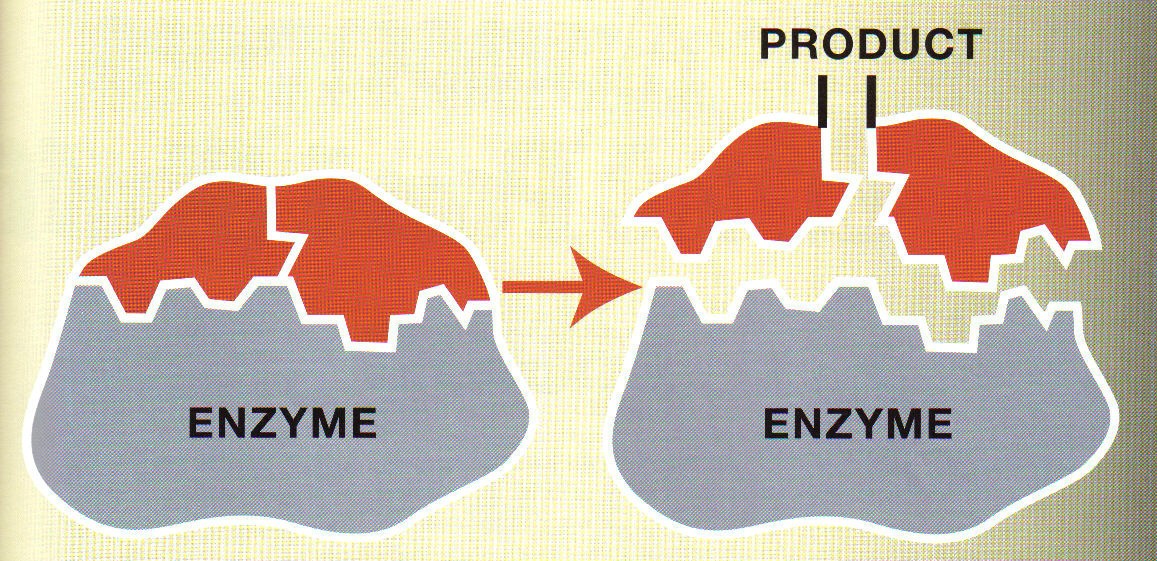
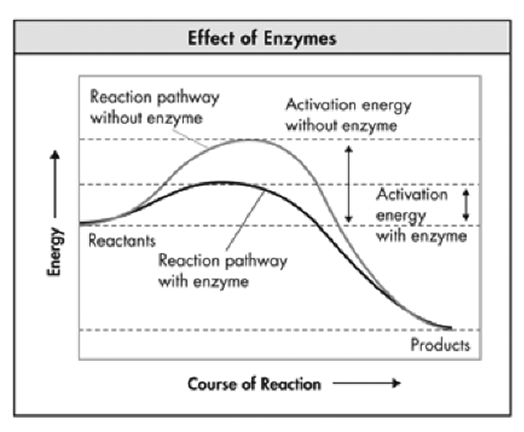
The graph shows how enzymes affect reactions in cells. Which statement best summarizes the information shown in the graph?
a)
Enzymes increase the energy of the reactants.
b)
Enzymes decrease the energy level of the products.
c)
Enzyme decrease the activation energy of the reaction.
d)
Enzymes reverse the direction of the reaction.
5.
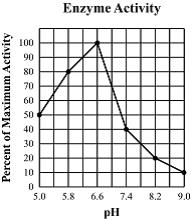
Which of the following conclusions can be drawn from this graph?
a)
The optimum pH of the enzyme is 6.6.
b)
The optimum pH of the enzyme is 5.8
c)
The enzyme’s activity increases as pH increases 5.0 to 9.0
d)
The enzyme’s activity is greater around pH of 8.0 .
6.
Any substance that is acted upon by an enzyme is called a(n)?
a)
Coenzyme
b)
Substrate
c)
Vitamin
d)
Polypeptide
7.
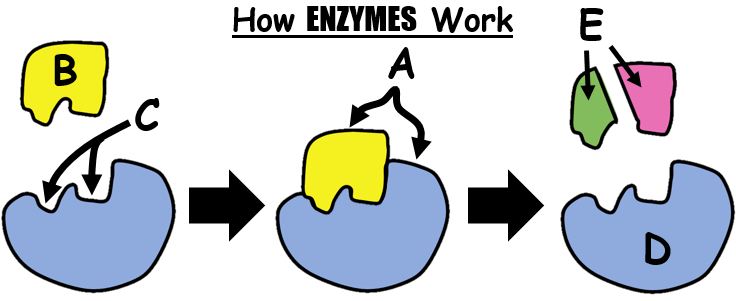
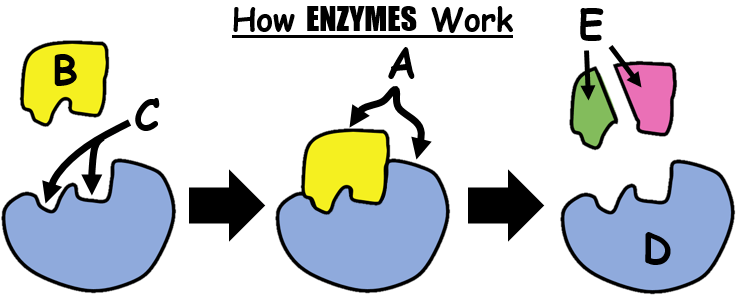
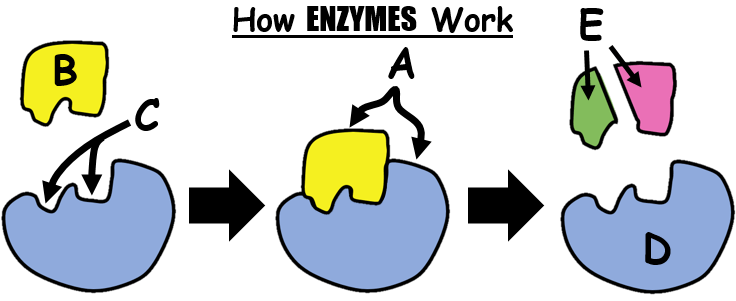
In the diagram, what is letter A? 
a)
product
b)
substrate
c)
enzyme-substrate complex
d)
active site
8.
Enzymes are...
a)
nucleic acids
b)
proteins
c)
lipids
d)
carbohydrates
9.
What happens when enzymes are heated to a high temperature?
a)
The enzymes die.
b)
The shapes of the enzyme are altered denature
c)
The enzymes' amino acid sequence changes.
d)
The enzymes remain the same
10.
Which of these is most likely an enzyme?  
a)
Sucrose
b)
Galactose
c)
Fructose
d)
Amylase
11.
Enzymes speed up reaction rates by changing...
a)
Activation Energy
b)
pH
c)
Hydrogen Bonds
d)
Kinetic Energy
12.
Letter D...
a)
active site
b)
enzyme
c)
substrate
d)
products
13.
Letter C...
a)
active site
b)
enzymes
c)
substrate
d)
products
14.
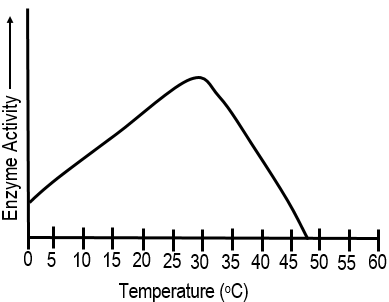
Based on the graph, what is the optimal temperature for this enzyme? 
a)
15oC
b)
40oC
c)
30oC
d)
35oC
15.

are proteins that carry substances from one side of a biological membrane to the other

a)

carrier protein

b)

channel protein

c)

receptor protein

16.

An embedded protein in the cell membrane, providing a hydrophilic passageway for small, polar ions.

a)

carrier protein

b)

channel protein

c)

receptor protein

17.

Located on the cell membrane surface, nucleus membrane or other cellular organelle membrane - they can bind to corresponding proteins to initiate cellular signaling pathways (reactions).

a)

carrier protein

b)

channel protein

c)

receptor protein

18.

Diffusion is the movement of a substance

a)

through a lipid bilayer

b)

only in water

c)

from an area of low concentration to an area of high concentration

d)

from an area of high concentration to an area of low concentration

19.

Molecules that are too large to be moved through the cell membrane can be transported OUT OF the cell by

a)

osmosis

b)

exocytosis

c)

endocytosis

d)

diffusion

20.

Some molecules can move through the membrane while others cannot.

a)

Fully Permeable

b)

Selective Permeable

c)

Impermeable

d)

Partially Permeable