
 Worksheets
Elements and the Periodic Table
Total questions: 74
Worksheet time: 1hrs 14mins
What is an atom?
Dalton's Atomic Theory States that:
All elements consist of atoms that cannot be divided
All atoms of the same element are different
An atom of one element can be changed to an atom of a different element by a chemical reaction
Compounds are formed when atoms of more than one element combine in a specific ratio
What did Thomson discover about atoms?

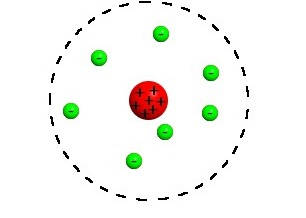
Which scientist developed the model of the atom shown?
Chadwick
Thomson
Rutherford
Bohr
Which scientist described a positively charged core (“nucleus”) in the middle of a lot of empty space?
Chadwick
Thomson
Rutherford
Bohr


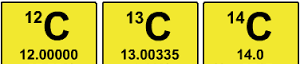
How many neutrons would you expect the average gold atom to have given the information shown?
79
118
197
276


What is the periodic table?
a chart of the elements
the average mass of all the isotopes of an element
True or False: The elements in the current periodic table are arranged in order of atomic mass.
True
False

What is the name of this element?
Oxygen
Tin
Sulfur
Magnesium

What is the atomic number of this element?
8
15.999

What is the chemical symbol of this element?
O
Ox
Oy
Og

What is a row of elements on the periodic table called?
period
group

What is a column of elements on the periodic table called?
period
group
What does malleable mean?
able to be hammered or bent
ability to move heat and electricity
conducts heat and electricity only sometimes
What is a conductor?
able to be hammered or bent
can move heat and electricity
can move heat and electricity sometimes
What is a semiconductor?
can be hammered or bent
can move heat and electricity
can move heat and electricity sometimes
Reactivity means the ability to bond with other atoms.
True
False
Which group has the most reactive metals?
Alkali metals
Halogens
Which group has the least reactive gases?
Halogens
Noble gases
Which group has the magnetic elements iron, cobalt, and nickel?
Transition Metals
Alkaline Earth Metals
Which group has very reactive nonmetals like fluorine and chlorine?
Halogens
Noble Gases
Which group has the element we need for breathing?
Boron Family
Oxygen Family
Which group of elements contain the most useful semiconductors?
Metals
Nonmetals
Metalloids
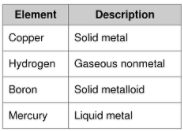
Use the table.
An unknown substance is a semi-conductor and is very brittle. This unknown substance could be which of the following elements form the table?
Copper
Mercury
Boron
Hydrogen
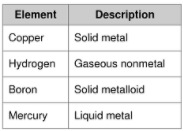
Use the Table.
An unknown substance takes the shape of its container and has a mirror like luster. This unknown substance could be which of the following elements from the table?
Mercury
Hydrogen
Boron
Copper
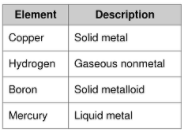
An unknown substance is colorless and has a very low density. This unknown substance could be which of the following elements form the table?
Boron
Mercury
Hydrogen
Copper
An unknown substance is a very good conductor of heat and electricity and can be bent and shaped easily. This unknown substance could be which of the following elements form the table?
Boron
Mercury
Hydrogen
Copper
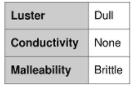
metalloid
nonmetal
metal
alloy
The non-metal which is a very good conductor of electricity.
(a)
Which of the following metals is used for making foil to pack foodstuff?
Aluminium
Mercury
Sodium
Copper
Metals react with oxygen to form:
Basic oxides
Acidic oxides
Neutral oxides
None of these
Which of the following statements is incorrect?
Metals have lustre
Metals are malleable
Metals are good conductors of electricity
Metals are poor conductors of heat
Which of the following metals corrodes easily?
Gold
Silver
Nickel
Iron
A __________reactive metal can displace a ________reactive metal from its salt solution.
(a)
When iron is exposed to moist air , a brown reddish coating is deposited on its surface. This process is called (a) .
(a) , the hardest natural substance known, is an allotrope of carbon.
Non-Metals generally have ____ boiling points.
High
Low
Non-metals are insulators, this means electricity ______ flow through them.
can
cannot
Where would you find a list of all of the Metals and Non-metals that scientists have discovered?
(a)
Radioactive isotopes that can be
followed through the steps of a chemical
reaction or industrial process are called
transformers
tracers
gamma rays
reactants
Which statement is NOT true of
radioactive decay?
It involves the nucleus of an atom.
It involves radioactive isotopes.
The identity of the atom remains the same.
Fast moving particles and energy are
released.
Alpha and beta decay are almost
always accompanied by
gamma radiation
an increase in atomic number
a decrease in atomic number
a catalyst
In relation to the original atom, the
atom that results from beta decay has an
atomic number that is
1 less
1 more
2 less
the same
Uranium was the radioactive element studied by Becquerel and the Curies.
True
False
The most penetrating type of nuclear radiation is the
alpha particle.
true
false
The half-life of cobalt-60 is 5.26 years. After 10.52 years,
5 grams of a 20-gram sample will remain.
true
false
During radioactive decay, the identity of an atom remains
the same.
true
false
Alpha particles are fast-moving electrons given off during
radioactive decay.
true
false
Chemical reactions involve the protons and neutrons in the
nucleus of an atom.
True
False

