
 Worksheets
Stars, Supernova, Galaxies, Nebula
Total questions: 48
Worksheet time: 26mins
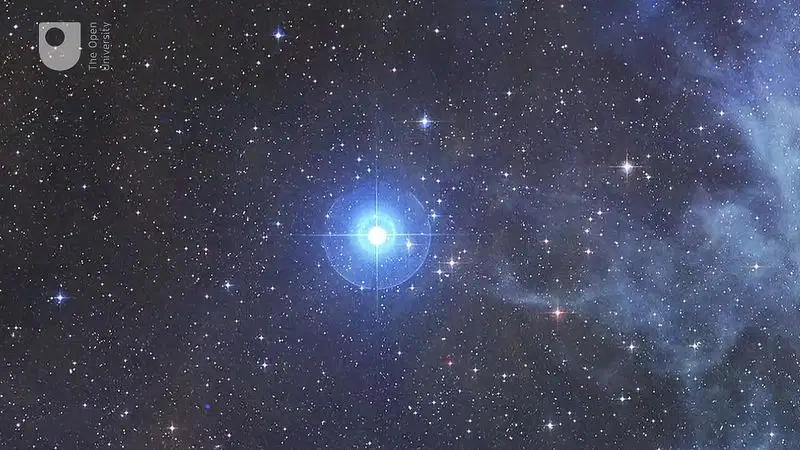
a hot, dense, slowly cooling sphere of carbon that remains when a red giant star dies
red giant
supergiant
black hole
white dwarf
What makes supernovas explode?
It can happen because a chicken nugget decides it wants some sauce and it falls into a nuclear reactor and creates a supernova.
It can happen from a Moon stealing mass from a companion star and then stealing so much it explodes into a million pickles.
It can also happen when two neighboring galaxies collide.
It can happen when a star comes to the end of its life and has no more nuclear energy and some mass flows to the core until it can’t withstand its own gravitational force and collapses in on itself and blows up

Which of the following is a distinguishing property of a neutron star?
Spinning Rapidly
Strong Magnetic Field
Density beyond belief
All of the above

Neutron stars are formed when gravity squeezes electrons & _____ into neutrons in a supernova.
protons
isotopes
quarks
matter
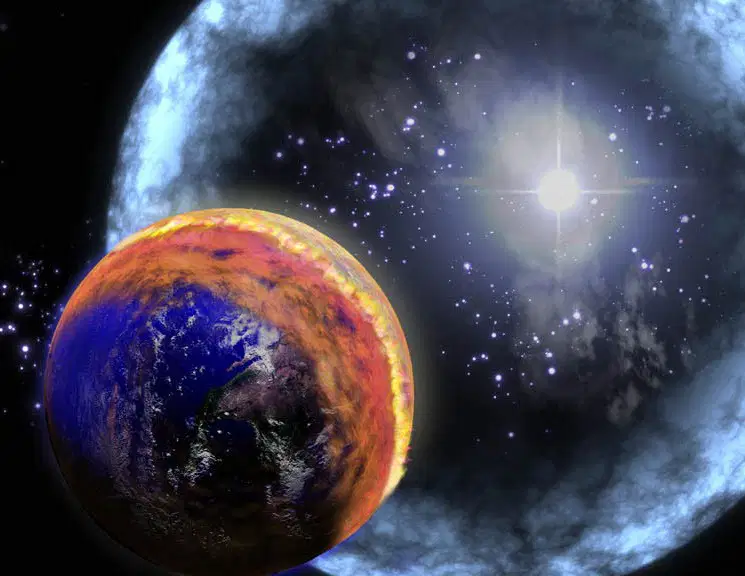
If a supernova occurred within a few dozen lightyears of Earth, how would it affect life on our planet?
The light would be so bright, that our eyes would be instantly damaged.
The atmosphere would be stripped away, collapsing food chains.
The temperatures would soar, vaporizing everything.
Our magnetic shield would burst, allowing large amounts of solar wind to strike the surface.
Why don't we need to worry about the sun becoming a supernova?
The sun already became a supernova.
It is spinning too slowly.
It doesn't have the right elements.
It is not big enough.
When the energy production of a star stops, what does gravity do to it?
collapse the core
cause it to spin rapidly
shed the outer layers
produce a blue light
When our sun dies, it will leave behind a white dwarf star composed of the elements:
hydrogen and helium
silicon and oxygen
carbon and oxygen
iron and nitrogen
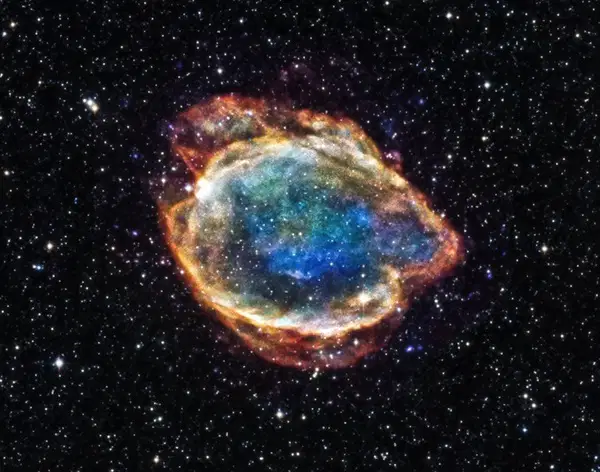
Since most stars orbit in pairs, if one of the stars is a white dwarf, it can steal material from the other star and explode as a Type ____ supernova.
II
3G
1a
X
Where does most of the iron in the universe come from?
Iron is fused in the core of some white dwarf stars and released during a Type 1a supernova.
Iron is created as light leaves a star and interacts with the star's atmosphere.
Recycled metal on Earth is launched into space.
Iron was created during the big bang.
A supernova will have at least .......... Solar masses
0.4
1.4
2.4
3.4
Supernova of this type can be used as 'Standard Candles'
Type 1a
Type 1b
Type 1c
Type 2


The interstellar medium & nebula clouds are important because
the Big Bang would've never occurred without them.
black holes would never exist if the clouds were not there.
they make up the space between the stars.
they are regions for new star formation.

A cloud of gas that has been excited by light from a nearby star (or star within) is called ___
a reflection nebula
an emission nebula
a lit nebula
a glowing nebula

Dust clouds that reflect the light of nearby bright massive stars are called ___
mirror nebulae
emission nebulae
reflection nebulae
excited nebulae

The dark nebula in the constellation Orion that is shaped like a gigantic chess piece is called ___
the Rook's Reprise
the Queen's Gambit
the Horsehead Nebula
the Bishop Nebula

Three giant towers of gas and dust in the Eagle Nebula have been called ___
the Elephant Salute
the Pillars of Creation
the Fingers of Cronus
the Eagle's Wing
When was the Crab Nebula first spotted?
1054
1055
1056
Greek Astronomers
What is a Pulsar?
A quickly rotating neutron star
A quickly rotating white dwarf
A quickly rotating supernova
A quickly rotating planet

"Polycyclic aromatic hydrocarbons" are better known as ___
water crystals
fog
soot
light gases

Proto-stars are also known as ____ for the constellation in which the first one was observed.
neutron stars
very hot fusion orbs
T Tauri stars
A Tari stars.

T Tauri stars give off very little heat and are mostly ____ except for in the infrared.
blue in color
rare to find
invisible
yellow/white in color

Why do low-mass stars take much longer to reach the main sequence?
because they do not form in star clusters
with stars "lower" is equivalent to "slower"
they do not have enough mass to ever produce core fusion
because they have less initial material to work with

In a stable star, the expansion created by the heat of fusion is usually balanced by a star's gravity, creating ___
an imbalance
a conversion
an inversion
an equilibrium


Spectroscopic parallax uses a star's spectrum with ____ to measure star distances (> 330 L.Y.).
its color and/or apparent brightness
the doppler effect
other stars
its radius

Which type of Binary Star system is most useful for determining the masses and radii of the stars?
Spectroscopic Binary
Eclipsing Binary
Astronmetic Binary
any Double Star systems.

Stars that have 10-20 times the mass of the Sun are classified as
O & B type stars.
supergiants.
A & F type stars.
red supergiants.

K & M class stars have masses that are
classified as yellow-orange dwarfs.
classified as white dwarfs.
only a few tenths that of the Sun.
just a little smaller than that of the Sun.
Which of the following terms directly relate to the actual brightness of a star?
size and brightness
absolute brightness and size
apparent magnitude and size
apparent magnitude and absolute brightness

Based on the graph, which color most likely has the lowest absolute brightness?
red
blue
white
yellow

Which of the star listed would look the brightest when observed from Earth?
Rigel
Sirius
Vega
Betelgeuse

Based on the chart, which star has the greatest absolute brightness?
Rigel
Sirius
Betelgeuse
Aldebaran

Which statement best describes "stellar parallax" when measuring star distance?
as a term used for "parsec"
the geometric term for stellar angles
as another term used for "light year"
the apparent shifting of a star's position over a year
With greater distance, the parallax angle
increases
decreases
stays the same

A blackbody curve on a graph tells us how an object releases
radio waves according to Planck's constant.
light through a black hole's event horizon.
radiation over different frequencies.
heat over time.

Blackbody curves also tell astronomers about the ___ of an object (like a star).
rotational energy
temperature
distance
composition

Most stars in our galaxy (and probably throughout the Universe) are in multiple-star systems.
True
False

____ binaries orbit far enough from each other that they can be viewed with the naked eye or a small telescope's magnification.
Spectroscopic
Independent
Visual
Parallax
Which of the following correctly places these in order from LARGEST to SMALLEST?
galaxy -- local group/cluster -- planet -- solar system -- universe
universe -- local group/cluster -- galaxy -- solar system -- planet
planet -- solar system -- galaxy -- local group/cluster -- universe
universe -- galaxy -- solar system -- local group/cluster -- planet
Galaxies are classified and named according to their
shape
wavelength
distance from Earth
cosmic background radiation
Hubble’s Law states that galaxies that are further from Earth
are usually orbited by black holes
are, in general, moving faster away from Earth than closer galaxies.
have fewer stars in their galaxies than the Milky Way does.
contain more planets than the Milky Way.

