wayground logo

Free Printable Worksheets

NEW

Font size

S
M
L
XL
Worksheets

Final Review

Total questions: 54

Worksheet time: 27mins
Name
Class
Date
1.
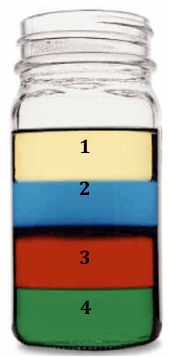
Put the liquids in order from most dense to least dense?
a)
4, 3, 2, 1
b)
1, 2, 3, 4
c)
3, 4, 2, 1, 
d)
4, 3, 1, 2
2.
What is the formula for density?
a)
density = mass x volume
b)
density = mass / volume
c)
density = mass + volume
d)
density = mass - volume
3.
Jack has a rock. The rock has a mass of 14g and a volume of 2cm3. What is the density of the rock?
a)
7 mL
b)
7 g/cm3
c)
28 g/cm3
d)
1/7 g/cm3
4.
Helium balloons rise on earth because
a)
helium is less dense than air
b)
helium is more dense than air
c)
helium is cooler than air
d)
helium is warmer than air
5.
A crayon has a mass of 10g and volume of 5 mL. What is the density?
a)
30 g/mL
b)
15 g/mL
c)
1 g/mL
d)
2 g/mL
6.
Which box has a higher density?  
a)
Box A
b)
Box B
c)
cannot be determined
d)
they are the same
7.

Which has the greatest density?

a)

A

b)

B

c)

C

d)

All the same density

8.
Describe a solute.
a)
part of solution present in largest amount
b)
gets dissolved
c)
water
d)
surrounds and breaks apart
9.
__________ are made up of solutes and solvents.
a)
Solutions
b)
Suspensions
c)
Heterogeneous Mixtures
d)
Pure Substances
10.
You can make a solution more concentrated by adding __________.
a)
solute
b)
solvent
c)
water
11.
What is able to dissolve other substances?
a)
Solute
b)
Salt
c)
Suspension
d)
Solvent
12.
If I dissolve sugar in water, what is the solute?
a)
Water
b)
Hydrogen
c)
Sugar
d)
Carbon
13.
If I dissolve carbon dioxide in water, what is my solvent?
a)
Carbon Dioxide
b)
There is no solvent
c)
Oxygen
d)
Water
14.

How close a measurement is to the true value is called..

a)

Accuracy

b)

Precision

c)

Significant

d)

Estimate

15.
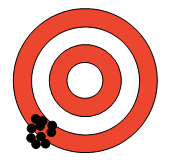
This bullseye demonstrates...
a)
High Accuracy & High Precision
b)
High Accuracy & Low Precision
c)
Low Accuracy & High Precision
d)
Low Accuracy & Low Precision
16.
When a measurement is repeatable and consistent it is said to have...
a)
High precision
b)
Low precision
c)
High accuracy
d)
Low accuracy
17.
A set of data are all close to each other, but they are not close to the actual value.  This set of data can be described as...
a)
accurate
b)
precise
c)
both precise and accurate
18.
A set of data are not close to each other, but the average of the data is very close to the actual value.  This set of data can be described as...
a)
accurate
b)
precise
c)
both precise and accurate
19.

Does this image show results that are accurate and/or precise?

a)

Accurate, but not precise

b)

Precise, but not accurate

c)

Both precise and accurate

d)

Neither precise nor accurate

20.

Does this image show results that are accurate and/or precise?

a)

Accurate, but not precise

b)

Precise, but not accurate

c)

Both precise and accurate

d)

Neither precise nor accurate

21.

Does this image show results that are accurate and/or precise?

a)

Accurate, but not precise

b)

Precise, but not accurate

c)

Both precise and accurate

d)

Neither precise nor accurate

22.
Write the following in standard form:
6x10⁵
a)
600,000
b)
60,000
c)
0.00006
d)
0.0006
23.
What is another way to write 103
a)
10
b)
30
c)
100
d)
1,000
24.
What is 2.4 x 10³?
a)
2.4
b)
2400
c)
24
d)
240
25.
Dividing by 1000 moves the decimal how many places?
a)
2
b)
3
c)
1
d)
40
26.
The smallest unit of a pure substance that has the properties of that substance
a)
element
b)
atom
c)
neutron
d)
compound
27.
Atoms are made up of three basic parts, which are -
a)
Protons, neutrons, electrons
b)
neutrinos, protons, neutrons
c)
quarks, protons, electrons
d)
electrons, neutrons, and quarks
28.
The nucleus is made up of -
a)
neutrons and electrons
b)
protons and neutrons
c)
protons and electrons
d)
electrons and quarks
29.
Protons have this charge -
a)
positive
b)
negative
c)
neutral
d)
no charge
30.
Electrons have this charge - 
a)
positive
b)
negative
c)
neutral
d)
no charge
31.
Neutrons have this charge -
a)
positive
b)
negative
c)
neutral
d)
They don't exist
32.
An atom's overall charge is ________.
a)
positive 
b)
depends
c)
neutral 
d)
negative 
33.
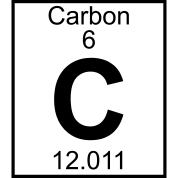
What does the 6 represent?
a)
atomic mass
b)
atomic number
c)
element name
d)
chemical symbol 
34.
What does 12.011 represent?
a)
atomic mass
b)
atomic number
c)
element name
d)
chemical symbol 
35.
What does the C represent?
a)
atomic mass
b)
atomic number
c)
element name
d)
chemical symbol 
36.
These are found on the Periodic Table.
a)
Compounds
b)
Elements
c)
Mixtures
37.

the basic structural unit of matter

a)

atom

b)

matter

c)

element

d)

nucleus

38.

a unique number for each element that equals the number of protons in an atom of that element

a)

element name

b)

element symbol

c)

atomic number

d)

atomic mass

39.

the mass of an atom, calculated by adding the number of protons and neutrons in the nucleus of the atom

a)

element name

b)

element symbol

c)

atomic number

d)

atomic mass

40.
The atomic number of this pictured element is
a)
28
b)
58.6934
c)
Ni
d)
Nickel
41.
What is the atomic mass of Neon?
a)
10
b)
30
c)
10.18
d)
20.18
42.
How many protons are in this element?
a)
79
b)
196
c)
117
d)
Cannot be determined
43.

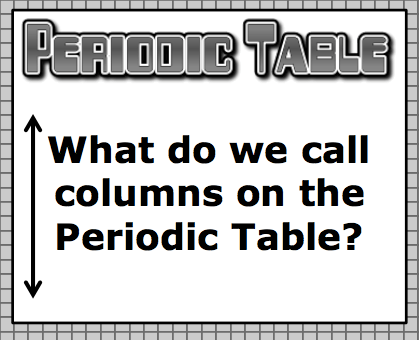
The vertical (up and down) columns in the Periodic Table are called

a)

groups

b)

towers

c)

periods

d)

atomic numbers

44.
Which group of the periodic table is composed of inert (not reactive)  gases?
a)
alkali metals
b)
alkaline earth metals
c)
halogens
d)
noble gases
45.
Elements in a ..................have similar chemical properties.  
a)
period
b)
group
c)
row
46.
Electronegativity is...
a)
the ability of an atom to attract/ accept electrons
b)
the ability of an atom to lose electrons
c)
the energy required to remove an electron from a specific atom
d)
how easy it is to make friends. 
47.
Elements in the same column of the periodic table always have the same # of _______ as one another.
a)
Protons
b)
Neutrons
c)
Electrons
d)
Valence Electrons
48.
a)
2
b)
3
c)
5
49.
a)
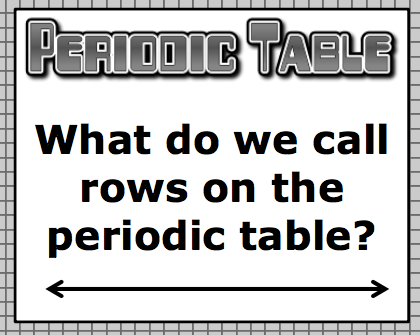
Periods
b)
Groups
50.
a)
Periods
b)
Groups
51.
a)
energy levels
b)
valence electrons
c)
protons
d)
neutrons
52.
a)
energy levels
b)
valence electrons
c)
protons
d)
neutrons
53.
a)
Group 1
b)
Group 17
c)
Group 18
d)
Group 2
54.
a)
Metals
b)
Nonmetals
c)
Metalloids