wayground logo

Free Printable Worksheets

NEW

Font size

S
M
L
XL
Worksheets

Weather Review

Total questions: 62

Worksheet time: 1hrs 8mins
Name
Class
Date
1.
This type of cloud is thin, wispy, and made of ice crystals
a)
cumulus cloud
b)
stratus cloud
c)
cirrus cloud
d)
cumulonimbus cloud
2.

Which type of cloud is white and puffy?

a)

cumulus

b)

cirrus

c)

stratus

d)

cumulonimbus

3.

Clouds form during the process of...

a)

evaporation

b)

condensation

c)

precipitation

d)

runoff

4.
What type of clouds are called "fair weather clouds" and look like floating cotton?
a)
Cumulus
b)
Stratus
c)
Nimbus
d)
Cumulonimbus
5.
Are stratus clouds or cirrus clouds found closer to the ground?
a)
Cirrus
b)
Stratus
6.

Which type of cloud is highest in the sky?

a)

Cirrus

b)

Cumulus

c)

Stratus

7.

Which type of cloud is lowest in the sky?

a)

Cirrus

b)

Cumulus

c)

Stratus

8.

What are clouds made out of?

a)

Molecules of pure oxygen

b)

ozone and carbon dioxide

c)

water droplets, dust, and smoke particles

d)

78% nitrogen, 21% oxygen, and 1% other gases

9.

Clouds are classified by altitude and precipitation types.

a)

True

b)

False

10.
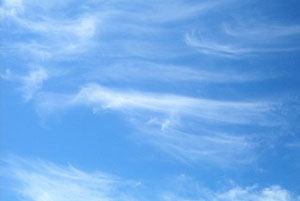
what type of cloud is shown?
a)
cumulus
b)
cirrus
c)
stratus
11.
When are you most likely to see cumulus clouds?
a)
On a foggy day
b)
On a rainy day
c)
Before a thunderstorm
d)
On a sunny day
12.
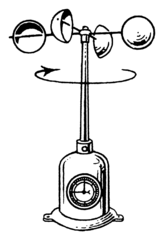
This weather instrument is a...
a)
anemometer
b)
barometer
c)
wind vane
d)
thermometer
13.
This weather instrument is a...
a)
thermometer
b)
wind vane
c)
anemometer
d)
rain gauge
14.
This weather instrument is a...
a)
rain gauge
b)
U.F.O.
c)
satellite
d)
anemometer
15.
This weather instrument is a...
a)
thermometer
b)
anemometer
c)
rain gauge
d)
barometer
16.
This weather instrument is a...
a)
anemometer
b)
Christmas ornament
c)
wind vane
d)
barometer
17.
This weather instrument is an...
a)
wind vane
b)
anemometer
c)
barometer
d)
thermometer
18.
This tool is used with a wind vane to determine the direction of the wind.
a)
wrench
b)
screwdriver
c)
compass
d)
telescope
19.
This weather instrument is a...
a)
wind vane
b)
hydrometer 
c)
rain gauge 
d)
anemometer 
20.
What does the wind vane point towards.
a)
Where the wind is coming from
b)
Where the wind is blowing to
c)
the sun
d)
the moon 
21.
What instrument measures wind speed?
a)
thermometer 
b)
wind vane
c)
barometer
d)
anemometer 
22.
What instrument measures air pressure?
a)
barometer
b)
hydrometer 
c)
rain gauge
d)
anemometer 
23.
What instrument measures temperature?
a)
rain gauge 
b)
hydrometer
c)
thermometer 
d)
wind vane
24.
What instrument measures wind direction?
a)
wind vane
b)
hydrometer
c)
rain gauge
d)
barometer 
25.
What instrument measures the humidity?
a)
anemometer
b)
rain gauge 
c)
barometer
d)
hydrometer 
26.
This tool photographs clouds and sends data to meteorologists.
a)
camera
b)
iPhone 5
c)
satellite
d)
radar
27.
A rain gauge measures what?
a)
Air pressure
b)
Wind speed
wind speed
c)
Amount of rain fall
d)
Wind direction
28.
What kind of precipitation is formed when water falls from the clouds and lands on the ground as liquid water?
a)
Hail
b)
Sleet
c)
Rain
d)
Snow
29.
For snow to fall, the air temperature must be what?
a)
Above 0 degrees celsius
b)
Below 0 degrees celsius
c)
Freezing
d)
Warmer at the ground than high in the air
30.
How is sleet formed?
a)
Snowflakes fall, go through an area of cold air and turns into sleet before hitting the ground
b)
Rain falls, freezes in an area of cold air above the ground to make sleet
c)
Snowflakes fall and are melted a bit by warm air near the ground
d)
Sleet is not real
31.
Precipitation MUST start from where?
a)
Sky
b)
Clouds
c)
Sun
d)
Ground
32.
What kind of precipitation is formed when water falls from the clouds and lands on the ground as liquid water?
a)
Hail
b)
Sleet
c)
Rain
d)
Snow
33.

Which of the following best describes weather?

a)

day to day conditions of the atmosphere at a place in regards to heat, dryness, sunshine, wind, rain, etc.

b)

long-term conditions (months/years) of the atmosphere at a place in regards to heat, dryness, sunshine, wind, rain, etc.

34.

Which of the following best describes climate?

a)

day to day conditions of the atmosphere at a place in regards to heat, dryness, sunshine, wind, rain, etc.

b)

long-term conditions (months/years) of the atmosphere at a place in regards to heat, dryness, sunshine, wind, rain, etc.

35.

It is raining outside right now.

a)

weather

b)

climate

36.

Over the last decade we have had an increase in the amount of rain in our area.

a)

weather

b)

climate

37.

The high temperature today will be near 75 degrees F.

a)

weather

b)

climate

38.

The average winter temperature is 30 degrees F.

a)

weather

b)

climate

39.

The meteorologist predicts that tomorrow, it will be very windy outside.

a)

weather

b)

climate

40.
A front is
a)
where warm air is cooling at earth's surface
b)
a line where hot and cold air are separating
c)
a line where two different air masses meet
d)
where cold air is rising and forming rain clouds
41.
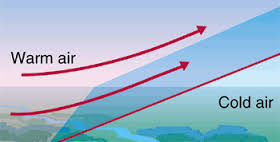
Which type of front is pictured?
a)
Cold front
b)
Warm front
c)
Occluded front
d)
Stationary front
42.
What symbol is this?
a)
warm front
b)
cold front
c)
stationary front
d)
occluded front
43.
Which type of front is associated with purple humps and triangles facing the same direction?
a)
Cold
b)
Warm
c)
Stationary
d)
Occluded
44.
How are fronts formed?
a)
When two air masses meet
b)
when two winds meet
c)
when two clouds meet
45.

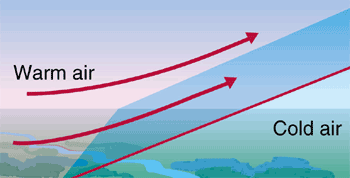
What type of front is shown?

a)

Warm Front

b)

Cold Front

c)

Occluded Front

d)

Stationary Front

46.
When a cold front or a warm front stays in place for several days without invading another front, it is called a ______. 
a)
stationary front 
b)
 cold front 
c)
occluded front
d)
warm front 
47.
This is the symbol for which type of front?
a)
cold front
b)
warm front
c)
stationary front
d)
occluded front
48.

This is the symbol for a _____________ weather front.

a)

Cold

b)

Warm

c)

Stationary

d)

Occluded

49.

A _____________ weather front occurs when a cold air mass moves forward, pushing the warm air mass up.

a)

Cold

b)

Warm

c)

Stationary

d)

Occluded

50.

A _____________ weather front occurs two cold air masses meet and push/force the warm air in the middle upwards.

a)

Cold

b)

Warm

c)

Stationary

d)

Occluded

51.

Why does warm air rise above cold air?

a)

Warm air is less dense

b)

Warm air is more dense

c)

Cold air is stronger than warm air

52.

Which type of weather front can produce foggy weather that can last for several days?

a)

Cold

b)

Warm

c)

Stationary

d)

Occluded

53.

Which type of weather front can produce precipitation (rain or snow)?

a)

Cold

b)

Warm

c)

Stationary

d)

Occluded

e)

All of the above

54.

What type of weather will you see along a cold front?

a)

Thunderstorms

b)

Sunny skies

c)

Gentle rain

d)

No weather

55.

A _____________ is a large body of air in the lower atmosphere that has similar temperature, humidity, and air pressure.

a)

Front

b)

Air Mass

c)

Continental

d)

Jet Stream

56.

What type of air mass is warm, forms in the tropics, and has low air pressure?

a)

Tropical

b)

Polar

c)

Maritime

d)

Continental

57.

What type of air mass is cold, forms over the poles, and has high air pressure?

a)

Tropical

b)

Polar

c)

Maritime

d)

Continental

58.

What type of air mass is warm, humid, and forms over oceans?

a)

Maritime Tropical

b)

Maritime Polar

c)

Continental Tropical

d)

Continental Polar

59.

What type of air mass has cool, dry air and forms over land?

a)

Maritime Tropical

b)

Maritime Polar

c)

Continental Tropical

d)

Continental Polar

60.

Maritime air masses will contain more moisture than continental air masses?

a)

True

b)

False

61.

Tropical air masses tend to be colder than polar air masses.

a)

True

b)

False

62.

What type of air mass would form over the Atlantic Ocean and bring warm, humid air to the United States?

a)

Maritime Tropical

b)

Maritime Polar

c)

Continental Tropical

d)

Continental Polar