wayground logo

Free Printable Worksheets

Font size

S
M
L
XL
Worksheets

First Semester Exam Review OL

Total questions: 161

Worksheet time: 2hrs 1mins

Name
Class
Date
1.
A jet airliner flies 4100 km from New York City to San Francisco in 4.25 hours.  What is its average speed?
a)
964.71 km/hr
b)
96.47 km/hr
c)
17,425 km/hr
d)
174.25 km/hr
2.
A bus carrying Ava's friends to a soccer game traveled 10 km in 30 minutes. To determine the average speed of the bus in km/hr, your first step would be to __________?
a)
convert speed to distance
b)
convert minutes to hours
c)
convert hours to seconds
d)
convert seconds to hours
3.
If, on a hike, Nathaniel traveled 2,800 m in 2 hours, what was his average speed in m/hr?
a)
5,600 m/hr
b)
140 m/hr
c)
56 m/hr
d)
1,400 m/hr
4.
Avery swims 1000 m in 30 minutes.  What is her average speed?
a)
33.33 m/min
b)
300 m/min
c)
30 m/min
d)
3 m/min
5.
Akela rode her bike 48 km for 3 hours, she rested for 1/2 an hour and then rode another 24 km for 1 hours. What was the total time she spend on her bike ride? (Remember, stops count!)
a)
24 hours
b)
48 hours
c)
4 hours
d)
4.5 hours
6.
Using the graph provided, how long did it a ball to roll 30 cm?  What was the average speed of the ball?
a)
35 seconds, 1.17 cm/s
b)
30 seconds, 1 cm/s
c)
30 seconds, 1.17 cm/s
d)
35 seconds, 1 cm/s
7.

Speed formula

a)

S=S X T

b)

S=TX S

c)

S=D/T

d)

S=T/D

8.

Distance formula

a)

S X T

b)

T X S

c)

T/D

d)

D/T

9.

Time formula

a)

T= D/S

b)

T= S X T

c)

T = D/ T

d)

T= T/ T

10.
Location of object.
a)
Position
b)
Reference Point
c)
Area
d)
Place
11.
Location for comparison.
a)
Position
b)
Location
c)
Reference Point
d)
Direction
12.
Change in position over time.
a)
Location
b)
Velocity
c)
Motion
d)
Movement
13.
Distance over time.
a)
Travel
b)
Motion
c)
Velocity
d)
Speed
14.
Speed plus direction.
a)
Velocity
b)
Motion
c)
Position
d)
Acceleration
15.
How would decreasing the time it takes you to run a certain distance affect your speed? Speed will...
a)
Increase
b)
Decrease
16.
What is happening at D?
a)
Stationary
b)
Accelerating
c)
Fast steady speed; moving away from the starting position
d)
Slower steady speed; moving away from the starting position
17.
What is happening at A?
a)
Stationary
b)
Accelerating
c)
Slower steady speed; moving away from the starting position
d)
Steady speed; returning to start position
18.
Which runner won the race?
a)
A
b)
B
c)
C
19.
How long did it take this object to travel 10 m?
a)
0 s
b)
10 s
c)
15 s
d)
20 s
20.
At 60 seconds, how far had this object traveled? 
a)
0 m
b)
10 m
c)
20 m
d)
40 m
21.
What is this graph showing?
a)
Constant Speed
b)
Acceleration (speeding up)
c)
Deceleration (slowing down)
d)
No motion
22.
What does this graph represent?
a)
Constant speed
b)
Acceleration
c)
Not moving
23.
How many times does this object STOP moving?
a)
None
b)
Once
c)
Twice
d)
Three times
24.
How fast is the object traveling between points B and C?
a)
1 km/hr
b)
0 km/hr
c)
There is no way to tell from this graph
d)
0.9 km/hr
25.
What is the speed of this object at 3 seconds?
a)
5 m/s
b)
45 m/s
c)
5 s/m
d)
45 s/m
26.
During what segments is the object returning to the reference point?
a)
A to B
b)
B to C
c)
C to D
d)
D to E
27.
What is this objects speed at 2 s?
a)
5 m/s
b)
5 s/m
c)
20 m/s
d)
20 s/m
28.
How long did it take Charlie to finish the race?
a)
A)14 meters  
b)
B)12 seconds
c)
C)16.5 seconds
d)
 D)14 seconds 
29.
How far did they run?
a)
A)100 seconds  
b)
B)100 meters
c)
C)18 meters 
d)
D)18 seconds
30.
What does the flat line mean for Charlie?
a)
He stayed at the same speed
b)
He slowed down
c)
He stopped running 
d)
He stayed at the same speed but at a slower rate
31.
Who won?
Hint: Greatest distance shortest time
a)
A)Albert  
b)
B)Bob
c)
C)Charlie
32.
A runner races in the 100 meter dash.  It takes her 10 seconds to finish.  What is her average speed?
a)
10 m/s
b)
1000 m/s
c)
100 seconds
d)
10 seconds
33.
Alan travels 100 km in 5hrs. Find his average speed in km/h
a)
5km/hr
b)
10km/hr
c)
50km/hr
d)
20km/hr
34.
Find speed when distance is 142 km and time is 2 hours.
a)
71km/hr
b)
52km/hr
c)
17km/hr
d)
90km/hr
35.
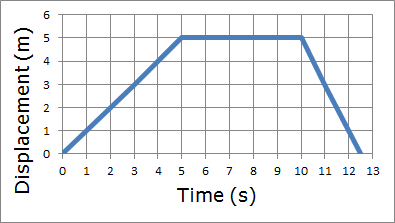
According to the graph how far does the person travel in the first 5 seconds?
a)
2 m
b)
10 m
c)
0 m
d)
5 m
36.
What is the person doing from 5 seconds to 10 seconds?
a)
Walking 
b)
Running
c)
Standing Still 
d)
Walking Fast
37.
How far is the person from the starting point after 3 seconds?
a)
0 m
b)
2 m 
c)
3 m
d)
6 m 
38.
How long would it take a bus traveling at 50 km/h to travel 125 km?
a)
6,250 hours
b)
2.5 km
c)
2.5 hours
d)
6,250 km
39.

In four minutes, about how far did the car travel?

a)

2.1 km

b)

3.3 km

c)

4.1 km

d)

5.4 km

40.

During what time was the car moving fastest?

a)

from 0 to 2 minutes

b)

from 2 to 4 minutes

c)

from 4 to 6 minutes

d)

from 6 to 8 minutes

41.

What might be happening between 8 to 10 minutes?

a)

The car is stopped.

b)

The car is driving on a city street.

c)

The car is going up a steep hill.

d)

The car is driving on the highway.

42.

Ms. Longino had a snail in her kitchen which traveled 50 cm in 8 minutes. What was the speed of the snail?

a)

7 cm/min

b)

9 cm/min

c)

5.50 cm/min

d)

6/25 cm/min

43.

What is the average speed of this trip?

a)

5 m/s

b)

6 m/s

c)

30 m/s

d)

150 m/s

44.

What is the speed at 15 seconds?

a)

5 m/s

b)

30 m/s

c)

150 m/s

d)

6 m/s

45.

Students were doing a lab with HotWheels. The group made this graph. How do the speeds of the cars compare?

a)

Car 1 was slower than Car 2

b)

The cars went the same speed

c)

Car 1 was faster than car 2

d)

The cars were stopped

46.

How long did it take this object to travel back to its reference/starting pointfrom 40m?

a)
20 s
b)
30 s
c)

40s

d)

60

47.
You and your dad are moving the couch from one side to another. Your dad pushes with a force of 35 N to the right and you push with a force of 25 N right. What is the net force on the couch?
a)
60 N right
b)
10 N left
c)
60 n right
d)
50 N left
48.
A wheeled cart is moving to the right at a constant speed.  Two forces of equal magnitude are acting upon the cart. Which of the following best describes the forces and motion of the cart?
a)
Balanced Forces, Constant Speed
b)
Balanced Forces, Acceleration
c)
Unbalanced Forces, Constant Speed
d)
Unbalanced Forces, Acceleration
49.
Which could be an example of an unbalanced force?
a)
A plate sitting on a dining table
b)
A ball at the top of a hill that is not moving
c)
Earth orbiting the Sun 
d)
A baseball that has been thrown to home plate.
50.
Which could be an example of a balanced force?
a)
An asteroid moving at a constant speed through space 
b)
A car accelerating from a stop sign
c)
A box of dishes falling from a counter 
d)
A rocket taking off 
51.

Which of the following objects will experience an unbalanced force?

a)

A bike rider on a smooth and level road, pedaling at a constant rate.

b)

A train pulling on another train, each with the same amount of force.

c)

A chair sitting on the floor with balanced forces acting in opposite directions.

d)

A ball rolling across the floor with friction acting in the opposite direction.
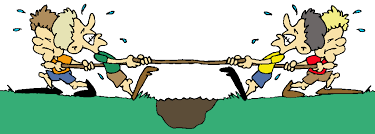
52.
If these teams are pulling with the same amount of force what will happen?
a)
The boy in blue will win.
b)
They will not move at all.
c)
The boy in red will win.
d)
Both will fall down.
53.
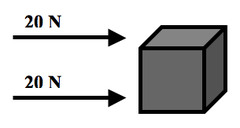
What is the net force?
a)
40 N left
b)
0 N Balalnced
c)
400 N right
d)
40 N right
54.
How will this object move? 
a)
It won't move. 
b)
It will move to the right. 
c)
It will move to the left. 
d)
It will move up. 
55.
In a tug of war the left team pulls with a force of 200N. The right team pulls with a force of 150N. What is the resultant force?
a)
50N to the left.
b)
350N to the left.
c)
350N to the right.
d)
50N to the right.
56.
What is the net force?
a)
400 N Up
b)
400 N Down
c)
- 400 N Down
d)
800 N Down
57.
Which of the blocks above has balanced forces acting on it?
a)
A
b)
B
c)
C
d)
D
58.

two forces acting in opposite directions on an object, and do not cause a change in motion; equal in size

a)

Force

b)

Balanced Force

c)

Unbalanced Force

d)

Inertia

59.

two forces acting on an object and causes a change in motion; not equal in size.

a)

Force

b)

Balanced Force

c)

Unbalanced Force

d)

Net Force

60.
An airplane is travelling North through the sky at a constant speed when turbulence causes it to take a different route, changing its direction. Explain the forces at work on this plane.
a)
Unbalanced, because the plane is moving forward, not backwards
b)
Unbalanced, because the speed is constant and there is a change in direction
c)
Balanced, because the plane is not falling to a lower altitude
d)
Unbalanced, because the plane is in motion
61.
What is this?
a)
a screw 
b)
a wedge
c)
an inclined plane
62.

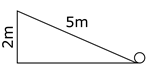
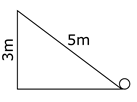
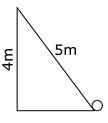
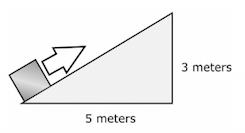
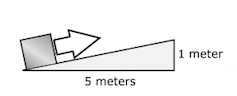
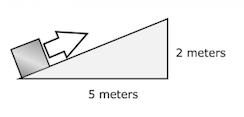
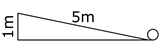
Which inclined plane requires the most effort to push the ball to the top?
a)
b)
c)
d)
63.

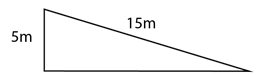
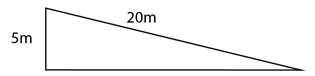
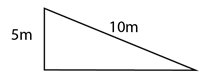
Which of the following inclined planes would require the least amount of effort to lift a box?
a)
b)
c)
d)

They all require the same amount of effort.

64.

Which of the following is TRUE?

a)

Ramps increase work

b)

Ramps make it harder to move things

c)

Ramps reduce the amount of effort

d)

Inclined planes are only found in buildings
65.
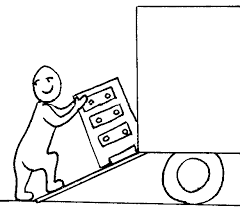
What is a disadvantage of using an inclined plane to lift a heavy object?
a)
The object must be moved a greater distance.
b)
It takes less effort to move the object.
c)
Many objects are difficult to lift straight up.
d)
Heavy object usually take up more space.
66.
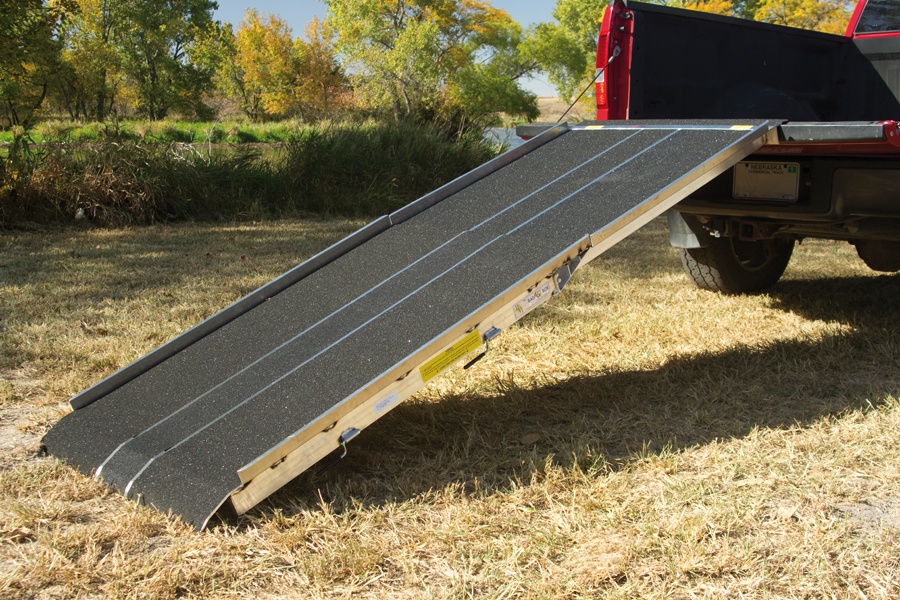
Which has the longer distance - straight lift from the ground directly to the back of truck or using an inclined plane?
a)
Straight lift
b)
Inclined plane
c)
They are the same
67.

How does using an inclined plane make lifting a load easier?

a)

it makes the mass levitate upward

b)

it increases the effort needed to lift a mass

c)

it decreases the effort needed to lift a mass

d)

it doesn't help

68.
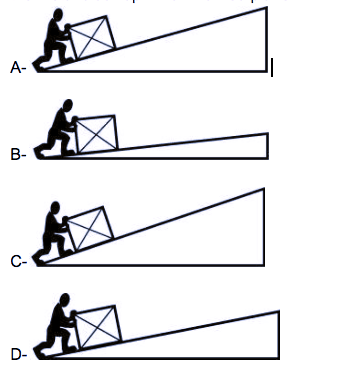
The greatest amount of force is required to move the metal block up which inclined plane?
a)
A
b)
B
c)
C
d)
D
69.

Which of the following will require the least force to move the load up the inclined plane?
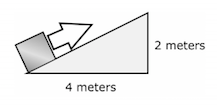
a)
b)
c)
d)
70.

The inclined plane makes work easier by __________________ the amount of effort that must be applied to raise or lower a load.

a)

reducing

b)

increasing

71.

All of the following are examples of inclined planes EXCEPT - - -

a)

an escalator

b)

an uphill trail

c)

a slide

d)

a table

72.

Is a waterslide an inclined plane?

a)

Yes

b)

No

73.

If a mineral can SCRATCH another one, it is -

a)

harder than the mineral

b)

weaker than the mineral

c)

the same mineral

74.

Calcite can scratch -

a)

Apatite

b)

Fluorite

c)

Talc

75.

Diamond is the hardest mineral.

a)

True

b)

False

76.

What type of property test is a mineralogist conducting when she rubs a mineral over a mirror, tile, or hard surface?

a)

Streak Test

b)

Luster Test

c)

Appearance Test

d)

Cracking Test

77.
What are the 3 major types of rocks?
a)
Igneous, Metamorphic, Sedimentary
b)
Metamorphic, Igneous, Cementation
c)
Brown, Red, Gray
d)
Streak, Hardness, Breakage
78.

Rocks formed by heat and pressure beneath the Earth's surface are...

a)

igneous

b)

metamorphic

c)

sedimentary

d)

magma

79.

Two types of igneous rocks are:

a)

Interior and exterior

b)

Intrusive and extrusive

c)

Inside and outside

d)

Enter and exit

80.
A solid material that is made up of one or more minerals.
a)
mineral
b)
rock
c)
fossil
d)
soil
81.
Rock formed from materials that have settles into layers from weathering
a)
igneous rock
b)
sedimentary rock
c)
metamorphic rock
82.
An object that is solid, formed in nature, and has never been alive
a)
sand castle
b)
mineral
c)
plant
83.
What is the small broken down pieces of rock called?
a)
dirt
b)
grime
c)
sediment
d)
popcorn
84.
What is the small broken down pieces of rock called?
a)
dirt
b)
grime
c)
sediment
d)
popcorn
85.
A shiny material is described as having a __________________ luster
a)
metallic
b)
nonmetallic
86.
What is the LEAST useful way to identify a mineral?
a)
luster
b)
streak
c)
color
d)
density
87.
When sediments are pressed together tightly, this is called ____________.
a)
Compaction
b)
Cementation
c)
Weathering
d)
Erosion
88.
The process by which metamorphic rocks are formed...
a)
heat and pressure
b)
erosion and deposition
c)
melting and cooling
89.
_______ rock forms from magma/lava
a)
Metamorphic
b)
Sedimentary
c)
Igneous
90.

What causes igneous rocks to form

a)

pressure

b)

cooling magma and lava

c)

compaction

d)

cementation

91.

A rock made of magma that cools inside the Earth and contains large crystals?

a)

Igneous

b)

Sedimentary

c)

Metamorphic

d)

Magma

92.

How can a Metamorphic rock become an Igneous rock?

a)

Weathering and Erosion

b)

Compaction and Cementation

c)

Heat and Pressurew

d)

Melting and cooling

93.
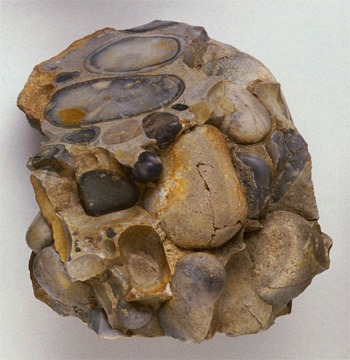
This rock was formed by smaller pieces of rock that settled at the bottom of a lake millions of years ago. What type of rock is this?
a)
Sedimentary
b)
Igneous
c)
Metamorphic
94.

A student wanted to conduct a series of tests to identify different minerals. Which list below shows the tests that the student should conduct on each of the different minerals?

a)

color, taste, shape, and size

b)

hardness, color, luster, and streak

c)

taste, hardness, color, and size

d)

streak, size, taste, and shape

95.

In a comparative investigation, students had to identify different mineral specimens. Which physical property is the LEAST reliable for identifying one mineral from another because it cannot be measured?

a)

streak

b)

hardness

c)

cleavage

d)

color

96.

Minerals can be identified using the physical properties hardness, streak, and cleavage because

a)

crystal structure is too hard to determine.

b)

minerals have different recognizable properties.

c)

crystal size is determined by the environment.

d)

minerals are inorganic.

97.

Students have a rock sample that may contain the mineral hematite. They know that hematite has a red or rusty streak. How can the students determine the color of the streak in the rock sample?

a)

use a rock with the known mineral to strike the sample

b)

rub the sample on a piece of porcelain  tile

c)

use a file to break off a piece of the sample

d)

scratch the sample with an iron nail

98.

A metamorphic rock becomes an igneous rock by...

a)

melting completely, then cooling

b)

weathering into sediments, then eroding

c)

compacting under pressure and cementing

d)

changing shape under heat and pressure

99.

The process of weathering creates ___________ rock.

a)

metamorphic

b)

igneous

c)

sedimentary

d)

all rock types

100.

What process happens at X

a)

cooling

b)

melting

c)

weathering

d)

heat and pressure

101.

What process occurs at Z

a)

melting

b)

cooling

c)

weathering

d)

heat and pressure

102.

What process occurs at Y?

a)

cooling and melting

b)

heat and pressure

c)

weathering

d)

erosion

103.

If a sedimentary rock like sandstone gets put under heat and pressure, what does it become?

a)

it stays as sedimentary sandstone

b)

it becomes metamorphic quartzite

c)

it melts completely to igneous basalt

d)

it becomes a different type of sedimentary rock

104.

Most of the ocean floor is a type of rock called basalt.  At the edge of continents, this basalt erodes and becomes small particles.  Over time, the particles are cemented and compacted together and form what type of rock?

a)

igneous

b)

sedimentary

c)

metamorphic

105.

Rocks that contain fossils are usually...

a)

igneous

b)

metamorphic

c)

sedimentary

106.

Rocks that can be found in the area of a volcano and have been cooled from a liquid state should be classified as 

a)

igneous

b)

sedimentary

c)

metamorphic

107.

What are the three type of rocks?

a)

hardness, streak, color

b)

igneous, metamorphic, sedimentary

c)

minerals, rocks, metals

108.

Igneous rocks are made from...

a)

cooling magma and lava

b)

weathering and erosion

c)

heat and pressure

109.

In the rock cycle, sedimentary rock forms when rock is ______ 

a)

crystallized into natural glass.

b)

exposed to great temperature.

c)

melted into liquid magma.

d)

broken down by weathering.

110.

What do all rocks have in common?

a)

Rocks are made of two or more minerals.

b)

Rocks are made of two or more elements.

c)

Rocks are made of magma and sediments.

d)

Rocks are made of sand changed by pressure.

111.

Which processes change magma into igneous rock?

a)

compaction and cementation

b)

heat and pressure

c)

cooling and crystallization

d)

weathering and erosion

112.

Small pieces of weathered rock become sedimentary rock by from ...

a)

heat and pressure

b)

compaction and cementation

c)

melting and cooling

d)

weathering and erosion

113.

Which mineral from the table can scratch all of the other minerals?

a)

Olivine

b)

Pyrite

c)

Calcite

d)

Quartz

114.
On a roller coaster, where is maximum potential energy?
a)
At the bottom of a big hill
b)
When going around a corner
c)
When going upside down
d)
At the top of a big hill
115.
On a roller coaster, where is maximum kinetic energy?
a)
At the bottom of a big hill
b)
When going around a corner
c)
When going upside down
d)
At the top of a big hill
116.
Wood, batteries, gasoline, and  food are all examples of ________________________.
a)
gravitational potential energy
b)
elastic potential energy
c)
chemical potential energy
d)
None of the above
117.
The faster an object moves, the ________ kinetic energy it has. 
a)
more
b)
less
c)
none of the above
d)
all of the above 
118.

When you compress a spring, you are storing __________ energy.

a)

sound

b)

elastic

c)

light

d)

chemical

119.
Gravitational potential energy depends on the ________ and ________ of the object. 
a)
Height and mass
b)
Friction and movement
c)
Mass and Movement
d)
Height and Friction 
120.
Energy can not be created or destroyed, only converted from one form to another.
a)
true
b)
false
121.
Explain what happens to the potential energy of a rock as it falls off the side of a cliff.
a)
The kinetic energy decreases as the potential energy increases.
b)
The kinetic energy decreases as the potential energy decreases.
c)
The potential energy decreases as the kinetic energy increases.
d)
The potential energy decreases as the kinetic energy decreases. 
122.
When riding a roller coaster, you go up and down many hills. As you get to the top of a roller coaster, what energy change is taking place.
a)
Potential energy is changed into kinetic energy.
b)
Kinetic energy is changed into potential energy.
c)
Chemical energy is changed into heat energy.
d)
Heat energy is changed into chemical energy. 
123.

Which passenger has the most potential energy?

a)

A

b)

B

c)

C

d)

D

124.

At which point is potential energy greatest?

a)

W

b)

X

c)

Y

d)

Z

125.
Which is the best example that something has kinetic energy?
a)
a. a car parked on a steep hill 
b)
b. a tennis ball rolling across the court
c)
c. a picture hanging on the wall 
d)
d. a piece of coal before it's burned 
126.
What kind of energy is in a person climbing a ladder?
a)
Potential
b)
Kinetic
c)
Both
127.
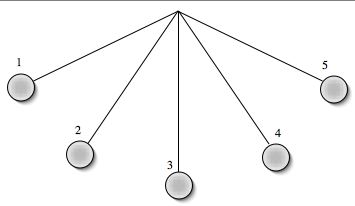
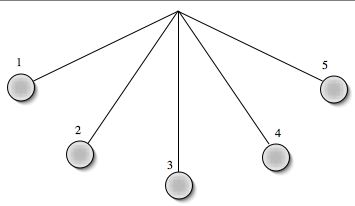
When a pendulum swings, at which point is kinetic energy highest?
a)
1
b)
2
c)
3
d)
4
128.
When a pendulum swings, at which point is potential energy at its greatest?
a)
1
b)
2
c)
3
d)
4
129.
Click to look at the picture. 
The picture is an example of _____ .
a)
gravity
b)
potential energy
c)
kinetic energy
d)
friction
130.
Click to look at the picture.
The picture is demonstrating an example of ______ . 
a)
gravity
b)
speed
c)
kinetic energy
d)
potential energy
131.

Which point has the most potential energy?

a)

G

b)

F

c)

B

d)

A

132.

The faster an object moves, the ________ kinetic energy it has.

a)

more

b)

less

133.

__________ is stored energy.

a)

Potential

b)

Kinetic

134.
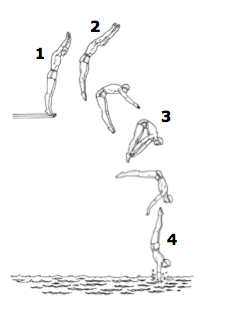
2. The diagram to the right represents a diver’s motion from the top of a high diving board into a pool of water. At what point does the diver have the greatest kinetic energy and the least potential energy?
a)
1
b)
2
c)
3
d)
4
135.
A cell phone battery dies.  It gets plugged into an electrical outlet to recharge. Which of the following energy transformations occur during the charging?
a)
mechanical to chemical
b)
electrical to solar
c)
chemical to light
d)
electrical to chemical
136.
Tarzan is swinging through the jungle looking for Jane. He is constantly moving back and forth..his kinetic energy is being changed to 
a)
electrical
b)
chemical
c)
potenital
d)
nuclear
137.
Mrs. Goodwyn's students are complaining that it is hot in the classroom. She plugs in the fan and turns it on, which energy transformation occurs?
a)
mechanical to electrical
b)
electrical to mechanical
c)
chemical to mechanical
d)
electromagnetic to mechanical
138.
Which form of energy is produced by the splitting of the nucleus of an atom?
a)
solar
b)
nuclear
c)
chemical 
d)
none
139.
Energy that is produced by the internal motion of particles is called...
a)
light
b)
mechanical
c)
thermal
d)
chemical
140.
The sun’s energy used by green plants to produce food is an example oflight energy being converted to what other form of energy?
a)
kinetic energy
b)
heat energy
c)
mechanical energy
d)
chemical 
141.
Electrical Energy is transferred to _____ Energy.
a)
Thermal
b)
Solar
c)
Electrical
d)
None
142.
The Law of Conservation of Energy states that...
a)
energy can be destroyed
b)
energy can not be created or destroyed
c)
energy can only be destroyed using the force
143.

How does a windmill change forms of energy?

a)

Mechanical to electrical

b)

Electrical to mechanical

c)

Mechanical to light

d)

It is unable to change forms

144.

If you have a battery in a device, what is the first energy transformation that must happen?

a)

Chemical to light

b)

Chemical to electrical

c)

Electrical to chemical

d)

Electrical to light

145.

Where is energy converted from light energy to chemical energy

a)

rabbits

b)

snakes

c)

eagle

d)

grass

146.

Complex interactions must occur before solar energy is converted to energy humans can use for movement and heat. What is the correct energy flow from sun to animal

a)

heat to electrical to mechanical

b)

chemical to radiant to electrical

c)

radiant to chemical to mechanical

d)

mechanical to heat to electrical

147.

Choose the sequence that best shows this path of energy from the sun to a plant eating animal.

a)

radiant energy >mechanical energy > chemical energy

b)

radiant energy >chemical energy > mechanical energy

c)

chemical energy >mechanical energy > radiant energy

d)

chemical energy >radiant energy > mechanical energy

148.

An amoeba is a single cellular organism. It uses a sugar molecule to make energy and it releases heat to the environment. This is an example of what type of energy transformation?

a)

electrical to mechanical

b)

chemical to thermal

c)

electrical to kinetic

d)

mechanical to electrical

149.

Which energy transformation is shown in this picture?

a)

chemical -----> light

b)

light -----> mechanical

c)

mechanical -----> chemical

d)

chemical -----> mechanical

150.

What type of potential energy does a match have?

a)

thermal energy

b)

light energy

c)

chemical energy

d)

electrical energy

151.

What type of energy is made by vibrations and does not travel through empty space?

a)

sound energy

b)

light energy

c)

electrical energy

d)

chemical energy

152.

Which is an example of kinetic energy?

a)

A soccer ball is lying on the ground.

b)

A person is standing in line.

c)

A roller coaster is sitting at the top of a hill.

d)

Water is flowing over a dam.

153.

Which is an example of potential energy?

a)

A child is hopping down the sidewalk.

b)

A horse is galloping in a field.

c)

A person is sitting on a horse.

d)

A car is driving on the street.

154.

Which transformation best explains what happens in a glow stick when you shake it to make it glow?

a)

chemical to mechanical

b)

mechanical to chemical

c)

light to chemical

d)

chemical to light

155.

What is the energy transformation that occurs in an electric pencil sharpener?

a)

mechanical energy to electrical energy

b)

electrical energy to mechanical energy

c)

radiant energy to sound energy

d)

chemical energy to mechanical energy

156.
Which items would have this energy transformation: electrical energy -> thermal energy and light energy?
a)
toaster
b)
candle burning
c)
windmill turning
d)
Iron for your clothes
157.

Food

a)

radiant

b)

chemical

c)

potential

d)

kinetic

e)

sound

158.

Batteries

a)

radiant

b)

chemical

c)

potential

d)

kinetic

e)

sound

159.
Which skier will have a greater potential energy? 
a)
Skier 1
b)
Skier 2
160.
What kind of energy is represented in this picture?
a)
Thermal
b)
Potential
c)
Nuclear
d)
Mechanical
161.
As a pendulum swings from its highest to lowest position, what happens to its kinetic and potential energy? 
a)
Both the potential energy and kinetic energy decrease
b)
The potential energy decreases while the kinetic energy increases 
c)
The kinetic energy decreases while the potential energy increases 
d)
Bothe the potential energy and kinetic energy increase