wayground logo

Free Printable Worksheets

Font size

S
M
L
XL
Worksheets

Semester 1 Review

Total questions: 50

Worksheet time: 2hrs 40mins

Name
Class
Date
1.
Which major macromolecule is being represented in this image? 
a)
carbohydrate
b)
lipid
c)
protein
d)
nucleic acid
2.
What are the building blocks of proteins?
a)
amino acid
b)
fatty acid
c)
nucleotide
d)
lipid
3.
DNA and RNA are examples of...
a)
proteins
b)
nucleic acids
c)
carbohydrates
d)
lipids
4.
Which macromolecule stores energy, insulates us, and makes up the cell membrane?
a)
lipids
b)
proteins
c)
carbohydrates
d)
nucleic acids
5.
What is the function of nucleic acids?
a)
Stores energy
b)
Stores genetic information
c)
Movement
d)
Physical structure
6.
Most enzymes:
a)
speed up the chemical reaction
b)
have no effect on the rate of the chemical reaction
c)
slow the rate of the chemical reaction
d)
keep the rate of the chemical reaction the same
7.
In what organelle is the genetic material found inside?
 
a)
Endoplasmic Reticulum
b)
Golgi Complex
c)
Nucleolus
d)
Nucleus
8.
What is the function of nucleus?
a)
Structure that organizes motion of chromosomes. 
b)
Structure that contains DNA and directs the cell 
c)
Membrane that surrounds and protects the cell 
d)
Stack of membranes that packages chemicals
9.
The two kinds of cells are Prokaryotes and Eukaryotes. How are they different?
a)
Prokaryotes have a nucleus.
b)
Eukaryotes have a nucleus.
c)
Prokaryotes are plant cells.
d)
There is no difference.
10.
This organelle takes food and turns it into ENERGY for plant and animal cells.
a)
Chloroplast
b)
Mitochondria
c)
Lysosome
d)
Ribosome
11.
A rigid layer that lies outside the cell's  membrane is...
a)
Cytoskeleton
b)
Cilia
c)
Cell Wall
d)
Flagella
12.
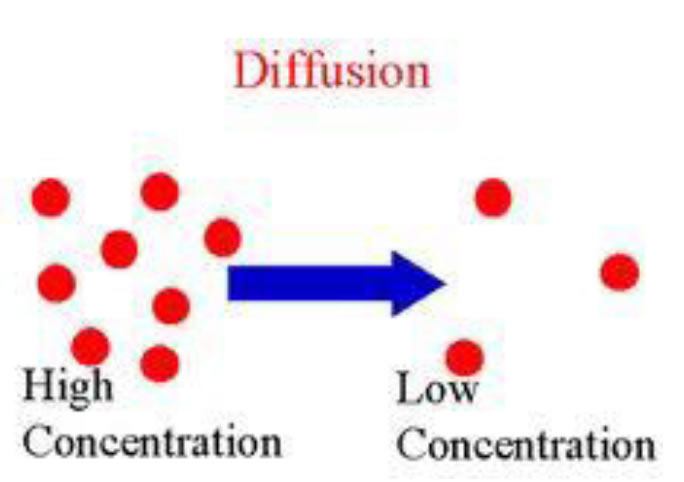
Movement of particles from high to low concentration. 
a)
Passive Transport
b)
Active Transport
13.
Osmosis is a form of ______________. 
a)
Passive Transport
b)
Active Transport
14.
a)
Passive Transport
b)
Active Transport
15.
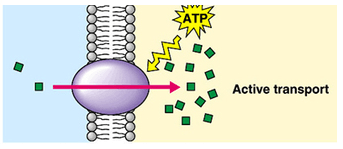
ATP is a form of energy.
a)
Passive Transport
b)
Active Transport
16.
What is it called when molecules move across the cell membrane from an area of high concentration to an area of low concentration through a carrier protein?
a)
Diffusion
b)
Osmosis
c)
Active Transport
d)
Facilitated Diffusion
17.
In which eukaryotic organelle does photosynthesis occur?
a)
mitochondria
b)
stomata
c)
xylem
d)
chloroplast
18.
The reactants of photosynthesis are
a)
sugar and water.
b)
sugar and oxygen.
c)
carbon dioxide and water.
d)
carbon dioxide and oxygen.
19.
What are the products of photosynthesis?
a)
Carbon dioxide and water
b)
Carbon dioxide and oxygen
c)
Glucose and oxygen
d)
Glucose and water
20.
Which of the following is the correct equation for PHOTOSYNTHESIS?
a)
6CO2 + 6H2O --> 6O+ C6H12O6
b)
6CO+ C6H12O6 + 6H2O --> O
c)
6O2 + 6H2O --> 6CO+ C6H12O6
d)
C6H12O6 + 6O2 ---> 6H2O + 6CO2 
21.
What are the products of aerobic respiration?
a)
Glucose and oxygen
b)
Carbon dioxide and water
c)
Lactic acid
d)
Carbon monoxide
22.
What are the REACTANTS for cellular respiration?
a)
oxygen and carbon dioxide
b)
water and glucose
c)
carbon dioxide and water
d)
glucose and oxygen
23.
Which is the correct chemical equation for CELLULAR RESPIRATION?
a)
Glucose (Sugar) + Oxygen --> Carbon Dioxide + Water + ATP (Energy)
b)
ATP (Energy) + Oxygen --> Carbon Dioxide + Water + Glucose (Sugar)
c)
Glucose (Sugar) + Carbon Dioxide --> Oxygen + Water + ATP (Energy)
d)
Glucose (Sugar) + Water + Oxygen --> Carbon Dioxide + Oxygen + ATP (Energy)
24.

Where are stomata located on the plant?

a)

On the stem

b)

In the roots

c)

Surface of the plant leaves

d)

On the xylem

25.
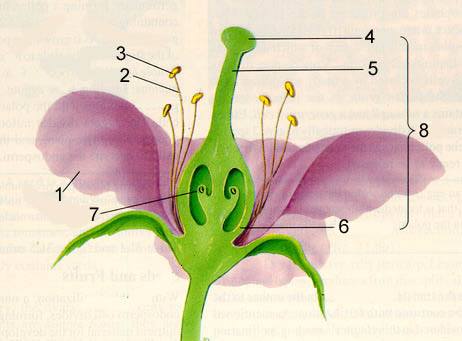
What is #4 pointing to?
a)
anther
b)
style
c)
stigma
d)
ovary
26.
Where is pollen made?
a)
ovary
b)
petal
c)
pistil
d)
anther
27.
What is the sticky part of the flower that catches pollen?
a)
style
b)
stigma
c)
ovary
d)
petal
28.
________ means flowering plant.
a)
angiosperm
b)
gymnosperm
c)
conifer
29.
Which of the following is the male reproductive structure in a plant?
a)
Sepal
b)
Stamen
c)
Pistil
d)
Stigma
30.
Carries water and minerals up from the root to the rest of the plant?
a)
xylem
b)
phloem
31.

Carries food/glucose down from the leaves to the rest of the plant?

a)

xylem

b)

phloem

32.
Terrestrial plants have stomata on the surface of their leaves. A single stomata is surrounded by two guard cells that change shape in response to environmental factors and open or close the stoma. Which of the following best explains how the structure of the leaf is used in processes that occur in plants?
a)
Water enters the plant through the surface of the leaf for transpiration
b)
Gases for photosynthesis are exchanged through the surface of the leaf. 
c)
Energy for cellular reproduction is absorbed through the surface of the leaf.
d)
Carbon dioxide enters the plant through the surface of the leaf for cellular reproduction.
33.
Which structure in the leaf controls the opening and closing of the stoma? 
a)
cuticle
b)
epidermis
c)
guard cell
d)
spongy mesophyll
34.
The diagram shows a cross section of a plant leaf. How does the structure marked X contribute to the survival of the plant?
a)
It allows the intake of gases necessary for photosynthesis.
b)
 It allows the intake of minerals necessary for plant growth.
c)
It allows the intake of sunlight necessary for ATP production.
d)
It allows the intake of sugars necessary for plant reproduction.
35.
The method of DNA replication is known as:
a)
Semi-conservative
b)
Conservative
c)
Dispersive
d)
Complementary
36.
Replicate the following strand of DNA: 
AATCATGGA
a)
AATCATGGA
b)
TTAGTACCT
c)
UUAGUACCU
d)
GGATAUCUA
37.
DNA replication results in two DNA molecules,
a)
each one with two original strands
b)
each one with two new strands
c)
each one with one new strand and one original strand
d)
one with two new strands and the other with two original strands
38.
Guanine bonds with ______________.
a)
Adenine
b)
Guanine
c)
Cytosine
d)
Thymine
39.
Adenine bonds with ______________.
a)
Guanine
b)
Thymine
c)
Cytosine
d)
Adenine
40.
Name this structure
a)
double helix
b)
nucelotide
c)
twisted ladder
d)
hydrogen bond
41.

What is the purpose of DNA replication?

a)

Cut the DNA

b)

Make more cells

c)

Apoptosis

d)

Duplicate/copy the DNA

42.
In what phase of the cell cycle does DNA replication take place?
a)
G1
b)
S
c)
G2
d)
M
43.

Select all stages of interphase?

a)

G1

b)

S

c)

G2

d)

Mitosis

44.

In the end of mitosis what is created?

a)

2 daughter cells that are identical

b)

2 daughter cells that are different

c)

2 daughter cells with 1/2 the genetic information

d)

2 daughter cells with 1/4 of the genetic information

45.

Cancer is...

a)

a cell that divides

b)

a chromosome that is too big

c)

uncontrolled cell growth

d)

spindle fibers

46.

Why are spindle fibers so important?

a)

they help to double the chromsome number

b)

they do not help at all

c)

they help to maintain the chromosome number

d)

they are only used in interphase

47.

Cytokinesis in a plant cell is different than an animal cell because...

a)

a plant cell uses a cell plate and an animal cell uses a cleavage furrow

b)

a plant cell uses a cleavage furrow and an animal cell uses a cell plate

48.

If the chromosomes are lined up in the MIDDLE, what phase of mitosis are they in?

a)

prophase

b)

metaphase

c)

anaphase

d)

telophase

49.

A human has 46 chromosomes in their original body cell, how many are in the two new cells formed after mitosis?

a)

23

b)

46

c)

92

50.

Asexual reproduction is...

a)

2 parents- genetically different

b)

1 parent- genetically different

c)

2 parents- genetically identical

d)

1 parent- genetically identical