wayground logo

Free Printable Worksheets

NEW

Font size

S
M
L
XL
Worksheets

8th grade mid term

Total questions: 80

Worksheet time: 20hrs 0mins

Name
Class
Date
1.
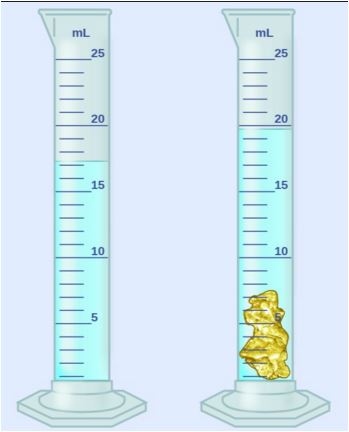
What is the volume of the liquid in this graduated cylinder?
a)
19 mL 
b)
35 mL 
c)
24 mL 
d)
1.9 mL
2.
What is the mass on the triple beam balance?
a)
345.5
b)
304.5
c)
700.5
3.
Frank has a paper clip. It has a mass of 9g and a volume of 3cm3. What is its density?
a)
3 g/cm3
b)
1/3 g/cm3
c)
27 g/cm3
d)
39 g/cm3
4.
Jill has a gel pen. The gel pen has a mass of 8g and a volume of 2cm3. What is the density of the pen?
a)
4 g/cm3
b)
16 g/cm3
c)
.25 g/cm3
d)
64 g/cm3
5.
Calculate the density of the cube.
a)
2 g/cm3
b)
4 g/cm3
c)
6 g/cm3
d)
8 g/cm3
6.
An irregularly shaped piece of gold was lowered into a graduated cylinder holding a volume of water equal to 17 ml. The height of the water rose to 20 ml. If the mass of the gold was 27 g, what was its density?
a)
9 g/mL
b)
10.5 g/mL
c)
6.5 g/mL
d)
8 g/mL
7.

What is a subatomic particle with a positive charge that is in the nucleus of an atom?

a)

neutron

b)

proton

c)

electron

d)

valence electron

8.

What is a subatomic particle without an electric charge, located in the nucleus of an atom?

a)

neutron

b)

proton

c)

electron

d)

valence electron

9.

What is the center of an atom containing protons and neutrons?

a)

nucleus

b)

neutron

c)

proton

d)

electron cloud

10.

What is the number of protons in the nucleus of an atom that determines the chemical properties of an atom?

a)

mass number

b)

atomic mass

c)

atomic number

d)

atomic symbol

11.

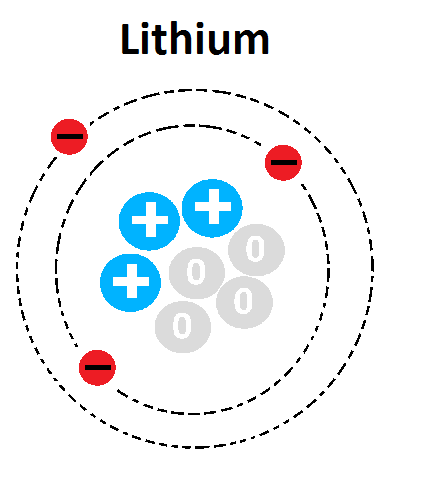
What is the atomic number of this atom?

a)

1

b)

3

c)

4

d)

7

12.
In order for an atom to be neutral what has to be true?
a)
The atom has more protons than neutrons
b)
The atom has more neutrons than protons
c)
The atom has the same number of protons and neutrons
d)
The atom has the same number of protons and electrons
13.
The atomic number of an element that has 9 protons, 9 electrons, and 10 neutrons is _____.
a)
9
b)
10
c)
19
d)
28
14.
An element with a mass number of 11 and an atomic number of 5 has how many neutrons?
a)
11
b)
5
c)
6
d)
16
15.

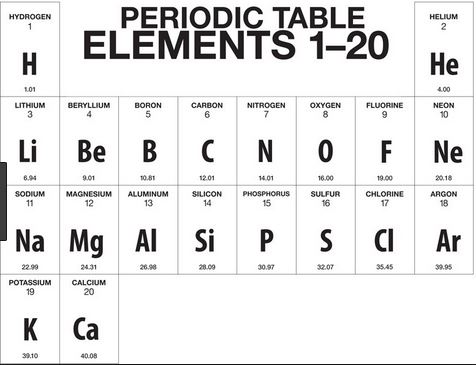
How many valence electrons does Helium Have?

a)

1 Valence electron

b)

2 Valence electron

c)

3 Valence electron

d)

4 Valence electron

e)

5 Valence electron

16.

How many valence electrons does Nitrogen Have?

a)

1 Valence electron

b)

2 Valence electron

c)

3 Valence electron

d)

4 Valence electron

e)

5 Valence electron

17.
Which two groups on the Periodic Table are the MOST reactive?
a)
Group 1 and Group 17
b)
Group 2 and Group 16
c)
Group 13 and Group 15
d)
Group 17 and Group 18
18.
Which group on the Periodic Table is inert?
a)
Group 1
b)
Group 2
c)
Group 17
d)
Group 18
19.
How many valence electrons are elements trying to reach in their outer shells?
a)
1
b)
2
c)
5
d)
8
20.
What determines the reactivity of an element?
a)
Size of its nucleus
b)
Number of total electrons
c)
Number of valence electrons
d)
Number of shells
21.
Sodium has an atomic number of 11, how many protons does this atom have?
a)
22
b)
11
c)
12
d)
2
22.
What number on the element key tells you how many protons an element has?
a)
Atomic Mass
b)
Element name
c)
Atomic number
d)
Element Symbol
23.
Which description about the proton is accurate?
a)
Positively charged particle with a mass less than 0 amu
b)
A neutrally charged particle with a mass less than 0 amu
c)
Positively charged particle with a mass of 1 amu
d)
A neutrally charge particle with a mass of 1 amu
24.

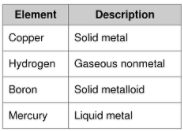
Use the table.


An unknown substance is a semi-conductor and is very brittle. This unknown substance could be which of the following elements form the table?

a)

Copper

b)

Mercury

c)

Boron

d)

Hydrogen

25.

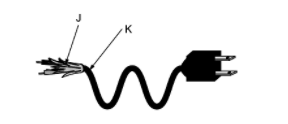
Material labeled K contains elements that do not conduct heat or electricity well. The materials that make up K are most likely

a)

nonmetals

b)

liquids

c)

metals

d)

gases

26.
Which of the following is NOT a characteristic of most metals?
a)
Brittle
b)
Good conductor
c)
Ductile
d)
Malleable
27.
How do metals differ from nonmetals?
a)
metals are shiny, nonmetals are dull
b)
metals are good insulators, nonmetals are good conductors
c)
metals are powdery
d)
nonmetals are shiny
28.
Which one has more than one type of atom in it?
a)
Element
b)
Compound 
29.

Examples are water (H2O) and carbon dioxide (CO2).

a)

elements

b)

compounds

30.

This picture represents which of the following?

a)

element

b)

compound

31.
Which of the following represents an element?
a)
H2O
b)
H2
c)
NaCl
d)
CaCO3
32.
How many atoms of carbon (C) are in C6H12O6?
a)
3
b)
6
c)
12
d)
24
33.
Which is the correct formula for:
 three hydrogen (H)
one sulfur (S)
four oxygen (O)
a)
H3SO4
b)
HSO4
c)
H4S3O
d)
H2O
34.
The blue numbers in the image below represent ________
a)
I don't know, and don't want to try
b)
coefficients
c)
subscripts
d)
none of the answers are correct
35.
How many atoms are there TOTAL in:
H2SO4
a)
6
b)
5
c)
7
d)
3
36.
How many nitrogen atoms in 
Mg(NO3)2
a)
1
b)
2
c)
3
d)
6
37.
How many oxygen atoms in 
Mg(NO3)2
a)
1
b)
2
c)
3
d)
6
38.

How many hydrogen atoms are there?

a)

1

b)

4

c)

5

d)

6

39.

How many phosphorus atoms are there?

a)

0

b)

1

c)

3

d)

4

40.
Which of the following equations demonstrates an actual chemical reaction that forms a new substance?
a)
A
b)
B
c)
C
d)
D
41.
Which of the following examples shows that a chemical reaction has occurred? 
a)
A rock breaks into smaller pieces when it is struck with a hammer.
b)
Rust forms on a hammer that has been left outside to long. 
c)
A cup of water turns pink when a few drops of red food coloring are added. 
d)
A solid is formed when heat is removed from a sample of water. 
42.
A student places a piece of a potato into a container of hydrogen peroxide. One observation the student makes is that bubbles form around the potato. The presence of bubbles might indicate the formation of a new substance because bubbles - 
a)
could show that a gas is forming
b)
always rise to the top of a liquid. 
c)
are almost always perfectly spherical.
d)
usually burst after a few minutes.
43.
Four students performed four different investigations by combining different substances. Their results are shown in the table provided. In which experiment are new substances being formed?
a)
Experiment 1
b)
Experiment 2
c)
Experiment 3
d)
Experiment 4
44.
Which evidence demonstrates that a chemical change has occurred.
a)
water level rises
b)
water becomes cloudy
c)
gas is produced (bubbles)
d)
tablet dissolves
45.

Which answer choice lists evidence of two possible chemical changes?

a)

rusting and freezing

b)

melting and precipitate created

c)

bubbles and precipitate formed

d)

dissolving and evaporating

46.

Which of the answer choices describes a chemical reaction?

a)

A substance changes state.

b)

A new substance is formed.

c)

A substance changes shape.

47.

A Chemical Change is also known as a ______.

a)

Physical Change

b)

Physical Property

c)

Chemical Reaction

d)

Chemical Property

48.
In a reaction A + B ----> C,  reactant A has 5g and product  C has 9g. How many grams does reactant B should have? 
a)
4g
b)
5g
c)
9g
d)
14g
49.

Does the equation H2+O2 →H2O follow the Law of Conservation of Mass?

a)

Yes, because the atoms are equal.

b)

No, because more info is needed.

c)

No, because there are more atoms in the product.

d)

No, because there are more atoms in the reactant.

50.

Which chemical equation supports the law of conservation of mass?

a)

Equation (a)

b)

Equation (b)

c)

Equation (c)

d)

Equation (d)

51.

Which of the following equations is balanced?

a)

Equation (a)

b)

Equation (b)

c)

Equation (c)

d)

Equation (d)

52.

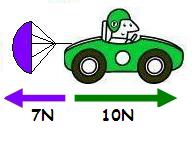
What is the net force?

a)

3 N

b)

3 N, right

c)

17 N, right

d)

3 N, left

53.
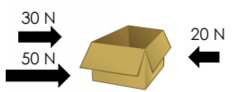
Calculate the Net Force. 
a)
60N, Left 
b)
40N, Right 
c)
0N
d)
60N, Right
54.
Calculate the net force shown in the  diagram?
a)
0N
b)
400 N
c)
600 N
d)
800 N
55.
Calculate the net force shown in the  diagram?
a)
41 N
b)
25 N
c)
16 N
d)
9 N
56.

What is the net force in this example?

a)

200 N

b)

125 N

c)

50 N

d)

75 N

57.

The red car rolled 0.5 meters across the table for 2 seconds. The table was 4 meters high. What was the average speed of the red car in m/sec?

a)

0.25 m/sec

b)

2 m/sec

c)

2.25 m/sec

d)

4 m/sec

58.

After 0.5 seconds, the blue car had traveled 2 meters across the floor. What is the average speed of the blue car in m/sec?

a)

0.25 m/sec

b)

0.25 cm/sec

c)

2.5 m/sec

d)

4 m/sec

59.

The green car traveled 5 meters in 10 seconds. The trip lasted 8 seconds longer than the red car's trip. What is the average speed of the green car in m/sec?

a)

0.28 m/sec

b)

0.5 m/sec

c)

0.8 m/sec

d)

1.875 m/sec

60.
Acceleration of an object happens when things ________
a)
slow down
b)
go faster
c)
change direction (turn)
d)
All of the above
61.
A car traveling 300 miles in 5 hours is an example of _____. 
a)
Speed
b)
Velocity
c)
Acceleration
d)
Direction
62.
The gees fly 23 mph to the south when they migrate for the winter. 
a)
speed
b)
velocity
c)
acceleration
63.
The Olympian swam 200 meters in 20 seconds. 
a)
speed
b)
velocity
c)
acceleration
64.
65mi/hr South is an example of...
a)
Speed
b)
Velocity
c)
Acceleration
d)
Direction
65.
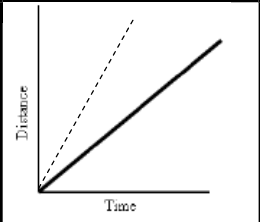
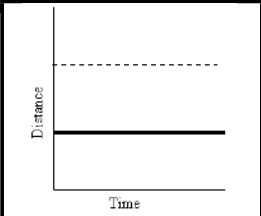
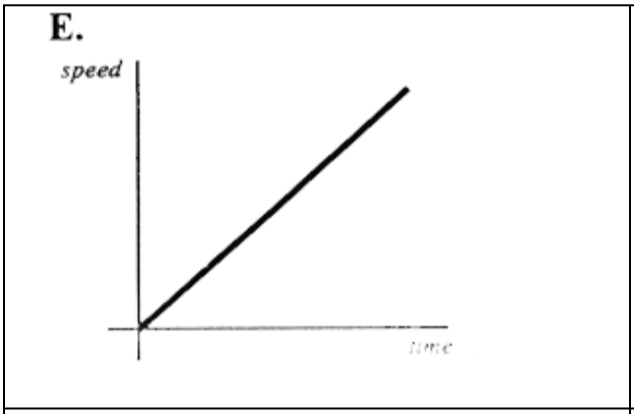
What does this graph represent?
a)
Constant speed
b)
Acceleration
c)
Not moving
66.
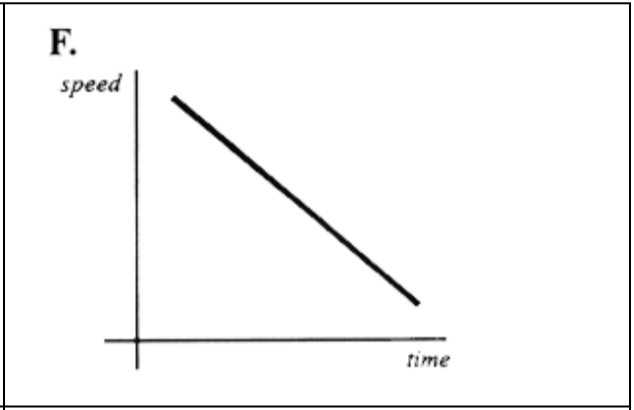
What does this graph represent?
a)
Constant Speed
b)
Acceleration
c)
Not moving
67.
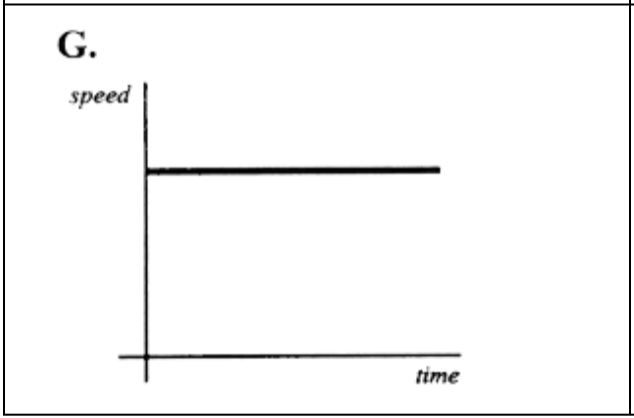
What does this graph represent?
a)
Constant speed
b)
Acceleration
c)
Not moving
68.

What is happening during point A to B?

a)

not moving

b)

increasing speed at a constant rate

c)

moving at a constant speed

d)

moving at 10 m/s2 acceleration

69.

Match the graph to the description:

"The car is accelerating."
a)
b)
c)
d)
70.

Match the graph to the description:

"The car is slowing down."

a)
b)
c)
d)
71.

Which law would we think of when we see the flames of a rocket shooting down so the rocket can go up?

a)

1st

b)

2nd

c)

3rd

72.

Which law can be simply described with the equation:

F = MxA

a)

1st

b)

2nd

c)

3rd

73.

Newton said that an object at rest stays at rest, with which law?

a)

1st

b)

2nd

c)

3rd

74.

If we put the same force on a bowling ball and a soccer ball, the soccer ball will move faster! Which law explains this?

a)

1st

b)

2nd

c)

3rd

75.

Which law explains that it would take more force to push the car than the lawnmower?

a)

1st

b)

2nd

c)

3rd

76.

Which law explains why the driver "keeps moving forwards, even though the car has stopped"?

a)

1st

b)

2nd

c)

3rd

77.
"For every action, there is an equal and opposite reaction."
a)
Newton's 1st Law
b)
Newton's 2nd Law
c)
Newton's 3rd Law
d)
Newton's 4th Law
78.

The reason a ball bounces up when it hits the ground:

a)

The ball and ground repel each other.

b)

The ball exerts a force on the ground, and the ground exerts a force on the ball.

79.

What causes the car to roll of the flatbed truck?

a)

inertia- First law!

b)

Mass of the truck- Second law!

c)

Action reaction of the car Third law!

80.

Letting go of a balloon full of air is demonstrating Newton's ______ _______ ________ _________ because the air comes out of the back and the balloon moves forward.

a)

1st law of motion

b)

2nd law of motion

c)

3rd law of motion