

wayground logo

Free Printable Worksheets

Font size

S
M
L
XL
Worksheets

Biology 1 First Semester Final Review

Total questions: 48

Worksheet time: 3hrs 54mins

Name
Class
Date
1.
Which biomolecule includes fats, such as triglycerides, oils, waxes, and steroids (cholesterol); insoluble in water; provides energy storage, insulation, part of cell membrane, and hormones 
a)
Nucleic Acid
b)
Lipids
c)
Carbohydrate
d)
Protein
2.
Which of the following is the correct equation for PHOTOSYNTHESIS?
a)
6CO2 + 6H2O --> 6O+ C6H12O6
b)
6CO+ C6H12O6 + 6H2O --> O
c)
6O2 + 6H2O --> 6CO+ C6H12O6
d)
C6H12O6 + 6O2 ---> 6H2O + 6CO2 
3.
Which organelle is only found in a plant cell? 
a)
nucleus
b)
chloroplast
c)
mitochondria
d)
cell membrane
4.
This organelle converts organic material (food) to ATP (cell energy).
a)
Nucleus
b)
Ribosome
c)
Mitochondria
d)
ER
5.
You are made up of...
a)
eukaryotic cells
b)
prokaryotic cells
c)
plant cells
d)
bacterial cells
6.
Has membrane bound organelles
a)
Prokaryote
b)
Eukaryote
c)
both
7.
One example of a prokaryote is a...
a)
fungus
b)
bacteria
c)
animal
d)
plant
8.
When many organ systems work together it can form...
a)
organ
b)
cells
c)
organ system
d)
organism 
9.
What is the correct order of organization
a)
tissues-cells-organs-organ systems-organism
b)
cell-tissue-organs-organ systems-organism
c)
organism-cells-tissues-organ systems-organism
d)
tissues-cells-organs-organ sytems-organism
10.

Which organism is NOT likely to carry out aerobic cellular respiration?

a)

bacteria on your skin

b)

anaerobic bacteria

c)

algae

11.

Which of the following are reactants of photosynthesis?

a)

CO2 and H2O

b)

O2

c)

H2O and Glucose

d)

None of the above

12.

In which organelle does photosynthesis occur?

a)

Cell Wall

b)

Chlorophyll

c)

Chloroplast

d)

Cytoplasm

13.

What is the byproduct of photosynthesis? What does the plant release?

a)

Oxygen

b)

Carbon Dioxide

c)

Water

d)

Glucose

14.

The graph indicates the energy used in photosynthesis. Which colors are the most useful in photosynthesis?

a)

green

b)

yellow

c)

blue

d)

red

15.

Which of the following are reactants of photosynthesis?

a)

CO2 and H2O

b)

O2

c)

H2O and Glucose

d)

None of the above

16.

Which of the following are reactants of photosynthesis?

a)

CO2 and H2O

b)

O2

c)

H2O and Glucose

d)

None of the above

17.
The pH scale is a range from:
a)
1-7
b)
0-14
c)
1-5
d)
1-20
18.

In a test of pH levels, a baking soda has a pH of 9 and bleach has a pH of 12. What is true about there relationship?

a)

Both of the solution are bases

b)

Both of the solution are acids

c)

The Baking soda is an acid and the Bleach is a base

d)

The baking soda is a base and the Bleach is an acid.

19.
According to the pH range which substance is more acidic than lemon juice
a)
Hydrochloric acid
b)
cabbage
c)
milk
20.
The purpose of cellular respiration is to produce ?
a)
energy
b)
oxygen
c)
sugar
d)
protein
21.
What is the energy molecule?
a)
DNA
b)
ATP
c)
RNA
d)
AAA
22.
What is the energy organelle?
a)
nucleus
b)
mitochondria
c)
ribosomes
d)
lysosomes
23.
The splitting of the glucose molecule is called?
a)
synthesis
b)
denaturalization
c)
glycolysis
d)
dissolving
24.
The two type of fermentation are alcohol and _____________ acid fermentation. 
a)
lactic
b)
sulfuric
c)
hydrochloric
d)
acetic 
25.
To get the most ATP molecules for energy in cellular respiration, you have to have lots of ?
a)
hydrogen
b)
oxygen
c)
carbon dioxide
d)
water
26.
The waste gas given off by cellular respiration is?
a)
oxygen
b)
carbon dioxide
c)
nitrogen
d)
methane
27.

What are the reactants (taken into) of cellular respiration? (Mark all of them!)

a)

oxygen

b)

glucose

c)

carbon dioxide

d)

water

e)

energy

28.

What is the correct equation for cellular respiration?

a)

6O2 + C6H12O6 -> 6CO2 + 6H2O + Energy

b)

6O2 + C6H12O6 + Energy -> 6CO2 + 6H2O

c)

6CO2 + 6H2O -> 6O2 + C6H12O6 + Energy

d)

6CO2 + 6H2O + Energy -> 6O2 + C6H12O6

29.

How many ATP are produced in aerobic respiration?

a)

2

b)

33

c)

4

d)

36

30.
What means of particle transport requires energy?
a)
passive
b)
active
c)
facilitated
d)
osmosis
31.
What is the diffusion of water through a selectively permeable membrane?
a)
active transport
b)
osmotic pressure
c)
facilitated diffusion
d)
osmosis
32.
My cells are Shriveled!    What state are my cells in?
a)
Hypertonic
b)
Hypotonic
c)
Isotonic
d)
Diffusion 
33.
Which way is the water moving in this cell?
a)
Water will move out of the cell
b)
Water will move into the cell
34.
Which way is the water moving in this cell?
a)
The water level will increase on the right side
b)
The water level will increase on the left side
c)
The water level on both sides will increase
d)
The water level on both sides will decrease
35.
In the picture to the right, which area(s) represent(s) the hydrophobic part of the phospholipid membrane?
a)
Structure A
b)
Structure B
c)
Structures A & B
d)
Neither structure A or B
36.
Glucose is not able to pass through a semi-permeable cell membrane. If the cells need sugar to make ATP and carry out cellular processes, how does the sugar get into the cell? 
a)
passive transport by diffusion
b)
active transport using ATP and carrier proteins
c)
passive transport by osmosis
d)
phagocytosis
37.
During which phase of the cell cycle does the cell spend the most time?
a)
Mitosis
b)
Cytokinesis
c)
Interphase
38.
In mitosis, the two resulting cells are
a)
different from the starting cell and identical to each other.
b)
different from the starting cell and different from each other.
c)
identical to the starting cell and different from each other.
d)
identical to the starting cell and identical to each other.
39.
Where does a cell contain it's genetic material?
a)
nucleus
b)
nucleolus
c)
cytoskeleton
d)
golgi
40.

The correct sequence of mitosis:

a)

metaphase, anaphase, telophase, prophase

b)

prophase, metaphase, anaphase, telophase

c)

prophase, anaphase, metaphase, telophase

d)

telophase, metaphase, prophase, anaphase

41.
Which phase of mitosis is shown in the picture?
a)
Interphase
b)
Metaphase
c)
Telophase
42.
Which phase of mitosis is shown in the picture?
a)
Prophase
b)
Metaphase
c)
Anaphase
43.
Which phase of mitosis is shown in the picture?
a)
Prophase
b)
Telophase
c)
Metaphase
44.

Which chemical compounds are the reactants of photosynthesis and products of cellular respiration?

a)

carbon dioxide (CO2) and water (H2O)

b)

water (H2O) and glucose (C6H12O6)

c)

glucose (C6H12O6) and oxygen (H2O)

d)

oxygen (O2) and carbon dioxide (CO2)

45.

What gas is MOST LIKELY represented by the arrow labeled X?

a)

carbon dioxide

b)

Oxygen

c)

nitrogen

d)

hydrogen

46.

Match the process with the correct organelle.

a)

Photosynthesis occurs in the chloroplast; Respiration occurs in the chloroplast

b)

Photosynthesis occurs in the mitochondria; Respiration occurs in the ribosome

c)

Photosynthesis occurs in the chloroplast; Respiration occurs in the mitochondria

d)

Photosynthesis occurs in the ribosome; Respiration occurs in the mitochondria

47.

How are photosynthesis and respiration related?

a)

ATP is a product of both reactions

b)

The same products are made in both reactions

c)

The two processes occur in the same organelle

d)

The products of one are the reactants of the other
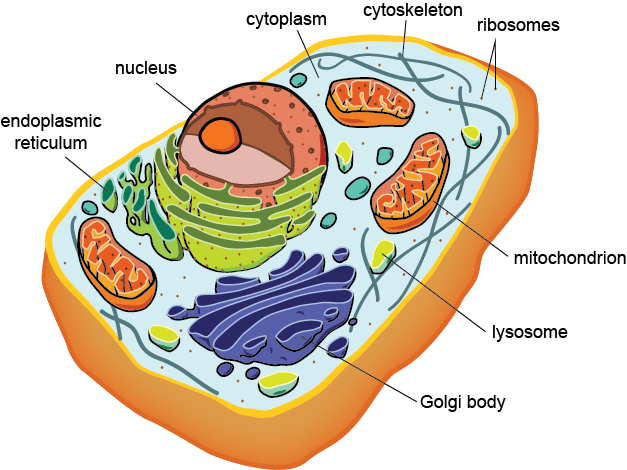
48.
Which of the following statements is not part of the cell theory?
a)
Cells are the basic unit of structure and function in all living things.
b)
All cells are produced from other cells.
c)
Only animal cells are composed of cells.
d)
All living things are composed of cells.
