
 Worksheets
Bonding
Total questions: 45
Worksheet time: 44mins

What is the number of valence electrons for Carbon (Group 14)?
1
2
3
4
A covalent bond forms when atoms ___________ electrons.
gain
share
increase
transfer

Ionic bonding is between a
nonmetal and nonmetal
metal and nonmetal
metal and metal
Depends on the situation
Which category of elements usually form negative ions?
metals
nonmetals
metalloids
noble gases
Predict the bond between Mg and Cl
covalent
ionic
metallic
none of the above
What charge would a potassium (K) ion have?
+1
-1
+2
-2
A solid substance is soft, has a low melting point and is a poor conductor of electricity. The substance is most likely
Ionic Compound
network solid
metallic solid
covalent solid
What is the correct Lewis Dot Structure for ammonia NH3


In metallic bonds the electrons:
are shared between atoms
move freely around positive ions
are transferred from one atom to another
Which of the following would be held together by the metallic bond?
Atoms of iron (Fe)
Molecules of CH4
Atoms of sulfur (S)
Formula units of NaCl
A substance which has a high melting point, conducts electricity when dissolved in water, has a crystalline structure, but does not conduct electricity as a solid probably has what type of bond?

Ionic compounds are held together by
intermolecular forces
electrostatic forces
magnetic forces
nuclear forces
Which compound would have a very low melting point?
sodium chloride
copper (II) sulfate
sulfur dioxide
aluminum
Which solid would be a good conductor?
sodium chloride
copper (II) sulfate
glucose
aluminum
Which of the following gives the correct chemical formula for the compound Magnesium Fluoride?
Mg2F
MgF
MgF2
Mg2F2
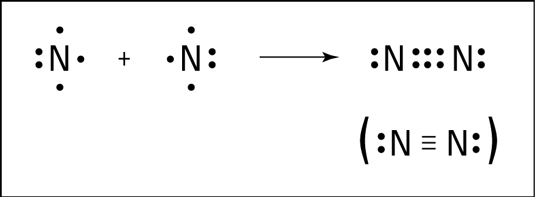


This is an example of a __________ bond.
non-polar covalent
polar covalent
ionic
metallic

Partial charges like the ones shown here are called:
dipoles
deltas
ions
magnetic poles
H2O
OF2
CCl4
A diatomic molecule like O2 is always_______ because electrons are shared ________.
The electronegativity difference in the bonds of CH4 (methane) is:
The electronegativity difference in the bonds of CCl4 (carbon tetrachloride) is:

