wayground logo

Free Printable Worksheets

NEW

Font size

S
M
L
XL
Worksheets

Nuclear Physics

Total questions: 25

Worksheet time: 35mins

Name
Class
Date
1.

What is a beta particle made of?

a)

One proton

b)

A helium nucleus

c)

A fast moving electron

d)

One proton and one neutron

2.

Which of these processes describes a nuclear fusion reaction?

a)

A nucleus absorbs energy to produce lighter nuclei.

b)

A nucleus splits to produce energy and lighter nuclei

c)

Two nuclei bind together to produce energy and heavier nuclei.

d)

Two nuclei bind together to produce energy and a lighter nuclei.

3.

Of the main types of radiation emitted from naturally radioactive isotopes, which is the hardest to block?

a)

Alpha decay

b)

Gamma decay

c)

Beta decay

d)

They are all blocked using the same method

4.
What is emitted during Alpha Radiation?
a)

A helium nucleus

b)
A helium atom
c)

Gamma rays

d)

Electrons

5.
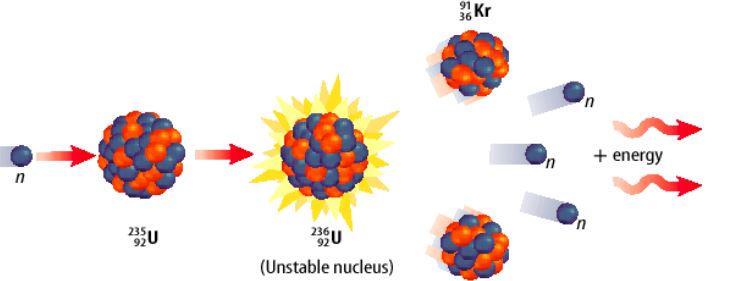
This is an example of...
a)
Fission  reaction
b)
Fusion reaction
c)
Decomposition reaction
d)
Decay
6.
What is the mass of an alpha particle?
a)
1
b)
2
c)
3
d)
4
7.
This process requires a radioactive fuel source, usually Uranium 235 or Polonium 239
a)
Fusion
b)
Fission
8.
Produces temperatures in excess of 40,000,000 degrees celsius.
a)
Chain Reaction
b)
Fission
c)
Fusion
9.
When small nuclei combine to produce a nucleus of greater mass
a)
Fusion
b)
Fission
c)
Chain Reaction
10.
It is the energy producing reaction that takes place in our sun and other stars.
a)
Fission
b)
Chain Reaction
c)
Fusion
11.
When neutrons produced react with other fissionable atoms, continuing the fission.
a)

Absorbtion

b)
Chain Reaction
c)
Fusion
12.
After the third half-life, how much of the sample is left?
a)
1/2
b)
1/3
c)
1/16
d)
1/8
13.
The half-life of strontium-90 is 25 years. How much strontium-90 will remain after 100 years if the initial amount is 4.0 g?
a)
3.0g
b)
0.25mg
c)
0.3g
d)
0.25g
14.
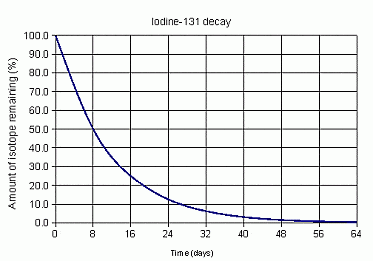
What is the half-life of iodine-131?
a)
32 days
b)
8 days
c)
16 days
d)
24 days
15.

The % of the original isotope remaining after 1 Half Life.

a)

50%

b)

25%

c)

12.5%

d)

6.25%

16.

The % of the original isotope remaining after 2 Half Lives.

a)

50%

b)

25%

c)

12.5%

d)

6.25%

17.

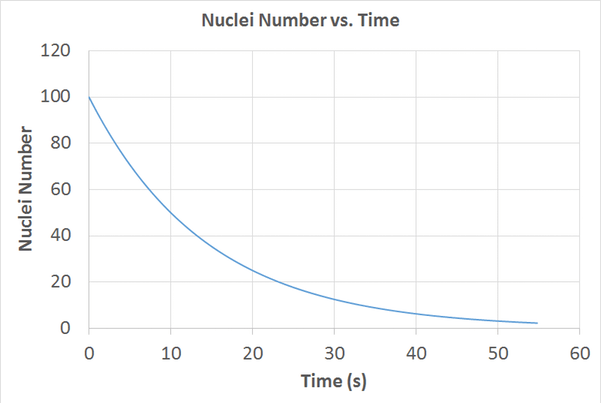
What is the Half life of this isotope?

a)

5 seconds

b)

10 seconds

c)

15 seconds

d)

20 seconds

18.

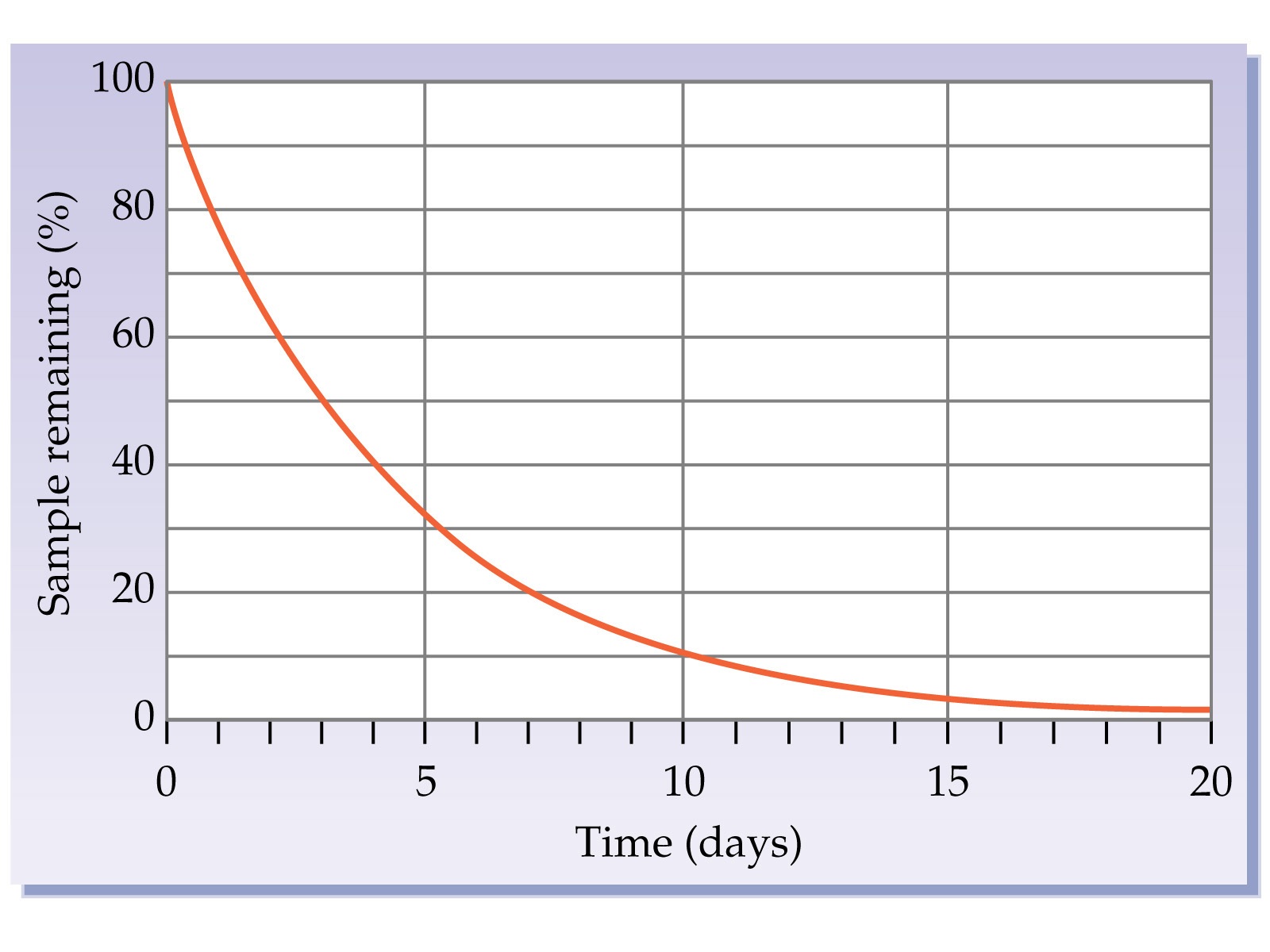
What is the Half Life of this isotope?

a)

3 days

b)

5 days

c)

8 days

d)

10 days

19.
Imagine you have 50,000 atoms of uranium-238. If U-238 has a half-life of 4.5 billion years, how many U-238 atoms will be left after 4.5 billion years? 
a)
25,000
b)
50,000
c)
12,500
d)
0
20.

A gamma ray is described as

a)

high frequency electromagnetic radiation

b)

fast moving electron

c)

a helium nucleus

d)

two proton and two neutrons

21.

What is the unit for activity?

a)

Bq

b)

Sv

c)

Gy

d)

s

22.

What is the unit for absorbed dose?

a)

Bq

b)

Gy

c)

Sv

d)

Decays

23.

What is the unit for equivalent dose?

a)

Bq

b)

Gy

c)

Sv

d)

kg

24.

Which type of radiation is used for radioactive tracers?

a)

Alpha

b)

Beta

c)

Gamma

25.

Which of these would NOT decrease the equivalent dose received from a radioactive source.

a)

Increasing the distance from the source

b)

Using shielding between yourself and the source

c)

Increasing time of exposure to the source