wayground logo

Free Printable Worksheets

Font size

S
M
L
XL
Worksheets

Q3 - Chemical Reactions and Equations

Total questions: 56

Worksheet time: 2hrs 52mins

Name
Class
Date
1.

What is matter?

a)

Matter is made of atoms.

b)

Matter is a measure of the amount of material in an object.

c)

Matter may exist as a solid, liquid, or a gas.

d)

Matter forms when particles chemically bond together.

e)

Matter includes both elements and compounds.

2.

What type of chemical reaction is burning paper?

a)

Chemical

b)

Physical

3.

What breaks during a chemical reaction?

a)

glass

b)

bonds

c)

molecules

d)

atoms

4.

Instead of using a chemical's long name, scientists use this instead when writing a chemical equation.

a)

Shorthand

b)

Braile

c)

Elemental symbols

d)

Elemental Code

5.

How do you know a chemical reaction has occured?

a)

Properties of the materials change.

b)

Energy in the system changes.

c)

Both A & B are correct.

d)

Neither A nor B are correct

6.

When I want to balance a chemical equation, this is the only number that I can change.

a)

Subscript

b)

Coefficient

c)

Elemental Symbol

d)

Yields

7.

The subscript tells you how many of what there are in a chemical reaction?

a)

atoms of that element

b)

molecules of that compound

c)

number of reactions

d)

They don't tell you anything.

8.

A coefficient tells you what about the chemical reaction?

a)

Numbers of atoms in that element

b)

Numbers of molecules for that compound.

c)

How many reactions there are.

d)

They don't tell you anything.

9.
A teacher writes the equation representing the chemical reaction between hydrochloric acid and sodium on the board.HCl + Na → NaCl + H2The teacher states that the equation has not been balanced. Which of these correctly shows the products of this reaction after the equation has been balanced?
a)
Na2Cl + H2
b)
 2NaCl + H2
c)
NaCl + 2H2
d)
 2NaCl + 2H2
10.
Which among the following is(are) double displacement reaction(s)?(i) Pb + CuCl2 → PbCl2 + Cu (ii) Na2SO4 + BaCl2 → BaSO4 + 2NaCl (iii) C + O2 → CO2 (iv) CH4 + 2O2 → CO2 + 2H2O
a)
(i) and (iv)
b)
(ii) only
c)
(i) and (ii)
d)
(iii) and (iv)
11.
Which of the following are combination reactions?(i) 2KClO3⎯Heat⎯→ 2KCl + 3O2 (ii) MgO + H2O ⎯→ Mg(OH)2 (iii) 4Al + 3O2 ⎯→ 2Al2 O3 (iv) Zn + FeSO4 → ZnSO4 + Fe
a)
(a) (i) and (iii)
b)
(b) (iii) and (iv)
c)
(c) (ii) and (iv)
d)
(d) (ii) and (iii)
12.
Which of the following reactions is balanced?
a)
2CH4 + O2 -> CO2 + H2O
b)
CH4 + 2O2 -> CO2 + H2O
c)
CH4 + 2O2 -> CO2 + 2H2O
d)
None of the chemical equations are balanced.
13.

7.The equation

Cu + xHNO3 -> Cu(NO3)2 + yNO2 + 2H2O

The values of x and y are

a)

3 and 5

b)

8 and 6

c)

4 and 2

d)

7 and 1

14.

These are all models of the same molecule. What would this molecule look like in a chemical/molecular formula?

a)

CH

b)

C4H

c)

CH4

d)

4CH

15.
How many Hydrogen are in 4H2O?
a)
6
b)
8
c)
2
d)
4
16.
Is the following equation balanced?...
Al + O2 --> 2Al2O3
a)
Yes!
b)
No!
17.

Which of the following chemical equations follows the Law of Conservation of Mass? Hint: which is balanced?

a)

CO2 + H2O --> C6H12O6 + O2

b)

C6O + H12O --> C6H12O2

c)

CO2 + H2O --> C6H12O6 + O2

d)

CO2 +H2O --> C6H12O6 +O2

18.

What are the substances on the left side called and right side of the chemical equation called respectively ?

a)

products and reactants

b)

groups and electrons

c)

nothing

d)

reactants and products

19.

How many elements are in C6H12O6?

a)

1

b)

2

c)

3

d)

4

20.

In the equation, 2Mg + O2 ---> 2MgO, which are the reactants?

a)

2Mg and O2

b)

2MgO

c)

Mg and MgO

d)

O and MgO

21.

Which is NOT an example of chemical change?

a)

production of gas.

b)

change in color.

c)

change in size.

d)

transfer of energy.

22.

2H2O + 2N → 4H + 2NO

The chemical symbols on the RIGHT (at the end of the equation) are called:

a)

products

b)

reactants

c)

yields/produces

23.

How many atoms are represented in the reactants of this equation?

a)

6

b)

12

c)

24

d)

36

24.

Which of the following chemical equations follows the Law of Conservation of Mass? Hint: which is balanced?

a)

CO2 + H2O --> C6H12O6 + O2

b)

C6O + H12O --> C6H12O2

c)

CO2 + H2O --> C6H12O6 + O2

d)

CO2 +H2O --> C6H12O6 +O2

25.

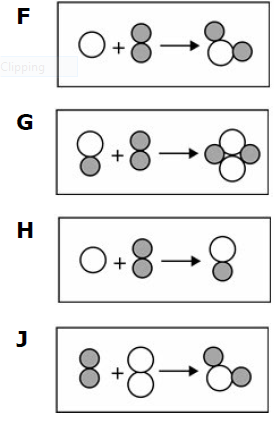
Which of the following models best demonstrates a balanced chemical equation?

a)

F

b)

G

c)

H

d)

J

26.

Does this follow the Law of Conservation of Mass? (is it balanced?)

Mg + Cl2 --> MgCl2

a)

No

b)

Yes

27.
The following is what type of reaction:
PbCl2 + AgNO3 → Pb(NO3)2 + AgCl
a)
Synthesis
b)
Decomposition
c)
Single Replacement
d)
Double Replacement
28.
The following is what type of reaction:
NH3 + HCl  → NH4Cl
a)
Synthesis
b)
Decomposition
c)
Single Replacement Replacement
d)
Double Replacement Replacement
29.
What is decomposition?
a)
putting substances together
b)
breaking substances apart
c)
element replacing another element in a compoud
d)
burning of a subtance
30.
What type of chemical reaction is this?
Al(OH)3 → Al2O3  + H2O
a)
Decomposition
b)
Combustion
c)
Synthesis
d)
Single Replacement 
31.
Ions in two compounds switch. 
a)
Synthesis
b)
Combustion
c)
Single Replacement
d)
Double Replacement
32.
3Ca + 2AlCl3 --> 3CaCl2 + 2Al
a)
Synthesis
b)
Decomposition
c)
Single Displacement
d)
Double Displacement
33.
One element replaces another in a compound.
a)
Synthesis
b)
Combustion
c)
Single Replacement
d)
Double Replacement
34.
One reactant into several products.
a)
Decomposition
b)
Synthesis
c)
Combustion
d)
Single Replacement
35.
Two Reactants and One Product
a)
Decomposition
b)
Synthesis
c)
Combustion
d)
Single Replacement
36.
4Si   + S8   -->   2Si2S4
a)
Synthesis
b)
Decomposition
c)
Single Displacement
d)
Double Displacement
37.
C4H12 + O2 → CO2 + H2O
a)
Synthesis
b)
Combustion
c)
Single Replacement
d)
Double Replacement
38.
2Pb(NO3)2   -->   2PbO +  4NO2  +  O2
a)
Synthesis
b)
Decomposition
c)
Single Displacement
d)
Combustion
39.
3KOH + H3PO4 --> K3PO4 + 3H2O
a)
Synthesis 
b)
Decomposition
c)
Single displacement
d)
Double displacement
40.
3KOH + H3PO4 --> K3PO4 + 3H2O
a)
Synthesis 
b)
Decomposition
c)
Single displacement
d)
Double displacement
41.
Fe + H2SO4 --> Fe2(SO4)3 + H2
a)
Synthesis (combination)
b)
Decomposition
c)
Single replacement
d)
Combustion
42.
Which reaction type is the following: C5H10O4 + O2 --> CO2 + H2O
a)
Decomposition
b)
Single Replacement
c)
Combustion
d)
Double Replacement
43.
C4H12 + O2 --> CO2 + H2O
a)
Synthesis
b)
Combustion
c)
Single Replacement
d)
Double Replacement
44.
PbCl2 + AgNO3 ---> Pb(NO3)2 + AgCl 
a)
Synthesis
b)
Decomposition
c)
Single Replacement
d)
Double Replacement
45.

What term is given to a reaction which transfers heat energy to the surroundings?

a)

Endothermic

b)

Reversible

c)

Exothermic

d)

Exotermic

46.

When barium hydroxide and ammonium chloride react, the temperature of the mixture decreases. What kind of reaction is this?

a)

Endothermic

b)

Decomposition

c)

Exothermic

d)

Indothermic

47.

When calcium reacts with water, the temperature changes from 18°C to 39°C. Which statement is correct?

a)

The solution at the end is acidic

b)

The reaction is reversible

c)

The reaction is exothermic

d)

The reaction is endothermic

48.

if less heat energy is released in making bonds in the products than is taken in when breaking bonds in the reactants

a)

Endothermic

b)

Exotermic

c)

Exothermic

d)

Entrothermic

49.
Exothermic reactions...
a)
Absorb energy
b)
Release energy
c)
Release Color
d)
Absorb Color
50.
In an endothermic reaction, heat is ...
a)
taken in or absorbed
b)
given out or released 
51.

 6 CO2+ 6 H2O + Energy  C6H12O6 + 6 O26\ CO_2+\ 6\ H_2O\ +\ Energy\ \rightarrow\ C_6H_{12}O_6\ +\ 6\ O_2 

a)

endothermic reaction

b)

exothermic reaction

52.

 O2(g) + 2 H2 (g)  2 H2O (g) + EnergyO_2\left(g\right)\ +\ 2\ H_2\ \left(g\right)\ \rightarrow\ 2\ H_2O\ \left(g\right)\ +\ Energy  

a)

endothermic

b)

exothermic

53.
Which of the following is a sign that a chemical reaction has occurred?
a)
change in shape
b)
melting
c)
formation of a gas
d)
dissolving
54.
Which of the following is NOT an example of a physical change?
a)
crumpled paper
b)
pencil sharpening
c)
shrunken clothing
d)
rust
55.
Which of these is a result of a chemical change?
a)
A mixture
b)
A solution
c)
A new substance
d)
Melting or freezing
56.

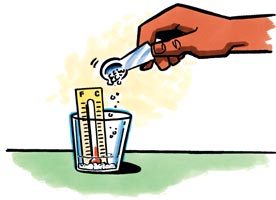
What form of energy is being CREATED here? There is more than one answer!

a)

Electrical

b)

Thermal

c)

Radiant (Light)

d)

Mechanical