
 Worksheets
Properties of Matter Review
Total questions: 52
Worksheet time: 46mins
Which of the following is a characteristic of pure substances?
Are a mixture of elements and compounds
Can be separated physically into different elements and compounds
Have uniform and definite composition
Have a uniform composition
What is the smallest unit of a compound?
Atom
Particle
Molecule
Element
Which of the following is an example of a heterogeneous mixture?
Sugar water
Milk
Cereal
Saltwater
What is an alloy?
Metals combined by smelting
The smallest unit of an element
A mixture of elements and compounds that are evenly distributed
A compound that cannot be broken down further by physical means
What is the main difference between elements/atoms and compounds?
Elements can be separated physically into different elements and compounds, while compounds cannot
Elements are a mixture of elements and compounds, while compounds are not
Elements have a uniform composition, while compounds do not
Elements cannot be decomposed by chemical changes, while compounds can
What is the smallest unit of an element?
Compound
Atom
Molecule
Alloy
Which of the following is an example of a homogeneous mixture?
Sand and water
Oil and water
Sugar and water
Water and stones
Which of the following is not a characteristic of pure substances?
Have a uniform composition
Cannot be separated physically into different elements and compounds
Have a variable composition
Cannot be decomposed by chemical changes

Which of these is the correct definition for Boiling Point?
Temperature when a substance turns from a liquid into a gas.
Temperature at which a substance turns from a solid into a liquid.
Temperature at which a substance turns from a liquid to a solid.
None of these.

Which of these is the correct definition for Melting Point?
Temperature at which a substance turns from a liquid to a solid.
Temperature at which a substance turns from a solid into a liquid.
Temperature when a substance turns from a liquid into a gas.
None of these.

Mixtures are made of ... ?
None of these.
two or more substances that have been combined without undergoing a chemical change.
one substance that have been combined without undergoing a chemical change.
substances that have been combined by undergoing a chemical change.

In ____ , the particles that make up the mixture are evenly distributed.
Which words below make this statement correct?
homogeneous mixtures
heterogeneous mixtures
both homogeneous and heterogeneous mixtures
None of these.
In ____ , the particles which may clump together or separate.
Which words below make this statement correct?
homogeneous mixtures
heterogeneous mixtures
both homogeneous and heterogeneous mixtures
None of these.

What is density?
A way of describing how tightly packed a substance is.
A way of describing how many molecules can be found in gases only.
A way of describing the volume of solids only.
A way of describing the volume of liquids and gasses, but not solids.

Which diagram shows the LEAST dense object?
left
center
right
A block of aluminum occupies a volume of 15.0 mL and weighs 45.0 g. What is its density?
3 g/mL
0.3333 g/mL
675 g/mL
I have no idea
A sample of liquid has a mass of 300 g and occupies 50 mL in a graduated cylinder. What is the density?
15,000 g/mL
.16667 g/mL
6 g/mL
Yup, still no clue

Which set of properties, intensive or extensive, are based on the size of a sample?
intensive
extensive
Which of the following properties is related to mass and volume, but not an extensive property?
Number of Atoms
Moles
Density
Potential Energy
What kind of physical property is this? States of Matter
intensive
extensive
A pot of water boils at 1000C at the same temperature as a cup of water. Is this intensive or extensive?
Intensive
Extensive
Properties that DO depend on the amount of matter present.
Mass
Hardness
Extensive
Intensive
Properties that depend on the identity of substance.
Mass
Hardness
Extensive
Intensive
Phase change going from a Gas to a Liquid...
Sublimation
Deposition
Ionization
Condensation
Phase change going from a Liquid to a Gas...
Vaporization
Deposition
Condensation
Melting
Phase change going from a Gas to a Liquid...
Sublimation
Deposition
Ionization
Condensation
Phase change going from a Liquid to a Gas...
Vaporization
Deposition
Condensation
Melting
Phase change going from a Solid to a Gas...
Deposition
Sublimation
Condensation
Recombination
Phase change going from a Solid to a Liquid...
Freezing
Condensation
Melting
Sublimation
Phase change going from a Gas to a Solid...
Deposition
Sublimation
Condensation
Vaporization
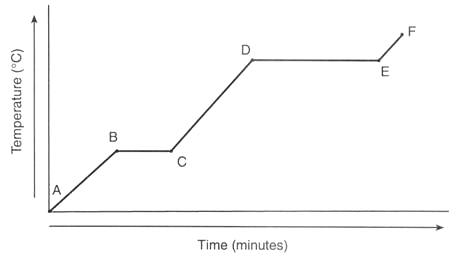
What state/phase is the object likely from points A to B?
Solid
Liquid
Gas
Plasma
What is happening to the particles in the substance between points D and E?
Melting
Freezing
Vaporizing
Sublimating

Where on the graph are phase changes taking place?
1
2
3
4
5
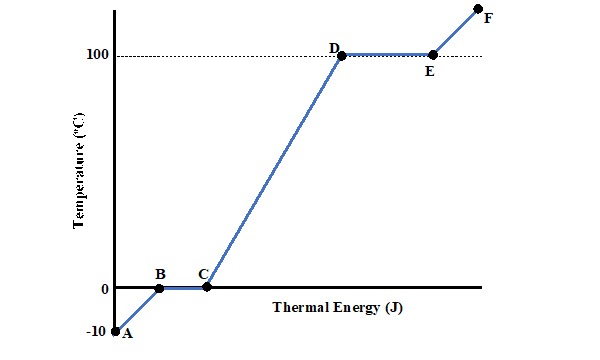
Between which two points is the gas heating up?
A ----> B
B <---- C
C ----> D
D ----> E
E ----> F
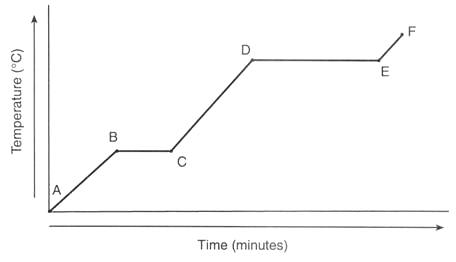


Type of mixture that has the SAME COMPOSITION in every part.
Homogenous
Heterogeneous

Type of mixture that DOESN'T HAVE the same composition in every part.
Homogeneous
Heterogeneous

